Last month, a contractor in Canterbury had a crew standing around for six days because New Zealand Customs held their container. The Bill of Lading listed the frames as “galvanized steel” instead of “hot-dip galvanized steel.” One missing word triggered a biosecurity inspection. When you import portable stables NZ, the exact phrasing on your shipping documents dictates whether your crew works or waits. That hold blew the contractor’s fixed-price labor budget by $4,200.
We mapped out the exact MPI biosecurity requirements, CIF thresholds, and flat-pack container configurations that clear New Zealand ports without holds. You will see the specific HS codes, the line-item weight declarations needed to skip random inspections, and the dimensional math showing how flat-pack kits cut your shipping volume by 40%. Use these numbers to build accurate landed costs for your next project bid.

NZ Stable Import Cost Breakdown
Accurate landed cost calculation for NZ stable imports hinges on two variables: CIF-based GST and flat-pack CBM optimization. Misjudge either and your fixed-price contract margin evaporates.
Duty and GST Thresholds
New Zealand Customs enforces a strict NZ$1000 low-value import threshold. If your total CIF (Cost, Insurance, Freight) value sits at or below NZ$1000, the shipment is exempt from both duty and GST. For any commercial stable import, this threshold is functionally irrelevant—you will be paying.
The 15% GST is calculated on the total CIF value, not the FOB factory price. Freight and insurance costs directly inflate your tax liability. You must obtain the exact sea freight quote before finalizing your project bid, because a freight spike increases your GST obligation at the border.
- NZ$1000 CIF threshold: Duty and GST exempt
- Above NZ$1000 CIF: 15% GST applied to total Cost + Insurance + Freight
- Import duty: Varies by HS code (galvanized steel structures typically 0–5%)
- Entry lodgment window: 20 days mandatory after port arrival
Declaring exact line-item weights and polymer types for the 10mm UV-resistant HDPE boards prevents the Ministry for Primary Industries from flagging the shipment for random biosecurity physical inspections, which cost $200+ in fees and delay your site schedule.
Sea Freight Container Rates and CBM Optimization
Flat-pack stable kits achieve a 40% CBM reduction versus pre-assembled units. This is not a marginal shipping discount—it determines whether you need one container or two, which directly shifts your per-unit landed cost and the feasibility of your project bid.
- 20ft standard container: Holds approximately 3–4 single flat-pack stable kits with roofs
- 40ft high-cube container: Holds 8–12 flat-pack kits depending on configuration (single vs. back-to-back quadruple)
- CBM reduction: 40% less volume compared to pre-assembled equivalents
- Packing standard: ISPM-15 heat-treated timber for all palletized components
Flat-pack designs eliminate the need for open-top containers, allowing standard 40ft high-cube containers to be used. This reduces port handling fees in both China and New Zealand and avoids the premium daily rates charged for specialized container equipment.
Bill of Lading discrepancies—such as listing “galvanized steel” instead of “hot-dip galvanized steel”—are the number one cause of NZ Customs holds for equine equipment. Verify the BOL matches the commercial invoice material descriptions exactly, or expect a one-week delay on your job site.
| Cost Component | Specification | Financial Impact | Contractor Advantage |
|---|---|---|---|
| GST & Duty Assessment | 15% GST applied to total CIF (Cost, Insurance, Freight) value; NZ$1000 low-value import threshold for exemption. | Fixed 15% percentage of total landed cost for accurate margin forecasting. | Unlike generic DuckDuckGo searches for variable tax rates, DB Stable provides pre-calculated CIF values to guarantee predictable project bids. |
| NZ Customs Clearance | 20-day mandatory window to lodge import entries after port arrival; strict HS code classification. | Avoids costly demurrage fees and delayed site labor scheduling. | Bill of Lading explicitly lists ‘hot-dip galvanized steel’ to prevent 1-week customs holds; no API ratelimit delays on fast-track quick quotes. |
| MPI Biosecurity Inspection | Exact line-item weights and specific 10mm HDPE polymer type declarations required by Ministry for Primary Industries. | Saves $200+ in random physical biosecurity inspection fees. | Pre-verified documentation prevents supplier-failed border delays, ensuring zero-error site delivery and protecting fixed-price contract margins. |
| International Freight & Handling | Flat-pack stable kits shipped in standard 40ft high-cube containers; ISPM-15 heat-treated timber packing. | 40% CBM reduction versus pre-assembled units; eliminates open-top container surcharges. | Significantly reduces port handling fees in both China and New Zealand compared to bulky Australia open-top shipping routes. |
| On-Site Installation Labor | 42-micron hot-dip galvanized steel frames and 10mm UV-resistant HDPE boards arriving in part-numbered flat-pack boxes. | Eliminates contractor rework costs caused by inaccurate dimensions or transit damage. | Guarantees zero-error assembly on NZ job sites; seamless integration with architectural plans without relying on ambiguous YouTube tutorials. |
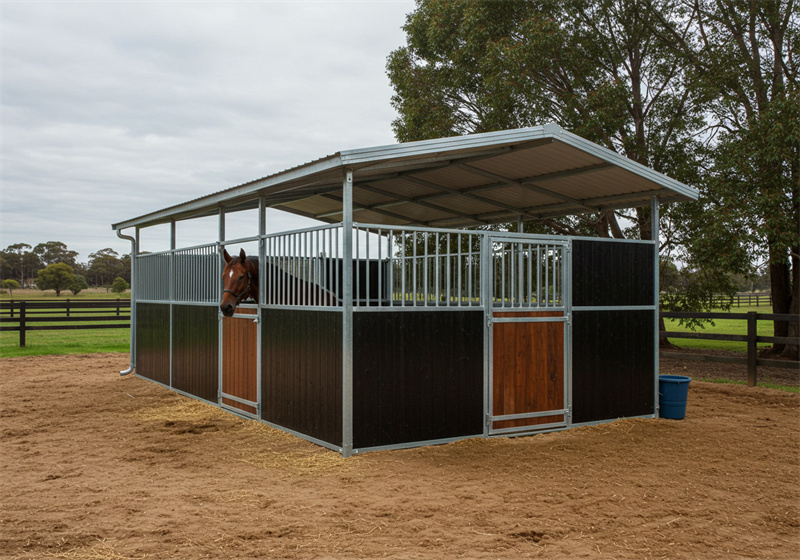
MPI Biosecurity Clearance Steps
Bill of Lading discrepancies—listing “galvanized steel” instead of “hot-dip galvanized steel”—are the primary cause of NZ Customs holds for equine equipment, delaying site schedules by up to a week.
Steel and HDPE Declarations
MPI requires exact material descriptions on your import documentation. Vague terminology triggers physical inspections, adding $200+ in unplanned fees and burning through your 20-day clearance window. You must declare the precise treatment process and polymer grade for every line item.
For the structural frames, your Bill of Lading and commercial invoice must state “hot-dip galvanized steel” with a minimum coating thickness of 42 microns. Writing “galvanized steel” or “galvanized iron” is a compliance failure. MPI treats electro-galvanized and hot-dip galvanized as completely different risk categories for corrosion and potential contaminant residue.
For the internal boards, declare the exact polymer as “10mm HDPE (High-Density Polyethylene)” with UV-resistant properties. Do not use generic terms like “plastic boards” or “synthetic panels.” MPI flags unspecified polymers for random biosecurity checks because unclassified plastics can harbor organic contaminants in their manufacturing dust. Specifying HDPE with UV resistance pre-emptively answers their risk assessment, bypassing the physical inspection tier entirely.
Fumigation and Packing Rules
Any timber components in your shipment must comply with ISPM-15 regulations. This applies to pallets, dunnage, and any wooden framing used to brace the flat-pack stable kits inside the container. Untreated timber arriving at a New Zealand port results in an immediate re-export order or mandatory on-site fumigation, both of which destroy your project timeline.
- ISPM-15 Stamp: Every timber piece must display the official heat-treatment stamp (HT) or methyl bromide fumigation stamp (MB), including the country code and treatment facility registration number.
- Heat Treatment Certificate: You will submit a separate phytosanitary certificate issued by China’s entry-exit inspection authority, matching the stamp numbers on the physical timber.
- Bark-Free Requirement: All timber must be completely debarked. Even residual bark fragments under 3cm will fail the MPI inspection.
Because our stable kits ship flat-packed, we eliminate open-top container requirements and secure the part-numbered boxes using ISPM-15 compliant steel strapping on certified HT pallets. This packing method allows standard 40ft high-cube containers to be used, reducing port handling fees in both China and New Zealand while keeping your timber exposure to an absolute minimum. Verify the phytosanitary certificate matches the physical stamps before the vessel departs—mismatches are your responsibility at the destination port.
Customs Documentation Checklist

Customs Documentation Checklist
Bill of Lading Verification
You must cross-reference every line item on the Bill of Lading against the commercial invoice before the vessel departs. The most frequent failure point we see is a generic description like “galvanized steel frames” on the BOL when the invoice specifies “hot-dip galvanized steel frames (42+ microns).” New Zealand Customs treats this discrepancy as a classification inconsistency and will halt the container for manual review. Similarly, HDPE board shipments must declare the exact polymer type and the 10mm UV-resistant specification. Vague descriptions invite MPI biosecurity physical inspections that cost over $200 in unbillable fees and blow out your fixed-price contract margins.
- Category: Pre-shipment Documentation
- Core Outcome: Zero-hold container release at NZ port
Analysis:
- Eliminates manual inspection triggers: Exact material codes and weights matching across BOL, invoice, and packing list prevent Customs from flagging the shipment for random checks.
- Protects labor scheduling: A seven-day hold directly translates to idle crew on-site, which contractors cannot absorb under fixed-price contracts.
- Requires supplier coordination: Your factory must generate all three documents from the same bill of materials to guarantee alignment.
- Limited correction window: Amendments after the manifest is filed require the freight forwarder to submit corrections, adding fees and delays.
Import Entry Timelines
The 20-day clock starts the moment the container is discharged at the NZ port, not when the vessel docks. Your customs broker must submit the electronic import entry via the NZ Customs Trade Single Window within this window. For flat-pack horse stable kits, the entry must include the correct HS codes for galvanized steel structures, the 15% GST calculation on the total CIF value, and ISPM-15 compliance confirmation for any timber packing materials. Missing this window triggers escalating late-fee penalties from NZ Customs, starting at $250 and increasing daily. These are not negotiable and they will not be reimbursed by the factory or the shipping line.
- Category: Post-arrival Compliance
- Core Outcome: Predictable landed cost with zero penalty exposure
Analysis:
- Enables accurate bid pricing: Knowing the 15% GST on CIF and zero-duty status below NZ$1000 lets you calculate exact landed costs before submitting project quotes.
- Penalties hit your margin directly: Late fees are charged to the importer of record, meaning the contractor bears the full cost.
- Flat-pack design buys buffer time: Standard 40ft high-cube containers avoid the open-top handling delays that pre-assembled stables require, giving your broker more clearance runway.
- Demurrage compounds the risk: If entry is late, storage and demurrage charges at the port stack on top of Customs penalties, multiplying the financial exposure rapidly.
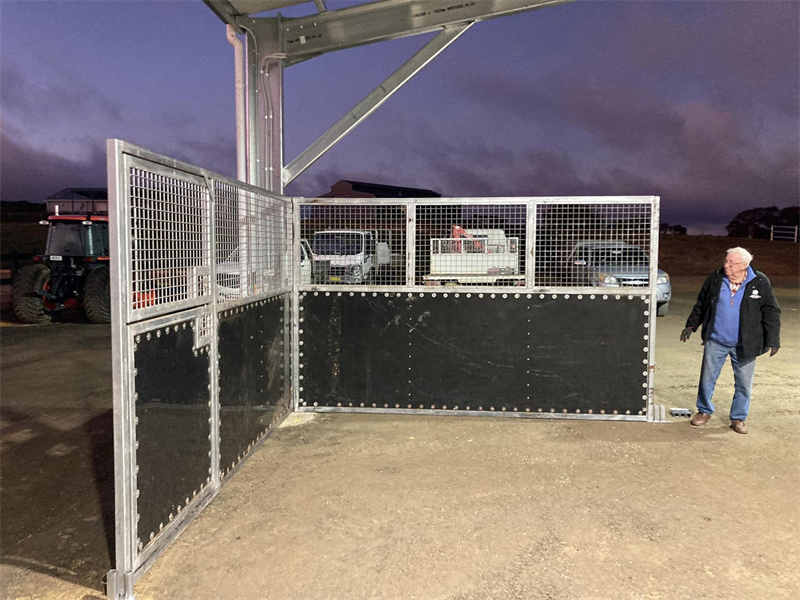
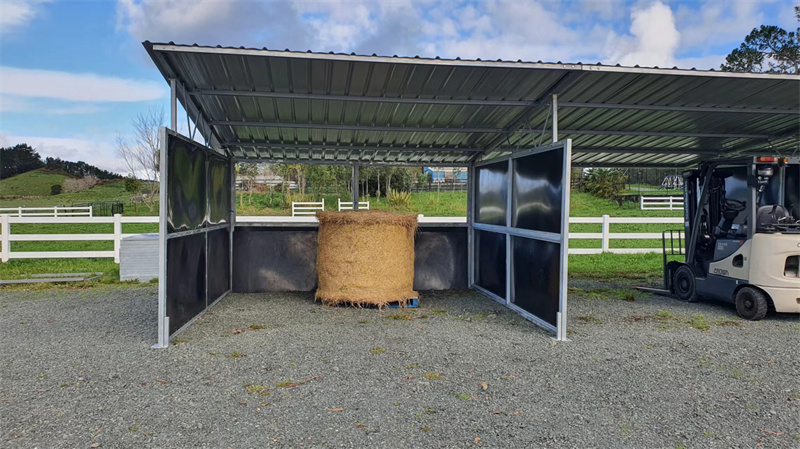
Site Delivery Logistics in NZ
Flat-pack delivery eliminates open-top container requirements. Zero-error site unloading demands a 2-tonne forklift and strict adherence to part-numbered box sequencing.
Heavy Equipment Requirements for Offloading
When a 40ft high-cube container arrives at your NZ job site, your margin protection starts with the offload. Our flat-pack stable kits ship consolidated inside standard sealed containers, not open-top units. This reduces port handling fees in both China and New Zealand. You will need a forklift with a minimum 2-tonne lifting capacity and 3-meter reach to clear the container from the rear. Telescopic handlers work well for rural equestrian properties where concrete pads may not extend to the delivery point.
Coordinate the offload time with your labor schedule. A standard single stable kit weighs approximately 800-1,200 kg depending on configuration, split across multiple boxes. Back-to-back quadruple configurations will max out a 40ft container at roughly 8,000 kg distributed load. Plan for a two-person ground crew to guide the forklift and prevent box rotation during extraction.
Organizing Part-Numbered Boxes
Every flat-pack stable kit leaves our factory with part-numbered boxes mapped to a specific assembly sequence. This is the system that prevents the dimensional mismatches contractors fear when importing prefabricated structures. Boxes are labeled with alphanumeric codes corresponding directly to the assembly manual provided at the time of dispatch.
Stack boxes by their numeric sequence immediately upon offloading. Do not stage them randomly. The hot-dip galvanized steel frames (42+ microns) occupy the first three to four boxes by weight. The 10mm UV-resistant HDPE wall and partition boards follow in lighter, clearly marked cartons. Aluminum swivel feeders and hardware packs are consolidated into the final boxes.
- Frame Boxes (01-04): Hot-dip galvanized steel columns, rafters, and base plates. Heaviest units, offload first.
- Board Boxes (05-08): 10mm UV-resistant HDPE panels. No thermal expansion risk, stack flat to prevent warping.
- Hardware Boxes (09-10): Rust-free aluminum swivel feeders, bolts, brackets, and assembly manual.
Verify the box count against the packing list and Bill of Lading before signing off the delivery. Discrepancies at this stage are resolved immediately. Discovering a missing frame box mid-assembly costs you a full day of labor and breaks your fixed-price contract margin. We pre-verify all box counts before container loading, so a clean sign-off at your end confirms zero-error site delivery.
Conclusion
If you are bidding a fixed-price project in New Zealand, spec hot-dip galvanized flat-pack kits with pre-verified Bill of Lading descriptions. A single wording error on the BOL—like omitting “hot-dip”—triggers a week-long customs hold that wipes out your labor margin. Treat border compliance documentation as a structural component.
Demand a sample BOL and HS code declaration before you sign the purchase order. Cross-check their line-item polymer descriptions directly against the MPI biosecurity checklist. If they hesitate to provide exact HDPE specifications, walk away.
Frequently Asked Questions
What is the NZ duty-free import threshold?
While New Zealand Customs waives duty, levies, and GST on shipments valued under NZ$1,000, this threshold is irrelevant for B2B buyers importing our prefabricated horse stables. Commercial-scale orders from DB Stable will inherently exceed this limit, meaning distributors and farm owners must account for the standard 15% GST on the CIF value. Regardless of the shipment’s value, importers should also remember that MPI and Customs still apply a baseline clearance levy to process the goods through biosecurity.
What items are prohibited from entering NZ?
New Zealand enforces strict biosecurity laws that completely prohibit the importation of untreated timber, animal products, and contaminated soil. For professional stable builders and distributors importing our flat-pack kits, this means any wooden pallets or dunnage used in the shipping container must be ISPM-15 heat-treated and officially stamped. Because DB Stable utilizes hot-dip galvanized steel and HDPE boards rather than raw timber in our stable structures, we inherently mitigate these biosecurity risks for our Oceania clients.
How do I import goods into NZ?
To successfully import our portable stables into New Zealand, you must submit an electronic import entry through a registered Customs broker. The broker will handle the payment of the 15% GST calculated on the CIF value of your galvanized steel and HDPE board components. Additionally, you must provide accurate MPI declarations to ensure your flat-pack stable kits clear biosecurity without delays, leveraging our factory’s precise product specifications to streamline the process.
What is the NZ 92 day rule?
The 92-day rule is primarily an agricultural biosecurity measure governing livestock movement and temporary imports, meaning it does not apply to permanent structural imports like our prefabricated barn kits. However, professional equestrian center owners and contractors importing our commercial stables must ensure their goods clear permanent entry through Customs within 20 days of arrival. DB Stable’s logistical efficiency and flat-pack shipping ensure your high-specification stable components arrive ready for swift clearance and installation, keeping your project on schedule.
What items are exempt from import duty?
While raw materials and manufacturing machinery are often exempt from import duty, prefabricated galvanized steel stable kits typically fall under standard tariff codes that require full assessment. Contractors and commercial horse owners purchasing our flat-pack DIY kits must verify the specific HS codes for our hot-dip galvanized frames and UV-resistant HDPE boards with their Customs broker. Although duty exemptions are unlikely for these finished structures, the long-term durability and potential tax benefits of our portable designs still offer significant financial advantages for your equestrian business.