A contractor in Queensland quoted a 24-stall build around welded configurations, then watched his per-stall landed cost spike 60% when freight invoiced. That’s the margin killer nobody calculates upfront. Welded stables fit 12-15 units in a 40HQ container; flat pack stables wholesale loading achieves 30-45 sets in the same space. We’ve burned full crew days re-welding joints that shifted in transit. Bolt-together assembly fixes that — but only if galvanization happens after fabrication.
We pulled three years of factory spec data — steel gauge, zinc depth, container loading, and actual assembly hour logs — against what most suppliers ship under identical descriptions. The gaps are brutal. Q235B versus Q345B for cold climates, 14-gauge versus 16-gauge tubing walls, and whether that 42-micron galvanization happens before or after the welds. This gives you the exact thresholds to put in your next RFQ.
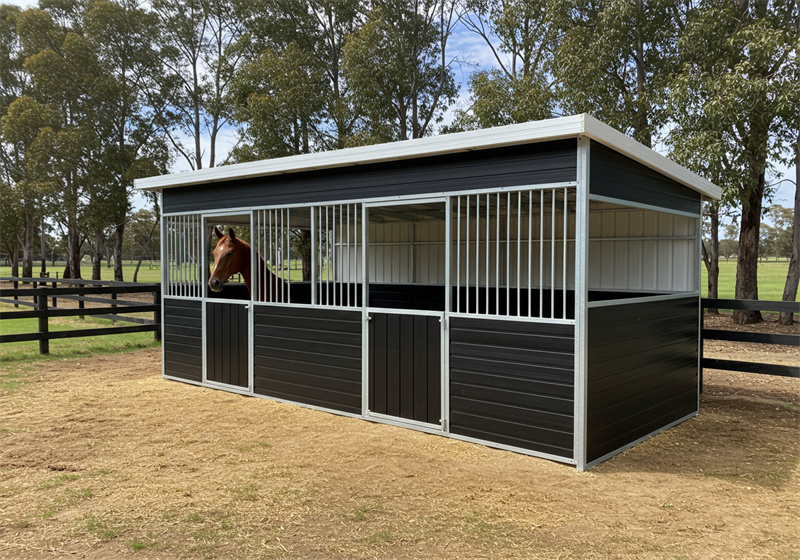
Flat Pack Stables Wholesale Specs
Three specification thresholds separate contract-grade flat pack stables from commodity imports: post-fabrication galvanization, panel thermal stability, and hardware metallurgy.
Q235B Steel & Galvanization Grade
We specify 14-gauge (2.0mm+) Q235B steel tubing as the kick-proof baseline across all flat pack configurations. Q235B delivers sufficient yield strength for standard ANZ climates; we reserve Q345B cold-climate grade exclusively for alpine installations where sub-zero steel embrittlement becomes a structural risk.
Zinc coating thickness exceeds 42 microns via hot-dip galvanization. The process sequence is the non-negotiable spec: we galvanize after fabrication. Competitors who galvanize raw tubing first and then weld expose bare steel at every joint—the dominant rust failure point in ANZ’s humid coastal barns. Always verify the supplier’s galvanization sequence in your RFQ before awarding the contract.
HDPE vs Bamboo Infill Panels
We supply two infill options with distinct structural and maintenance trade-offs.
- 10mm UV-Stabilized HDPE: Zero thermal expansion under direct sun exposure. Will not warp, crack, or splinter. Delivers consistent gap tolerances and requires zero maintenance over a 10-year service life.
- Bamboo Planks: Janka hardness rating exceeds 3,000 lbf, offering superior blunt-force impact resistance for high-kick-risk thoroughbred installations. Requires periodic sealing and shows natural weathering over time.
For commercial equestrian clubs where client-facing aesthetics and maintenance-free operation drive the specification, HDPE is the standard selection. For large-scale breeding operations where raw impact absorption outweighs appearance, bamboo justifies the higher upkeep cost.
304 Stainless Steel Hardware Pack
Every flat pack kit ships with a complete 304 stainless steel hardware pack covering anchors, connectors, and screws. We removed zinc-plated fasteners from our bill of materials because zinc hardware corrodes within 12 to 18 months in indoor arena environments where elevated ammonia concentrations accelerate oxidation. The 304 stainless upgrade adds marginal per-unit cost but eliminates post-installation rust callbacks entirely.
The hardware pack also includes cold galvanizing spray. Bolt-together assembly inevitably scratches the zinc coating at frame connection points. Without immediate touch-up, these micro-exposures become rust nucleation sites within months in high-humidity indoor environments. This inclusion is absent from nearly every competitor’s kit and directly impacts the zero-defect delivery rate contractors are judged on.

40HQ Container Loading Capacity
Flat pack configurations load 2.5x to 3x more units per 40HQ container than welded, collapsing per-stall freight costs by approximately 60%.
Welded vs Flat Pack Density
We load 30 to 45 flat pack stable sets into a single 40HQ container, secured on steel pallets. Welded configurations, by contrast, max out at 12 to 15 sets per 40HQ due to the rigid, pre-assembled geometry consuming unusable void space. For contractors bidding on multi-stall projects in Australia or New Zealand, this density gap directly determines whether a project requires one container or three.
The loading efficiency comes from disassembling the Q235B steel frame into modular components. Our engineers flat-pack the hot-dip galvanized tubing, HDPE or bamboo infill panels, and 304 stainless steel hardware packs onto steel pallets. Unlike wooden pallets that compress under container weight, steel pallets prevent component collapse during sea freight and double as on-site assembly platforms, reducing ground-contact damage to the galvanized frames.
Per-Stall Freight Cost Breakdown
The financial impact of container density compounds fast. Based on current ANZ-bound shipping rates, the per-stall freight differential between flat pack and welded configurations breaks down as follows:
- Welded per-stall freight: Estimated $1,000 to $1,200 USD per stall (based on 12-15 sets per 40HQ, factoring typical Australia/New Zealand lane rates).
- Flat pack per-stall freight: Estimated $400 to $500 USD per stall (based on 30-45 sets per 40HQ on steel pallets).
- Per-container savings: A single 40HQ loaded with flat pack stables at 35-set average saves $15,000+ in freight costs compared to shipping an equivalent 35 welded sets across three containers.
- Total project impact: On a 60-stall equestrian facility build, flat pack freight logistics save $30,000 to $42,000 USD in landed shipping costs alone.
We specify bolt-together assembly using the included 304 stainless steel hardware pack, which eliminates the need for on-site welding. This means the labor savings from flat pack extend beyond the shipping lane. No welders on-site reduces your mobilization costs and removes a fire risk compliance variable from the build schedule. The cold galvanizing spray included in every hardware pack addresses the inevitable scratches from bolt assembly, preventing rust nucleation at joint points in high-humidity indoor arena environments.
For procurement managers running RFQ comparisons, the metric to lock onto is cost-per-stall-landed. Flat pack stables at $4,000 FOB for a single-stall configuration, combined with sub-$500 freight per unit, consistently underbid welded imports on total landed cost even before factoring in the reduced on-site labor hours.
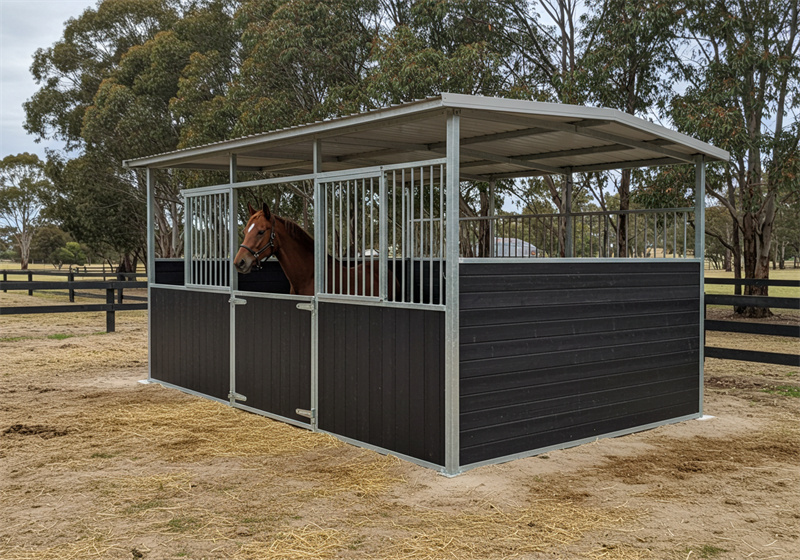
Contractor Assembly Requirements
Our bolt-together panel system eliminates on-site welding entirely, cutting assembly labor costs by approximately 30% compared to welded configurations.
Bolt-Together Panel Connection System
We engineer every flat pack stable kit around a fully modular bolt-together connection system. All structural joints use 304 stainless steel hardware from the included hardware pack—no field welding, no grinding, no hot work permits required on your job site. This approach directly eliminates the variable labor rates of certified welders and removes the fire risk liabilities that complicate insurance on commercial equestrian builds across Australia and New Zealand.
The connection architecture relies on pre-drilled 14-gauge (2.0mm+) Q235B steel tubing. Because we apply hot-dip galvanization after fabrication, the zinc coating (>42 microns) remains fully intact at every joint. Competitors who galvanize before welding leave raw steel exposed at every seam—the primary rust failure point in ANZ’s humid coastal barn environments. Our process sequence ensures zero micro-exposures at the connection points.
Labor Time & Tool Requirements
Based on our tracked assembly data across ANZ job sites, a standard 12×12 flat pack stall kit requires 2 to 3 hours for a two-person crew to fully assemble. This assumes the steel pallets shipped in the 40HQ container are used as the on-site assembly platform, keeping galvanized frames off bare ground and preventing coating damage before erection.
- Socket Wrench Set: Standard metric sizes matching 304 stainless hardware pack
- Drill/Driver: For HDPE infill board fastening to steel frames
- Spirit Level: For plumb verification before final torque
- Cold Galvanizing Spray: Included in every hardware pack for field touch-ups
That cold galvanizing spray is a detail most wholesale suppliers omit entirely. Installation inevitably scratches the zinc coating at bolt interfaces—without immediate touch-up, these micro-exposures become rust nucleation points within months in high-humidity indoor arenas. We include it standard because your margin should not absorb premature coating failure callbacks.
For contractors building project bids, the math is direct. A 30-stall facility using welded configurations might require 90+ on-site labor hours plus welding equipment mobilization. Our flat pack stable kit bolt-together assembly specs bring that down to roughly 60 to 75 hours with standard hand tools. That 30% labor reduction flows straight to your per-stall landed cost advantage.
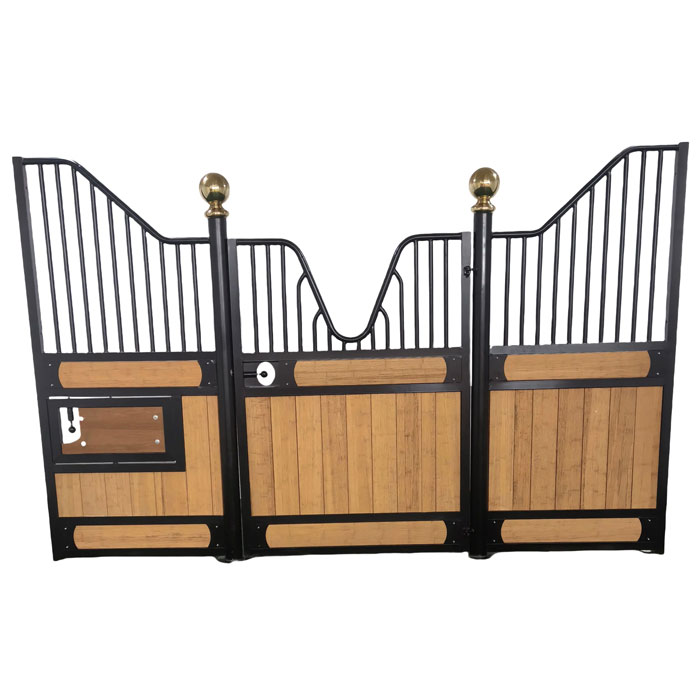

Wholesale MOQ & Pricing Tiers
Factory-direct pricing eliminates distributor markups. Sample orders start at $4,000 FOB; distributor-tier pricing applies at 30-40 sets per 40HQ container.
Volume Discount Breakpoints
We structure pricing around 40HQ container utilization, not arbitrary unit counts. A single-stall flat pack kit starts at $4,000 FOB—this is our sample-tier rate for contractors verifying dimensions and galvanization quality before committing to a project bid. It covers one complete stall front, frame, and hardware pack on a steel pallet.
Distributor-tier pricing activates at 30-40 sets per 40HQ container. At this volume, the per-stall FOB cost drops significantly because container space—the dominant freight variable—is fully optimized. Flat pack configurations load 30-45 sets into a single 40HQ versus only 12-15 welded sets, which is where the 60% freight cost reduction comes from. This is not a margin game; it is a cubic meter efficiency calculation.
Multi-stall configurations like back-to-back quadruple units push FOB values to $20,000+, but the per-stall landed cost decreases because shared partition walls reduce steel and infill panel volume per individual stall. For contractors building project bids, the critical metric is per-stall FOB divided by CBM per container—not the headline unit price.
FOB vs CIF Cost Structure
We quote FOB by default. The reason is straightforward: CIF quotes from factory-direct suppliers often bury inflated freight rates into the total, recreating the middleman markup that B2B buyers are trying to avoid. FOB gives your freight forwarder control over routing, carrier selection, and consolidation with other shipments.
For ANZ-bound shipments, CBM is the primary cost driver. A flat pack single stall on a steel pallet occupies roughly 1.5-2.0 CBM depending on configuration. A 40HQ container holds approximately 60-67 CBM of usable payload. At 30 sets per container, you are loading at roughly 90-95% space utilization—near the structural limit of what steel pallets can safely stack without frame compression during ocean transit.
If you require CIF, we calculate it on actual freight quotes from our contracted carriers to Sydney, Melbourne, Brisbane, or Auckland—never estimates. We provide the exact CBM per pallet, gross weight per set, and total container payload so your forwarder can cross-validate. For contractors comparing supplier RFQs, insist on itemized FOB plus separate freight line items. Any supplier rolling freight into a single CIF number without providing CBM breakdowns is making apples-to-oranges comparison impossible.
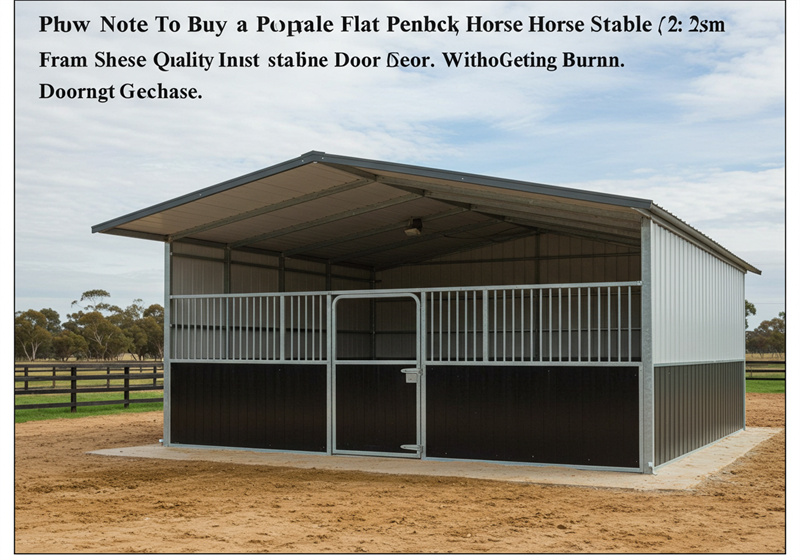
Flat Pack Stable Sizing Guide
Our engineers specify 3.65m x 3.65m as the baseline flat pack stall footprint, extending to 3.65m x 4.25m for horses exceeding 17hh.
12×12 Stall Standard Dimensions
The 12×12 stall (3.65m x 3.65m) is the baseline footprint we manufacture for flat pack stable kits bound for Australia and New Zealand. This dimension aligns with ANZ equestrian facility standards and accommodates the majority of stock horse and riding horse breeds. Every frame in this configuration uses 14-Gauge (2.0mm+) Q235B steel tubing with hot-dip galvanization exceeding 42 microns, applied after fabrication to eliminate raw steel exposure at weld joints.
For facilities housing thoroughbreds or warmbloods exceeding 17hh, we extend the depth to 3.65m x 4.25m. The critical detail for contractors: this 600mm extension uses the same structural spec—identical tubing gauge, identical post spacing. Kick resistance and frame rigidity remain unchanged because we do not stretch the panel spans, we add an additional vertical post. Your labor crew assembles the extended stall with zero deviation from the standard bolt-together sequence.
Multi-Stall Configuration Options
Flat pack stables wholesale pricing scales predictably with configuration complexity. Single-stall FOB starts at approximately $4,000, while back-to-back quadruple configurations and linear row builds reach $20,000+ FOB. The modular bolt-together design eliminates on-site welding across all configurations, which is the primary variable controlling your per-stall assembly labor hours.
- Back-to-Back Configurations: Shared central partition walls reduce per-stall material usage. Quadruple setups (two rows facing each other) are the most freight-efficient layout we produce.
- Linear Row Expansions: End-to-end modular connections allow unlimited row length. Each stall module bolts to the next using the 304 stainless steel hardware pack included in every kit.
- 40HQ Container Capacity: 30-45 flat pack sets per container on steel pallets, compared to 12-15 welded sets. This yields a 60% freight cost reduction per stall on ANZ-bound shipments.
- Steel Pallet Loading: Components ship on steel pallets that prevent collapse during sea freight and double as on-site assembly platforms, reducing ground-contact damage to galvanized frames.
Back-to-back configurations pack differently in a 40HQ container than linear row modules because the shared partition panels nest together, freeing cubic volume for additional stall fronts and roofing components. When you request a quote, specify your intended layout early—our engineering team pre-configures the pallet map to match your site plan, which directly reduces on-site sorting time and prevents the margin erosion that comes from discovering missing components after the container is unloaded.
| Configuration | Frame Specs | Infill Options | Container Capacity (40HQ) | FOB Price Range |
|---|---|---|---|---|
| Single Stall (12×12 ft) | Q235B 14-Gauge (2.0mm+), >42µm Hot-Dip Galvanized | 10mm UV-Stabilized HDPE OR >3000 lbf Janka Bamboo | 30-45 flat pack sets | $4,000+ |
| Single Stall (12×14 ft) | Q235B 14-Gauge (2.0mm+), >42µm Hot-Dip Galvanized | 10mm UV-Stabilized HDPE OR >3000 lbf Janka Bamboo | 25-35 flat pack sets | $4,500+ |
| Back-to-Back Double (12×24 ft equiv.) | Q235B 14-Gauge (2.0mm+), >42µm Hot-Dip Galvanized | 10mm UV-Stabilized HDPE OR >3000 lbf Janka Bamboo | 15-22 flat pack sets | $8,000+ |
| Back-to-Back Quadruple (12×48 ft equiv.) | Q235B 14-Gauge (2.0mm+), >42µm Hot-Dip Galvanized | 10mm UV-Stabilized HDPE OR >3000 lbf Janka Bamboo | 7-11 flat pack sets | $16,000 – $20,000+ |
| Cold-Climate / High-Wind Spec | Q345B Grade Steel, >42µm Hot-Dip Galvanized | 10mm UV-Stabilized HDPE OR >3000 lbf Janka Bamboo | Custom per RFQ | Quote Dependent |
Conclusion
Spec flat pack configurations exclusively for your next build. You fit 30 to 45 sets in a single 40HQ container compared to just 15 welded units, cutting your per-stall freight cost by 60%. Demand post-fabrication hot-dip galvanization, because pre-galvanized welds will rust out in coastal humidity within two years.
Request the CAD files to verify dimensional tolerances against your site plans before you issue an RFQ. Ask the supplier if their hardware pack includes cold galvanizing spray for on-site touch-ups. If they say no, walk away.
Frequently Asked Questions
What is a good size for a horse stable?
Minimum recommendations are 3.65m x 3.65m (12×12 ft) for standard horses and 3.65m x 4.25m (12×14 ft) for large horses (17hh+). Undersizing stalls increases injury risk from cast situations and slows daily mucking by 15-20 minutes per stall.
How much does it cost to build a 12×12 horse stall?
Flat pack 12×12 stall kits start around $4,000 FOB for single units. Distributor-tier orders (30+ sets) reduce per-unit cost significantly. Total landed cost including freight, duties, and site prep typically ranges $5,500-$8,000 per stall in ANZ markets.
What is the best floor for a horse stable?
Compacted aggregate with small stone size provides optimal drainage and traction. Concrete is common but requires rubber mat overlay ($40-80 per sqm) for horse joint comfort and caregiver safety. Avoid bare concrete—it increases slip injuries and hoof wear.
What should a flat pack stable quote include?
A complete quote must list: structural panels (steel grade and gauge), infill material and thickness, hardware pack contents (verify 304 stainless), cold galvanizing spray, assembly instructions, and steel pallet packaging. Exclude concrete flooring and local permits—these are site-side costs.
How many flat pack sets fit in a 40HQ container?
Engineered flat pack systems fit 30-45 sets per 40HQ container when loaded on steel pallets. Fully welded configurations max out at 12-15 sets. This 3x density improvement is the primary lever for reducing per-stall freight cost by approximately 60%.