Sourcing diy horse stable kits australia usually comes down to one daily headache for regional distributors: predicting the actual landed cost before the client asks for a final quote. You see a unit price from an overseas manufacturer, but the real math starts when you factor in the mandatory timber fumigation certificates, the inland freight legs from port to farm, and the markup you need to survive a 10-year warranty claim if the internal kickboards rot.
The fastest way to filter out unreliable manufacturers is to ignore the timber grade entirely and look straight at their hardware pack. Most factories quote generic galvanized steel for the brackets and hinges. In high-humidity coastal zones, that cheap galvanizing rusts out in under three years, leaving the whole partition unstable. Ask the sales rep for a documented hardware manifest listing exact stainless steel grades. If they send a blurry photo of a pile of screws instead of a spec sheet, walk away.
Plywood vs HDPE: 5-Year Cost Analysis
Plywood rot in horse stables is not moisture damage — it is ammonia hydrolysis at pH 11-12 destroying urea-formaldehyde resin from the inside out while the exterior paint looks perfectly intact.
Why Plywood Stalls Die at Year 4, Not Year 1
Every distributor who has fielded the “my walls are turning to mulch” complaint knows the pattern. The plywood panels look fine on the outside for three years, then suddenly fail in bulk. What your customers do not realize, and what most local builders will not admit, is that this is a chemical attack, not a weathering problem. Horse urine produces ammonia that drives stall environments to pH 11-12. At that alkalinity, urea-formaldehyde resin — the glue holding plywood layers together — undergoes hydrolysis. The bond lines liquefy. The exterior paint or sealer masks the internal breakdown until the structural integrity is gone entirely.
Our engineers specify 10mm UV-stabilized HDPE panels specifically because high-density polyethylene has a water absorption rate below 0.01%. There is no resin to hydrolyze, no fiber to swell, and no chemical pathway for ammonia to destroy the wall. The material chemistry makes the rot equation irrelevant, which is why we stand behind a 10-year structural lifespan on HDPE board assemblies in Oceania conditions.
The 5-Year Landed Cost Breakdown
The mistake novice distributors make is comparing the FOB unit price of an imported kit against a local builder’s per-square-meter quote. That ignores the replacement cycle that kills your actual margin. Here is the real math on a standard 4x4m (16sqm) stall.
- Local Plywood Build: $1,200–$1,500/sqm fully installed = $19,200–$24,000 day one. At year 4, panel replacement runs $6,000–$9,000. Five-year real cost: $25,200–$33,000.
- Imported HDPE Kit (Landed Australia): $450–$700/sqm FOB. On a 16sqm stall, FOB lands around $7,200–$11,200. Add Chapter 94 customs duty at 5%, plus 10% GST on CIF+Duty. Total landed cost to an Australian port: $10,048.50 (using mid-range FOB). Five-year real cost: $10,048.50, because there is no panel replacement event.
- Freight Density: A flat-pack 4x4m stall compresses to roughly 2.5CBM, keeping sea freight costs contained even when shipping to New Zealand or regional Australian ports.
For the price of a single locally built 4x4m plywood stall at $19,200, a distributor can land two imported HDPE kits at $20,097. That is double the sellable inventory from the same CapEx allocation, with zero mid-cycle warranty liability from rotting walls.
The Frame Problem Nobody Mentions
Focusing only on wall panels misses the second failure mode that sinks plywood stall reputations. Most local builders use cold-rolled painted steel for the frame. The fatal flaw is not the initial corrosion — it is what happens during assembly or after a horse kicks the wall. A single scratch through the paint layer exposes bare steel to the inside of a hollow tube. Moisture enters, and the frame rusts from the interior outward. The structure looks fine externally until a horse puts a foot through a wall that has been hollowing itself out for two years.
We use Q235 steel with a 42-micron hot-dip galvanized coating. The galvanization is a metallurgical bond, not a surface paint layer. A scratch or abrasion during assembly does not expose bare steel to the inside of the tube because the zinc-iron alloy layers extend deep into the substrate. Even if the outer zinc layer is disturbed, the underlying alloy layers continue providing sacrificial cathodic protection. This is why our frame specification carries a 10-year lifespan rating — the corrosion mechanism that kills cold-rolled frames simply does not apply.
What This Means for Your Margin Per Square Meter
Distributors who stock plywood kits are not just buying a cheaper product — they are buying a deferred warranty claim. When your customer calls at year 4 with walls disintegrating, you absorb the replacement cost or lose the account. With HDPE and hot-dip galvanized kits, the product you deliver at installation is the same product standing at year 10. Your support tickets drop to near zero, your brand reputation in the local market stabilizes, and your per-square-meter margin becomes predictable across the entire lifecycle of the product in the field.
The risk is not in the geography of the factory. The risk is in the material chemistry sitting inside your customer’s stable. HDPE and hot-dip galvanized steel eliminate that risk at a landed cost that undercuts local plywood by roughly 50% on a true 5-year basis.
| Metric | Local Plywood Build | Imported HDPE Kit | 5-Year Financial Impact | Root Cause |
|---|---|---|---|---|
| Initial Build Cost (16sqm) | $19,200 – $24,000 ($1,200-$1,500/sqm) | $10,048.50 fully landed ($450-$700/sqm) | Saves $9,000+ upfront per unit, doubling inventory capacity | Factory-direct flat pack efficiency vs local labor premiums |
| Mid-Lifecycle Replacement | $6,000 – $9,000 at Year 4 | $0 (No replacement required) | Protects profit margins per square meter from hidden maintenance costs | Chemical rot in plywood vs durability of 10mm hdpe horse stall walls australia |
| Expected Lifespan | ~4 Years | 10+ Years | Secures long-term distributor brand reputation against product failures | Weak structural integrity vs 42 micron hot dip galvanized horse stable frames |
| Environmental Degradation | High (Ammonia pH 11-12 destroys internal glue) | Negligible (<0.01% water absorption rate) | Eliminates costly customer complaints from rotting stalls | Chemical vulnerability exposed in hdpe vs plywood horse stable panels comparison |
| Import & Tax Fees | N/A (Workshop pickup) | 5% Customs Duty + 10% GST on CIF value | Fully transparent flat pack horse stables import cost australia | Predictable horse stable kit customs duty australia with no hidden fees |
True Landed Cost: FOB to AU Port
A 16sqm HDPE flat-pack horse stable kit lands at an Australian port for $10,048.50 total. For the price of one local plywood stall, you import two.
The Line-Item Breakdown Nobody Shows You
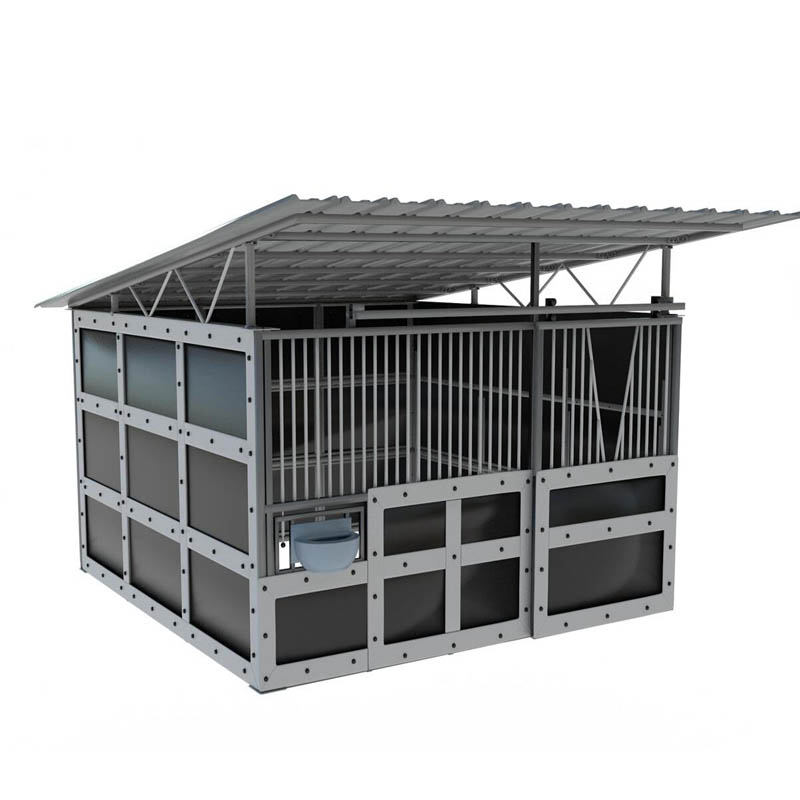
Most Chinese suppliers quote FOB and leave you guessing on the rest. Here is the exact math on a standard 4x4m (16sqm) DIY horse stable kit with 10mm UV-stabilized HDPE walls and a 42-micron hot-dip galvanized Q235 steel frame, shipped flat-pack to an Australian port.
- FOB Price (16sqm at $450/sqm): $7,200
- Sea Freight (2.5CBM flat-pack, China to AU): ~$1,500
- CIF Value: $8,700
- Customs Duty (Chapter 94): $435 (5%)
- GST (calculated on CIF + Duty): $913.50 (10%)
- Total Landed Cost at AU Port: $10,048.50
Why 2.5CBM Is the Number That Actually Matters
Your flat pack horse stables import cost australia is dictated almost entirely by volume, not weight. Our engineers compress the entire kit—frames, 10mm HDPE horse stall walls, hardware, and aluminum swivel feeders—into roughly 2.5CBM. A competitor shipping the same 4x4m stall loosely packed might occupy 5 to 6CBM. You would be paying double the sea freight for the identical product.
The Distributor Margin Reality Check
A local Australian builder charges $1,200 to $1,500 per square meter for a plywood stall. A 16sqm build costs your customer $19,200 to $24,000. You land our 42 micron hot dip galvanized horse stable kit for $10,048.50. That is not a marginal saving—that is a structural gap in your favor.
For the price of one local plywood stall at $19,200, you land two imported HDG/HDPE kits for $20,097. You double your available inventory without increasing your CapEx. The hdpe vs plywood horse stable panels debate ends when you show a client the 5-year total cost of ownership, which includes a $6,000 to $9,000 plywood panel replacement at year four caused by ammonia hydrolysis destroying the urea-formaldehyde resin from the inside out.
The GST Trap That Catches Novice Importers
The horse stable kit customs duty australia is straightforward at 5% under Chapter 94 for prefabricated buildings. Where distributors get burned is the GST calculation. GST is not 10% of the FOB price. It is 10% of the CIF value plus the duty. If you budget GST on the wrong base figure, you end up $200 to $400 short per container when your customs broker demands payment before release.
| Cost Component | Rate / Calculation | Amount (AUD) | Details | Distributor Advantage |
|---|---|---|---|---|
| FOB Factory Price | $450 – $700 per sqm | ~$8,700.00 | 16sqm kit featuring 10mm UV-stabilized HDPE panels and 42-micron hot-dip galvanized Q235 steel frames. | Provides a fixed, predictable cost baseline significantly lower than local AU manufacturing. |
| Sea Freight | Based on 2.5CBM volume | ~$450.00 | Flat-pack modular design compresses a 4x4m stall into roughly 2.5CBM for highly efficient container loading. | Minimizes expensive cubic meter shipping rates, protecting per-square-meter profit margins. |
| CIF Value | FOB + Sea Freight | ~$9,150.00 | Total Cost, Insurance, and Freight value upon arrival at the Australian port. | Serves as the transparent baseline for calculating mandatory government import charges. |
| Customs Duty | 5% of CIF Value | ~$457.50 | Standard Australian Border Force tariff rate under Chapter 94 for prefabricated buildings. | Eliminates fear of hidden import fees; the rate is fixed and publicly verifiable. |
| GST | 10% on (CIF + Duty) | ~$961.00 | Australian Goods and Services Tax applied at the border on imported commercial goods. | Fully recoverable for registered B2B entities, effectively reducing the true net cost. |
| Total Landed Cost | Sum of all stages | $10,048.50 | Complete cost to get a 16sqm premium HDPE/Galvanized kit to an Australian port. | Delivers a 50% cost reduction compared to a $19,200 local plywood build, doubling inventory potential. |
Hot-Dip Galvanized vs Painted Steel Frames
Painted steel frames fail from the inside out. A single assembly scratch is all it takes to guarantee a structural failure within 3-5 years.
The Inside-Out Rust Mechanism That Kills Painted Frames
Most distributors sourcing flat pack horse stables see a painted steel frame and assume the coating is doing its job. The exterior looks fine for years. What they cannot see is the hollow tube slowly filling with iron oxide. Cold-rolled painted steel relies on a surface-level barrier. During on-site assembly, a standard socket wrench slips, or a bolt scrapes the inner wall of the tube. That microscopic scratch exposes bare steel to the humid air trapped inside the hollow section. Moisture enters, oxygen follows, and the rust begins expanding internally with nowhere to go. We have seen structural failures where a horse put a foot through a stable wall that looked perfectly painted on the outside. The frame had turned to mulch inside the tube.
Why 42-Micron Hot-Dip Galvanizing Is a Different Engineering Category
Hot-dip galvanizing is not a coating applied after the steel is formed. The Q235 steel frame is fully submerged in a molten zinc bath at approximately 450 degrees Celsius. This creates a metallurgical bond where the zinc actually alloys with the surface layer of the steel itself. If an assembly scratch occurs on a hot-dip galvanized frame, the surrounding zinc acts as a sacrificial anode, corroding preferentially to protect the exposed steel underneath. The rust never starts. Our factory standard mandates a minimum zinc thickness of 42 microns on every frame component, which is the threshold required to deliver a reliable 10-year structural lifespan in high-ammonia, high-moisture equine environments.
- Coating Type: Painted steel uses a physical barrier layer; hot-dip galvanizing creates a zinc-iron alloy bond.
- Scratch Vulnerability: A scratch on painted steel exposes bare metal to immediate oxidation. A scratch on 42-micron HDG triggers sacrificial protection.
- Internal Protection: Painted hollow tubes have zero internal coating. HDG fully coats the interior of every tube during the dip process.
- Expected Lifespan: Painted frames in stable environments typically show critical rust at year 3-5. 42-micron HDG frames are engineered for a 10-year minimum before any structural inspection is needed.
The Distributor Math: Warranty Claims vs Landed Cost
For an Oceania distributor, the frame material choice is not a technical preference. It is a warranty liability calculation. A painted steel flat pack horse stable might save you 8-12% on the initial FOB price compared to a 42-micron hot-dip galvanized kit. But when your client in regional Queensland calls at year three because a wall panel is separating from a rusted frame, you are absorbing the replacement freight, the labor cost, and the brand damage. The slightly higher landed cost of a hot-dip galvanized horse stable kit eliminates an entire category of after-sales complaints. You are not paying more for steel. You are paying to remove a predictable failure mode from your business.
Container Efficiency: Flat Pack CBM Math
A fully flat-packed 4x4m HDPE stable kit compresses to roughly 2.5CBM, meaning a single 40ft high-cube container holds 24+ complete stalls — freight per unit collapses to a fraction of local build logistics.
The Real Math Behind 2.5CBM Per Stall
Most distributors we talk to calculate freight using the gross external dimensions of a assembled stable — 16 cubic metres for a 4x4m box. That number is irrelevant for flat pack horse stables import cost Australia because you are not shipping air. Our 4x4m single stall kit, including the 42-micron hot-dip galvanized Q235 steel frame, 10mm HDPE wall and partition panels, and all hardware, breaks down into bundled steel and stacked boards totaling approximately 2.5CBM.
A standard 40ft high-cube container offers roughly 76CBM of usable internal volume. At 2.5CBM per stall, the theoretical maximum is 30 units. In practice, we load 24 to 26 stalls per container depending on the configuration — single stalls with peaked roofs pack tighter than quadruple back-to-back layouts because the roof trusses on larger modules create irregular stack profiles that leave gaps. For a distributor, that means your per-unit sea freight from a China port to Sydney or Auckland drops significantly as volume scales.
Two Things That Blow Up Your CBM Calculations
We have seen distributors get burned on quoted CBM twice, and both times it came down to the same oversight: accessories quoted outside the main pack. If your supplier quotes 2.5CBM for the “stable frame and walls” but separately ships aluminum swivel feeders, sliding door tracks, and waterer brackets in loose cartons, those add-ons can consume an extra 0.3 to 0.5CBM per stall. Across 24 stalls, that is 7 to 12CBM of wasted space you are still paying for — enough to have fit 3 more complete kits.
The second killer is the weight ceiling. A 40ft HC to Australia has a maximum payload around 26 to 28 tonnes depending on the shipping line and route. Our HDPE and galvanized steel kits weigh approximately 350 to 400kg per stall depending on configuration. At 24 stalls, you are sitting at roughly 8.4 to 9.6 tonnes — well under the limit. But if a supplier uses heavier materials or packs plywood (which is denser than HDPE at equivalent panel thickness), you can hit the weight cap before filling the volume, meaning you pay for 76CBM of space you cannot physically use.
What This Means for Your Per-Square-Metre Margin
Freight efficiency is where the landed cost advantage of HDPE over plywood actually materializes. At roughly $10,048.50 fully landed in Australia for a 16sqm kit, your cost per square metre sits around $628. A local plywood build at $1,200 per square metre cannot compete on price, and it certainly cannot compete on shipping efficiency — plywood stalls do not flat-pack as cleanly because the sheets are rigid, heavier per panel, and more prone to forklift damage during container loading. For a distributor focused on margin per square metre, the CBM math on flat pack HDPE kits is the mechanism that makes the $450 to $700 per square metre FOB price actually translate into real-world savings at the wharf.
Conclusion
Buying a local plywood stall at $1,200 per square meter destroys your five-year margins when ammonia hydrolysis forces a full panel replacement at year four. For $10,048.50 landed, a 16-square-meter HDPE kit eliminates that chemical rot risk entirely while delivering a decade of actual service life. You are selling infrastructure, not a recurring repair bill.
Request a landed cost calculation for your next shipment to see exactly what hits your local dock. We will send the material test reports and freight breakdown so you can quote your clients with hard numbers instead of guesswork.
Frequently Asked Questions
How much does a prefabricated horse stable kit cost?
Expect to invest between $450 and $700 per square meter FOB for a premium prefabricated kit featuring 10mm UV-resistant HDPE boards and 42-micron hot-dip galvanized steel. For a standard 16-square-meter stall, this translates to roughly $10,048.50 landed in Australia, offering exceptional value for distributors and commercial owners. This factory-direct pricing model perfectly balances our high manufacturing standards with the lowest possible export cost for the Oceania market. By utilizing efficient flat-pack shipping, we further reduce your overall landed expenses compared to traditional construction methods.
How long does setup take?
A standard flat-pack modular stable typically requires just 8 to 14 hours for a two-person team to complete a DIY assembly. If you are utilizing professional stable builders, the process can be finished in a single day thanks to our pre-welded and clearly labelled frame components. This rapid installation timeline minimizes downtime for equestrian centers and allows contractors to take on more projects efficiently. Our product experts ensure every kit is designed for straightforward on-site construction without the need for specialized heavy machinery.
How long are quotes valid?
Our manufacturing quotes are typically firm for 30 days to account for natural fluctuations in raw steel and polymer markets. However, as a trusted partner to Australian and New Zealand distributors, we make every effort to honor original pricing whenever reasonably possible. This approach provides you with the financial predictability needed to plan your inventory purchases or large-scale equestrian facility builds. We recommend locking in your order promptly to secure the most competitive factory-direct pricing available.
Can I pick up my order instead?
Because we operate as a specialized manufacturer exporting directly from our factory, imported flat-pack kits cannot be picked up locally but instead arrive efficiently at your nearest Australian port or designated freight depot. This streamlined international logistics model is specifically designed to simplify commercial unloading and distribution for our B2B retail partners and builders. Your order will be fully containerized to maximize shipping safety and reduce the complexity of handling upon arrival. Ultimately, this direct-to-port delivery ensures your high-quality stables reach you in pristine condition without the markup of local middlemen.
What are your payment terms?
Standard B2B terms require a 50 percent deposit to initiate the fabrication of your hot-dip galvanized steel and HDPE components, with the remaining balance due prior to shipping. For large-scale multi-bay orders from equestrian centers or major distributors, we are fully prepared to negotiate customized milestone payment structures. This flexible approach ensures your cash flow remains healthy while our production team maintains its strict quality control standards. We maintain complete transparency throughout the process, providing professional documentation for your commercial and potential tax benefit records.