You got a quote from a local builder for $1,400 a square meter to put up new stalls, so you started looking into diy horse stable kits australia to save your capital expenditure. The problem is you are probably staring at a local flat-pack option built with plywood and painted steel, expecting it to hold up against a kicking thoroughbred for a decade. I have seen operators buy exactly that, only to watch the plywood panels turn into an ammonia-soaked sponge within four years while the exterior paint still looked fine to the eye. The real failure happens at the base of the frame; a simple scratch on cold-rolled steel during assembly lets moisture inside the hollow tube, and rust destroys the structure from the inside out until a horse puts a foot through the wall.
We pulled the material specs on the most common local kits and compared them against what actually survives a high-ammonia environment. This guide shows you why your risk assessment needs to focus on material chemistry rather than the location of the factory. We are going to compare 10mm UV-stabilized HDPE against traditional plywood, and explain why a 42-micron hot-dip galvanized frame coats the internal cavity to stop hidden rust. You will walk away knowing the exact cost per square meter for a flat-pack kit that hits a 10-year maintenance-free lifespan, along with the engineering specs required to pass council checks and get the structure assembled in under two days.

Plywood vs HDPE: 5-Year Failure Rate
Plywood stalls rot from the inside out within 3-5 years due to ammonia hydrolysis. HDPE eliminates this failure mode entirely, making it the cheaper material on any 5-year horizon.
The Chemistry of Ammonia Rot: Why Plywood Fails Silently
Horse urine decomposes into ammonia gas, and in a poorly ventilated stall that concentration sits directly against the lower 600mm of your wall panels. The failure mechanism is not surface wetting — it is chemical. Ammonia is highly alkaline (pH 11–12), and it actively hydrolyzes the urea-formaldehyde and phenol-formaldehyde resins used to bond plywood veneers. Once those glue lines break down, the plies separate internally while the exterior paint continues to look perfectly intact.
We have seen plywood panels pulled from 4-year-old stalls in Australian equestrian centers where the outside face still held a fresh coat, but the internal core had turned to soft mulch. Competitors market “ply and mesh” combos as an airflow solution, but that mesh does nothing to stop plywood from acting as an ammonia sponge at the base. According to equine facility research from Purdue University’s Agricultural Extension, sustained ammonia exposure above 25ppm accelerates organic material degradation significantly — levels routinely exceeded in enclosed horse stalls where urine soaks into bedding and off-gases against lower wall surfaces.
10mm UV-Stabilized HDPE: Zero Water Absorption, Zero Rot
High-Density Polyethylene (HDPE) is a non-polar, hydrophobic polymer. Its water absorption rate is essentially zero — below 0.01% by mass even after prolonged immersion. Ammonia cannot penetrate it, cannot react with it, and cannot degrade it. There are no glue lines to hydrolyze, no grain direction to delaminate, and no organic fibers to support microbial colonization.
We spec 10mm UV-stabilized HDPE for a specific reason: thickness below 8mm allows enough flex for a horse to permanently bow or crack the panel under repeated kicking stress, while anything above 10mm adds material cost with zero structural gain for a standard 2.4m wall height. The UV stabilization package is critical under Australian sun — un-stabilized polyethylene chalks and becomes brittle within 2–3 years of full exposure. Our formulation maintains impact resistance through 10+ years of direct UV without warping, gapping, or surface degradation between frame members.
5-Year Total Cost of Ownership: The Hard Math
Using a standard 4x4m (16sqm) single stable as the baseline, here is what the numbers look like when you factor in the plywood replacement cycle that every farm operator knows is coming but nobody budgets for upfront:
- Local builder plywood stable: $1,200–$1,500 per sqm. Initial build: $19,200–$24,000. Full wall panel replacement at year 4 (labor, materials, stall downtime): add $6,000–$9,000. Five-year real cost: $25,200–$33,000.
- Imported HDG/HDPE flat-pack kit: $450–$700 per sqm. Initial cost: $7,200–$11,200. No replacement cycle within the 10-year frame lifespan. Five-year real cost: $7,200–$11,200.
The imported HDPE kit is not just cheaper on day one — it is cheaper on day 1,825. When a farm owner evaluates a $7,500 kit against a $22,000 local build, the instinct is to assume the cheaper product carries hidden quality risk. The data says the opposite: the hidden risk lives in the plywood, not the polymer. For commercial operators managing thoroughbreds, a panel failure during a storm or from a kick-through is a liability event. HDPE at 10mm thickness absorbs that impact and returns to shape. Plywood at the point of internal delamination shatters.
Local Builder vs Imported Kit Cost Breakdown
At $450/sqm for an HDG/HDPE flat-pack kit versus $1,200/sqm for a local plywood build, the material science gap is the real cost driver — not the shipping distance.
Base Rate Reality Check for a 4x4m Stall
A standard 4x4m horse stable carries a 16sqm footprint. When you apply the current Australian market rates, the gap is immediate. A local builder quoting $1,200 per square meter for a custom steel-and-ply stall delivers a base structure cost of $19,200 before site preparation, concrete pouring, and council inspection fees. An imported HDG/HDPE flat-pack kit at $450 per square meter lands at $7,200 for the same 16sqm footprint. That $12,000 difference exists before a single panel is bolted together.
The critical detail most buyers miss is that the local quote assumes you already have a level concrete pad. If your property requires earthworks, road base compaction, or a new slab, add $3,000 to $6,000 to the local build. The imported flat-pack kit, by contrast, can be assembled directly onto a compacted road base foundation — eliminating the concrete contractor entirely.
True Landed Cost Calculation
The “too good to be true” fear collapses the moment you run the actual import math for a single 4x4m stall. Here is the exact landed cost breakdown based on current Australian border charges for flat-pack equine structures under Chapter 94:
- Kit FOB Cost: $7,200 (16sqm at $450/sqm for 10mm HDPE panels with 42-micron hot-dip galvanized Q235 steel frame)
- Sea Freight to AU Port: $1,500 (flat-pack configuration compresses a 4x4m stall into roughly 2.5CBM, making it highly container-efficient)
- Customs Duty (5%): $435 (calculated on the CIF value of $8,700)
- GST (10%): $913.50 (calculated on the CIF-plus-duty value of $9,135)
- Total Landed Cost: $10,048.50
That $10,048.50 is your all-in figure to get the complete stable kit to your nearest Australian port or depot. It includes every wall panel, the structural steel frame, roof sheeting, and hardware. No hidden line items. For context, the Australian Border Force confirms that GST is applied to the combined value of goods, freight, insurance, and duty — which is exactly how the $913.50 figure above is derived.
The 2-to-1 Stall Multiplier
This is where the commercial math becomes impossible to ignore for equestrian center operators. One locally built 4x4m plywood stall at $1,200/sqm costs $19,200 on a concrete slab. For that identical budget, you can land two imported HDG/HDPE kits ($20,097) and still have change left for a weekend of DIY assembly. If your local builder quotes at the upper end — $1,500/sqm, which pushes a single stall to $24,000 — you are now in the territory of landing two full imported kits and having over $3,900 remaining for site preparation.
The multiplier compounds further when you consolidate shipping. A 20-foot container holds approximately 6 to 8 flat-pack 4x4m stalls. The per-unit freight cost drops from $1,500 for a single stall to roughly $800 to $900 per stall when filling a container. At that freight rate, the landed cost per stall falls below $9,500 — meaning you could potentially build three imported HDPE stalls for the price of one local plywood stall built on a concrete slab. The structural irony is that the three imported stalls will still outlast the single local one, because 10mm UV-stabilized HDPE does not absorb ammonia and 42-micron hot-dip galvanizing coats the internal cavity of the steel tube — two failure modes that local ply-and-painted-steel constructions cannot survive past year five.
| Comparison Factor | Local Builder Standard | DB Stable Imported Kit | Engineering Reality |
|---|---|---|---|
| Capital Expenditure | $1,200 – $1,500 per square meter | $450 – $700 per square meter | Delivers over 50% cost reduction per stall while upgrading structural specifications and eliminating contractor scheduling bottlenecks. |
| Infill Panel Material | Plywood and mesh combinations | 10mm UV-stabilized HDPE boards | Plywood acts as a sponge for ammonia, silently rotting the internal core within 3-5 years; HDPE features zero water absorption for a 10+ year maintenance-free lifespan. |
| Steel Frame Protection | Cold-rolled RHS with spot welds and painted finish | Q235 silicon-killed steel, 42-micron hot-dip galvanized (ISO 1461) | Scratched painted tubes rust from the inside out in coastal or sweat environments; hot-dip galvanizing coats the internal cavity to prevent hidden structural failure. |
| Roofing Engineering | Often flat or minimal pitch on budget builds | Engineered with minimum 5-degree pitch | Flat roofs pool static water exceeding 40kg per square meter during tropical Australian storms, creating a severe collapse risk for lightweight frames. |
| Installation Logistics | Contractor-dependent, variable timelines | Flat-pack DIY kit design | Pre-engineered components allow practical farm owners to complete assembly in under 2 days without compromising commercial-grade safety standards. |
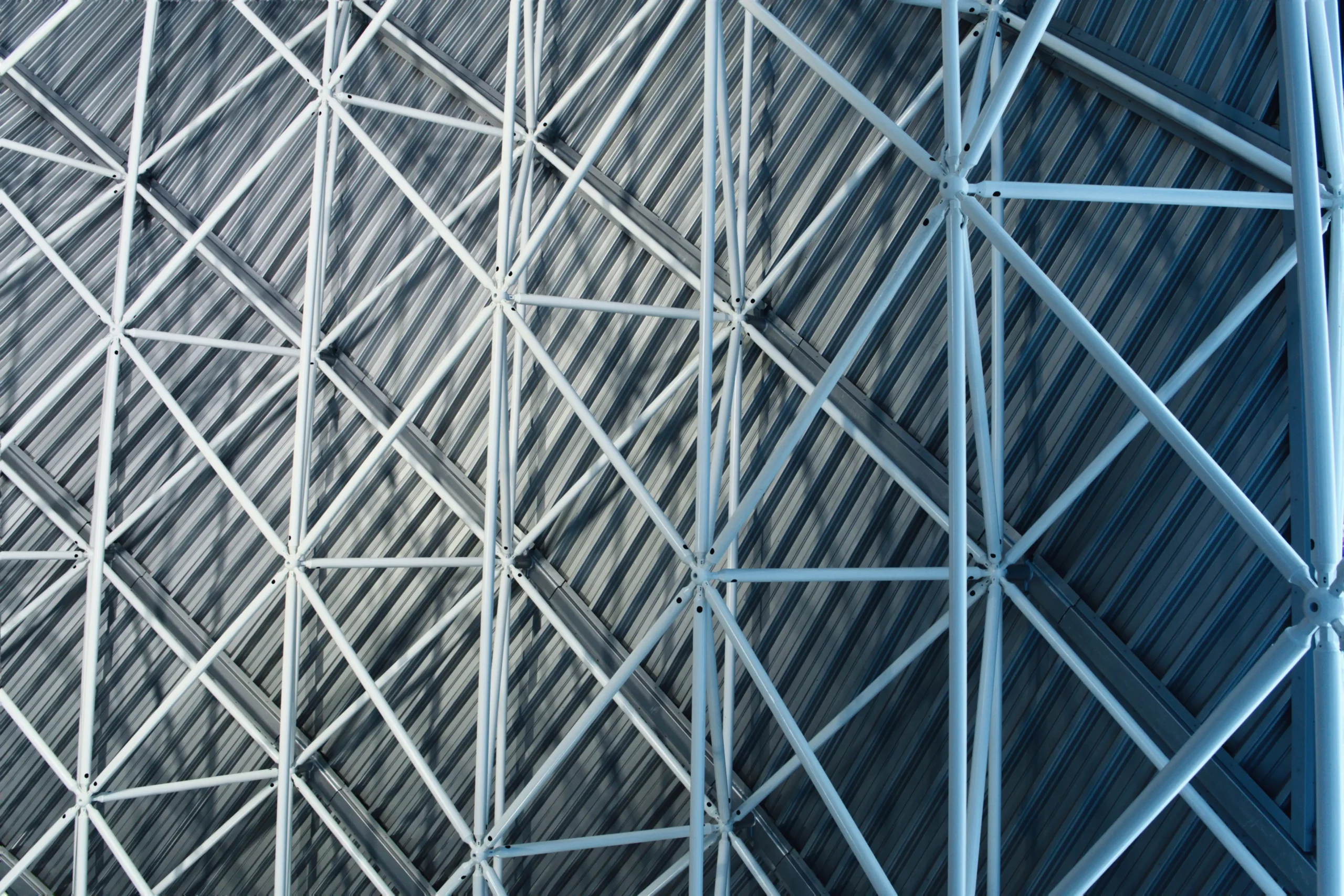
Hot-Dip Galvanized Frames: 42 Microns
Painted cold-rolled RHS steel fails from the inside out once the base coating scratches during assembly. ISO 1461 hot-dip galvanizing at over 42 microns coats the entire internal cavity, eliminating this hidden failure mode.
The Rust Failure Mechanism of Painted RHS Steel
Most local Australian flat-pack kits rely on cold-rolled Rectangular Hollow Section (RHS) steel with a post-weld painted finish. The critical vulnerability sits at the base of the frame. During on-site assembly, the bottom edge inevitably scratches against concrete or road base when you position the panels. That scratch exposes bare steel to moisture, horse urine, and ammonia-rich runoff. In a hollow tube, rust does not stay external — it travels inside the uncoated internal cavity where you cannot see it. Within 3 to 5 years, the internal wall thickness degrades to the point where a horse kicking the panel can buckle the entire section. The exterior paint still looks acceptable, which is exactly why this failure catches farm owners off guard during routine inspections.
ISO 1461 Hot-Dip Galvanizing: Over 42 Microns Inside and Out
The ISO 1461 standard governs the hot-dip galvanizing process. The entire welded frame is submerged in a zinc bath at approximately 450 degrees Celsius. Because the zinc is in liquid form, it flows into the internal cavity of every RHS tube and fully coats the weld joints — areas where painted finishes are inherently weakest. Our specification is over 42 microns of zinc coating on both the internal and external surfaces. For Australian coastal environments and the high-sweat conditions inside enclosed stables, this thickness delivers a 10-year lifespan without maintenance. The practical distinction matters: painted coatings sit on the surface and break at the first scratch. Galvanized coatings are metallurgically bonded to the steel substrate, meaning even if the outer layer is abraded, the remaining zinc continues to provide sacrificial cathodic protection to the exposed steel beneath it.
Q235 Silicon-Killed Steel: Preventing Weld Cracking During Galvanizing
Hot-dip galvanizing is not compatible with all steel grades. If the base metal contains excessive carbon or silicon in the wrong proportions, the zinc-iron alloy layer grows too aggressively during the dipping process, becoming brittle and flaking off at the weld seams — a defect known as zinc peeling. We use Q235 silicon-killed steel specifically because its controlled chemical composition prevents this reaction. Silicon-killed steel has been deoxidized with silicon during the steelmaking process, which regulates the zinc-iron alloy growth rate during galvanizing. The result is a consistent, adherent coating across the entire frame, including at every weld intersection. If a supplier cannot specify their base steel grade, they cannot guarantee their galvanizing quality — because the zinc coating is only as reliable as the steel chemistry beneath it.
Road Base vs Concrete Foundation Specs
Road base is the only foundation that preserves a hot-dip galvanized frame’s 10-year lifespan. Concrete slabs actively destroy it by trapping capillary moisture at the steel base.
Exact Site Prep: The 100mm Road Base Specification
For a 4x4m flat pack horse stable kit, the substrate must be laid in a specific sequence. First, strip topsoil and level the subgrade. Lay a non-woven geotextile fabric over the exposed earth to prevent fine particles migrating upward into the aggregate. Spread 100mm of compacted road base (Class 2 or Class 3 crushed rock, depending on your local council supply) evenly across the fabric.
Compact the road base in two 50mm passes using a plate compactor. Leveling must be verified using the 3-4-5 method: measure 3 meters along one edge, 4 meters along the adjacent edge, and confirm the diagonal reads exactly 5 meters. This guarantees the footprint is perfectly square before the frame is assembled. A deviation of even 15mm across a 4m span will force the hot-dip galvanized Q235 steel channels out of alignment, making panel insertion difficult and creating stress on the bolted joints.
Why Concrete Slabs Fail Portable Stables
Concrete is an excellent foundation for a permanent structure, but it is chemically hostile to the base of a portable galvanized steel frame. The problem is capillary moisture rise. Concrete is porous, and groundwater wicks upward through the slab via capillary action, keeping the surface perpetually damp. When you bolt a galvanized steel base channel directly onto a concrete slab, the bottom flange sits in a thin, invisible film of moisture 24 hours a day.
Even with 42-micron hot-dip galvanizing (ISO 1461 standard), constant wetting at a single point bypasses the zinc layer’s passive protection. The zinc sacrifices itself to protect the steel, but in a continuously wet environment, that sacrifice rate accelerates dramatically. We have seen frames on concrete slabs in coastal NSW show white zinc oxide corrosion streaks at the base within 18 months. The frame itself does not fail overnight, but the localized corrosion weakens the base connection points where shear loads from horse kicks are highest. For a thoroughbred facility where panel integrity is non-negotiable, this is an unacceptable risk profile.
Drainage Mechanics and the 10-Year Lifespan Guarantee
Road base functions as a permeable buffer. Water from rainfall, hosing, or horse urine does not pool at the surface. It drains through the gaps in the crushed rock, hits the geotextile fabric, and then disperses laterally into the surrounding subgrade. The steel base channels of the stable sit on top of a firm, well-draining surface that dries out within hours of wetting.
This wet-dry cycle is critical for galvanized steel. ISO 1461 galvanization is designed for atmospheric exposure where the zinc layer forms a stable patina between wetting events. When the steel dries completely between exposures, the corrosion rate drops to negligible levels. This is the exact mechanism that allows our 42-micron hot-dip galvanized frames to achieve a verified 10-year maintenance-free lifespan in Australian conditions. Concrete eliminates that drying cycle. Road base preserves it.
Conclusion
Stop evaluating local builders against imported kits by geography. A $700 per square meter hot-dip galvanized and HDPE flat-pack kit outlasts a $1,200 local plywood build by six years. You slash your capital expenditure per stall and eliminate the ammonia rot that silently destroys cheap timber.
Demand the ISO 1461 galvanization test reports and HDPE UV-resistance certificates from any supplier before you sign a proforma invoice. If they cannot prove 42-micron internal cavity coating on their steel frames, walk away. Your horses will find the weak spot, and you will pay for it in vet bills.
Frequently Asked Questions
What are the best DIY horse stable kits in Australia?
The best DIY horse stable kits in Australia utilize a robust combination of 42-micron hot-dip galvanized steel frames and 10mm UV-resistant HDPE boards rather than traditional plywood. This specific material pairing is critical because plywood typically degrades within three to five years due to exposure to urine ammonia, whereas HDPE boards resist thermal expansion and last over a decade with zero maintenance. For B2B buyers and professional stable builders, sourcing these premium prefabricated kits ensures structural security for high-value thoroughbreds while maximizing long-term ROI. Ultimately, a top-tier kit balances factory-direct pricing with commercial-grade durability to withstand the demanding Australian climate.
Are free DIY stable plans a good idea?
Relying on free DIY horse stable plans is highly discouraged for professional equestrian centers and commercial builders due to a lack of engineering compliance and structural liability. While free schematics exist online, they fail to account for the precise load requirements and safety standards necessary for securely housing horses. Instead, investing in prefabricated flat-pack kits provides certified structural welds and access to a dedicated design team with over five years of specialized experience. By choosing a comprehensive, engineered solution, B2B clients eliminate the significant safety risks and potential financial liabilities associated with self-fabricated structures.
How much do cheap DIY stable kits cost?
While cheap DIY horse stable kits may initially start around $2,800 for a basic 4x4m plywood frame, they inevitably incur hidden costs, such as a $1,300 replacement expense within just five years due to material degradation. Conversely, a premium prefabricated kit featuring hot-dip galvanized steel and 10mm HDPE boards represents a higher upfront investment of $3,500 to $4,500 but requires absolutely zero replacement parts over its 10-year lifespan. For distributors and commercial farm owners, this premium pricing tier aligns perfectly with the high-quality, low-price philosophy by drastically reducing the total cost of ownership. Furthermore, investing in durable, portable structures can unlock potential tax benefits for commercial horse owners, making the premium kit the most economically sound choice.
How long does installation take?
The installation of a flat-pack DIY horse stable kit is highly efficient, typically requiring only two people with basic tools like an impact driver and socket set to complete a 4x4m structure in just 1.5 days. This rapid turnaround is a direct result of DB Stable’s logistical expertise in designing portable, prefabricated components that drastically reduce on-site construction complexity. On the first day, a professional builder can easily handle the frame erection and secure the wall panels, leaving the second day for roofing and final bolt tensioning. This streamlined assembly process allows distributors and equestrian center operators to minimize labor costs and quickly deploy secure, high-specification accommodations for their horses.
Do I need a concrete slab?
You do not absolutely need a concrete slab; in fact, a compacted road base layered 100mm thick over geotextile fabric is often the preferred foundation for portable horse stables. This alternative foundation provides superior rapid drainage, which is essential for maintaining a healthy, mud-free environment for thoroughbreds and other high-value horses. Conversely, pouring a concrete slab can trap moisture directly against the steel frame base, inadvertently accelerating corrosion even on heavy-duty galvanized metal. By utilizing well-compacted road base, professional stable builders and farm owners can preserve the 10-year lifespan of the hot-dip galvanized frames while maintaining the structure’s inherent portability.