A quadruple horse stable looks straightforward on a quote sheet, right up until one container lands in Brisbane with thin coating, loose hardware, and panels your dealer can’t identify from the packing list. I’ve seen that movie before. The margin looked fine at order stage, then freight surcharges, customs cleanup, and two warranty claims turned a decent buy into a long apology tour with farms that expected better.
This layout guide gets into the parts that actually decide whether a four-stall roofed block sells well in Australia or comes back to bite you later: back-to-back versus face-to-face layouts, what flat-pack loading really does to container yield, where install time blows out on remote sites, and which proof documents you should demand before you pay a deposit. My view is simple. If a supplier can’t show coating evidence, spare-part logic, landed-cost clarity, and a clean receiving checklist, the unit price means nothing.

Quadruple Stable Layout
For a quadruple horse stable, the layout decision is not cosmetic. It drives freight efficiency, drainage performance, install time, and long-term warranty risk.
2×2 and Conjoined Layout Logic
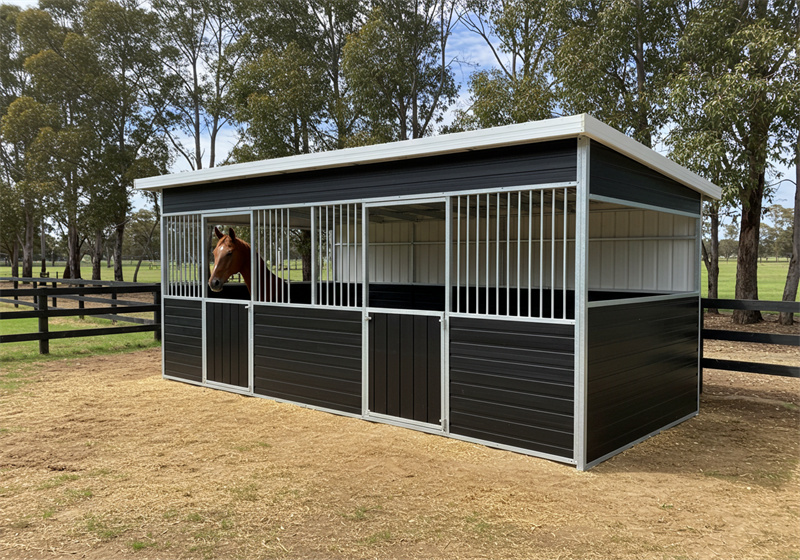
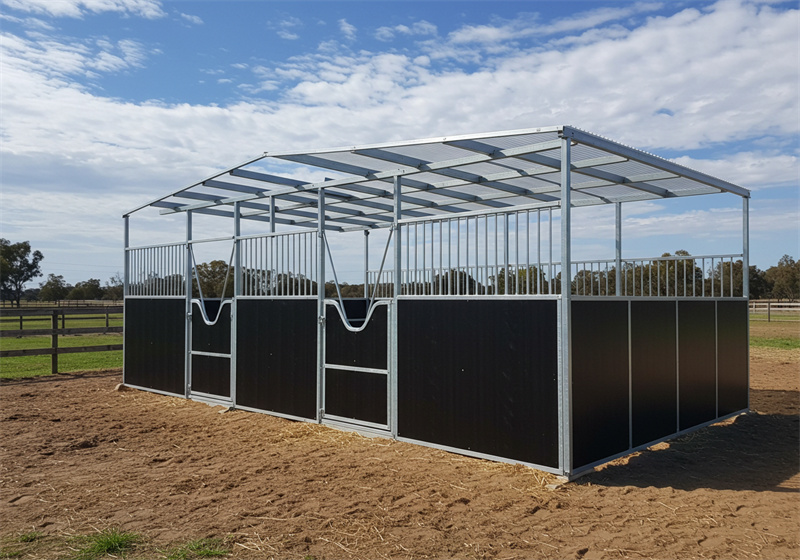
A quadruple horse stable usually makes the most commercial sense when four stalls are grouped as a 2×2 or other conjoined block rather than treated like four isolated singles. The reason is simple: shared structure reduces duplicated posts, repeated roof framing, and unnecessary side-wall material. That lowers steel consumption per stall and gives distributors a cleaner resale package.
In practice, shared roofing is where the savings become visible. One roofed block is easier to plan, easier to ship as a flat-pack system, and easier to explain to contractors than four independent roof kits. For Australia and New Zealand buyers, that matters because installation delays and missing-part confusion quickly turn into margin loss.
- Lower framing duplication: Shared internal walls and roof supports reduce repeated steel members compared with multiple standalone stalls.
- Simpler planning: One coordinated block is easier to place on a slab or prepared pad than four separate footprints.
- Cleaner bill of materials: Fewer repeated components make packing, counting, and receiving easier for wholesale portable horse stable kits in NZ and Australia.
- Better resale positioning: A roofed quadruple block gives dealers a more commercial product than low-spec temporary singles.
We see serious buyers focus less on “modular flexibility” slogans and more on whether the layout actually reduces operational friction. If a conjoined block cuts duplicated framing but creates poor water runoff or awkward horse movement, the saving is fake. The right layout has to work on paper and on the ground.
Aisle Flow, Drainage, and Installation Sequence
Layout affects daily use first, not just installation day. A quadruple block must leave enough clear movement space for horses, handlers, bedding carts, and washdown flow. If aisle flow is cramped, staff lose time every day and accident risk goes up, especially in commercial equestrian facilities handling multiple horses in a tight working window.
Drainage is the other non-negotiable. Poor runoff creates wet bedding, muddy entry points, and more corrosion exposure around base connections and hardware. DB Stable’s systems are built around hot-dip galvanized steel with zinc thickness above 42 microns and 10 mm UV-resistant HDPE boards, but no coating or board choice cancels out bad site water management.
- Aisle flow: Keep feed, muck-out, and horse entry routes obvious and direct. Avoid layouts that force repeated reversing or cross-traffic.
- Drainage path: Roof runoff and surface water should move away from stall thresholds, not across them.
- Base preparation: The pad should be level for structure, but the surrounding site still needs planned fall for water discharge.
- Installation sequence: Set anchors or bolt-down points first, then main frame, then roof structure, then infill panels, then doors and hardware. That sequence reduces rework.
- Receiving discipline: Labelled parts and staged unloading matter because mixed roof and panel bundles slow crews and increase install errors.
For flat pack horse stable bulk order buyers, this is where supplier quality shows up. The layout may be sound, but if unloading order is not thought through, crews waste hours moving bundles twice. That is exactly the kind of avoidable cost distributors remember when deciding whether to reorder.
Back-to-Back Layout: Freight and Cost Efficiency
A back-to-back horse stable block with roof is usually the stronger choice when freight efficiency and cost control lead the decision. Two rows share the central structural logic, which reduces rear-facing duplication and can improve roof span efficiency. For importers, that often means a tighter flat-pack package and better container use.
Back-to-back layouts also simplify rear panel strategy. Instead of treating every stall as an exposed standalone box, the design can optimize the internal rear-to-rear interface and reduce wasted material. Done properly, this lowers per-stall framing demand without dropping the commercial-grade feel of the finished block.
- Freight efficiency: Shared structural logic usually packs better than four separated units, which helps flat pack quadruple horse stable container loading.
- Cost efficiency: Less duplicated rear framing can improve material yield per stall.
- Roof optimization: A unified roofed block can reduce awkward short roof sections that waste steel and create more join lines.
- Loading and unloading implications: Back-to-back packs need clear bundle identification so crews separate roof members, wall panels, and hardware in the right order.
The trade-off is access. A back-to-back arrangement is efficient, but if the site approach is poor or the service side becomes cramped, feeding, mucking out, and horse handling can become less fluid. Buyers should not chase container efficiency and then ignore daily workflow.
Face-to-Face Layout: Access and Workflow
A face-to-face layout is usually chosen for operational visibility. With stalls opening toward a central aisle, staff get cleaner sight lines, easier horse observation, and a more controlled handling path. For thoroughbred or high-management environments, that daily visibility can outweigh the extra structure and footprint.
This layout also supports a stronger working rhythm. Feed delivery, stall checks, and horse movement happen along one central access line instead of being split between opposite service zones. That sounds minor until the site is busy. Then it becomes a labor and safety issue.
- Central aisle access: Staff can service all four stalls from a single controlled corridor.
- Horse handling visibility: Doors facing the aisle make supervision easier during feeding, cleaning, and movement.
- Workflow benefit: One main working lane usually improves routine efficiency for commercial operators.
- Footprint trade-off: Face-to-face layouts typically need more planned access width than tightly packed back-to-back blocks.
- Roof length and install complexity: Covering a central aisle can increase roof span logic, flashing points, and installation coordination.
So the comparison is straightforward. Back-to-back usually wins on freight and steel efficiency. Face-to-face usually wins on access and horse-management workflow. The right choice depends on whether the buyer is optimizing for landed cost, resale simplicity, or day-to-day stable operations.
Roof Coverage, Runoff, and Long-Term Exposure
Roof design is not just a weather add-on. On a quadruple horse stable with roof in Australia or New Zealand, roof coverage controls runoff direction, bedding dryness, mud buildup, and how much moisture reaches the frame base and hardware. If roof water falls straight into the traffic zone, the stable will feel badly designed no matter how good the steel looks in a brochure.
Overhang matters because it pushes water away from door lines and wall faces. Gutter compatibility matters because some sites need controlled collection rather than open discharge. Ventilation integration matters because trapping humid air under a roof can leave bedding damp and increase internal corrosion pressure over time, especially in coastal or washdown-heavy environments.
- Overhang: Helps protect door openings, reduces splashback, and keeps entry areas drier.
- Runoff path: Water should discharge away from walk zones, anchor points, and bedding access points.
- Gutter compatibility: Useful where site drainage rules or mud control require managed roof-water collection.
- Ventilation integration: Roofed blocks still need air movement so moisture does not sit inside the unit.
- Bedding dryness: Better roof control reduces repeated wet bedding replacement and lowers hygiene problems.
- Mud control: Cleaner runoff planning reduces churned-up access areas around the stable.
- Corrosion exposure: Less standing water around base zones helps the galvanized frame perform closer to its intended lifespan of around 10 years under normal use conditions.
This is where low-spec imports usually get exposed. Sellers talk about galvanized frames but ignore where the water actually goes. Our view is simple: if the roof, runoff path, and ventilation are not designed together, the buyer inherits the problem later through bedding cost, mud complaints, and premature hardware replacement.
For distributors and stable builders, the best quadruple stable layout is the one that survives scrutiny at three levels: it packs efficiently, installs in a logical sequence, and works cleanly after the first rain. That is the standard serious buyers should use when comparing any portable horse stable distributor Australia NZ offer.
Material Specs That Matter
For B2B buyers, material quality is only real when it is backed by documents, measurable specs, and a clear spare-parts plan.
Start with proof, not brochure language
If you are sourcing a quadruple horse stable for Australia or New Zealand, the main risk is not the sales pitch. It is vague documentation. Brochure claims do not protect distributor margin when a coating fails, a panel cracks, or installation teams find missing hardware on site.
Our team typically sees experienced buyers ask for the proof layer first: material specs, coating evidence, panel thickness confirmation, spare-part lists, and replacement rules. That is the right order. A supplier that cannot document these basics will usually become expensive after landing, even if the EXW price looks attractive.
- Ask for coating proof: Request a zinc-thickness report, production record, or third-party verification instead of accepting “galvanized” as a generic claim.
- Ask for panel proof: Confirm the HDPE board thickness is 10 mm and that the board is specified as UV-resistant.
- Ask for hardware proof: Get a full hardware list covering hinges, latches, bolts, fasteners, and any optional feeder assemblies.
- Ask for replacement rules: Clarify which parts are field-replaceable and whether individual boards, feeder components, or hardware packs can be reordered without replacing a full stall front.
- Ask for after-sales logistics: For Australia and New Zealand, confirm spare hardware stocking strategy and replenishment lead times before placing a bulk order.
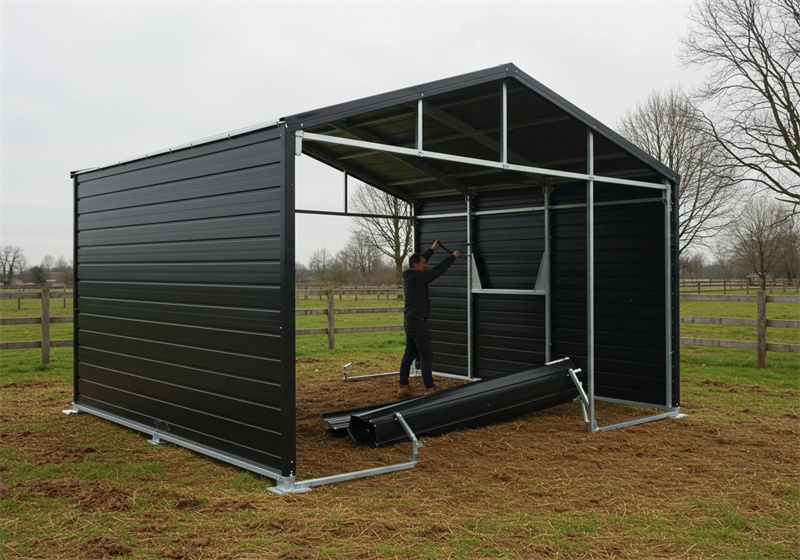
Galvanized steel frame: verify the coating, not just the word
This is the first material checkpoint that matters. DB Stable specifies hot-dip galvanized steel frames with zinc thickness above 42 microns for corrosion resistance in export markets. That is not the same as light electro-galvanizing, cold galvanizing, or painted steel sold under loose anti-rust language.
For procurement, the question is simple: what galvanizing method was used, and what is the measured coating thickness? If the supplier cannot answer both clearly, you are buying uncertainty. In coastal or high-washdown conditions, vague coating claims usually come back as warranty leakage.
- Base material: Hot-dip galvanized steel frame.
- Verification point: Zinc coating thickness should be documented at 42 microns or above, in line with DB Stable’s stated export specification.
- Method confirmation: Confirm the frame is hot-dip galvanized after fabrication or to the supplier’s stated production method. Do not accept “galvanized finish” as enough detail.
- Lifespan expectation: DB Stable states a typical structural lifespan of around 10 years under normal use conditions.
- Limitations: Lifespan still depends on environment, move frequency, anchoring quality, and maintenance. Not all portable stable systems belong in the same durability bucket.
- Buyer requests we often see: Mill certificates, coating reports, and in larger project submissions, structural calculation requests aligned with AS 4100 expectations.
A serious supplier should be comfortable with this level of scrutiny. If they avoid thickness verification or dodge the coating method question, that is your answer. Cheap anti-rust claims are easy to print and expensive to defend once the stable is installed.
HDPE wall panels: check sun, impact, cleaning, and replacement logic
DB Stable uses 10 mm UV-resistant HDPE boards as a core material choice. For commercial equestrian facilities and distributor programs, that matters because panels take abuse from sunlight, washdown, and kicking. A good panel spec reduces recurring service calls. A weak panel spec creates them.
The practical buying test is not whether the supplier says “HDPE.” It is whether they can explain how that board behaves in real use. You want confirmation on UV resistance, impact tolerance, hygiene, thickness, and how individual damaged boards are replaced in the field.
- UV resistance: The board should be specified as UV-resistant for Australia and New Zealand exposure, where sun damage is a real commercial issue.
- Kick resistance: Ask how the panel is supported within the frame and whether the board can be replaced individually if a horse damages one section.
- Washdown hygiene: HDPE is easier to wash down than many porous or coated alternatives, which helps with day-to-day stable hygiene.
- Maintenance load: Lower repainting and lower surface-failure risk generally mean less recurring maintenance than lower-spec wall materials.
- Expansion behavior: DB Stable highlights HDPE boards that do not suffer from the thermal expansion issues buyers often worry about in outdoor installations.
- Thickness verification: Confirm the board thickness is 10 mm on the formal quotation, production sheet, or packing documents, not just on marketing artwork.
- Replacement protocol: Ask whether replacement boards ship as single pieces, how they are identified by size, and whether the hardware needed for swap-out is included or sold separately.
This is where weak suppliers get exposed. Many can say “UV-stabilized HDPE.” Fewer can tell you how a damaged panel is reordered six months later, how it is labeled, and whether your local dealer can replace it without stripping down the whole stable bay.
Hardware and feeders: small parts decide after-sales cost
Distributors lose money on small parts far more often than on main frames. Hinges, latches, bolts, and feeder fittings are where installation delays and warranty friction usually start. If the supplier has no clean hardware list and no spare-parts method, you are going to feel it after the container lands.
DB Stable’s product range includes specialized fittings such as rust-free aluminum swivel feeders. That is useful, but the buying question is still operational: which components are standard, which are optional, and which can be replaced locally without waiting for a full shipment from overseas?
- Hinges and latches: Confirm quantity per stall, material spec, finish, and whether left-hand and right-hand door hardware are packed separately and labeled clearly.
- Fasteners: Request a full fastener schedule so installers know exactly what arrives in each pack and what local tools are required.
- Optional feeders: If swivel feeders are included, confirm material, mount type, and whether the feeder assembly can be replaced without changing the full front panel.
- Replaceable parts: Ask which items are field-replaceable as single SKUs, including latches, hinge sets, feeder components, and individual HDPE boards.
- Local spare hardware stocking: For distributor programs in Australia and New Zealand, keep a local spare hardware pack. That is cheap insurance against brand damage from a missing latch or lost bolt pack.
The blunt truth is this: buyers rarely switch suppliers because of a brochure. They switch because the first warranty problem turns into a paperwork mess. If your portable horse stable supplier can prove the coating, prove the 10 mm HDPE spec, and support replaceable hardware locally, you are dealing with a commercial-grade partner rather than a generic exporter.
| Feature | Specification | Why It Matters | Buyer Check |
|---|---|---|---|
| Frame Material | Hot-dip galvanized steel frame | Improves corrosion resistance for portable horse stables used in coastal, rural, and high-washdown environments across Australia and New Zealand. | Ask for galvanizing process details and confirm the frame is hot-dip galvanized rather than lightly coated or painted steel. |
| Zinc Coating Thickness | >=42 microns zinc coating | Higher coating thickness helps reduce anti-rust claims, extends service life, and protects distributor margin on resale programs. | Request coating-thickness evidence or inspection records before placing a flat pack horse stable bulk order. |
| Expected Frame Lifespan | Approx. 10 years under normal use conditions | Gives commercial equestrian buyers a more realistic durability benchmark than generic short-life portable systems. | Verify what ‘normal use’ means, especially for coastal exposure, move frequency, anchoring method, and maintenance routine. |
| Wall Infill Material | UV-resistant HDPE boards | Helps reduce sun damage, washdown issues, and recurring panel replacement risk in high-UV export markets such as Australia. | Confirm the boards are UV-resistant HDPE and ask whether replacement panels can be supplied individually as spare parts. |
| HDPE Board Thickness | 10 mm | Supports a stronger commercial-grade panel specification for equestrian facilities that need durability without frequent maintenance. | Check the panel thickness on drawings or quotations and compare against lower-spec alternatives offered by local fabricators. |
| Thermal Stability | HDPE boards promoted as not suffering from thermal expansion | Reduces fit-up issues, rattling, and panel distortion risk in outdoor installations exposed to heat and changing weather. | Ask how the board system performs in direct sun and whether field replacement is simple if a panel is damaged in service. |
| Portable Construction | Prefabricated flat-pack modular design | Cuts freight volume, simplifies handling, and supports easier installation planning for distributors and stable builders. | Request packing lists, palletization details, and container loading plans to protect landed margin and reduce receiving errors. |
| Configuration Range | Single, double, quadruple, and back-to-back variants | Creates multiple resale price points and allows phased project expansion without changing the core material platform. | Match configuration choice to site layout, drainage, and dealer demand before ordering mixed SKUs for your distributor program. |
| Roof Option | Roofed configurations available | Adds weather protection and improves suitability for commercial farms comparing a quadruple horse stable with roof against open units. | Confirm roof inclusion on the quotation and review how roofed units affect freight volume, installation scope, and drainage planning. |
| Feeding Hardware | Rust-free aluminum swivel feeders available | Supports a more complete commercial-grade specification and reduces maintenance issues compared with low-spec rust-prone accessories. | Ask which hardware items are standard, which are optional, and which small components are field-replaceable after delivery. |

Freight And Container Math
For Australia and New Zealand importers, landed margin is usually won or lost in container planning, not in the ex-factory quote alone.
Freight planning changes the margin more than the unit price
A cheap quadruple horse stable on EXW terms can become an expensive mistake once inland haulage, origin handling, ocean freight, customs, GST or VAT, and local delivery are added back in. Serious distributors do not judge a supplier on product price alone. They judge on landed cost per stall, claim rate, container yield, and how much admin pain the shipment creates after arrival.
This matters even more in Australia and New Zealand, where freight lanes, port charges, and local delivery can move faster than factory pricing. We see buyers ask for a low unit price, then lose margin through poor packing density, mixed cartons, or avoidable transit damage. That is why a modular horse stable manufacturer serving Oceania needs to talk clearly about loading plans and receiving controls, not just frame size.
Why flat-pack efficiency matters in a 40ft container
Flat-pack design is not just a shipping convenience. It directly affects how many saleable stalls fit into a 40ft container, how safely they travel, and how quickly your dealer or installer can sort parts on site. For a flat pack horse stable bulk order, good packing logic protects both freight cost per unit and warranty exposure.
- Container utilization: Better nesting of frames, roof members, and panels reduces wasted cube and improves landed cost per stall.
- Damage reduction: Properly secured flat-pack bundles reduce rubbing, impact damage, and coating chips during port handling and inland transport.
- Reseller economics: More complete sets per shipment gives distributors more resale inventory without adding another container booking.
- Installation speed: Labeled sub-assemblies cut sorting time and reduce site confusion for builders handling a quadruple horse stable with roof australia projects.
For B2B buyers, the real question is not whether a portable stable is modular. The real question is whether the modular design ships cleanly, lands cleanly, and can be resold without missing parts or field improvisation. That is where margin protection starts.
Checks to complete before the shipment is booked
If a supplier cannot provide shipment control documents before vessel booking, that is a warning sign. Competitors often talk about fast installation, but skip the paperwork that prevents freight claims and unpacking mistakes. For a wholesale portable horse stable kits nz or Australia order, these checks should be standard.
- Packing list: Confirm exact panel count, roof components, door sets, hardware boxes, and spare parts by carton or bundle number.
- Loading plan: Ask how frames, HDPE panels, and roof members are positioned inside the container so unloading is predictable.
- Weight distribution: Heavy bundles should be balanced correctly to reduce handling risk and prevent cargo shift in transit.
- Palletization method: Check whether goods are steel-banded, wrapped, blocked, or palletized, and whether the method suits port and yard handling.
- Labeled sub-assemblies: Roof packs, door packs, side panels, partitions, and fixings should be clearly identified for site teams and dealers.
This is especially important when you are importing a roofed quadruple block rather than a simple single unit. More components mean more chances for carton mix-ups, wrong unloading order, and install delays. Good suppliers know that documentation is part of the product.
EXW vs DDP: know what is inside the quote
Many disputes come from buyers comparing EXW from one supplier against DDP from another as if the numbers mean the same thing. They do not. If you are reviewing an equine stable kit exw ddp australia offer, separate every cost layer before comparing quotes.
- Product cost: The stable itself, including the agreed frame, roof, panels, doors, and hardware specification.
- Inland haulage: Factory-to-port trucking in the origin country.
- Origin handling: Export clearance, terminal handling, documentation, and container loading charges.
- Ocean freight: Main sea freight cost, including any peak season swings or route-specific surcharges.
- Customs: Import declaration, broker fees, and any duty treatment that applies in the destination market.
- GST or VAT: Tax paid at import or under local rules in Australia or New Zealand.
- Local delivery: Port-to-warehouse or port-to-site transport, including remote area impact if relevant.
- Installation support: Remote guidance, assembly drawings, call-out support, or local installer coordination if offered.
EXW can look cheaper because several real costs sit outside the quote. DDP can look higher while actually giving better cost visibility and less admin work. The right choice depends on whether you already control freight, customs, and last-mile delivery in your market.
Receiving checks before you sign off the shipment
Do not let the warehouse team sign delivery paperwork first and inspect later. Once that happens, freight claims get harder and warranty arguments get messy. For a galvanized horse stable anti rust supplier relationship, receiving discipline is part of supplier validation.
- Inspect coating chips: Check hot-dip galvanized surfaces for visible impact marks or rubbed areas, especially on exposed frame edges.
- Verify panel count: Match actual HDPE boards and steel frame members against the packing list before unloading is finalized.
- Confirm door alignment: Dry-check door frames and moving parts to catch transit distortion early.
- Photograph damage: Take clear photos of cartons, bands, bundles, and affected parts before any repacking or site movement.
- Reconcile serial or carton labels: Make sure labels match the shipment documents and sub-assembly schedule before sign-off.
This is not bureaucracy. It is claim control. A portable horse stable distributor australia nz operation can absorb normal freight cost swings, but repeated hidden losses from chipped coatings, missing panels, and mislabeled kits will crush repeat-order confidence much faster than a small difference in factory price.

Wind Drainage And Anchoring
On a roofed quadruple horse stable, wind uplift and roof runoff change the risk profile immediately. Anchoring and drainage need to be designed before delivery, not after installation.
Why roofed units need better anchoring and base prep
A roofed unit behaves differently from an open panel setup. The roof catches wind, creates uplift at the eaves, and concentrates rainwater at defined discharge points. That means a portable stable with roof in Australia or New Zealand cannot be treated like a simple yard divider dropped onto bare ground.
For distributors and stable builders, this matters because site failures rarely look like a product defect at first. A unit that shifts, ponds water, or develops deep mud at the entry will come back as a warranty argument even when the real issue is poor base preparation. We see buyers ask for frame specs first, but the commercial risk often sits under the stable, not in it.
Wind exposure basics buyers should check first
Start with the local wind environment, then work backward into anchoring and fixing details. Exposure category, topography, nearby shielding, and the roof profile all affect the loads moving into the frame and the base. If the stable is going into an exposed rural site, coastal property, or elevated ground, generic anchor advice is not enough.
- Anchoring method: Check whether the job is suited to ground anchors or bolt-down plates. The right choice depends on the base type and the engineering assumptions behind the wind load.
- Exposure category: Open paddocks and ridge sites are not the same as sheltered yards. Higher exposure generally means more conservative anchoring and fixing requirements.
- Roof profile: A roofed quadruple horse stable with larger shared coverage will change uplift and edge pressure compared with individual open bays.
- Fastener maintenance: Even a hot-dip galvanized steel frame with zinc thickness above 42 microns still depends on correctly installed and maintained fixings. Loose roof fasteners create movement, noise, leaks, and progressive damage.
- Site-specific engineering: For Australia and New Zealand projects, use engineering input aligned with the local job rather than relying on a one-size-fits-all rule.
- Local code review: If the project needs council submission or formal approval, confirm the required documentation early, especially where AS/NZS expectations or project engineers are involved.
The blunt truth is this: wind compliance is site-dependent. A supplier can provide the stable system, but the final anchoring decision should reflect the actual ground condition, exposure, and local approval pathway. That is particularly important for commercial equestrian facilities where failure affects safety, insurance, and brand reputation.
Base and drainage: where most avoidable problems start
Good drainage is not cosmetic. It controls bedding consumption, reduces hoof exposure to wet ground, and stops entry points from turning into churned mud. On a roofed block, runoff is concentrated, so the base must direct water away from the stable instead of trapping it around the perimeter.
- Slab fall: If the unit is installed on concrete, the slab needs a deliberate fall so washdown water and rainwater can exit instead of ponding inside or at the front.
- Compacted base: For non-slab installations, use a properly compacted base. Soft fill settles, shifts anchor performance, and creates uneven door operation.
- Water exit paths: Every site needs a clear path for roof runoff and surface water. If water has nowhere to go, it will sit at the wall line or move into the entry area.
- Runoff direction: Do not send roof discharge straight into traffic areas, feed zones, or shared walkways. That just relocates the problem.
- Splash zones: The area below roof edges takes repeated wetting. Plan for erosion control and surface protection there.
- Entry mud control: The front of the stable gets the most hoof traffic. If that zone stays wet, bedding use rises and daily cleaning becomes harder.
- Bedding cost and hoof health: Poor drainage pushes up bedding replacement and keeps horses standing in damp conditions for longer than they should.
This is where a cheap install becomes an expensive operating problem. A well-built portable stable with 10 mm UV-resistant HDPE boards and a galvanized frame will still underperform on a bad base. If buyers want fewer complaints after resale, they need a site preparation drainage checklist before the container even lands.
Ground anchors vs bolt-down plates
Anchor selection is not about preference. It is about the base you actually have, the wind demand on the roofed unit, and the documentation required for the job. For a flat pack quadruple horse stable container loading plan, anchor hardware may look like a small line item, but it is a major risk-control item once installed.
- Ground anchors: Best suited to prepared ground installations where a concrete slab is not being used. They are common for portable layouts, but performance depends heavily on soil condition, embedment, and engineering assumptions.
- Bolt-down plates: Best suited to concrete slabs or engineered hardstand where anchor bolts can be specified to suit the substrate. This route is often cleaner for sites needing formal review or repeatable installation detail.
- Best-use scenario for ground anchors: Rural or temporary-style deployments where portability matters and the site has suitable ground conditions verified before install.
- Best-use scenario for bolt-down plates: Permanent or semi-permanent commercial yards, equestrian centers, and projects where slab accuracy and documented fixing details are part of the approval process.
- Engineering input: Local wind conditions should drive the final anchor schedule. This is especially important for exposed Australian and New Zealand sites.
- Council submissions: If the project goes through council or consultant review, anchor details should be supported by project-specific documentation rather than generic marketing drawings.
The practical takeaway is simple. If the stable has a roof, treat anchoring, drainage, and base design as part of the product decision, not as site extras someone can improvise later. That approach reduces install delays, protects resale margin, and lowers the chance that a perfectly sound quadruple horse stable gets blamed for a preventable site failure.
Explore Flat-Pack Horse Stable Kits for Australia & New Zealand.
Assembly And After-Sales
Most apparent stable defects start in assembly, not manufacturing. Clean install sequence, labeled kits, and disciplined handover keep claims, callbacks, and reseller support costs under control.
Installation quality determines many apparent product failures
For a flat pack quadruple horse stable, installation quality is usually the dividing line between a clean project and a warranty dispute. We see buyers ask whether a door issue, roof leak, or panel movement is a product defect, but many of those cases trace back to base level, assembly order, or skipped final checks.
That matters even more in Australia and New Zealand, where remote sites, freight handling, and uneven ground can turn a small install mistake into a visible failure. If a distributor wants margin protection, the first control point is not the claim form. It is the install process on day one.
Install sequence that prevents avoidable field problems
For a roofed modular block, sequence is not a nice-to-have. It directly affects frame geometry, door alignment, and runoff performance. Our team typically checks the build in a fixed order because skipping ahead creates rework and false fault reports.
- Unload inspection: Check all bundles before sign-off for transit dents, chipped galvanizing on exposed edges, missing hardware, and roof sheet damage. Do this before parts are spread around the site.
- Frame squaring: Set the base positions, confirm the slab or footing is level, and square the main frame before tightening fully. If the frame starts out of square, the doors will tell you immediately.
- Panel insertion: Fit the 10 mm UV-resistant HDPE boards only after the frame is correctly positioned. Forcing panels into a twisted frame is how installers create stress, gaps, and unnecessary trimming.
- Door hardware alignment: Install and align hinges, latches, and sliding or swing door hardware after the structure is stable and square. Uneven bases are a common reason doors appear “defective” when the hardware is actually fine.
- Roof install: Fit roof components only after the lower structure is locked in correctly. On a quadruple horse stable with roof, the roof must follow the intended runoff direction, not whatever angle the site happens to give you.
- Final torque check: Complete a final hardware check after assembly and again after initial settling or short-distance relocation. Loose fasteners after transit are common and should be treated as a commissioning item, not a surprise.
This sequence sounds basic, but it is where reseller support burden either shrinks or explodes. A disciplined install on a hot-dip galvanized steel frame with zinc thickness above 42 microns and correctly fitted HDPE boards gives the product a fair chance to perform as designed.
Labeled kits and clear manuals reduce field errors and reseller support burden
Distributors do not lose money because a stable is modular. They lose money because field teams waste hours identifying parts, calling for clarification, or assembling in the wrong order. Labeled kits and clear manuals are not admin extras. They are margin protection tools.
For wholesale portable horse stable kits in New Zealand and Australia, documentation needs to support receiving, assembly, and after-sales, not just sales presentation. If the installer can identify each frame member, board set, roof component, and hardware pack without guessing, error rates drop and remote support becomes manageable.
- Part labels: Each major component should match the manual naming logic so the field crew is not translating between carton notes and drawing references.
- Hardware separation: Mixed fastener bags create assembly mistakes and missing-part claims. Separate hardware by stage or connection point.
- Sequence drawings: Good manuals show install order clearly, especially for roofed blocks where frame squareness and roof runoff matter.
- Receiving notes: A simple pre-assembly checklist helps the buyer catch transit damage before installation muddies responsibility.
This is especially important for a portable horse stable distributor in Australia and New Zealand. Your local dealer network does not want marketing language after the container lands. They want a kit they can receive, install, and support without burning labor on guesswork.
Common failure points that are usually preventable
Most recurring site complaints fall into a short list. None of them should be treated casually, but they also should not be confused with full structural failure. The right response is to identify whether the issue came from transit, site condition, assembly error, or a true component problem.
- Chipped galvanizing at edges: This usually comes from freight handling, unpacking tools, or impact at exposed points. It should be documented during unload inspection, not discovered after the build is complete.
- Misaligned doors from uneven base: A door that binds or drifts often points to slab level or frame squareness, not bad hardware. Installers should verify level before adjusting hinges repeatedly.
- Loose hardware after transit: Vibration during shipping can relax connections. A final torque check is standard good practice for flat pack quadruple horse stable container loading and site commissioning.
- Incorrect roof runoff setup: If the roof pitch or water direction is installed incorrectly, the buyer may report leaks, splashback, or drainage problems that are really setup issues. Poor runoff also increases bedding and maintenance cost.
There is a bigger commercial point here. Corrosion means claims, poor runoff means operating cost, unlabeled parts mean install delays, and unresolved door alignment means brand damage for the reseller. That is why after-sales performance starts at receiving and assembly, not after the horse moves in.
Warranty readiness buyers should clarify before ordering
For B2B buyers, “warranty” is too vague on its own. A serious supplier should define what the structural warranty covers, what corrosion exclusions apply, how fast claims are answered, and how quickly spare parts can move. Without that detail, a portable horse stable warranty and spare parts promise is just sales language.
- Structural warranty scope: Confirm which load-bearing frame components are covered and under what normal-use conditions. DB Stable states a typical structural lifespan of around 10 years for its galvanized frame systems under normal use conditions, but buyers should still match warranty language to the actual project environment.
- Corrosion exclusions: Clarify what happens in coastal exposure, chemical contact, standing water, poor drainage, cut edges, or damage caused during unloading and site installation. Hot-dip galvanized steel with zinc thickness above 42 microns is a strong baseline, but no coating should be sold as immune to bad site conditions.
- Response SLA: Ask for a defined service response window for claim acknowledgement. Distributors need predictable communication, especially when local dealers are waiting on a decision.
- Spare-parts lead time: Identify which hardware, door fittings, HDPE boards, and small replaceable items can be supplied separately, and how long replenishment takes. Field-replaceable small parts matter more than broad warranty slogans.
- Photo-based claim process: A good process should ask for clear site photos, unpacking evidence, close-ups of the affected part, and order references. This speeds triage and reduces arguments over whether the issue came from manufacturing, transit, or installation.
The practical rule is simple: if the supplier cannot explain claim intake, exclusions, and spare-part handling in plain English before purchase, the distributor will end up absorbing the confusion later. For a quadruple horse stable sold into Australia or New Zealand, after-sales readiness is part of the product, not a separate service layer.
Supplier Vetting Checklist
Supplier Vetting Checklist
Shortlist suppliers on proof, not promises. For Australia and New Zealand buyers, weak documentation usually turns into freight damage disputes, install delays, and warranty leakage.
Use evidence packets rather than feature lists to shortlist suppliers
If you are importing a quadruple horse stable with roof for resale or project supply, feature lists are not enough. Every factory says “galvanized,” “portable,” and “easy installation.” That language does not protect your margin when a container lands with mixed parts, coating disputes, or missing hardware.
We see serious Australia portable horse stable supplier evaluations come down to one question: can the supplier prove what they build, how they pack it, and how the buyer will install and service it? For export-focused systems, that matters more than generic claims about modular flexibility.
For example, DB Stable positions its systems around hot-dip galvanized steel with zinc coating above 42 microns, a typical galvanized frame lifespan of around 10 years under normal use conditions, and 10 mm UV-resistant HDPE boards. Those points only carry weight when backed by usable documents, photos, labeling logic, and loading evidence.
- 🏷️ Category: Supplier shortlisting method
- 🎯 Core Outcome: Lower warranty exposure and better repeat-order confidence for flat pack horse stable bulk order programs
Analysis:
✅ Advantages
- Shows whether the factory can support distributors after shipment, not just before deposit.
- Helps compare suppliers on proof of coating, packing, and serviceability instead of sales language.
- Reduces install failures caused by unlabeled parts and vague assembly steps.
- Protects margin when selling portable horse stables for commercial equestrian facility use in harsh rural or coastal conditions.
⚠️ Considerations
- A strong packet still needs review against your exact Incoterms 2020 scope and landed-cost model.
- Photos alone are weak evidence if they are not tied to a real bill of materials or project reference.
- Even good exporters may not be the right fit if they cannot support your dealer spare-parts workflow.
Documents to request before you approve a supplier
For a modular horse stable manufacturer Australia or New Zealand buyers can rely on, the document pack should be practical, not cosmetic. You are checking whether the factory can support freight planning, customs, receiving, installation, warranty, and repeat buying.
- Coating proof: Ask for evidence of hot-dip galvanizing and the stated zinc thickness. If the supplier claims anti-rust performance, the proof should align with the frame specification, not just a generic statement. For DB Stable, that means coating evidence consistent with zinc thickness above 42 microns.
- Material spec sheet: Request the frame material, board material, and board thickness. If UV-resistant HDPE is claimed, the sheet should clearly state HDPE and 10 mm thickness rather than “plastic panel” or “UV board.”
- Packing list: Every pallet, bundle, and carton should be tied to a part code and quantity. This is essential for flat pack quadruple horse stable container loading and for receiving checks at the warehouse.
- Installation guide: The guide should show part identification, fastener references, step order, anchoring logic, and roof assembly sequence where applicable. A one-page sketch is not enough for a roofed quadruple block.
- Warranty terms: Ask what is covered, what is excluded, the claim window, and the replacement method for field-damaged hardware, panels, or accessories. If there is no spare-parts process, the warranty is weak by definition.
- Container loading plan: Request a loading diagram showing pallet count, bundle arrangement, and basic weight distribution logic. This is one of the most overlooked files, and it directly affects freight damage risk and unloading time.
- Prior Australia or New Zealand project photos: Ask for export-market photos tied to real jobs, especially roofed blocks, back-to-back layouts, or wholesale portable horse stable kits NZ deliveries. Export references matter because local conditions, expectations, and documentation standards are different from domestic factory sales.
If the supplier also claims AS/NZS standards awareness, AS 4100 calculation support, ASTM B117 request familiarity, or NZ biosecurity documentation readiness, ask how those requests are handled in real orders. The goal is not to collect buzzwords. The goal is to see whether the supplier knows the paperwork sequence for Australia and New Zealand projects.
- 🏷️ Category: Procurement document checklist
- 🎯 Core Outcome: Better container utilization, faster receiving, cleaner installs, and fewer claims on portable horse stable warranty and spare parts
Analysis:
✅ Advantages
- Makes supplier comparison faster because every bidder is judged on the same proof set.
- Cuts warehouse confusion by linking packing data to part numbers and install steps.
- Supports dealer confidence when selling a quadruple stable layout for horse farm projects.
- Improves after-sales response because spare-parts logic is defined before shipment.
⚠️ Considerations
- Some suppliers can send templates that look complete but are not product-specific.
- Loading plans must match the actual order mix, not a sample container from a different model.
- Warranty terms are meaningless if there is no named replacement process or response path.
Red flag signals that should stop your shortlist
Experienced importers do not get caught by obvious fraud very often. They get hurt by soft failures: unclear specs, weak packing control, and missing after-sales structure. In a galvanized horse stable anti rust supplier review, those gaps matter more than marketing design work.
- Vague coating claims: If the supplier says “heavy galvanized” or “anti-rust treated” without stating the process or thickness, treat that as a problem. For export work, the claim should be specific enough to review against the order.
- No loading diagrams: If there is no container loading plan, the supplier is asking you to absorb the risk of freight inefficiency and transit damage. That is a direct margin issue, not a minor admin gap.
- No parts labeling method: A serious flat-pack supplier should be able to explain how panels, posts, roof sections, and hardware packs are identified. If they cannot, expect installation cost overruns and site confusion.
- No separate spare-parts list: This is a major after-sales weakness. Without a distinct spare-parts list, dealers cannot solve missing or damaged item issues quickly, and small claims turn into reputation damage.
- No clear export-market references: If the supplier cannot show prior Australia or New Zealand work, or cannot explain local documentation expectations, they may still be a domestic producer learning on your order.
One more reality check: inconsistency is a red flag on its own. If a supplier talks about decade-long corrosion resistance in one place but gives no usable proof, no spare logic, and no export references in another, that is not a branding issue. It is a commercial risk signal.
- 🏷️ Category: Supplier risk screening
- 🎯 Core Outcome: Faster rejection of weak suppliers before deposit, production, or freight booking
Analysis:
✅ Advantages
- Stops you wasting time on factories that are not built for export discipline.
- Prevents avoidable claim costs caused by packing confusion and missing service parts.
- Improves shortlist quality for portable horse stable distributor Australia NZ programs.
- Protects resale credibility with dealers, farms, and stable builders who expect repeatability.
⚠️ Considerations
- A new supplier may lack export references but still be competent; if so, require a stronger proof pack and tighter order controls.
- Some issues can be corrected before order placement, but only if the supplier responds clearly and fast.
- If multiple red flags appear together, move on. Procurement time is better spent on suppliers with evidence discipline.
Conclusion
Buy the roofed quadruple block, not four singles. One shared frame and roof cuts repeated steel, improves weather cover, and usually gives you better freight efficiency while the hot-dip galvanized frame above 42 microns and 10 mm UV-resistant HDPE do more to protect your margin than a lower entry price ever will. That is the cleaner resale package.
Next, ask for four things before you place the order: the coating-thickness proof, a container loading plan, a full spare-parts list, and the receiving checklist your yard team will use on arrival. Then compare landed cost on EXW versus delivered terms, because hidden freight, customs, and damage claims ruin a good-looking quote fast.
Frequently Asked Questions
Best options for horse shows?
For Australian horse shows and agricultural events, DB Stable recommends modular quadruple units with integrated roofing systems that utilize hot-dip galvanized steel frames exceeding 42 microns and 10mm UV-resistant HDPE boards to withstand repeated assembly cycles and demanding equine activity. These portable configurations feature clearly labeled flat-pack components that enable rapid deployment by contractors or event staff without specialized equipment, minimizing downtime between shows. Distributors should prioritize systems with replaceable hardware and kick-resistant paneling to maximize resale value and reduce long-term maintenance costs across multiple event seasons.
Wind and snow resistance?
DB Stable’s portable systems withstand severe Oceania weather conditions through hot-dip galvanized steel frameworks over 42 microns thick combined with engineered anchoring systems specifically designed for Australian wind zones and snow load requirements. Performance depends critically on proper site anchoring and roof profile selection, with quadruple configurations offering enhanced structural stability through shared frame geometry and integrated roof bracing. For exposed rural installations or high-altitude New Zealand properties, professional stable builders should request project-specific engineering assessments to ensure compliance with local council requirements and optimize drainage designs for heavy precipitation.
Roof material and lifespan?
DB Stable utilizes premium coated steel roofing materials engineered for the harsh Australian sun and coastal conditions, paired with galvanized purlins and hardware to prevent corrosion at connection points. The expected service lifespan extends beyond 10 years when specifications exceed 42 microns of hot-dip galvanization and incorporate proper roof pitch designs that prevent water pooling and debris accumulation. Long-term durability requires prompt maintenance of any coating chips or scratches to prevent substrate oxidation, particularly in coastal regions of Queensland or Tasmania where salt spray accelerates wear on inferior materials.
How to choose stable types?
B2B buyers should select configurations based on operational scale and capital efficiency: single units suit farms requiring phased expansion or quarantine isolation, while quadruple back-to-back layouts maximize per-stall economies and minimize roofing material costs for Australian equestrian centers. Face-to-face configurations optimize central aisle workflow for thoroughbred operations requiring high-traffic handling areas, whereas standalone units offer tax advantages for commercial owners seeking fully depreciable temporary structures. DB Stable’s design team assists distributors and farm owners in evaluating site constraints, drainage requirements, and livestock density to specify the optimal combination of HDPE paneling and galvanized framing for specific Australian climatic zones.
What is a portable stable?
A portable stable is a prefabricated equine housing system manufactured in modular flat-pack sections that enable cost-effective international shipping and rapid on-site assembly without permanent foundations, specifically engineered for the Australian and New Zealand markets. Unlike conventional site-built barns, these structures utilize hot-dip galvanized steel and UV-resistant HDPE components that allow complete relocation when farm layouts change or event requirements shift, often qualifying for accelerated tax depreciation as temporary assets. DB Stable’s designs range from single mobile units to quadruple roofed configurations, providing professional equestrian centers and commercial thoroughbred operations with flexible infrastructure that balances durability with the logistical efficiency required for seasonal shows or property development phases.