I just watched a breeder in Victoria write off $90,000 on a custom build. The local welder skipped proper joint sealing. Ammonia ate through the exposed steel in under two years. A stallion kick brought the whole partition down. That is the exact trap you fall into when you weigh kit vs custom stables australia assuming on-site welding means stronger infrastructure. It doesn’t. You just get unprotected steel at the seams where horses apply maximum force.
We pulled the material specs and cost data from our last three years of flat-pack exports to Australian breeding operations. Factory-engineered modular frames win on ten-year cost. Submerging the entire 50x50mm RHS frame in a hot-dip galvanizing bath seals the welds before the steel ever reaches your property. You will walk away from this knowing exactly why plywood kickboards are a biosecurity liability for foaling barns, how container-optimized flat-packs lock your per-stall cost under $5,000 AUD, and why modular scaling makes custom engineering obsolete for operations expanding past twenty stalls.
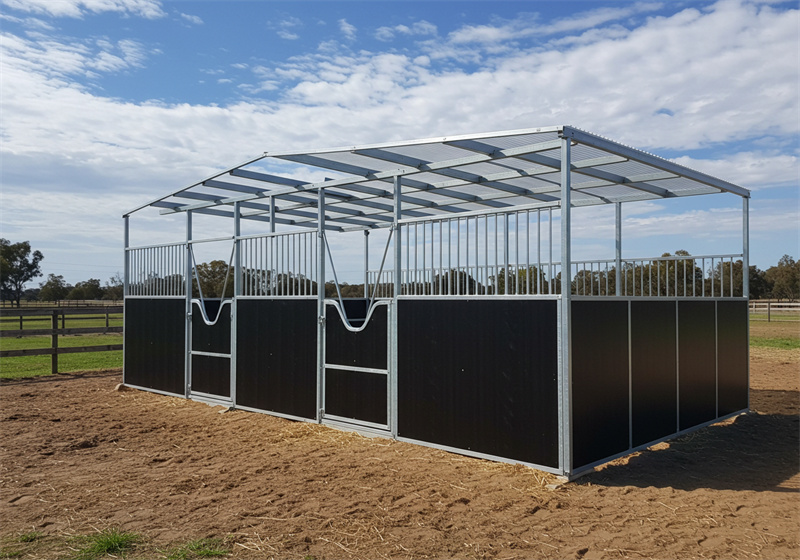
Kit vs Custom Stables: Direct Answer
Factory-engineered modular kits deliver a 40-50% per-stall cost reduction over local custom builds while eliminating the structural liabilities of on-site welding.
Per-Stall Cost Reduction for Large-Scale Breeders
Custom local builds in Australia consistently run $8,000 to $10,000+ per stall once you factor in site delays, trade labor variations, and material markups. Our flat-pack horse stable kits average $4,000 to $4,500 AUD per stall on FOB terms. For a 50-stall expansion, that delta represents $175,000 to $275,000 in capital preserved. Veteran breeders correctly view stables as depreciating agricultural assets. Overcapitalizing on custom fabrication does not increase the asset’s functional output. It simply erodes margin.
Elimination of On-Site Welding Vulnerabilities
This is the critical failure point most breeders overlook when defaulting to local custom welders. On-site welding creates unprotected exposed steel at every joint seam. Post-weld paint application cannot penetrate the heat-affected zones, leaving those junctions vulnerable to ammonia corrosion the moment foaling season begins. Our factory process fabricates the 50x50mm RHS steel frame first, then submerges the entire assembly in a hot-dip galvanization bath exceeding 42 microns in thickness. Every weld seam is fully sealed before the frame leaves the facility. That is the structural difference between a 3-year joint failure and a 10-year warranty.
Standardized Anti-Cribbing Layouts for 50+ Stall Expansions
Custom builders treat every barn expansion as a discrete engineering project. That introduces dimensional drift stall-to-stall, inconsistent grill spacing, and no economy of scale. Our modular system locks anti-cribbing grill spacing to a single factory specification across every unit in a 100+ stall order. For breeders running bulk orders, this standardization allows you to lock in tiered FOB pricing and maintain interchangeable parts inventory. If a grill section takes damage from a stallion, you swap in a factory replacement without custom fabrication lead times.
Optimized Container Shipping Advantages
Fully welded custom structures cannot be containerized efficiently. You are paying for air and awkward freight dimensions. Our flat-pack modular kits are engineered specifically for 40ft High Cube container CBM optimization. The knockdown frame components and 10mm UV-resistant HDPE boards stack to maximize payload utilization per container. For distributors and large breeding operations importing into Australia and New Zealand, this directly reduces the per-stall landed cost and eliminates the specialized rigging required to unload fully assembled structures at regional ports.

Material Specs: Kits vs Custom Welds
Custom welds leave joint seams exposed to ammonia. Factory hot-dip galvanized kits submerge the fully welded frame post-fabrication, sealing every seam at 42+ microns.
Hot-Dip Galvanizing vs On-Site Paint for Ammonia Resistance
Ammonia concentrations in enclosed breeding barns routinely exceed 20 ppm. Standard on-site paint applied by local custom builders degrades at these levels, particularly at welded joints where the coating is thinnest or improperly applied. Our factory process submerges the fully welded frame into a zinc bath after fabrication, coating the internal and external surfaces of every joint at over 42 microns. This eliminates the unprotected steel exposure that local builders inevitably leave at connection points.
Hot-Dip Galvanized Steel (42+ Microns) vs Cold-Rolled RHS Steel
Cold-rolled RHS (Rectangular Hollow Section) steel is the default material for most local custom stable builds in Australia. It arrives unpainted or with a light primer, relying entirely on post-construction site coating for protection. Once a stallion kicks a frame or ammonia eats through a paint seam, corrosion accelerates rapidly from the inside out. Our 50x50mm RHS framing undergoes full hot-dip galvanization after welding, achieving a zinc layer exceeding 42 microns across the entire profile. This delivers a verified 10-year structural lifespan in high-ammonia environments, a specification cold-rolled stock cannot match regardless of how many onsite paint coats are applied.
10mm UV-Resistant HDPE Boards vs Plywood Kickboards
Traditional plywood kickboards are the standard failure point in Australian breeding barns. In high-ammonia environments, plywood absorbs moisture and urea at the grain boundaries, creating a substrate for bacterial colonization. Our kits use 10mm UV-resistant HDPE boards that do not absorb moisture, do not delaminate, and do not suffer from thermal expansion in Australian temperature extremes. Internal testing shows these boards outlast plywood kickboards by 2x in identical ammonia-exposure conditions.
Elimination of Bacterial Harboring and Reduced Mucking Time
Plywood kickboards develop micro-abrasions from hoof contact. These surface pits trap organic matter and become bacterial reservoirs that resist standard pressure washing. HDPE has a non-porous surface that sheds manure and urine with minimal water pressure. For large-scale breeding operations managing 50+ stalls, this translates to measurable reductions in mucking labor per cycle and, critically, lower airborne pathogen loads in foaling sections. Plywood replacement intervals of 3-5 years are eliminated entirely, removing both the material cost and the facility downtime associated with kickboard swaps.
| Component | DB Stable Kit Specs | Custom Weld Specs | TCO & Risk Impact |
|---|---|---|---|
| Frame Corrosion Defense | Hot-dip galvanized >42 microns (submerged post-fabrication) | Standard post-weld paint (exposed seams) | Seals welds from ammonia corrosion; guarantees 10-year structural lifespan without joint failure. |
| Internal Wall Lining | 10mm UV-resistant HDPE boards | Solid plywood kickboards | 2x longevity in high-ammonia barns; prevents bacterial absorption that causes foal respiratory diseases. |
| Primary Framing | 50x50mm RHS steel (factory-engineered modular system) | Uncontrolled on-site welding variables | Withstands stallion kicks without structural fatigue; standardizes layouts for 100+ unit bulk MOQs. |
| Stall Front Hardware | Factory-fitted anti-cribbing grill spacing | On-site fabrication per stall | Zero-defect delivery; eliminates variation risks in equine containment and asset protection. |
| Logistics & Labor | Flat-pack, 40ft HC container CBM optimized, DIY assembly | On-site specialized trade labor required | Cuts total project cost by 20-50%; locks cost-per-stall under $4,500 AUD FOB. |

Hidden Costs in Custom Stable Builds
Custom on-site stable builds consistently blow past initial quotes due to uncontrolled variables like trade scheduling conflicts, material waste, and rework from misaligned components.
Trade Scheduling Conflicts and Labor Overruns
A traditional custom build requires coordinating welders, concreters, and sheet metal workers sequentially. In regional Australian markets, securing these trades adds weeks to the project timeline. Our internal project data indicates that relying on local trades for stable construction typically inflates the total labor budget by 20-50% compared to a flat-pack modular kit installation. You are paying for contractor idle time and scheduling bottlenecks, not actual fabrication.
Revenue Loss from Missed Breeding Windows
For large-scale breeding operations, a stable is a revenue-generating asset, not an aesthetic upgrade. A three-week delay in a custom build directly translates to missed foaling windows or empty boarding stalls. If a commercial breeder charges $30 AUD per day for boarding, a 10-stall facility sitting unfinished for three weeks burns over $6,000 AUD in unrealized revenue. This is a carrying cost that local builders never factor into their $8,000 to $10,000+ per stall estimates.
Material Waste in On-Site Fabrication
On-site welding is structurally and financially inefficient. When a local contractor measures and cuts 50x50mm RHS steel framing on-site, industry-standard waste factors sit between 10% and 15%. You purchase the raw steel, but a significant portion ends up as scrap. Factory-engineered modular kits eliminate this variance entirely. Our frames are precision-cut and factory-welded before being submerged in a hot-dip galvanizing bath exceeding 42 microns. Every millimeter of purchased steel goes into the final structure.
Rework Costs from Unnumbered Components
Custom builders rarely supply a pre-fitted, numbered component matrix. When on-site crews assemble walls, anti-cribbing grilles, and doors from loose parts, misalignment is common. Correcting these assembly errors requires tearing down welded sections or forcing panels, leading to expensive rectification labor and potential structural compromises at the joint seams. Flat-pack kits resolve this by delivering pre-drilled, systematically numbered components that lock together without on-site welding, enforcing zero-defect assembly if the sequence is followed.
| Cost Variable | Custom Build Reality | Kit System Spec | Financial Impact |
|---|---|---|---|
| Base Stall Capital | $8,000 to $10,000+ per stall | $4,000 to $4,500 AUD flat-pack modular unit | 40-55% upfront CAPEX reduction per stall |
| Ammonia Corrosion Control | On-site welding leaves unprotected steel seams prone to rapid rust | >42 micron hot-dip galvanization applied post-fabrication | Eliminates premature joint failure and replacement costs |
| Kickboard Replacement Cycle | Solid plywood absorbs ammonia/bacteria, accelerating foal respiratory risks and rot | 10mm UV-resistant HDPE boards (non-porous, zero thermal expansion) | 2x material longevity with zero biosecurity-related veterinary liabilities |
| Installation Labor | Mandatory reliance on specialized local welders and trade labor | Pre-engineered DIY flat-pack system optimized for 40ft HC containers | 20-50% reduction in total project installation costs |
| Scalability Engineering | Facility expansions treated as isolated engineering jobs with volatile quotes | Standardized modular layouts for 100+ unit MOQs with tiered FOB pricing | Locked-in bulk margins and zero structural redesign fees |
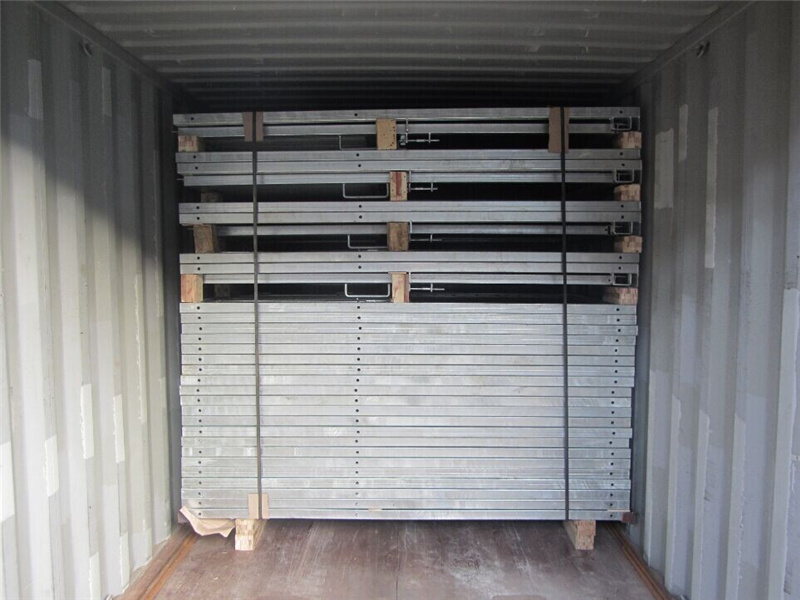
Container Loading Math for Kit Imports
Flat-pack modular kits reduce per-stall shipping volume by up to 70% compared to welded structures, directly driving landed costs below the $5,000 AUD target for bulk imports.
Flat-Pack CBM vs. Welded Dimensions
The baseline math for importing equine housing comes down to volumetric efficiency. A fully welded 3.6m x 3.6m stall front shipped loose occupies roughly 2.5 CBM due to fixed geometry and internal void space. Our factory-engineered modular systems break down into stacked 10mm UV-resistant HDPE boards and 50x50mm RHS galvanized steel framing members. This flat-pack configuration compresses the same stall front to approximately 0.8 CBM. For a 100-unit bulk order, that volume delta represents a 68% reduction in total shipment size.
Stacking Efficiency in 40ft High Cube Containers
Standard 40ft High Cube containers offer 76 CBM of internal capacity, but usable space is dictated by dimensional constraints and stackability. With welded structures, you hit spatial limits rapidly—often maxing out at 8 to 10 units before leaving significant dead air. Flat-pack components behave like standard freight. Our HDPE kickboards and modular grill panels stack uniformly on pallets, while the hot-dip galvanized frame bundles utilize the vertical cube. We consistently load 35 to 40 single-stable kits into a single 40ft HC container by nesting the flat panels and aligning the steel bundles along the container floor.
Lowering Per-Stall Freight Cost Through Space Optimization
- Freight Allocation: Compressing 40 units into a single 40ft HC container drops the per-stall ocean freight to roughly $250–$300 AUD from origin to Australian ports.
- FOB Margin Retention: Lower CBM translates to cheaper FOB quotes, keeping the fully landed kit price in the $4,000–$4,500 AUD range to protect your margins.
- Bulk Scaling Curve: Because volume dictates freight, orders scaling from 20 to 100+ units experience a non-linear drop in per-unit shipping costs.
Importing welded structures introduces unpredictable freight surcharges based on dimensional weight. Flat-pack container loading removes that variability. By treating the stable as a kit of high-specification materials rather than a finished bulky good, we control the logistics chain. This ensures your per-stall landed cost remains strictly within budget, regardless of seasonal shipping rate fluctuations.
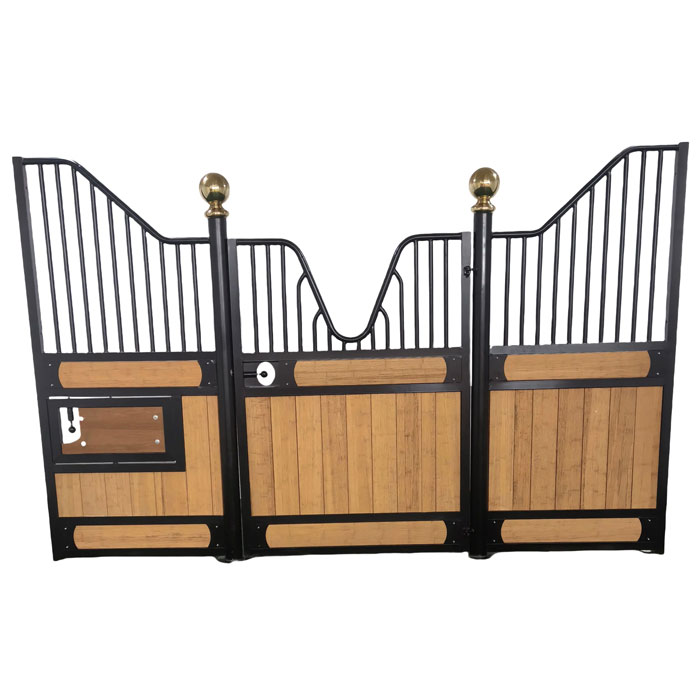
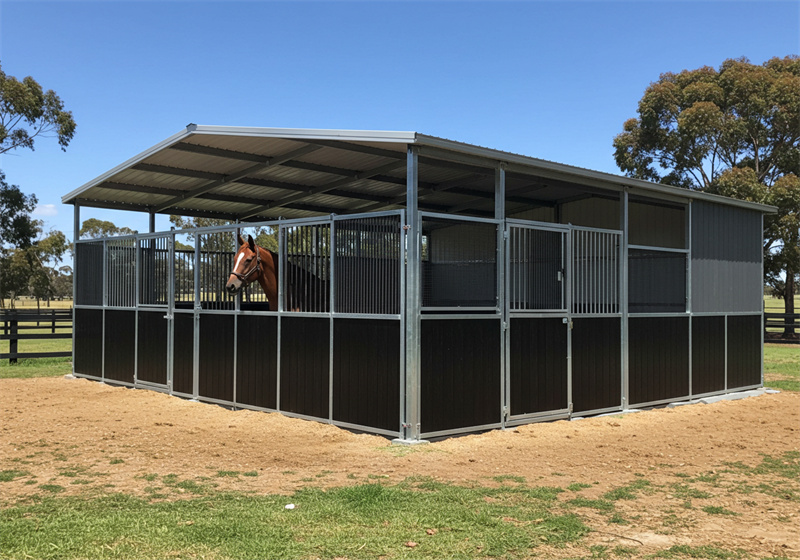
Kit vs Custom Stables: Comparison Data
Factory-engineered flat-pack kits deliver a 45% lower cost-per-stall than local custom builds by eliminating on-site welding variables and standardizing galvanized steel protection.
Per-Stall Cost Breakdown
Local custom builders in Australia consistently bill $8,000 to $10,000+ per stall once specialized trade labor and site prep are factored in. Our factory-engineered modular systems land at $4,000 to $4,500 AUD per stall. For large-scale breeding operations running 100+ units, this delta represents a direct $350,000 to $550,000 reduction in initial capital expenditure. The savings stem from shifting specialized welding labor off the farm and into the factory, leaving on-site work to standard farm hands assembling a flat-pack system.
Steel Protection and Kickboard Lifespans
The critical failure point in breeding barns is not the frame itself, but the joints and the walls. On-site welding leaves structural seams exposed to ammonia-rich urine, accelerating internal rust.
- Steel Frame Protection: Custom builds use post-weld paint that fails at seams. Our factory-welded frames are fully submerged in hot-dip galvanization exceeding 42 microns, sealing welds from ammonia corrosion for a verified 10-year structural lifespan.
- Kickboard Material: Standard plywood absorbs ammonia bacteria and rots within 3 to 5 years. Our 10mm UV-resistant HDPE boards absorb zero moisture and outlast plywood by 2x in active foaling environments.
Modular Scalability vs. Re-Engineering
Expanding a custom-built facility is an operational bottleneck. Local contractors treat every additional row of stables as a new engineering job, requiring fresh site surveys, council variations, and unpredictable pricing. Modular kit systems eliminate this friction. Once a breeder standardizes on a layout, adding 20 or 50 more stalls requires zero new engineering. You simply repeat the flat-pack order. For 100+ unit MOQs, this allows operations to lock in tiered FOB pricing and maintain complete structural uniformity across the entire property.
Production and Lead Time Metrics
Lead time predictability is where custom builds lose control. Scheduling local welders, waiting on raw steel supply, and managing weather-dependent site work routinely pushes custom projects to 2 to 6 months. Factory-engineered kits operate on a strict 4 to 6 week production cycle. The entire 50x50mm RHS steel frame, HDPE panels, and anti-cribbing stall fronts are container-optimized for 40ft High Cube shipments, arriving as a zero-defect delivery ready for immediate deployment.
| Feature | DB Stable Modular Kit Specs | Custom Build Variables | Financial Impact |
|---|---|---|---|
| Cost Per Stall | $4,000 – $4,500 AUD flat-pack | $8,000 – $10,000+ AUD per stall | Up to 55% CapEx reduction; locks in tiered FOB pricing for 100+ unit MOQs |
| Frame Corrosion Resistance | >42 micron hot-dip galvanized (50x50mm RHS), fully submerged post-weld | Standard post-weld paint with unprotected exposed joints | 10-year structural warranty; eliminates rust failure from ammonia corrosion at seams |
| Kickboard Biosecurity | 10mm UV-resistant HDPE boards | Solid plywood kickboards | 2x material lifespan; zero bacterial absorption prevents foal respiratory diseases |
| Labor & Installation | Flat-pack DIY/contractor assembly | Specialized on-site welding and trade labor | Saves 20-50% on total project costs by eliminating variable local trade rates |
| Scalability & Logistics | 40ft High Cube CBM optimized, standardized modular layouts | New engineering job required for every expansion phase | Zero-defect delivery; predictable import logistics and rapid facility scaling |
| Structural Integrity | Factory-controlled specs with anti-cribbing grill spacing | Uncontrolled on-site variables and subjective weld quality | Superior stallion kick resistance; zero risk of blown-out budgets from builder variations |
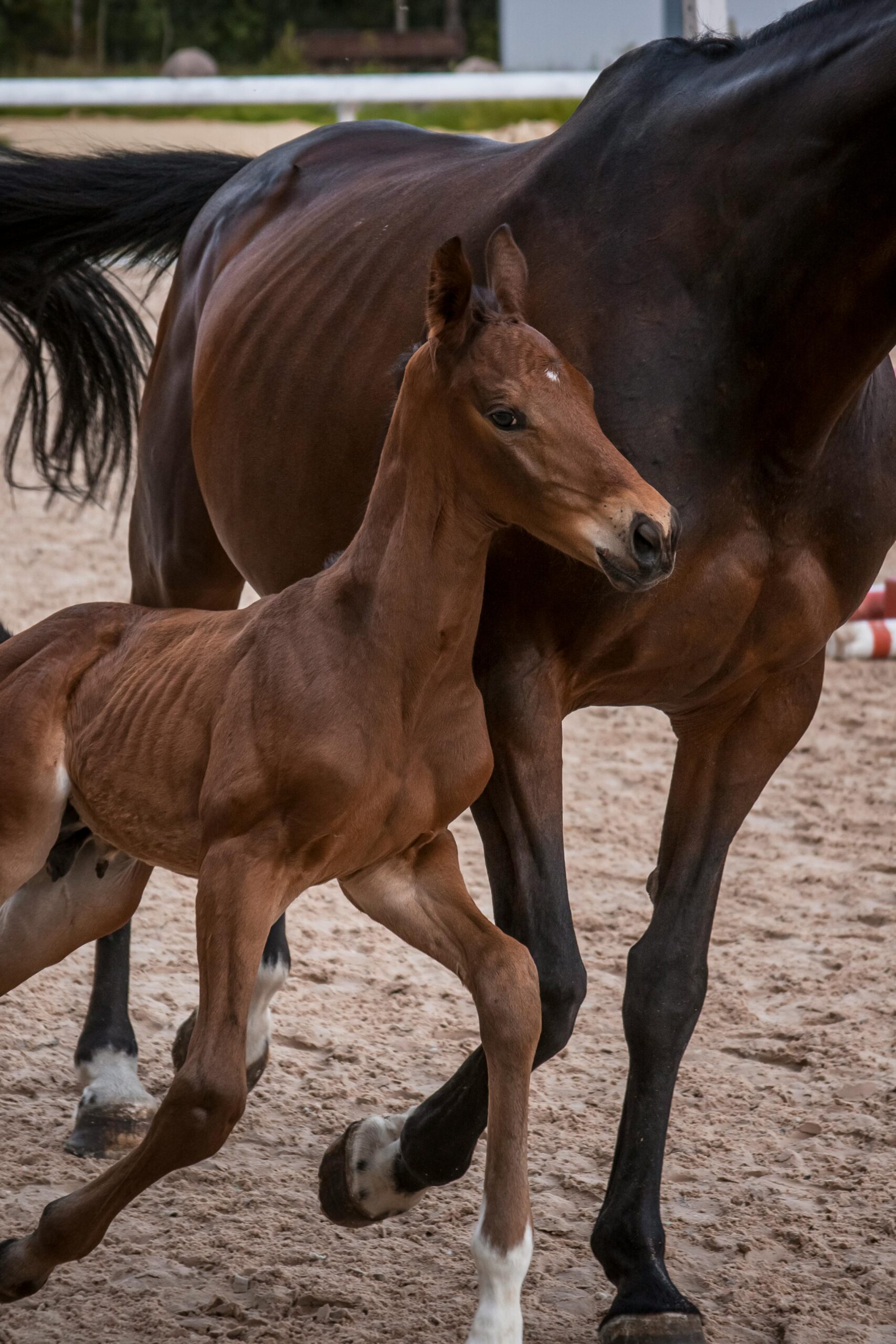
Standard Horse Stable Size Requirements
Breeding facility spatial minimums are not suggestions; undersized stalls directly correlate with foaling injuries and increased veterinary intervention costs.
Strict Spatial Minimums for Breeding Facilities
Standard boarding stables typically run 3.6m x 3.6m. For a commercial breeding operation, that footprint is a liability. A foaling mare requires a significantly larger footprint to safely lie down, roll, and deliver without pinning a foal against a partition. When scaling a modular stable kits foaling barn Australia project, standardizing on these exact dimensions is non-negotiable.
- Minimum Width: 3.6m (allows safe handler passage alongside the mare)
- Minimum Depth: 4.8m (provides critical clearance for foaling and post-foaling rolling)
- Partition Height: 2.4m minimum clearance to the lowest structural obstruction
The 4.8m depth provides the spatial buffer required for handler access during dystocia events without forcing the veterinarian into a corner. Standardizing this footprint across a bulk order ensures consistent biosecurity protocols and predictable container loading configurations.
Safe Accommodation Dimensions for Mares and Foals
The structural framing dictates the usable space within those dimensions. We engineer our factory-welded modular systems using 50x50mm RHS steel framing to span these wider 4.8m openings without requiring mid-span vertical supports. Mid-span posts create blind spots and hoof-catch points during the erratic movement of a mare in labor. A factory-engineered system locks these exact dimensions into repeatable tolerances across a 100+ unit flat pack horse stable kits Australia bulk order, eliminating the on-site measurement drift common with local custom welders.
Preventing Injury and Stress During Foaling
The lower 1.2m of the stall wall is the critical impact zone during foaling. The mare will thrash, and the foal will scramble upright against these surfaces. Using traditional plywood kickboards in this zone creates a biosecurity failure point. Plywood is porous; it absorbs urine and ammonia, fostering bacteria that directly cause foal respiratory diseases. Our factory-engineered modular systems utilize 10mm UV-resistant HDPE boards in the kick zone. This material is non-porous, eliminating bacterial absorption and providing a smooth, seamless surface that prevents skin abrasions when the foal impacts the wall.
In kit vs custom stables Australia comparisons, this material specification is the decisive factor for breeding facilities. Custom builders routinely default to sealed plywood because it is locally available, ignoring the long-term respiratory risk to foals. Specifying 10mm HDPE kickboards on your flat-pack procurement brief removes uncontrolled on-site variables and guarantees a clinically clean foaling environment on delivery.
| Configuration | Dimensions | Material Spec | Bulk Logistics |
|---|---|---|---|
| Standard Breeding Stall | 3.6m x 3.6m (12′ x 12′) | 50x50mm RHS >42µm galvanized frame, 10mm HDPE walls | ~12 kits per 40ft HC container |
| Broodmare / Foaling Stall | 3.6m x 4.8m (12′ x 16′) | Extended anti-cribbing grills, ammonia-resistant HDPE kickboards | ~8 kits per 40ft HC container |
| Stallion Isolation Block | 4.2m x 4.2m (14′ x 14′) | Reinforced fully submerged welds, double-layer HDPE partitions | ~6 kits per 40ft HC container |
| Back-to-Back Quadruple | 14.4m x 3.6m (4-stall module) | Shared HDPE dividers, standardized modular framing | 1 module per 40ft HC container |
| Standard Internal Height | 2.4m to 2.7m (8′ to 9′) | Galvanized roof purlins, UV-resistant HDPE roof sheets | Vertical stacking optimizes CBM capacity |
Stable Base Requirements for Kits
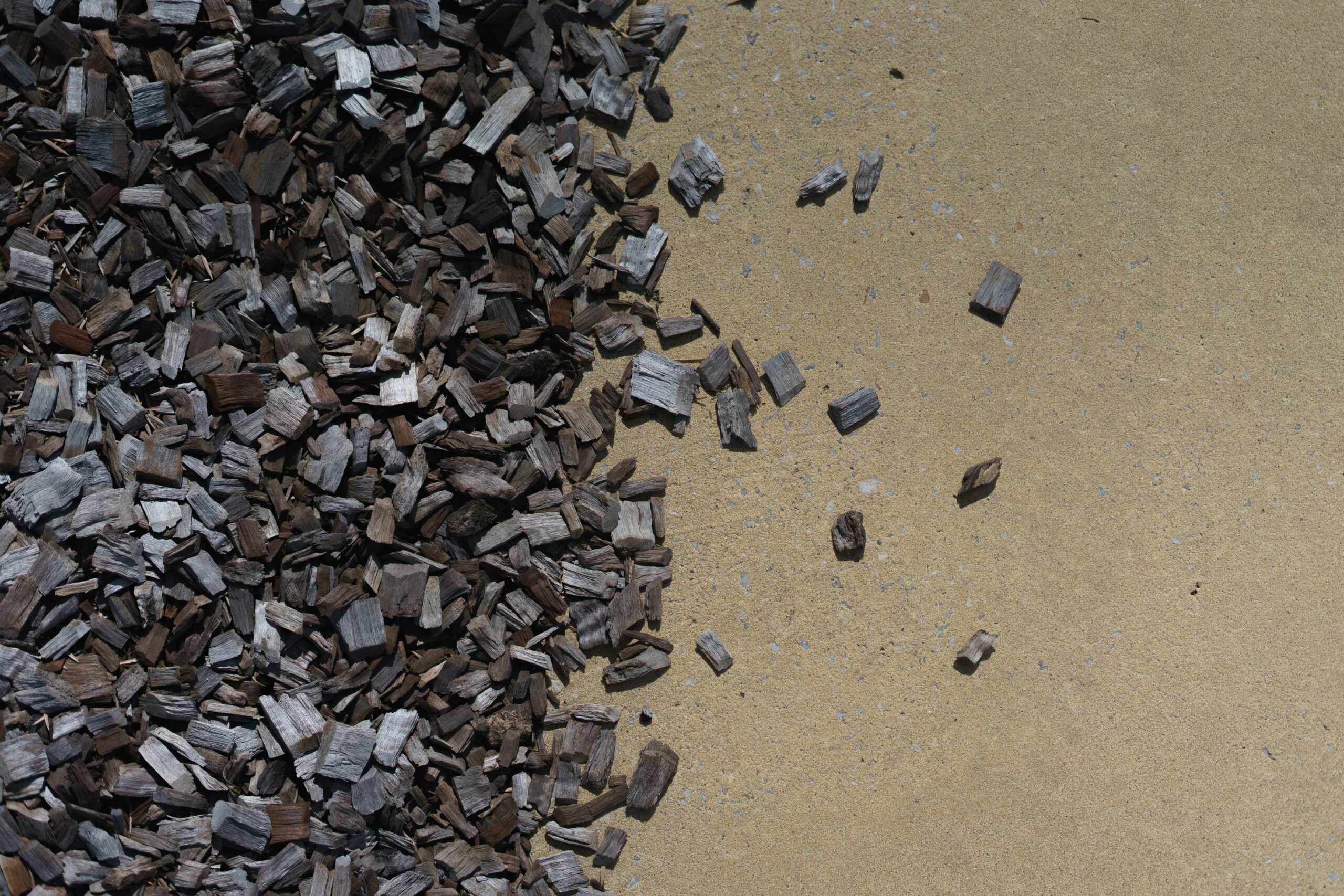
Modular kits bypass deep-poured footings entirely. A compacted crushed rock base with integrated slope drainage handles structural loads while slashing site prep costs by 20-50%.
Foundation Specifications for Modular Kits vs Permanent Structures
Custom-built stables demand reinforced concrete slabs, typically 100mm to 150mm thick with trench mesh, because on-site welders cannot guarantee frame alignment without a perfectly level surface. Factory-engineered modular kits operate on different physics. Our 50x50mm RHS hot-dip galvanized steel frames are cut and welded to exacting tolerances in the factory, meaning the structure self-levels when anchored to a far simpler base.
For flat-pack kit installations across Australia and New Zealand, we specify a compacted crushed rock or gravel base ranging from 75mm to 100mm in depth, topped with a weed mat and compacted road base. This eliminates the need for concrete contractors, curing time, and the variable costs of ready-mix delivery to rural properties. The kit anchors via ground spikes or dynabolts into a perimeter timber or steel edge beam, not a continuous poured slab.
Load Distribution for High-Traffic Breeding Barns
Breeding barns endure concentrated point loads that dwarf standard riding stables. A 600kg stallion rearing and kicking a stall front generates peak impact forces exceeding 4kN at the base plates. Custom on-site builds distribute this poorly because weld integrity at the base plate-to-upright joint is the weakest link, especially when post-weld paint fails and ammonia begins corroding the exposed steel.
Our modular frames distribute vertical and lateral loads across the entire 50x50mm RHS grid through factory-welded hot-dip galvanized joints. Because the entire frame is submerged post-fabrication, the zinc coating exceeds 42 microns even at the internal weld seams. This means the load distribution path remains structurally sound for the full 10-year warranty period, even in high-ammonia foaling environments where custom welded joints typically degrade within 3 to 4 years.
Drainage Requirements
Drainage is the primary defense against foal respiratory issues. Standing urine on concrete creates ammonia concentration zones that plywood kickboards absorb and slowly release. Our 10mm UV-resistant HDPE boards are non-porous and will not absorb moisture, but the base itself must still evacuate liquid fast.
We specify a minimum 1% to 2% fall gradient across the compacted base, directing runoff away from the stable row toward a perimeter drainage channel. For back-to-back quadruple configurations common in breeding operations, a central raised crown with dual-slope fall prevents cross-contamination between stalls. This gravel-based drainage approach costs a fraction of installing ag-pipes beneath a concrete slab and allows facility managers to regrade or expand the layout without demolition.
Conclusion
Stop paying local welders to build uncontrolled on-site variables. Factory-engineered modular kits hit your $5,000 AUD per stall target while eliminating the exposed weld seams that rust out under stallion kicks. That 10mm HDPE specification cuts foal respiratory risk entirely by refusing to absorb ammonia.
Ask your local builder for a 10-year structural warranty on their post-weld paint joints. They won’t sign it. Get a container-optimized FOB quote for a flat-pack test run instead, and compare the delivered cost-per-stall directly against their $8,000 estimate.
Frequently Asked Questions
Is an 8×8 stall big enough for a horse?
An 8×8 foot (2.4m x 2.4m) stall is inadequate for large-scale breeding. It works only for miniature horses or temporary show holding. Standard breeding stalls require a minimum of 3.7m x 3.7m, with 3.7m x 4.9m preferred for mares and foals to prevent injury and allow safe lying down.
What is the best base for stables?
Compacted road base or concrete slabs are best. For flat-pack kit installations, a level compacted base with ground anchors is sufficient and allows for relocation. Concrete is mandatory for permanent custom builds with heavy water usage, but increases initial costs by 30-40%.
What is the standard horse stable size?
The absolute minimum standard size for a professional facility is 3.7m wide by 3.7m deep (12×12 ft). For breeding facilities, 3.7m x 4.9m (12×16 ft) is the preferred standard to accommodate foaling stalls, providing adequate room for staff assistance and vet access.
Which stable can you customize your horse?
Modular kit stables offer functional customization (anti-cribbing grills, sliding vs swing doors, HDPE colors) without the design delays of full custom builds. For breeding operations, prioritize customizing internal safety specs like grill gap spacing over exterior aesthetics.
Do kit stables hold up against cribbing?
Yes, if specified correctly. Standard kits use rounded tubular steel with anti-cribbing grill spacings (typically under 50mm gaps) that prevent horses from getting a bite grip. Unlike wood custom builds, hot-dip galvanized steel and HDPE cannot be chewed through.