Why Supplier Vetting Decides Your Entire Import Project
Buying portable horse stables from a China factory is not a product purchase — it is a supplier decision. The same flat pack kit that performs for ten years in an Australian paddock can become a warranty nightmare if the frame steel is thin, the galvanizing is superficial, or the factory simply stops answering emails after the deposit clears. Before comparing prices, importers, distributors and stable builders need a repeatable vetting process that filters out trading companies posing as manufacturers and factories that cannot document their own quality claims.
This 12-point checklist is written for AU and NZ buyers evaluating a China portable horse stable manufacturer. Each point maps to evidence you can actually request: documents, photos, videos and verifiable specs. Work through it in order — the first six points eliminate most unsuitable suppliers before you spend time on commercial terms.
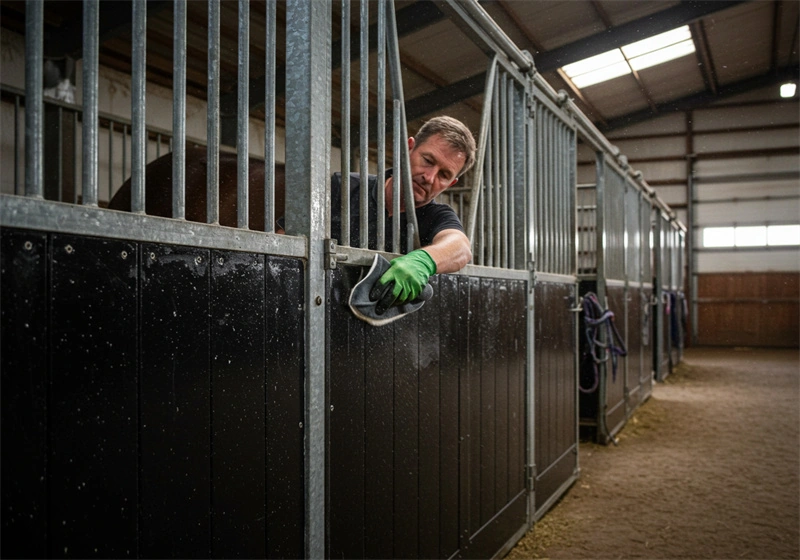
Point 1: Confirm You Are Dealing With a Manufacturer
Ask directly for the factory address and a live video walkthrough. China’s horse stable production is heavily concentrated in Anping, Hebei — a wire mesh and fencing cluster that also produces the welded frames and panels used in portable stabling. A genuine manufacturer can show you welding stations, galvanized stock and finished flat pack kits in the same facility. A trading company will offer factory photos that never quite match, or forward your technical questions to a third party with delays of a day or more.
Point 2: Verify the Frame Steel Grade and Tube Sizes
The industry-standard frame material is Q235 structural steel, typically in 50 x 50mm square tube (RHS), 60 x 30mm oval pipe or 32mm round pipe. Request the mill certificates for the steel batch used in your order. If a supplier cannot state the steel grade or tube wall thickness — 2.0mm walls are common on quality panels — treat the quote as unverifiable. Tube profile matters for load and kick resistance; under-specified frames flex at the joints and fail at the first season of hard use.
Point 3: Demand the Real Galvanizing Specification
“Galvanized” is the most abused word in stable quotes. There is a large durability gap between pre-galvanized tube (a thin factory coating, then spray paint) and true hot-dip galvanizing with a coating thickness of 42 microns or more, applied after welding so every joint is protected. Ask which process is quoted, and ask for coating thickness measured with a gauge on a finished frame. Hot-dip galvanizing executed to AS/NZS 4680 is the specification that matters for AU and NZ environments — including coastal sites where salt-air corrosion eats cheap coatings within two years.
Point 4: Check the HDPE Infill Board Specification
Quality portable stables use 10mm thick high-density polyethylene (HDPE) infill panels — the board that lines the lower walls. HDPE resists rot, does not splinter, flexes to absorb kicks, highly chew-resistant, and withstands UV exposure. Confirm three things: the thickness in writing (some budget kits drop to thinner board), whether the board is UV-stabilised, and the panel dimensions. Common production sizes include 2844 x 1194 x 10mm and 3494 x 1194 x 10mm boards fitted into a welded lower frame.
Point 5: Ask About Production Capacity and Realistic MOQ
A credible factory should state weekly output and a workable minimum order without pressure. For mid-size China stable manufacturers, an MOQ around 10 sets and production capacity in the region of 20 sets per week is a realistic benchmark. Be suspicious of both extremes: no minimum at all often signals a reseller, while inflated MOQs paired with vague lead times signal a factory juggling unrelated product lines. Capacity should also be matched to your schedule — ask how many production weeks stand between your deposit and container loading.
Point 6: Require a Pre-Production Sample Sign-Off
For first orders, insist on a documented sample approval step: the factory photographs or ships a sample panel (frame, welds, HDPE fit, hardware) and mass production only starts after your written approval. This single step prevents the most common import failure — a perfect showroom sample followed by mass production that quietly shifts bolt-hole patterns or material grades. Professional suppliers run a three-stage process: you submit drawings or reference images, receive a solution and quote, then approve before mass production begins.

Point 7: Confirm Third-Party QC Access
Ask whether you can appoint an independent inspection company (or your own agent) to check goods before shipment, at your cost. Factories confident in their welding and galvanizing accept this routinely; those that resist pre-shipment inspection are telling you what the container will look like. A working alternative offered by some manufacturers is a resident third-party QC arrangement during production.
Point 8: Test Response Discipline Before You Pay
Communication speed during the sales cycle predicts service after the deposit. Well-run manufacturers commit to answering enquiries within a few working hours — six hours is a reasonable published standard — and delivering full technical quotes within 24 hours of receiving drawings. Send a technical question that requires checking with the workshop (for example, wind bracing options for a roofed configuration) and time the reply. Evasive or copy-paste answers reveal how future warranty claims will be handled.
Point 9: Review Packaging for Weeks at Sea
Flat pack stables survive ocean freight only if packaged properly: panels stacked and strapped on pallets, corners protected, hardware boxed and labelled, and moisture protection between steel surfaces. Ask for photos of a previous container load and the packing list format. Poor packaging shows up as scratched galvanizing — and every scratch on a hot-dip coating is a future rust site that your customers will find before you do.
Point 10: Match Compliance Documents to the Claim
When a supplier claims ISO or EN compliance, ask which standard, held by whom, and request the certificate number so you can verify it. For galvanizing, the relevant benchmark for AU/NZ projects is hot-dip galvanizing to AS/NZS 4680. Keep the standard distinct from the marketing: a certificate framed on an office wall is not the same as a coating thickness report from your actual production batch.
Point 11: Look for Documented Projects in Your Market
A manufacturer that already exports to Australia and New Zealand has solved problems you have not met yet: quarantine-friendly packaging, container optimisation for flat pack dimensions, and wind-region-appropriate bracing. Ask for project references — for example, multi-stall back-to-back installations delivered to commercial properties — and for the issues that came up during those deliveries. Suppliers who can discuss a real NSW or NZ project in detail have done the work; suppliers who can only recite a product list have not.
Point 12: Agree Payment Terms That Protect Both Sides
Standard practice in this category is a deposit with the balance against shipping documents or after pre-shipment inspection. Structure the payment so the factory stays motivated through loading: deposit to start production, balance released only when the inspection report and packing photos match the approved sample. Put the sample approval, inspection rights and claims window into the proforma invoice — a written agreement on paper beats a friendly chat on WeChat every time.
Run the Checklist Before You Compare Prices
Price per stall only means something after the twelve points above are satisfied — otherwise you are comparing quotes for different products that happen to share a photo. A supplier who passes the full vetting process can back every claim with documents: steel certificates, coating measurements, board specs, sample photos and inspection access. That is the difference between buying a container of panels and buying ten years of quiet, low-maintenance service from your stables.
When you shortlist your next china portable horse stable manufacturer, run this checklist against DB Stable’s portable horse stable manufacturing credentials — factory location, materials, MOQ and process documentation are published in full — or request a quote with your drawings and required specifications.