Relocating an assembled stable sounds like the faster option — roll the structure across the property, drop it, done. Sometimes it is. But on a portable stable built from panels that each weigh about 200kg, the honest answer is that the tool-free corner-pin design often makes knocking the row down the quicker, safer move. The right call depends on distance, ground, roof height and how many hands you have.
This guide works through that decision against DB Stable’s factory specification. The company has manufactured portable stables for Australia and New Zealand since 2013, and the system — 2200mm-high modules in 3.0m and 3.6m lengths, joined by corner pins — was engineered to be struck and rebuilt quickly. Every number below comes from that specification sheet.
Key Takeaways
- Each stable panel weighs about 200kg, so an assembled row concentrates serious mass — relocating it intact needs firm ground, a straight path and enough people or handling gear to control that weight.
- The corner-pin system assembles a stable with 2-3 people in about 30 minutes — which is also the strike-down time, and the reason a short move often goes faster via disassembly.
- The raised steel roof stands 2.65m high, runs 4.6m long and overhangs 70cm at the front eave — check overhead clearance on any route before an assembled move.
- Modules are 3.0m or 3.6m long (4.0m and 4.2m also available) at 2200mm high, and double-module joins mean a “short move” is still several metres of structure.
- Whatever method you choose, re-anchor and re-level at the destination — a stable moved but not anchored is a stable waiting for the next front.
What an Assembled Row Actually Weighs
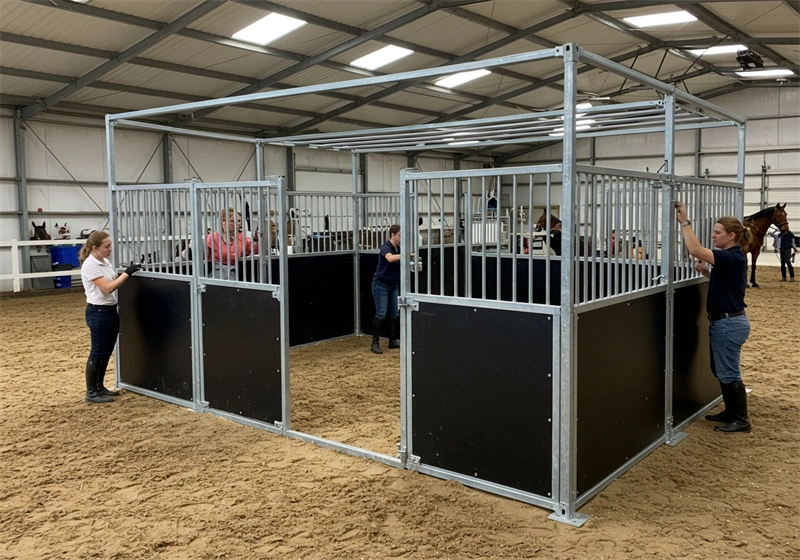
Start with the panel, because everything else follows from it. A stable panel — a 10mm HDPE board, 2844×1194mm or 3494×1194mm, in a 50×50×2.0mm square tube frame — weighs about 200kg. A single-bay stable is 3 side panels plus 1 door. Four of those panels are roughly 800kg of steel and plastic standing on feet, before any roof is counted.
Scale that up and the picture sharpens. A quadruple row is 9 side panels and 4 doors — about 1.8 tonnes of panels alone. Add the optional raised steel roof, which stands 2.65m high and runs 4.6m long with a 70cm front eave overhang, and you are relocating a structure with both mass and sail area. None of this makes an assembled move impossible; it makes an unplanned one dangerous. Weight that gets away from the crew on a slope does not stop for anyone.
The Case for Knocking It Down First
The specification sheet gives the strongest argument for disassembly in one line: a stable assembles with 2-3 people in about 30 minutes using tool-free corner pins. Assembly in half an hour means strike-down in the same order of time — pull the pins, stack the panels, carry them. Panels carried flat by two or three people are controlled load. An assembled row pushed across a paddock is a load that controls you.
Knocking down also protects the joints and the coating. The frame is hot-dip galvanised to a factory specification of 42 microns or more, with the process run to AS/NZS 4680, and dragging or levering an assembled structure across ground puts shear and scrape loads exactly where the zinc is thinnest. Disassembled panels travel as flat, stable stacks; they arrive at the far end with their galvanising intact. The assembly routine itself is covered in our two-person assembly plan, and the same steps run in reverse for a strike.
Our position is blunt: unless the move is short, flat and straight, the 30-minute knock-down beats the afternoon spent wrestling an assembled row. The corner-pin design is the feature you paid for — use it.
When a Short Assembled Move Makes Sense
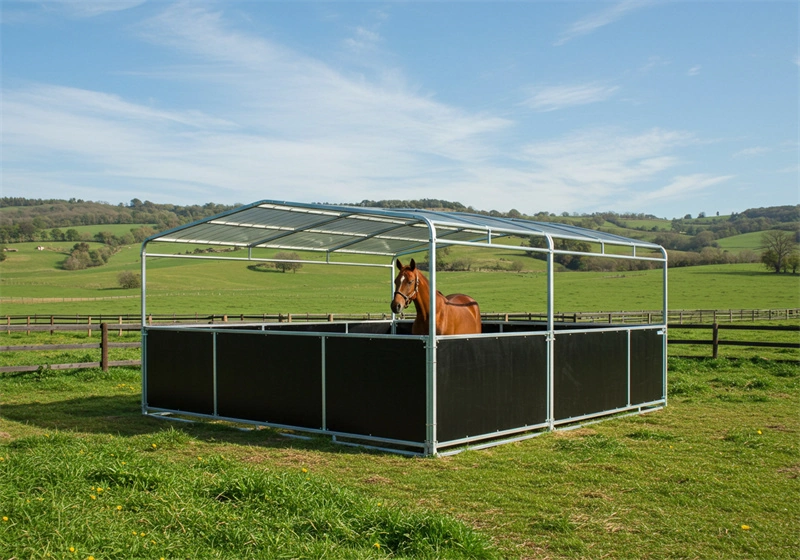
There are legitimate cases for keeping the row together. A shift of a few metres on firm, level ground — rotating a shelter out of a boggy corner, following the shade line across a season — can be done intact if three conditions hold. First, the path: firm and level, with no gates, ditches or livestock to route around. Second, the clearance: remember the 2.65m roof height plus the 70cm eave overhang when the route passes under branches, power lines or shed openings. Third, the crew and gear: enough hands or suitable handling equipment to keep the structure controlled at every point of the move.
Module dimensions set the geometry you are planning around. Lengths run 3.0m and 3.6m as standard, with 4.0m and 4.2m also available, at a uniform 2200mm height; double-module joins extend the run. A stable that stands alone in a paddock — the open-sided shelter style, with no row alignment to preserve — is the easiest candidate for an intact move. If the move fails any of the three conditions above, default back to knock-down; the cost is half an hour.
Preparing Both Ends of the Move
Half of relocating assembled stable structures is the far end. The destination needs to be level, drained and ready before anything moves, because a stable dropped on soft or sloping ground will need lifting again — and lifting is the part that hurts. Walk the new site the day before: check the footprint against the row length you are placing, confirm the ground is firm under every foot position, and plan where the roof orientation puts the 70cm eave overhang relative to weather.
Then anchor. A relocated stable needs the same anchoring assessment as a fresh installation — our guides on anchoring on slopes and storm securing cover the details, and both apply unchanged to a structure on its second or third site. Rebuild or reposition the accessories as you go: feeder, water bowl and tie-up points all come off or swing clear during a move, and each one is a chance to clean and inspect it before it goes back up. Replacement components and the full accessory list are available through the manufacturer.
Frequently Asked Questions
How long does it take to disassemble a portable stable?
About the same as assembly: the tool-free corner-pin system builds a stable with 2-3 people in roughly 30 minutes, and striking it runs the same steps in reverse.
How heavy is a portable stable panel?
About 200kg per panel. A single-bay stable is 3 side panels plus 1 door, so the panel weight alone is in the order of 800kg — plan handling for the delivered weight of the whole row.
What clearance does an assembled stable need when moving?
The raised steel roof stands 2.65m high and the front eave overhangs 70cm, so any route under branches, cables or shed openings needs clearance above 2.65m along the whole path, not just at the start.
Can I move a stable with the roof still attached?
For a short, level move with adequate crew, yes — treat the roof as sail area and check the 2.65m height and 70cm eave overhang against the route. For anything longer, knocking the row down protects the joints and the 42-micron-plus galvanised coating from drag damage.
Conclusion
The relocating assembled stable decision is a weight-and-time calculation: about 200kg per panel against about 30 minutes to strike and rebuild. Short, flat, clear routes can justify an intact move; everything else favours the corner-pin knock-down that the system was designed around.
Whatever you decide, prepare the destination first and finish with anchoring — a move is not complete until the row is level, pinned and tied down on ground that will hold it. Do that, and the same stable will survive its third relocation as well as its first.