Search for anchoring stables slope guidance and most results blur two separate jobs: getting the frame level, and stopping the assembled structure sliding, racking or tipping once it stands. This article deals only with the second job. Our levelling guide for uneven ground covers pads, cut-and-fill and drainage — anchoring is what you do after the box sits plumb, and on a slope it decides whether the structure survives its first storm season.
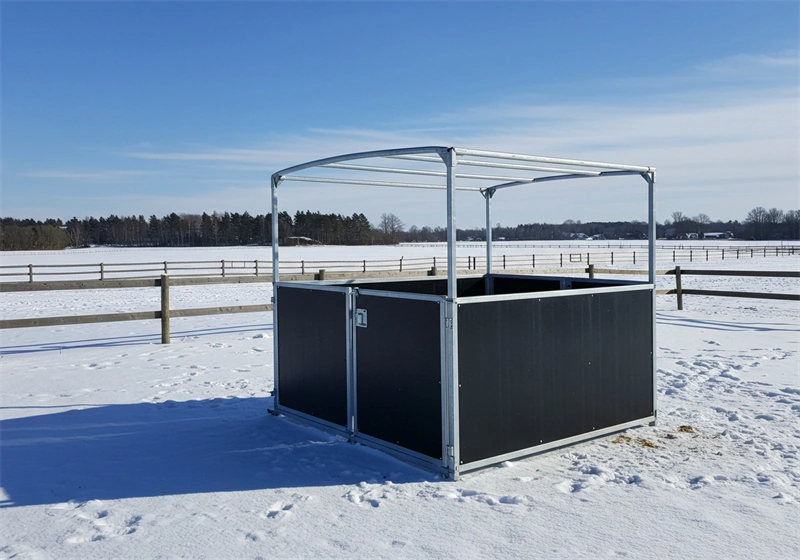
Scale explains why. A DB Stable unit stands 2200mm high on a fully welded Q235 steel frame of 50×50×2.0mm square tube, with 10mm HDPE infill panels at roughly 200kg each. Two or three people assemble a unit in about 30 minutes with the tool-free corner pins — but that fast, relocatable build leaves nothing resisting wind uplift or downhill creep. On a slope, the anchor system is the structural connection between a light steel box and the ground, and deserves the same engineering respect as the frame.
Key Takeaways
- Levelling and anchoring are separate jobs: levelling fixes contact, doors and drainage; anchoring resists sliding, overturning and wind uplift.
- Assess slope, soil and wind region before ordering hardware — the ground decides the method.
- Four routes exist: concrete pads or independent footings, driven ground anchors, ballast, and tying into fence lines or permanent structure.
- AS/NZS 1170.2 sets IL2 design wind speeds from 155 km/h (Region A) to 260 km/h (Region D); sloped terrain reshapes wind, so hill sites need site-specific assessment.
- Use a registered structural engineer for roofed units, steep or filled sites and cyclone-region installs; re-check anchors after storms.
Levelling vs Anchoring: Two Different Jobs
Levelling fixes contact. It stops the frame rocking on high points, keeps doors swinging true and drains water from panel bases. It does nothing to stop the box sliding downhill, racking in wind or lifting off its pads in a gust. A stable can be perfectly level and still move.
Assembly speed works against you: two or three people erect a unit in about 30 minutes with the tool-free corner pins — our two-person stable assembly guide covers the plan. Speed tempts crews to skip anchoring on “temporary” sites. It isn’t optional. Horses lean on walls, storms arrive on schedule, and a 2200mm-high box on a slope is a lever the wind pushes against daily.

Assess the Slope Before You Order Anchors
Anchor hardware is the last thing to order — the site decides the method. Walk it and record four things.
- Fall across the footprint: is the drop from uphill to downhill corners gentle enough for pads, or does it need cut-and-fill and stepped footings?
- Slope direction vs prevailing wind: a slope facing the storm wind behaves differently from one sheltered behind a ridge; the layout should reflect which wall takes the load.
- Soil: clay, sand, rock and imported fill hold anchors differently. Fill is the red flag — solid underfoot, poor holding until compacted and assessed.
- Configuration: single boxes, twin-box units and back-to-back rows share loads differently; a joined row spreads load across more points but shows the wind a bigger face.
Anchoring Methods That Work on Slopes
Four routes cover almost every sloped horse property we supply in Australia and New Zealand. They are not interchangeable: soil, slope, wind region and duration decide the right one.
Concrete pads and independent footings
The most positive fixing. A pad gives every leg a defined bearing point and isolates the frame from ground movement, and independent footings step down the fall instead of chasing it with one slab. Concrete mix, depth and reinforcement are engineering decisions — specified for your site, not a mate’s shed slab.
Driven ground anchors
Fast to install and reversible — suited to a relocatable product. Holding power depends entirely on what the anchor is driven into — firm in clay, it can creep in loose sand. Slopes load the uphill and downhill edges differently, so layout is not symmetric, and that is where a drawing earns its fee.
Ballast
Weight as the fixing. It suits sites where you cannot or should not penetrate the ground — existing concrete, shallow rock, leased land. Position ballast low and spread it across the frame; stacked high against the roofline it raises the centre of gravity and works against you in the very storms you added it for.
Tying into fence lines and permanent structure
Common on horse properties: tie the frame to fence posts, rails or an existing shed so loads share a path into the ground. Legitimate — but a fence post in shallow soil may hold less than a purpose-driven anchor, and the connector becomes load-bearing. Have both checked first.
| Slope situation | Practical route | Who should specify it |
|---|---|---|
| Near-level site, firm soil, unroofed units | Levelling pads plus ballast or light ground anchors | Installation crew, per drawings |
| Gentle slope, stable soil | Levelled pads with ground anchors or small footings | Installer, with builder input |
| Steep slope, fill or soft ground | Independent footings with designed anchorage | Registered structural engineer |
| Roofed units on any slope | Anchorage designed for frame plus roof load | Registered structural engineer |
| Wind Region C or D | Full site-specific wind design, then engineered anchors | Engineer of record, with council sign-off |
When to Bring In a Registered Structural Engineer
Some anchoring decisions sit outside a supplier’s competence — ours included. A manufacturer can confirm the frame: fully welded Q235 steel, 50×50×2.0mm square tube, hot-dip galvanised to AS/NZS 4680, twin-box and multi-stable joining options. Certifying how an anchor performs in your soil, on your slope, in your wind region is licensed engineering work.
Bring in a registered structural engineer — in Queensland an RPEQ (Registered Professional Engineer of Queensland), with state and NZ equivalents — when any of these apply:
- The unit carries a roof: the raised steel roof stands 2.65m with a 70cm front eave overhang — sail area the anchors must react.
- The slope needs stepped footings, or the site sits on fill or soft ground.
- The site falls in a cyclone-affected region — Regions C and D under AS/NZS 1170.2.
- Multiple units join into long rows acting as one body in wind.
- Failure would put horses, people or boundary structures in the fall zone.
Requirements differ between states and councils — confirm what triggers sign-off locally before anything gets poured or driven.
Wind Regions and Slopes Compound Each Other
Wind region is set by location, not negotiation. Under AS/NZS 1170.2 — the joint Australian and New Zealand wind loading standard — most stables fall under Importance Level 2 (IL2), the class for structures where failure carries ordinary consequences. IL2 design speeds run from 155 km/h (Region A) through 188, 220 and 260 km/h (Regions B, C and D). Our wind region and cyclone zone guide breaks them down.
Slope sites change that picture. Hills, crests and valleys reshape wind — a stable on a crest catches faster gusts than one on the flat below; a gully funnels flow into the downhill wall. The standard handles terrain through site-specific factors, so flat-site anchor designs never carry over to hill sites. Ask your engineer to assess your position on the slope, not the region average.
Inspection and Maintenance on Slope Sites
Anchors are wear items; the frame is not. The Q235 frame is fully welded and hot-dip galvanised to AS/NZS 4680, so it shrugs off weather for years — but bolted connections loosen, driven anchors creep, and pads wash out where drainage runs downhill. Put slope installs on a written routine, not memory.
- After every significant storm: check anchor points for movement, new gaps under pads, sight along the frame for racking.
- Each season: retighten connections and clear drainage paths so water stops undermining downhill pads.
- At corrosion hotspots: bolted joints and drilled or cut ends show coating damage first, even on galvanised frames — treat early.
- Keep records: dated photos of anchor points protect you on warranty and liability questions.
Frequently Asked Questions
Can I anchor a portable stable on a slope without concrete?
Sometimes. Ballast or driven anchors can hold unroofed units on firm, near-level ground; the right method depends on soil, slope and wind exposure. Treat any slope beyond gentle levelling as an engineering question.
Do roofed stables need different anchoring on slopes?
Yes. The raised steel roof reaches 2.65m with a 70cm front eave overhang — sail area the anchors must react. Roofed units on any slope deserve a site-specific engineering review.
Which wind regions require an engineer’s sign-off?
Regions C and D — IL2 design speeds of 220 and 260 km/h — typically demand site-specific design. Sloped terrain changes wind in every region, so ask an engineer or your local authority.
How often should I check slope anchors?
After every significant storm and at least each season. Check anchor points for movement, gaps under pads, racking and corrosion at bolted connections, and keep dated photos.
Conclusion
Levelling gets a portable stable standing correctly; anchoring keeps it there through wind, weather and daily horse contact. On sloped AU and NZ sites the two jobs sit in sequence, and the anchor design — not the frame — is where the judgment lives.
If your site drawings show a fall, include them when you enquire. A supplier who reviews slope, configuration and wind region before production flags engineering questions early — that costs an email, not a storm-damaged row of stables.