A live video call is the cheapest inspection tool an importer owns. Before you book flights to Hebei, a walkthrough of a portable horse stable factory tells you within ten minutes whether a supplier deserves a deposit or a polite pass. The camera either shows measurable steel, or it does not.
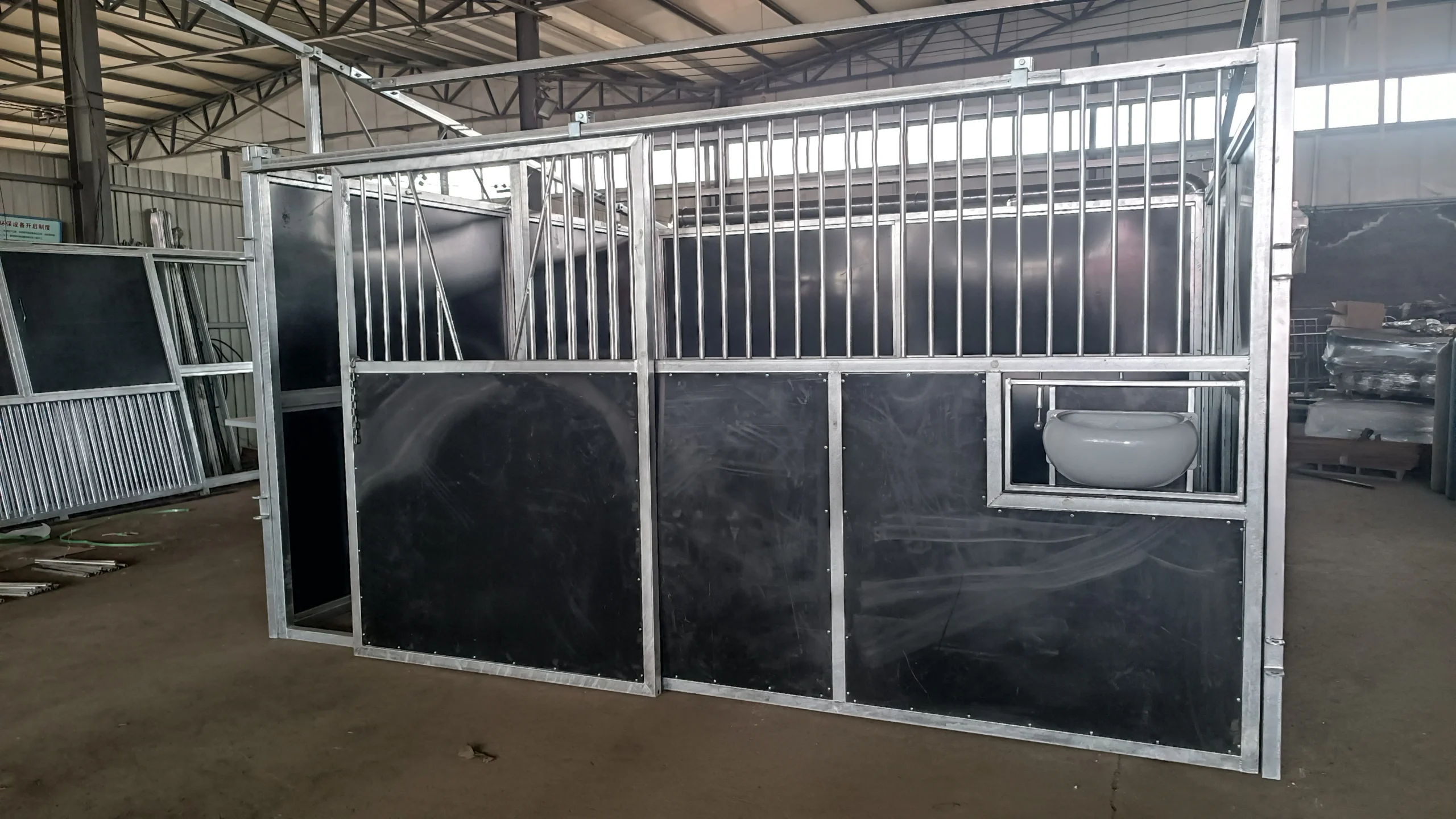
Every number in this article is verifiable through a lens. A stable frame is Q235 steel in 50×50×2.0mm square tube. Hot-dip galvanising should read at least 42 microns on a thickness gauge — our factory specification — with the process run to AS/NZS 4680 (the AU/NZ standard for hot-dip galvanised structural steel). HDPE infill boards should measure a full 10mm thick. A supplier who measures these live is showing you a factory. One who recites them from a brochure is showing you a script.
Key Takeaways
- Video first, travel second: a live call screens out weak suppliers before you spend on flights or an on-site audit.
- Caliper check: frame tube should read 50×50×2.0mm Q235 square steel; 25×25×1.6mm section belongs only on order-department frames.
- Gauge check: hot-dip galvanising should measure at least 42 microns per our factory specification, with the process run to AS/NZS 4680.
- Board check: pull one HDPE sheet and measure 10mm; standard sheets run 2844×1194×10mm or 3494×1194×10mm, about 200kg each.
- Assembly check: a corner pin should drop in with no tools; 2–3 people build one set in about 30 minutes.
- Factory facts: DB Stable in Anping has built portable stables since 2013, producing up to 20 sets per week, MOQ 10 sets.
Why the Video Audit Comes Before the Plane Ticket
A video audit is not a smaller version of an on-site audit, and the two answer different questions. On-site checklists — like our guide to choosing a portable horse stable supplier from China — verify licences, documents, workshop conditions and staffing in person. The video call answers one narrower question first: can this supplier physically measure the product they claim to build?
Treat the call as a screen, not a verdict. It costs an hour and filters out suppliers whose product photos outperform their workshop. If the call passes, fly out for the full audit or, when travel is not practical, commission third-party QC to inspect goods before shipment. Both routes work. The point is that video comes first.
Location raises the stakes. Anping county in Hebei is China’s fence and wire mesh belt, home to a dense mix of real factories, trading companies and workshops that assemble other people’s parts. That density cuts both ways: capable makers, and operators with a showroom and no floor. A live camera separates the two faster than any certificate scan.
What a Live Call Can and Cannot Verify
On a real-time call you can verify anything that sits in front of the lens with a tool on it: wall thickness off calipers, zinc coating off a gauge, weld quality in a close-up, board thickness, mesh wire diameter. Watching a corner connection being assembled exposes fit and finish faster than any spec sheet.
You cannot verify paperwork on a call. A certificate held up to a camera proves nothing — originals need an on-site check or an independent inspector. Nor can you see what sits outside the frame: outsourced welding, a galvanising line an hour away, or working conditions the camera is steered away from.
So structure the call around the machine-verifiable items and leave documents to the physical audit. State this split when you book. A factory that agrees to it has already passed a soft test.
The Shot List: Seven Camera Moves That Count
Send the shot list before the call, in writing. A prepared factory will have calipers, a coating gauge and a tape measure on the bench. An unprepared one burns your first fifteen minutes looking for them — which is itself information.
| Shot | What to look for | Red flag |
|---|---|---|
| Calipers on frame tube | Q235 square tube reads 50×50×2.0mm | “Our specs are standard” with no measurement taken |
| Coating gauge on frame | Hot-dip galvanising reads at least 42 microns per our factory specification; AS/NZS 4680 sets local minima by steel thickness (45μm for 1.5–3mm steel) | Refusal to measure, or a reading far below 42μm |
| Weld close-up | Continuous welds at joints on fully welded frames | Tack welds where the drawing calls for full welds |
| One HDPE board measured | Full 10mm thickness; sheet is 2844×1194mm or 3494×1194mm | A thinner board offered as “close enough” |
| Mesh panel close-up | 4.0mm wire, 50×50mm openings | A panel that flexes visibly when pushed by hand |
| Unbroken line walk | Tube stock, cutting, welding, galvanised frames and packed sets | Finished samples only, no work-in-progress anywhere |
| Corner-pin assembly demo | Pin drops in by hand, no tools; one set builds in about 30 minutes | Hammering, grinding or “persuasion” needed to seat parts |
Between scripted shots, ask for unplanned ones. Ten seconds panning across a random workshop corner tells you more than the scripted minutes, because nobody had time to dress it.
Measuring the Galvanised Coating on Camera
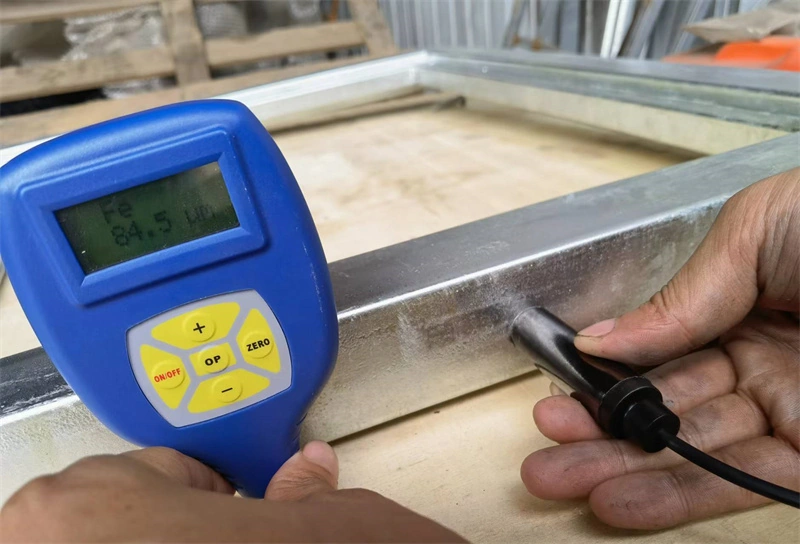
Ask the operator to place a coating thickness gauge — the pen-sized meter that reads the zinc layer in microns — on at least five points of one frame tube, including one weld. Hot-dip galvanising should read at least 42 microns on our factory specification, with the process run to AS/NZS 4680. Small variations across a hot-dip tube are normal. What you cannot accept is a refusal to measure or a reading well under the mark.
Separate the two finishes while the camera runs. True hot-dip frames are dipped after fabrication, so zinc covers welds and tube ends. Pre-galvanised tube with powder coat shows bare metal at cut ends and welds — a legitimate lower-cost option, but not what an AU or NZ coastal property should be invoiced for as hot-dip. Get the distinction in writing after the call.
The Line Walk and the Assembly Demo
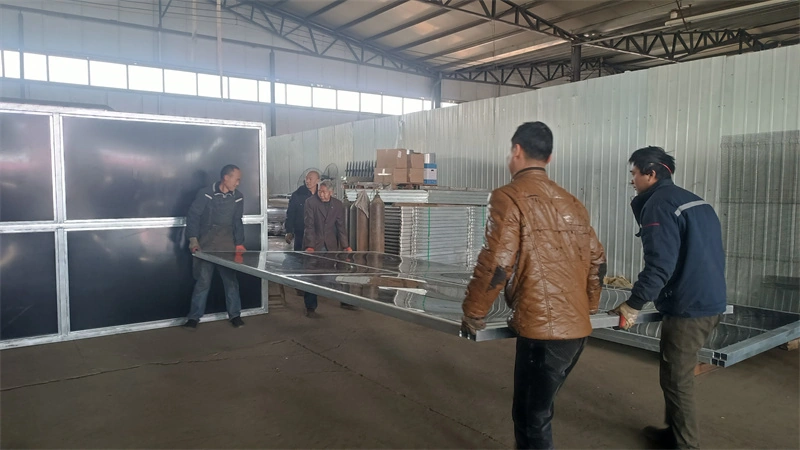
Request one continuous walk, no cuts, from raw tube stock to flat-packed panels. You want to see Q235 tube arriving, frames being cut and welded, and a dispatch area with packed sets. A floor with no work-in-progress is a showroom, not a factory.
Finish with the corner-pin demo. Our portable stables join on tool-free corner pins, and a 2–3 person crew assembles one set in about 30 minutes. Ask them to drop a pin into a frame connection by hand. If you see a hammer, a grinder or any persuasion, the tool-free claim ends there. Ask them to stand beside a front wall too — at 2200mm high, it gives honest scale.
For your own planning, what arrives is a flat-pack kit; our DIY stable kit tool list covers the hand tools your crew needs on delivery day.
Red Flags That End the Call Early
Some failures decide themselves: a “live” tour that turns out to be pre-recorded video, a camera that never leaves the sample room, a salesperson with no engineer present, numbers quoted from memory but never measured, a workshop area “closed today” — the same area, on both calls.
A workshop producing up to 20 sets a week has a floor worth showing. Evasiveness about the camera is a verdict, not a mood.
Watch who runs the camera, too. An engineer who knows the line answers “show me that again” with patience and a second angle; a salesperson answers with a redirect to the catalogue. Refusal to book the call at all is the loudest red flag of the lot.
What a Working Portable Horse Stable Factory Looks Like on Camera
For reference, here is what we at DB Stable can put in front of the lens. We build portable stables in Anping and have done so since 2013, on engineering experience that dates to 2009. Output runs up to 20 sets per week, minimum order 10 sets — a volume a genuine workshop floor absorbs without drama.
The service side is measurable too: enquiries answered within 6 hours, drawings quoted within 24, and third-party QC resident inspection on request. If a call with us is on your shortlist, send the shot list — the calipers will be ready.
Frequently Asked Questions
Is a video audit as reliable as an on-site factory audit?
No. A video call verifies measurable specs — tube walls, coatings, board thickness — but not documents or what sits outside the frame. Pair a passed call with an on-site visit or third-party QC before paying a deposit.
What tools should the factory hold up on camera?
Digital calipers, a coating thickness gauge and a tape measure, applied to the actual product live. If measurements come from a brochure instead of the lens, end the call.
What coating reading should I accept on galvanised frames?
At least 42 microns — our factory specification. Ask for readings at five or more points on the same tube, including over a weld.
Can a video audit replace third-party QC inspection?
No. The call screens the supplier; third-party QC verifies the goods. Ask your supplier to allow resident inspection before shipment — at DB Stable it is available on request.
What if the supplier refuses a live video walkthrough?
Treat refusal as the answer. A workshop building up to 20 sets a week has a floor worth showing, and a supplier who will not show it has told you what a visit would find.
Conclusion
A video audit will not replace boots on the floor or an independent inspector, and it is not meant to. Its job is to eliminate weak suppliers early and confirm the measurable specs — 2.0mm tube walls, 42-micron coatings, 10mm HDPE boards — before you commit a dollar to travel. Run it with a written shot list, unscripted follow-ups and a gauge in frame, and it becomes the highest-value hour in your sourcing process.
If you are comparing suppliers for an AU or NZ programme, start with our portable horse stable manufacturer page, then book the call and send the shot list. The calipers will be ready.