Every stable quote that leaves our factory for Australia or New Zealand starts with one question back to the buyer: what wind region is your site in? Matching the stable specification to that region — the core of every wind region horse stables decision — is not optional paperwork. AS/NZS 1170.2, the structural wind actions standard used across both countries, splits Australia into four wind regions, and the difference between them is the difference between a stable that weathers a decade of fronts and one that folds in its first cyclone season. The same standard frames how New Zealand sites are assessed for wind exposure.
This guide explains what regions A to D actually mean, where each one sits on the map, and how the region you are building in should change the stable configuration you order — frame specification, roof choice and how the unit is fixed down. It is written for importers, distributors and stable builders who specify equipment for sites they may never have visited.
Key takeaways
- Four regions, four wind climates: AS/NZS 1170.2:2021 defines Region A (normal, up to about 155 km/h), Region B (intermediate, about 188 km/h), Region C (cyclonic, about 220 km/h) and Region D (severe cyclonic, about 260 km/h) for importance level 2 structures.
- Cyclonic means different physics: in Regions C and D the design wind speed is not just higher — the loading includes cyclone gust behaviour, which punishes anything with a large unbraced surface.
- Roofed configurations are the exposure lever: a roof turns a stable from a wind-permeable frame into a sail; the raised roof option at 2.65 m adds height and uplift area.
- Frame specification is the baseline: DB Stable frames are fully welded Q235 steel — 50×50×2.0 mm square tube on panel frames — hot-dip galvanised to at least 42 microns.
- Match the certification to the site: for exposed cyclone-zone sites, ask for engineering documentation for your exact configuration, not a generic brochure claim.
What wind regions actually measure
A wind region is a mapped zone used by AS/NZS 1170.2 — the joint Australian and New Zealand standard for wind actions on structures — to set the design wind speed a structure must survive. The figures below are the ultimate design wind speeds for an importance level 2 structure on typical open terrain, the class most farm and commercial buildings fall under. They are planning figures: the final design speed for your site also depends on terrain, topography and shield.
| Region | Character | Ultimate design wind speed (IL2) | What it means for a stable |
|---|---|---|---|
| A | Normal, non-cyclonic | Up to ~155 km/h | Standard configurations; fixing detail still matters |
| B | Intermediate | Up to ~188 km/h | Transitional zone; treat exposed sites conservatively |
| C | Cyclonic | Up to ~220 km/h | Engineered configurations and positive fixing required |
| D | Severe cyclonic | Up to ~260 km/h | The most demanding zone in Australia; site-specific engineering |
The jump from A to D is not linear. A Region D design speed is roughly 1.7 times Region A, and wind pressure scales with the square of speed — so the force on the same panel can approach three times the Region A load. That is why a stable that stands quietly in Victoria can fail in the Pilbara with no change in workmanship.


Where each region sits on the map
Region A covers most of the Australian continent, including the southern capitals and inland areas where severe storms occur but tropical cyclones do not. Region B is a transitional band around parts of the coastline that sit outside the main cyclone belts but still see stronger storm winds. Region C runs along the cyclone-prone northern coasts — the Queensland coast north of roughly Bundaberg, the Western Australian coast north of around Carnarvon, and coastal areas of the Northern Territory. Region D is reserved for the most severe exposures, including the Pilbara and Top End coastal strips where Australia’s strongest cyclones make landfall.
Two practical cautions for buyers. First, region boundaries follow coastlines and latitude lines, not postcode logic — a property a short distance inland from a Region C coast can sit in Region A. Second, New Zealand is not mapped into lettered cyclone regions the same way, but the same standard’s wind actions method applies, and exposed NZ sites — coastal hill country, Canterbury nor’wester belts — deserve the same conservative thinking. Queensland buyers should also read our companion article on cyclone-rated stables and RPEQ compliance, since Queensland’s engineering certification requirements can add a second layer on top of the wind region question.
Translating a region into a stable specification
Wind region does not change the core frame material — it changes what you ask the frame to carry and how you hold it down. DB Stable panels are built on fully welded Q235 steel frames using 50×50×2.0 mm square tube for panel frames, with 60×30 mm oval and 32 mm round tube on other members, hot-dip galvanised to AS/NZS 4680 at 42 microns or more. Fully welded joints matter in wind: every joint that is welded rather than bolted is one fewer point that can work loose under cyclic gust loading.
For Region A and B sites, standard configurations with the bay heights and lengths we build (2200 mm frame height, 3000 mm or 3600 mm module lengths) are the common order. As you move into Region C, the specification conversation should cover three things: whether the configuration includes a roof, how the unit is fixed to the ground, and whether the site is on exposed terrain that attracts topographic speed-up. Our portable horse stable manufacturing team quotes to your site parameters rather than a one-size spec sheet, and wind region is the first parameter we ask for.
Roof options and uplift: the biggest decision
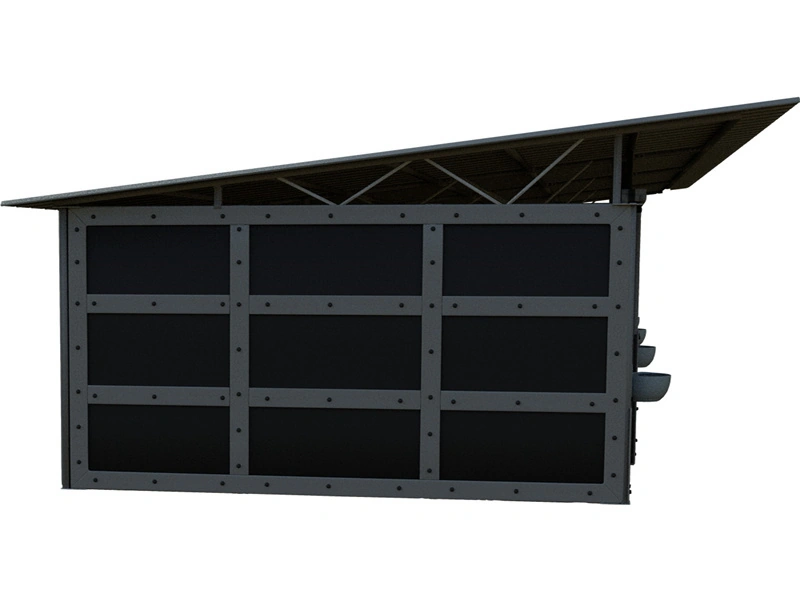
A roofless stable is mostly frame and HDPE infill, and wind largely passes through and around it. Adding a roof changes the structure’s relationship with wind completely: the roof plane collects uplift, and the whole assembly must resist it. DB Stable offers a Colorbond roof option, a raised steel roof at 2.65 m with 4.6 m length and a 70 cm front-eave overhang. Each of those is a comfort feature in Region A and a load calculation in Region C.
The overhang deserves a specific note. A 70 cm eave overhang improves weather protection for the horse standing at the front of the bay, but it also presents a larger lever arm for uplift at the frame’s weakest point. In cyclone zones, the practical options are usually to reduce the roof span, add intermediate supports, or fix the assembled structure to prepared footings. None of these are exotic demands — but they need to be in the order, not improvised after delivery.
Fixing down: exposure is local
Wind region sets the regional baseline; the site sets the rest. The same Region C rating applies to a stable tucked behind a shelterbelt and to one standing alone on a cleared ridge — but the loads they see in a real front are very different. AS/NZS 1170.2 adjusts for terrain category, topography and shielding, and those adjustments routinely move the effective load more than one region step.
For portable stables the practical takeaways are simple. Prefer sheltered placements where the site allows. Ask what fixing method suits the surface — level slab, compacted ground or posts — before the container ships, so the right hardware is on site. And for any roofed multi-bay block in a cyclone region, get the fixing detail reviewed by someone qualified to sign off on it for your location. A stable that sits on the ground under its own weight is fine for many Region A sites; that assumption does not survive a severe cyclone crossing.
Five specification questions that settle it
- What is the site’s wind region? Name it on the enquiry — A, B, C, D or an NZ site description — so the factory can quote the right configuration the first time.
- What terrain surrounds the pad? Open paddock, ridge, coastal frontage or shielded by structures and trees changes the effective load.
- Roof or open configuration? Roofless bays minimise wind exposure; roofed blocks maximise horse comfort and uplift at the same time.
- How will the unit be fixed? Surface, footing type and hardware should be decided before shipping, not during unloading.
- What documentation does the site need? Some councils and insurers in cyclone regions ask for engineering evidence for the exact configuration — confirm before you order.
One observation from the quoting desk: buyers who know their wind region almost always end up with a better specification than buyers who discover it after delivery. The question costs nothing to answer and prevents the most expensive class of after-the-fact changes. If you are comparing several suppliers, our 12-point supplier vetting checklist includes the wind and engineering questions worth asking each of them.
Frequently Asked Questions
Does New Zealand use the same A to D wind regions?
No. The lettered A–D region map is the Australian part of AS/NZS 1170.2. New Zealand sites are assessed under the same standard’s wind actions method with its own zone and terrain factors, so give your supplier a site description and location rather than a region letter.
Can a portable stable be used in Region C or D at all?
Yes, with conditions. The configuration, roof choice, fixing method and site exposure all need to suit the region, and exposed cyclone-zone sites should have the specific configuration reviewed by a suitably qualified engineer before installation.
Is a roof a bad idea in a cyclone zone?
Not necessarily, but it is the component that changes the wind calculation most. Roofed configurations need deliberate fixing and, in Regions C and D, usually a review of the roof structure and footing plan for the site.
How do I find my site’s wind region?
Wind region maps based on AS/NZS 1170.2 are published by engineering bodies and shelter suppliers, but the reliable route is to confirm with a local engineer or your council, who can also account for terrain and topography at your exact pad.
Conclusion
Wind region is the one site parameter that quietly shapes every other specification decision — frame configuration, roof, fixing and documentation. Regions A and B reward standard builds done well; Regions C and D reward buyers who front-load the engineering conversation. Either way, the answer belongs in your enquiry, because it is the cheapest input in the whole project and the most expensive to retrofit.
Before your next order, confirm the region and terrain at the pad, decide the roof question deliberately, and ask your supplier what fixing plan suits the surface. Those three answers put you ahead of most of the market.