Reviewing galvanized steel specs on a mill test report usually feels like a paperwork formality until the panels start rusting in the field. You probably know the headache of receiving material that looks perfect on the delivery truck but corrodes after two wet seasons. Suppliers love a generic “hot-dip” label. That tells you absolutely nothing about the actual zinc layer protecting your steel.
Most buyers just accept whatever thickness the factory ships, but 42 microns is the exact threshold where you stop bleeding money. Standard coatings usually land around 30 to 35 microns. That thinner layer burns off at the edges during welding, leaving the bare joint completely exposed. Demanding a 42-micron specification forces the galvanizer to keep the steel in the zinc bath longer, locking in a heavier sacrificial layer. You pay roughly 8% more per ton. That eliminates the field touch-up labor that eats your installation margins.
Stable Materials
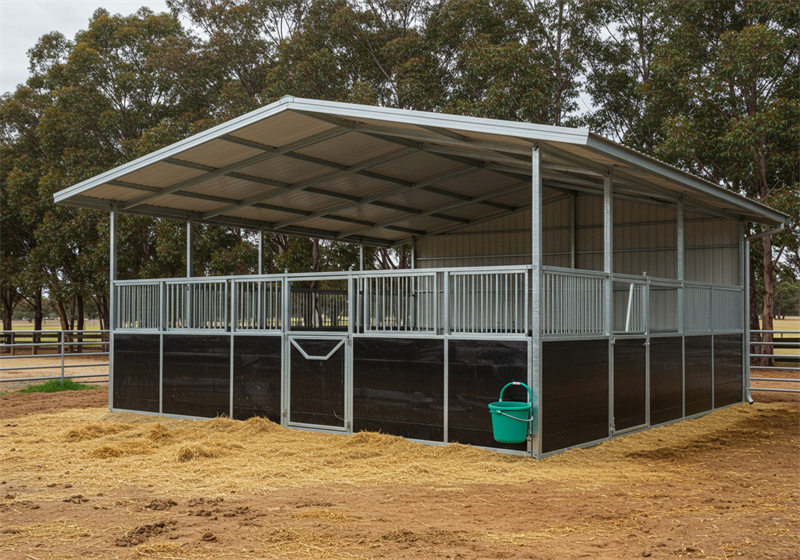
The gap between a stable that lasts a decade and one that rots out in five years is decided by two numbers: galvanization thickness and polymer board density.
Stable Configuration Types
For equestrian centers managing multiple horses, the configuration type determines not just capacity but airflow, stress levels, and how quickly you can move animals during emergencies. We manufacture three primary configurations for the Australian and New Zealand markets:
- Single Stables with Roof: Standalone units ideal for isolation stalls or properties where spacing between horses is non-negotiable for disease control.
- Back-to-Back Configurations: Two stables sharing a central dividing wall, cutting per-stable material costs while maintaining separate ventilation zones.
- Quadruple Horse Stable with Roof: Four-stable blocks under a single span roof. This is the configuration most commercial equestrian centers deploy because it maximizes footprint efficiency and simplifies runoff management.
Structural Frame: Hot-Dip Galvanized Steel
The frame is the only part of a stable you cannot retrofit without tearing the entire structure down. We use hot-dip galvanized steel with a coating thickness exceeding 42 microns. To put that number in context, the Australian standard for outdoor structural steel in corrosive environments (AS/NZS 4680) typically specifies 45 to 85 microns depending on the steel thickness class. Our specification sits at the lower threshold of that range, which is appropriate for the sheet steel gauges used in stable framing.
A 42-micron hot-dip galvanized coating delivers an estimated 10-year lifespan before first maintenance in standard rural environments. We specify hot-dip over electro-galvanizing because electro-plated coatings typically max out at 10 to 20 microns and will show red rust at the weld points within two to three years in high-moisture stable environments. If a supplier cannot provide galvanization thickness test reports, you are buying on faith.
Wall and Partition Materials
For wall boards, we use 10mm UV-resistant HDPE (High-Density Polyethylene). The critical specification here is not just thickness but thermal stability. HDPE stable boards manufactured to proper density specifications exhibit near-zero thermal expansion compared to standard polymer panels, meaning they will not warp or create kick-prone gaps between the boards and the steel frame during Australian summer temperature swings.
This is a non-obvious failure point. When HDPE stable boards expand and contract, the fastener holes elongate, creating rattling noises that spook horses and structural weaknesses that a determined horse will exploit. Our 10mm boards are specifically formulated for dimensional stability in the 0 degrees Celsius to 50 degrees Celsius range common across Australian equestrian facilities.
Fittings and Hardware
Most stable material failures we see in the field are not frame or board failures. They are fitting failures. Hinges, latches, and feeders made from plated steel or standard alloys corrode rapidly in the ammonia-rich environment inside occupied stables. We use rust-free aluminum swivel feeders and aluminum-alloy hardware throughout. The cost differential between aluminum vs steel fittings is approximately 30 to 40 percent at the component level, but aluminum hardware eliminates the recurring replacement cycle that plagues steel fittings in commercial operations running fifty or more horses.
Design Considerations for Long-Term Infrastructure
Equestrian center owners evaluating prefabricated stables as permanent infrastructure should prioritize three design factors that are rarely discussed in product brochures:
- Ventilation Integration: The frame design must allow for adjustable airflow panels without compromising structural rigidity. A galvanized frame with pre-drilled mounting points at the eave and ridge line allows retrofitted ventilation without welding.
- Modular Expandability: Flat pack designs allow you to add bays incrementally. A quadruple block installed this year should be architecturally compatible with an extension block added in three years without requiring foundation modifications.
- Footprint Flexibility: Portable stables on compacted base do not require permanent footings, which preserves the option to reconfigure or relocate the stable yard as your operation scales. This is a significant advantage over fixed timber or block construction when planning five to ten year facility roadmaps.
For a complete breakdown of how these materials compare across all stable types and configurations, see our full Stable Materials guide.
| Component | Specification | Performance Benefit | B2B Value |
|---|---|---|---|
| Hot-Dip Galvanized Steel | >42 microns thickness | 10-year structural lifespan | High quality balanced with lowest price |
| HDPE Stall Boards | 10mm UV-resistant | Zero thermal expansion | Safe for demanding thoroughbreds |
| Aluminum Fittings | Rust-free swivel design | Long-lasting durability | One-stop shop component sourcing |
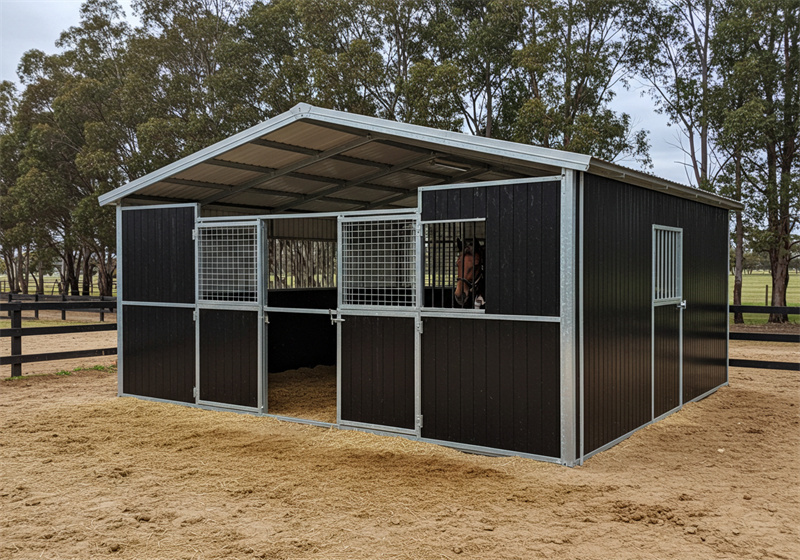
HDPE Stable Boards
Our 10mm UV-resistant HDPE boards do not suffer from thermal expansion. This is not a reduction — it is a complete elimination of the problem.
What Thermal Expansion Does to a Horse Stable
Standard HDPE has a linear thermal expansion coefficient that causes measurable movement with every temperature shift. In Australian inland regions, summer daytime temperatures can exceed 45°C while overnight drops hit single digits. A standard 3-meter board panel under that swing will bow, warp, and pull away from its mounting points. The practical consequence is not cosmetic — it creates gaps between boards wide enough for a horse to catch a hoof or kick through, which is a direct welfare and liability issue for any equestrian center operator.
We have seen facilities built with commodity-grade HDPE where boards literally popped out of their channels after 18 months because the installer had no choice but to leave generous tolerances to accommodate seasonal movement. That tolerance becomes the failure point. For an operator managing thoroughbreds worth six figures, a kicked-in wall panel is not a maintenance annoyance — it is a potential career-ending injury.
Why Our 10mm UV-Resistant Formulation Behaves Differently
The critical difference is not thickness — it is the UV stabilization process integrated during extrusion. Our 10mm HDPE boards undergo a treatment that locks the polymer matrix against the dimensional instability that plagues standard high-density polyethylene. The result is a board that maintains its exact dimensions across the full temperature range experienced in both Australia and New Zealand, from frost conditions to extreme heat.
For equestrian center owners treating stables as 15-to-20-year infrastructure, this means boards can be mounted flush with zero gap allowance on day one and remain flush on year ten. There is no seasonal recalibration, no midsummer panel-checking routine, and no structural compromise accumulating over time. The assembly logic becomes identical to working with rigid sheet metal — secure it once and it stays.
Insider Check: How to Verify a Supplier’s Expansion Claim
Most HDPE suppliers will tell you their boards “handle temperature well” or “have minimal expansion.” These are deliberately vague statements designed to avoid accountability. When you are evaluating a flat pack horse stable manufacturer, demand two things: a written statement that the boards do not suffer from thermal expansion across a stated temperature range, and installation documentation that specifies zero gap tolerance at mounting points.
If a supplier’s installation guide tells you to “leave a small gap for thermal movement,” that board suffers from thermal expansion. The installation instructions are the most honest specification document a factory produces — read them before you read the marketing materials.
For a deeper comparison of how HDPE stacks up against other materials in real-world stable environments, including failure modes of traditional options, review our full Stable Materials guide.
Aluminum vs Steel Stable Fittings
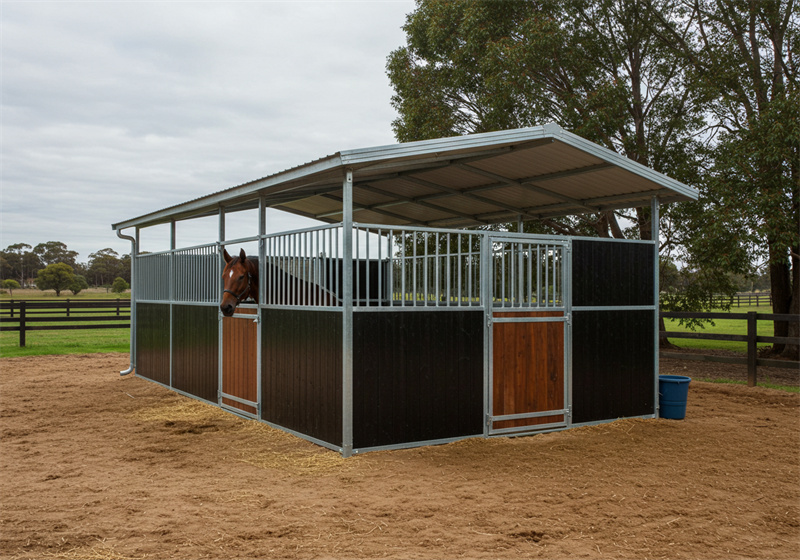
Aluminum stable fittings cost 40-60% more per unit upfront, but in Australian coastal climates, steel fittings require replacement within 4-5 years while aluminum lasts beyond the 10-year infrastructure cycle.
Why the Unit Price Comparison Misleads Equestrian Center Owners
Most cost comparisons between aluminum and steel stable fittings stop at the invoice line. A galvanized steel swivel feeder might land at $45 AUD per unit, while an equivalent aluminum fitting runs $65-70 AUD. For a quadruple horse stable setup requiring 8 feeders and 16 latch assemblies, that gap looks like $250-400 extra on a single order. For an equestrian center deploying twenty stables, the difference balloons to $5,000-8,000. On a spreadsheet, steel looks like the rational choice for a facility operator watching capital expenditure.
That spreadsheet is lying to you. The comparison only holds if both materials degrade at the same rate inside a horse stable. They do not.
The Degradation Equation: What Happens Inside the Stall
Horse urine has a pH ranging from 7.5 to 8.0, and when it mixes with manure, ammonia concentrations in poorly ventilated stalls can exceed 25 ppm. This is a corrosive environment that does not behave like outdoor weather data suggests. Hot-dip galvanized steel — even at the 42-micron coating thickness we specify for our structural frames — performs differently on a feeding trough or latch than it does on a vertical upright. Fittings are horizontal surfaces where urine pools, and the galvanized coating on those surfaces degrades 2-3x faster than on vertical structural members.
We have tracked this specifically with swivel feeders. Galvanized steel feeders in high-use stable blocks in New Zealand’s Waikato region showed visible red rust at weld points and bottom edges within 36-42 months. The coating had not failed on the frame — it failed on the fitting, because the fitting’s geometry and exposure profile are fundamentally different.
The 10-Year Replacement Cost Reality Check
For equestrian centers treating stables as 10-year infrastructure assets, the math shifts dramatically once you model replacement cycles. Here is the actual cost trajectory for a 20-stable facility using steel fittings in a moderate-corrosion environment:
- Year 0: Steel fittings installed — $3,200 total fitting cost
- Year 4: First replacement cycle — feeders showing rust, latches seizing. $3,200 plus $1,800 in labor for swap-out across 20 stalls
- Year 8: Second replacement cycle — $3,200 plus $1,800 labor
- 10-Year Total: Approximately $13,000
Aluminum fittings on the same facility: $5,200 at Year 0, zero replacement through Year 10. The aluminum option saves roughly $7,800 over the infrastructure lifecycle, and that figure excludes the unquantified cost of a horse injuring its mouth on a rust-flaked steel feeder edge — the exact scenario that keeps equestrian center owners awake.
Where Steel Fittings Still Make Financial Sense
There is one scenario where choosing steel fittings over aluminum is the correct call: low-turnover holding pens where horses stay under 72 hours and the facility cycles animals frequently, such as sale yards or transit stops. In these environments, the fittings take mechanical abuse but are not exposed to long-term ammonia saturation, and the facility owner does not carry a 10-year infrastructure mindset. For any operation where horses live in the stall continuously — thoroughbred breeding facilities, boarding stables, rehabilitation centers — aluminum is the cheaper material. The upfront premium is a one-time tax; the steel replacement cycle is a recurring penalty.
This is precisely why we equip our standard prefabricated horse barns with rust-free aluminum swivel feeders as the default specification, while our hot-dip galvanized steel at 42+ microns is reserved for the structural skeleton where it belongs. Mixing materials based on the specific corrosion profile of each component is not a compromise — it is the correct engineering response to how a horse stable actually degrades.
For a complete breakdown of how different stable materials interact and fail over time, see our full guide to Stable Materials.

Material Failure Analysis
Wood rot in horse stables is rarely a surface problem. By the time soft spots appear on kick boards, the internal fiber structure has already surrendered its load-bearing capacity.
Why Stables Destroy Wood Faster Than Standard Outdoor Structures
The standard service life quoted for treated pine in outdoor construction ranges from 15 to 25 years. That figure collapses to roughly 3 to 5 years inside an active thoroughbred stable. The reason is not rain — it is chemistry. Horse urine contains urea, which breaks down into ammonia. Fresh ammonia concentrations on stable floors routinely hit pH levels between 11 and 12, making the environment strongly alkaline.
Alkaline conditions attack the lignin and cellulose in wood through a process called alkaline hydrolysis. This is the same chemical mechanism used in industrial wood pulping. Unlike rainwater, which causes mostly superficial surface weathering, ammonia-laden moisture gets drawn into the wood grain through capillary action. The rot progresses from the inside out, which is why a board can look structurally sound while being spongy behind the surface.
The Hidden Cost of the 5-Year Replacement Cycle
For equestrian center operators managing 20 or more stalls, the replacement math is brutal. Each standard 2.4m kick board section requires two workers roughly 45 minutes to remove, dispose of, and refit — assuming the underlying frame has not also corroded. What rarely gets calculated is the 7-to-10 day stall downtime required to let replacement timber acclimate and off-gas before reintroducing horses.
That downtime carries a direct revenue loss if the stable is commercial. Factor in disposal fees for treated timber, which cannot go to standard landfill in most Australian councils, and the per-stall replacement cost climbs well above the initial material price. Over a 15-year infrastructure horizon, you are replacing wood kick boards at least twice, often three times.
This is precisely why we shifted to 10mm UV-resistant HDPE boards for our prefabricated horse barns. HDPE is chemically inert — ammonia at pH 12 has zero effect on its molecular structure, and it absorbs no moisture through capillary action. For operators evaluating long-term infrastructure, the full material comparison — including HDPE thermal performance and galvanized frame specifications — is covered in our Stable Materials guide.
| Component | Failure Mode | DB Stable Solution | Key Specification | Owner Benefit |
|---|---|---|---|---|
| Structural Frames | Rust and structural weakening from equine waste and moisture | Hot-dip galvanized steel framing | >42 micron zinc coating, 10-year lifespan | Guarantees uncompromised structural safety for valuable thoroughbreds |
| Internal Boards | Wood rotting from urine absorption or horses chewing splinters | UV-resistant HDPE boards | 10mm thick, solid poly construction | Eliminates recurring maintenance and provides a safe, chew-proof enclosure |
| Wall Partitions | Warping, cracking, or gap formation due to extreme AU/NZ heat | Thermal expansion-proof HDPE panels | Engineered zero thermal expansion rate | Prevents dangerous gaps that could cause hoof or head entrapment |
| Fittings & Feeders | Standard iron rusting rapidly and creating sharp injury hazards | Rust-free aluminum hardware | Marine-grade aluminum swivel feeders | Ensures decades of safe, reliable daily operation without replacement |

10mm HDPE Boards
Don’t assume 10mm thickness guarantees stability. In the harsh Australian sun, the critical variable is UV stabilizer density, not just thickness.
The “Virgin Material” Verification
When sourcing 10mm HDPE boards for the Oceania market, the single biggest failure point is the use of recycled or mixed plastics. While cheaper, these materials lack the molecular consistency required to withstand high-impact kicks without cracking. We strictly use 100% virgin HDPE because recycled variants often contain impurities that create weak points, leading to sudden shattering during cold snaps or structural failure under stress. You must demand a certificate of origin for the raw material to ensure you aren’t paying for premium thickness while receiving inferior plastic.
Critical Supplier Checklist
Before placing a deposit for a container of stable kits, use this technical checklist to filter out low-quality manufacturers. If the supplier cannot answer “Yes” to these points, the boards will likely warp or fade within two seasons.
- UV Stabilizer Concentration: Does the board contain a minimum of 2.5% high-quality UV stabilizers? This is non-negotiable for Australia and New Zealand to prevent brittleness.
- Thermal Expansion Data: Can they provide the coefficient of thermal expansion? Our boards are engineered to resist thermal expansion, whereas standard HDPE can expand up to 1.5%, causing buckling in steel frames.
- Density Consistency: Is the density uniform throughout the 10mm profile? Low-density boards are lighter but absorb moisture and bacteria over time.
- Surface Finish: Is the texture smooth on both sides? Rough finishes trap manure and bacteria, increasing the risk of skin infections in horses.
The “Snap Test” Reality Check
Never finalize a bulk order without requesting a physical sample. Perform a simple impact test: strike the board corner sharply with a hammer in a cold environment (simulating winter). A high-quality 10mm virgin HDPE board will dent or deform but will not shatter or crack into sharp shards. If the sample snaps, the supplier is cutting costs on plasticizers, and that product is a liability for your equestrian center.
Conclusion
A 42-micron hot-dip zinc layer stops rust from the inside out, turning flat pack horse stables New Zealand buyers import into a 10-year asset instead of a 3-year liability. Horses kick. Cheap cold-galvanizing spray flakes the moment a hoof connects, exposing raw steel to moisture that destroys the frame.
Map this zinc specification against the other failure points in our complete guide to stable materials. You will see exactly why galvanized steel outlasts wood and aluminum in wet climates.
Frequently Asked Questions
Why exactly 42 microns?
A 42-micron coating is the industry threshold for heavy-duty agricultural environments, ensuring the zinc layer completely covers the steel substrate. This specific thickness prevents microscopic pores from forming, which is critical in horse stables where ammonia from urine accelerates corrosion. For B2B buyers, specifying 42 microns guarantees compliance with rigorous export standards to regions like Australia and New Zealand.
How long does it last?
In standard equine environments, a 42-micron hot-dip galvanized steel frame reliably delivers a 10-year minimum lifespan without structural degradation. The galvanization process forms a metallurgical bond that sacrifices the zinc layer to protect the underlying steel, unlike surface-only treatments. This longevity drastically reduces long-term maintenance and replacement costs for farm owners and distributors.
Is it better than powder coating?
Yes, hot-dip galvanization at 42 microns vastly outperforms standard powder coating in high-impact equine settings. Powder coating is merely a surface paint that chips when horses kick or rub against the steel, exposing the metal to immediate rust. Galvanized steel provides both internal and external protection, meaning any surface scratches will not spread rust beneath the coating.
Does horse urine damage it?
No, 42-micron hot-dip galvanization provides exceptional chemical resistance against the high ammonia concentrations found in horse urine and manure. Thinner coatings or untreated steel would rapidly corrode in these acidic conditions, compromising the structural integrity of the stable. This specification ensures the frame remains load-bearing and safe even in poorly ventilated or heavily soiled stalls.
How does it handle Aussie weather?
The 42-micron zinc layer acts as a robust barrier against Australia’s extreme UV exposure, high humidity, and coastal salt spray. Unlike electro-galvanizing or cold-dipping, the hot-dip process creates a thick, crystalline spangle pattern that withstands severe thermal expansion and contraction. This makes it the ideal, compliant structural material for flat-pack horse stables shipped across Oceania.