Skip to content
If you are buying flat pack stables new zealand dealers will stand behind, the real risk is not the quoted unit price. It is the container that lands with dirty packaging, thin galvanizing burned off around the welds, parts packed with no loading logic, and a supplier who goes quiet once the first rust photos show up. I have seen importers save a few hundred dollars per set on paper, then lose the whole margin in MPI delays, replacement panels, and dealer arguments over what was damaged in transit and what was poor fabrication from day one.
This piece gets straight to the checks that matter before you pay a deposit: coating evidence in microns, galvanizing method, HDPE thickness, wind-load paperwork, packaging declarations, ISPM 15 exposure, and the loading plan that tells you how many sets you will really get into a 40HQ. We will also get into the part most suppliers avoid, which is after-sales discipline. If they cannot show a parts-label system, a defect logging process, and a replacement response window before shipment, do not expect clean warranty outcomes after install.
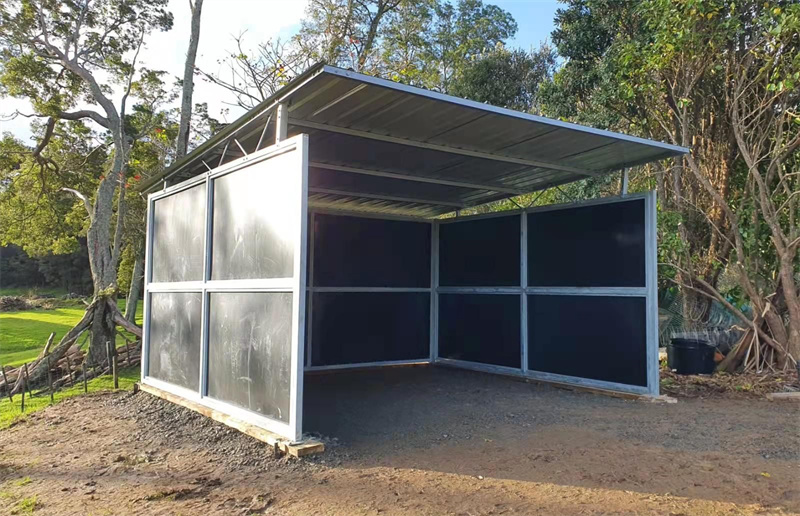
Flat-Pack Basics
Flat-pack stables are knock-down, palletized systems that ship denser, arrive with less transit exposure, and usually protect distributor margin better than fully welded units.
For buyers researching flat pack stables New Zealand, the plain answer is this: flat-pack means the stable is manufactured as modular panels, frames, doors, and fittings, then shipped unassembled on pallets rather than as bulky welded boxes. That matters because container space is expensive, and wasted cube kills landed margin fast.
In market examples, flat-pack systems load about 30 to 45 stable sets per 40HQ container, versus roughly 12 to 15 sets for fully welded alternatives. That is why experienced importers look past brochure claims and ask for the loading plan, pallet logic, and per-set freight math before paying a deposit.
What “flat-pack” actually means
A real flat-pack stable is a knock-down system engineered for palletized export. Panels, roof members, fronts, partitions, and hardware are separated, labeled, and packed to improve container efficiency and reduce damage risk from awkward welded frames shifting in transit.
For B2B buyers, the commercial advantage is not just cheaper freight. It is cleaner receiving, easier stockholding, lower breakage exposure, and simpler resale as repeatable kit sets. If you supply dealers or riding facilities, consistency from one palletized set to the next matters more than a sales pitch about “easy assembly.”
At DB Stable, that flat-pack logic is paired with hot-dip galvanized steel above 42 microns and 10mm UV-resistant HDPE boards. Those are not theoretical features. They are the baseline material choices we use for portable stable applications where New Zealand buyers care about weather exposure, maintenance control, and warranty risk.
That said, do not confuse “portable” with “zero paperwork.” In New Zealand, portability can reduce foundation complexity, but site conditions, wind exposure, drainage, and local rules can still trigger council checks or engineer input. Smart importers sell the kit honestly and flag that approval still depends on the final site and use case.
Common flat-pack stable formats
- Single stable: Best for entry-level resale, private farms, and buyers testing a new supplier with a low-complexity SKU.
- Back-to-back units: A practical commercial layout for higher density on limited footprints and a common format for dealers selling into working farms.
- Quadruple stables: Suitable when buyers want a balanced mid-scale block that is easier to quote, stock, and install than a custom barn build.
- Multi-bay roofed layouts: Better for facilities that want weather protection integrated into the kit rather than added later by local fabrication.
These formats are the reason flat-pack works well for wholesale and project supply. A distributor can carry a cleaner product ladder, from single units up to multi-bay roofed layouts, without tying up cash in oversized welded stock that is expensive to ship and awkward to store.
Best New Zealand use cases
- Resale kits: Ideal for importers and dealers who need palletized sets, predictable packing, and simpler landed-cost control per unit.
- Breeding farms: Useful where operators need additional stable capacity without committing immediately to a permanent masonry or timber build.
- Temporary overflow stalls: A practical fit for seasonal peaks, quarantine-style separation planning, or event-driven capacity pressure.
- Regional riding schools: Suitable for operators who need durable, repeatable blocks that can be expanded in stages as enrolment or horse numbers grow.
- Sites needing review: Coastal exposure, high-rainfall zones, freeze-prone areas, and wind-exposed sites may still require council confirmation or engineer review even if the stable is sold as portable.
The main mistake in New Zealand is assuming the buying decision is only about steel and panels. It is also about import friction. Ask the supplier for the packing list, commercial invoice, bill of lading, pallet or loading plan, packaging declaration, and ISPM 15 compliance evidence where timber is used. MPI delays usually come from packaging discipline and contamination risk, not from marketing claims about the frame.
One more point: competitors often push thicker coating claims or heavier structural language. Fine. Request evidence of coating thickness in microns, galvanizing method, weld coverage, and wind-load calculations. But do not ignore packaging governance, receiving inspection records, and spare-parts response planning, because that is where distributor margin gets protected or destroyed after the container lands.

NZ Compliance Basics
In New Zealand, compliance usually turns on site use, anchoring, drainage, and council rules, not the sales label “portable.” Verify those points before deposit.
For flat pack stables in New Zealand, the first decision is not model selection. It is classification and site approval risk. A unit sold as portable can still trigger consent issues if it stays on site long term, is fixed to the ground, connects into services, or breaches setbacks and drainage requirements. For distributors and project buyers, that means you should verify local council expectations before ordering, not after the container lands.
Consent checkpoints before ordering
Start with the local council because consent triggers are site-specific. Two farms can buy the same stable kit and get different answers depending on zoning, placement, drainage path, and how the structure is used. If you are buying for resale, build this into your pre-quote workflow so your dealer network is not relying on brochure language that has no value once an inspector asks questions.
- Local consent trigger: Ask whether the proposed stable layout, intended use, and duration on site require building or land-use approval in that district.
- Setbacks: Confirm required distances from boundaries, other buildings, accessways, and any sensitive site features before locking the footprint.
- Drainage: Check where roof water, wash-down water, and runoff will go. Bad drainage design creates both compliance risk and long-term maintenance issues.
- Anchoring: Verify what fixing method is acceptable for the ground condition and wind exposure. “Portable” does not remove the need for safe restraint.
- Site exposure: Request wind-load logic or engineering support where the site is exposed, elevated, coastal, or in a high-rainfall zone.
This is where experienced buyers separate marketing from procurement. Ask the supplier for anchoring details, base assumptions, and drainage implications before deposit. If the supplier cannot explain how the unit is intended to sit, drain, and resist movement, you are carrying the risk yourself.
Portable vs permanent is about use, not the sales label
In practice, New Zealand classification usually depends on what the stable is doing on the site. If it is treated like a long-term building, fixed down in a substantial way, tied into services, or left in place indefinitely, it may be viewed very differently from a genuinely relocatable unit. That distinction matters for consent, tax planning, and liability allocation across supplier, installer, and owner.
- Intended use: Temporary overflow housing and long-term operational stabling are not viewed the same way.
- Anchoring method: Light restraint for relocatable use is different from a permanent-style fixing approach integrated into a constructed base.
- Service connections: Water, drainage, power, and associated works can shift the compliance position quickly.
- Time on site: The longer the unit stays in one place, the weaker the “portable” argument usually becomes.
Do not let a supplier blur this. A flat pack horse stable can be easy to ship and still be treated as a permanent structure once installed a certain way. We advise buyers to document intended use, anchoring method, and service scope at quotation stage so there is a clear record for council discussions and internal approval.
Welfare and drainage checks that affect compliance
Welfare compliance is not just about horse comfort. It affects whether the facility is viewed as properly designed, safely maintainable, and fit for commercial use. For New Zealand buyers, the practical checks are simple: surfaces must be cleanable, fronts must reduce injury risk, ventilation must be adequate, and drainage must move water away without creating mud, contamination, or slip hazards.
- Cleanable surfaces: Specify materials that wash down properly and do not trap moisture or filth. DB Stable uses 10mm UV-resistant HDPE boards for dimensional stability and lower maintenance in ANZ exposure.
- Injury-safe fronts: Check door edges, latch positions, feeder integration, bar spacing, and any protrusions that can cut, trap, or bruise horses.
- Ventilation: Review how the front, side, and roof configuration manage airflow without creating a dark, damp box.
- Drainage design: Confirm fall direction, runoff control, and whether the stable base will stay dry under rainfall and wash-down conditions.
- Corrosion-sensitive components: Ask for evidence of galvanizing method, weld coverage, and coating thickness in microns. DB Stable’s baseline claim is hot-dip galvanized steel at over 42 microns with a 10-year service life expectation for portable stable use.
- Compliance-sensitive fittings: Check feeders, hinges, mesh sections, and fasteners for rust risk, sharp edges, and cleaning access.
This is also where climate matters. Buyers serving South Island freeze conditions or high-rainfall regions should not treat all panel and steel combinations as equal. Ask the supplier for evidence of coating performance, UV resistance for HDPE, and the intended drainage layout. If those answers are vague, expect warranty disputes later.
The commercial point is straightforward: compliance failures usually show up after installation, when freight is already paid and margin is already exposed. So before you place a flat pack stables New Zealand order, verify council triggers, confirm portable-versus-permanent assumptions, and pressure-test the welfare and drainage design with documented supplier evidence.
MPI Import Readiness
For flat pack stables New Zealand imports, MPI delays usually come from dirty packaging, non-compliant timber, or poor receiving checks, not the stable frame.
If you are buying flat pack stables for New Zealand resale or project supply, import readiness starts with packaging discipline. Experienced buyers do not stop at steel spec, HDPE thickness, or container fill rate. They ask the supplier for a clean-pack protocol, a packaging declaration, pallet logic, and a receiving checklist before deposit. That matters because margin gets wiped out by inspection fees, re-packing, or avoidable clearance delays.
Packing cleanliness rules that reduce MPI friction
MPI is looking for contamination risk. In plain terms, that means your shipment should arrive free from loose soil, plant matter, sawdust, straw, insects, and general factory debris. For flat pack horse stables new zealand imports, this is a packaging control issue as much as a product issue.
- Debris-free packing: Require pallets, frames, HDPE boards, and bundled hardware to be packed clean, dry, and free from visible dust, mud, wood offcuts, grass, seeds, and nesting material.
- Documented materials: Ask for a packaging declaration that states exactly what packing materials were used, including timber, plywood, steel pallet bases, plastic wrap, cardboard, and dunnage.
- Packing list accuracy: The packing list should match pallet count, bundle count, SKU or set count, and hardware carton count. If labels and paperwork do not match, inspection risk goes up fast.
- Container cleanliness: Ask for loading photos showing a swept, dry container floor with no prior cargo residue, standing water, oil staining, or torn lining.
- Hardware containment: Bolts, brackets, feeder fittings, and anchors should be bagged or boxed by set and clearly labeled to avoid rework during receiving.
For New Zealand distributors, this is not paperwork theatre. It is freight governance. A supplier that can ship 30 to 45 sets per 40HQ instead of roughly 12 to 15 fully welded units still creates problems if the packaging arrives dirty or undocumented. Ask for evidence of the packing method before final payment, not after the container is on the water.
ISPM 15 choices: when timber complicates entry and when alternatives are cleaner
If timber is used in pallets, bracing, or dunnage, assume ISPM 15 compliance must be checked. That means the wood packaging needs the correct treatment mark and should be suitable for entry inspection. If the supplier cannot clearly document timber compliance, you are taking on avoidable border risk.
- Timber packaging used: Request confirmation that every timber pallet, timber skid, and timber brace is ISPM 15 treated and visibly marked before loading.
- Mixed-material loads: If timber is only used in small braces or blocking pieces, it still needs to be compliant. Small non-compliant pieces can cause the same clearance problem as a full timber pallet.
- Steel pallets or steel bases: These generally simplify New Zealand entry because they remove the timber-treatment question from the pallet itself.
- Compliant alternatives: Where timber can be avoided, use steel pallet frames, plastic protection, cartonized hardware, and non-timber separators where practical.
- Proof before shipment: Ask for pallet photos that clearly show packaging type and any required treatment marks, plus the packaging declaration in the document set.
For a galvanized HDPE horse stable manufacturer shipping to New Zealand, steel-based packing logic usually fits the product anyway. DB Stable already supplies flat-pack systems designed for container efficiency, so the sensible procurement question is not just how many sets fit a 40HQ. It is whether the pallet and bracing method keeps MPI review simple and predictable.
Arrival inspection before you sign off the shipment
Do not sign off on arrival with a quick visual glance. Your receiving team should check the outer packaging, the labels, and the condition of the goods before the handover is closed. This is how you protect warranty position, claims timing, and dealer confidence.
- Pallet labels: Verify pallet numbers, product codes, set counts, and consignee details against the packing list and bill of lading.
- Coating damage: Inspect galvanized frames for scraping, impact marks, exposed steel, or damage around weld areas. DB Stable states hot-dip galvanized coating over 42 microns, so any visible breach should be photographed immediately.
- Board condition: Check 10mm UV-resistant HDPE boards for cracks, deep gouges, edge damage, or warping from poor packing pressure.
- Missing hardware: Count hardware cartons and confirm bolts, brackets, latches, feeder fittings, and installation packs are present by set, not just by pallet.
- Container condition: Record any water ingress, condensation damage, broken seals, floor contamination, punctures, or cargo shift before unloading is completed.
- Photo record: Take dated photos at door opening, during first pallet removal, and after full unload. If there is a claim later, this record matters.
The practical rule is simple: inspect first, sign second. For a portable horse stalls wholesale australia or New Zealand dealer model, one undocumented shortage or damaged pallet can turn into multiple site delays and margin loss across downstream customers. Ask the supplier for a receiving inspection template in advance so your warehouse team is not improvising on delivery day.
Wind And Weather
For New Zealand, weather risk is not one problem. Match the stable to the climate zone, then verify galvanizing and steel claims with documents, not brochure language.
If you are sourcing flat pack stables New Zealand dealers can resell with confidence, start here: coastal rain, northern humidity, and South Island cold do not punish materials in the same way. The wrong frame spec will corrode first at seams and welds, and the wrong wall spec will turn “kick-proof” into a warranty argument. For procurement teams, the practical move is simple: ask the supplier for coating-thickness evidence in microns, confirm whether the frame is hot-dip galvanized after fabrication, and request low-temperature steel details where freeze conditions are part of the job.
NZ climate zones change what matters
New Zealand is small on the map and brutal on lazy specifications. Wet coastal sites push corrosion risk hard, humid northern regions increase moisture exposure year-round, and colder South Island conditions raise tougher questions around steel toughness, impact performance, and maintenance intervals. If a supplier gives you one generic weather claim for all three, that is usually a sign they have not engineered for NZ conditions.
- Wet coastal zones: Salt-laden air and frequent rain make coating integrity the first checkpoint. Welds, cut ends, fastener areas, and roof-edge details are where corrosion usually starts.
- Humid northern regions: High moisture exposure means buyers should focus on galvanizing quality, drainage design, and panel stability. DB Stable uses 10mm UV-resistant HDPE boards as a core material choice because they reduce maintenance and stay dimensionally stable in ANZ weather exposure.
- Colder South Island conditions: Freeze-thaw cycles and low temperatures make impact performance more important. This is where higher-toughness steel grades and honest wall-thickness data matter more than generic “heavy duty” claims.
From a commercial angle, climate matching protects margin. A distributor does not lose money because a brochure looked weak; they lose money because corrosion shows up at welds, boards move more than expected, or callbacks start after the first winter. That is why weather suitability should be quoted as a documented specification review, not a sales promise.
Galvanizing proof: what to ask for before deposit
“Galvanized” by itself means almost nothing. Buyers should ask the supplier to prove coating thickness, galvanizing method, and weld coverage. DB Stable’s baseline claim is hot-dip galvanized steel with a coating over 42 microns and an expected 10-year service life for portable stable applications. That is a usable starting point, but experienced NZ importers should still request the supporting evidence pack.
- Coating thickness: Ask for the measured result in microns, not vague wording like “anti-rust treated.” Market-facing competitor benchmarks often claim hot-dip galvanizing to BS EN ISO 1461, with more than 70 microns on tubing and more than 85 microns on structural parts.
- Galvanizing method: Confirm whether the frame is hot-dip galvanized after fabrication or made from pre-galvanized tube. Post-fabrication hot-dip treatment generally protects welds and cut areas better because the whole finished frame is coated.
- Weld coverage: Ask for close-up photos or inspection records showing weld areas, corners, and seam transitions. This is where painted systems and pre-gal tube assemblies usually show their weakness first.
- Corrosion evidence: Request the coating report or corrosion test information the supplier actually has. If the evidence is internal, it should be labeled as internal testing rather than dressed up as a third-party certification.
Here is the blunt version. Painted steel can look clean on day one and still fail at impact points, seam lines, and welds. Pre-gal tube is better than paint-only, but once it is cut and welded, the exposed areas become the problem unless they are properly treated. For NZ coastal and high-rainfall use, hot-dip galvanizing after fabrication is the safer commercial answer when weld durability is part of the buying decision.
This is also where serious suppliers separate themselves from generic exporters. They should be able to provide not just a frame claim, but a loading plan, parts labeling, and MPI-ready packaging discipline as well. In New Zealand, import friction often comes from contamination risk and packaging non-compliance, not just frame corrosion. Weather durability and import readiness need to be checked together.
Cold-climate steel and the truth about “kick-proof”
Q345B or an equivalent higher-toughness structural steel starts to matter when the stable will be used in colder South Island locations, exposed inland areas, or demanding commercial yards where horses hit walls and doors hard. In mild climates, many suppliers can get by with lower-grade material claims. In colder operating conditions, buyers should not assume all carbon steel behaves the same under impact.
- Steel grade: Ask whether the frame uses Q235B, Q345B, or an equivalent grade. If the site has freeze conditions or heavy-use horses, higher-toughness material deserves a serious look.
- Wall thickness: “Kick-proof” without tube wall thickness is marketing fog. Competitor positioning in the market commonly points buyers toward 14-gauge or 2.0mm-plus wall thickness for structural credibility.
- Low-temperature detail: Ask what the supplier has actually designed for in colder conditions. If they make a low-temperature claim, they should be able to explain the steel choice and the use case, not just repeat the phrase.
- Wall construction: If HDPE panels are part of the design, verify panel thickness and attachment method. DB Stable uses 10mm UV-resistant HDPE boards; some competitors position much thicker HDPE panel systems, so buyers should compare the actual application rather than assuming thicker always means better.
A stable can be suitable for normal commercial use without pretending it is indestructible. We have seen too many “kick-proof” claims that skip the numbers that matter: steel grade, tube size, wall thickness, panel thickness, and the temperature context. If those details are missing, the claim is not procurement-grade. It is just sales language.
For New Zealand buyers, the clean decision rule is this: match the spec to the exposure, then ask suppliers to prove their galvanizing method, coating thickness, weld coverage, steel grade, and wall thickness before deposit. That is how you reduce defect risk, defend landed cost, and avoid warranty disputes after install.
Freight And Costs
For New Zealand importers, freight density is the first margin test: about 30-45 flat-pack sets per 40HQ versus roughly 12-15 welded sets.
If you are buying flat pack stables New Zealand distribution, do not stop at unit price. The commercial question is how many saleable sets you can land per 40HQ, clear through customs and MPI without delay, and install without a parts dispute. In practice, flat-pack systems usually win because they load about 30-45 sets per 40HQ container, while fully welded alternatives often sit around 12-15 sets. That difference is what protects distributor margin, not brochure language.
Container load math: where the freight advantage really comes from
The basic math is straightforward. If a 40HQ holds 30-45 flat-pack stable sets instead of 12-15 welded sets, the freight cost is spread across far more revenue-generating units. That is why experienced importers ask for a loading plan before deposit, not after production.
- Flat-pack density: About 30-45 stable sets per 40HQ when packing logic is properly engineered.
- Welded density: About 12-15 sets per 40HQ for fully welded alternatives.
- Commercial implication: The freight cost per set can drop by more than 60% when space utilization is optimized.
- What to request: A container loading plan, pallet count, bundle dimensions, and a per-set loading calculation before booking.
This is also where supplier discipline matters. A factory that sells “flat pack” but cannot show bundle logic, labeling sequence, and unloading order is handing you risk, not savings. We treat the loading plan as part of the product, because bad packing destroys the freight advantage on arrival.
Landed cost drivers: the numbers that actually decide your margin
For a distributor or reseller, landed cost is never just the EXW quote. You need the full chain priced out so you can see your real margin per set and your cash exposure per container. If a supplier avoids that conversation, assume you are being shown an incomplete number.
- EXW price: The factory gate price for the stable kit itself, before freight and border costs.
- Ocean freight: The shipping cost from China to New Zealand, which needs to be modeled per container and per set.
- Customs charges: Entry processing, broker fees, and any duty treatment that applies to your shipment classification.
- GST: New Zealand GST affects landed cash flow and must be included in your import planning.
- Inland delivery: Port-to-warehouse or port-to-customer transport inside New Zealand.
- Unloading: Forklift, labor, site access, and container unpacking time.
- Assembly support: Installer instructions, parts labeling, and response support if a crew hits an issue on site.
For commercial equestrian buyers, assembly support is not a soft extra. It is a cost control item. If the kit arrives with clear labeling, complete bolts, and an install sequence that local crews can follow, you protect labor time and reduce warranty noise. DB Stable’s portable systems are built around flat-pack logistics, with hot-dip galvanized steel over 42 microns and 10mm UV-resistant HDPE boards, but buyers should still ask for the exact packing list and parts map tied to the order.
Hidden cost traps that wipe out a “cheap” quote
Most bad imports do not fail on the headline price. They fail on avoidable friction after dispatch or after arrival. For New Zealand, MPI-readiness and packaging discipline are not side issues. They are margin protection.
- Port storage: Delays in clearance, document mismatch, or inspection holds can trigger storage and demurrage fast.
- MPI inspections: Contamination risk, dirty packaging, or poor packaging declarations can slow release and add cost.
- Non-compliant packaging: If timber is used, ask for ISPM 15 compliance. Also request a packaging declaration and clean-pack protocol.
- Missing bolts: One missing hardware bag can stop an install crew and turn a profitable job into a callback.
- Vague warranty exclusions: If corrosion, freight damage, missing parts, or install-related claims are handled vaguely, you carry the dispute cost locally.
This is the part many suppliers gloss over. Buyers should request the packing list, commercial invoice, bill of lading, pallet or loading plan, packaging declaration, and a receiving inspection checklist before shipment leaves the factory. Also ask for the warranty response process in writing, including spare-parts handling and response SLA. Reputational damage usually shows up after install, not on the quote sheet.
Ask for both per-set and per-container economics
If you only ask for a unit price, you are not protecting your margin. A serious horse stable kit supplier for dealers should be able to show you the economics two ways: per set and per 40HQ container. That lets you compare resale margin, cash tied up in inventory, and freight efficiency across different configurations.
- Per-set economics: Use this to calculate resale margin, landed cost, and installer exposure on each kit.
- Per-container economics: Use this to model total gross profit, working capital usage, and replenishment timing.
- What to verify before deposit: Sets per 40HQ, bundle dimensions, gross weight, customs documents, packaging compliance, spare-parts policy, and warranty exclusions.
For New Zealand distributors, this is the cleanest way to compare a flat pack horse stable factory direct quote against local welded supply or loosely packed imports. Ask the supplier for the landed-cost view, not just the EXW number. That is how you defend the purchase decision internally and keep margin intact when the container actually arrives.
| Item | DB Stable / Market Data | Buyer Check | Commercial Impact |
|---|---|---|---|
| Container loading efficiency | Flat-pack systems typically load about 30-45 stable sets per 40HQ, versus roughly 12-15 sets for fully welded alternatives. | Ask for a container loading plan, pallet layout, and confirmed sets-per-40HQ before deposit. | Optimized flat-pack loading can reduce freight cost per set by more than 60% and protect distributor margin. |
| Freight cost visibility | The key cost driver is not only unit price, but freight cost per set based on packing density and loading logic. | Request a per-set landed cost estimate with product cost, packing volume, sea freight basis, and destination charges separated. | Clear freight math helps buyers compare suppliers on real margin, not misleading ex-factory pricing. |
| Packing method | DB Stable positions portable and flat-pack stable systems as easier to ship and handle than welded structures. | Verify whether frames, panels, and accessories are packed by set, clearly labeled, and protected against rubbing, deformation, and moisture ingress. | Better packing discipline lowers transit damage risk, speeds unloading, and reduces missing-part claims. |
| NZ biosecurity packaging risk | For New Zealand imports, packaging compliance can be as important as the stable itself because MPI delays often come from contamination or non-compliant packing materials. | Request packaging declaration, ISPM 15 compliance evidence if timber is used, and confirmation of clean-pack protocols for export to NZ. | Good packaging compliance reduces MPI clearance risk, storage delays, and unexpected rework costs at arrival. |
| Required shipping documents | NZ-focused buyers should expect a full document pack including packing list, commercial invoice, bill of lading, pallet or loading plan, and packaging declaration. | Confirm all shipment documents will match SKU counts, package marks, and consignee details before vessel departure. | Accurate paperwork reduces customs friction, helps receiving teams reconcile cargo faster, and supports claims if shortages occur. |
| Receiving and inspection control | Experienced import programs treat arrival inspection as part of freight cost control, not just warehouse admin. | Ask for parts labeling logic, receiving inspection checklist, and photo-based packing records before shipment. | Structured receiving reduces labor waste, isolates transit damage quickly, and improves warranty accountability. |
| Corrosion-risk cost exposure | DB Stable states hot-dip galvanized steel over 42 microns with a 10-year service life expectation for portable stable use; market benchmarks may claim higher post-fabrication galvanizing levels. | Request coating-thickness evidence in microns, galvanizing method, and weld coverage proof before confirming the order. | Higher confidence in coating quality reduces long-term replacement costs, callback exposure, and dealer reputation damage. |
| Panel material and maintenance cost | DB Stable cites 10mm UV-resistant HDPE boards as a core material for dimensional stability and lower maintenance in ANZ conditions. | Verify HDPE thickness, UV-resistance evidence, and whether the panel specification matches the target climate and usage intensity. | Correct panel selection can lower maintenance spend and support more predictable lifetime cost for resale customers. |
| Climate-specific specification cost | Market content increasingly separates coastal, high-rainfall, and freeze-exposed regions as different engineering and corrosion cases. | Tell the supplier whether the destination is coastal, high-rainfall, or South Island freeze-prone, and request a fit-for-use recommendation in writing. | Proper specification upfront helps prevent under-engineered imports that create expensive warranty issues later. |
| Spare parts and after-sales cost | Freight savings can be erased if the supplier has no documented spare-parts strategy or slow defect response after installation. | Request spare-parts list, replacement-part turnaround commitment, and warranty response SLA before placing the order. | Fast after-sales support protects repeat-order confidence, dealer relationships, and 12-month defect-rate performance. |
Explore Flat-Pack Stable Kits for Australia and New Zealand.
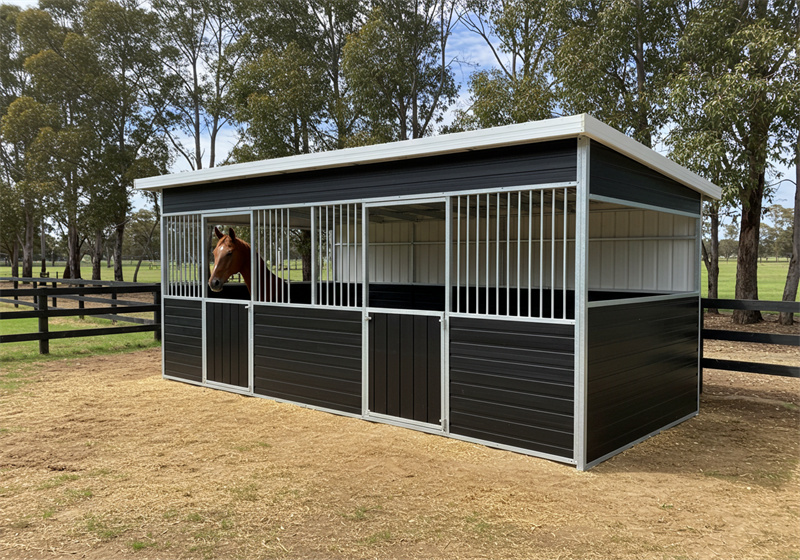
Spec Sheet Essentials
For flat pack stables New Zealand buyers, the spec sheet is your first risk filter. If it does not show steel wall thickness, zinc coating details, HDPE thickness, and spare-parts planning, do not approve the order.
Steel and zinc: what to verify before deposit
If a supplier only says “galvanized,” that tells you almost nothing. Ask for the steel grade, tube wall thickness in mm, galvanizing method, coating thickness in microns, and confirmation that weld areas are covered. For NZ importers, this is not paperwork for paperwork’s sake. Corrosion claims are where warranty disputes start.
- Steel grade: Ask the supplier to name the structural steel grade used on the frame. Market examples commonly reference Q235B or Q345B. If the grade is missing, the spec sheet is incomplete.
- Tube wall thickness: Request the actual wall thickness in mm, not vague words like heavy duty. Market benchmarks often point buyers toward 14-gauge or 2.0mm+ tubing. Verify the exact thickness used on posts, rails, and door frames.
- Galvanizing method: Confirm whether the frame is hot-dip galvanized and whether treatment is done after fabrication. Buyers are already being told in the market to ask for post-fabrication hot-dip galvanizing to BS EN ISO 1461.
- Coating thickness: DB Stable’s baseline claim is hot-dip galvanizing over 42 microns with a 10-year service life expectation for portable stable use. Separately, some competitor positioning pushes more than 70 microns on tubing and more than 85 microns on structural parts. Label those as market benchmarks, not the same claim.
- Evidence: Request a coating-thickness report, corrosion test or coating report, and close-up photos of weld zones. “Galvanized” without evidence is sales talk, not procurement data.
We have seen buyers focus only on the frame and miss the freight and compliance layer. That is a mistake. For flat pack stables New Zealand projects, ask the supplier for the pallet logic, loading plan, and packaging declaration at the same time as the steel spec. NZ import friction often comes from contamination risk and packaging non-compliance, not only from the frame itself.
HDPE and infill: check the panel, not just the frame
Panel failure is usually a maintenance problem first and a brand problem second. For commercial equestrian use, you need the infill material defined in mm, with evidence of UV resistance and a clear statement on wash-down performance. If the panel spec is vague, assume future callbacks.
- Thickness: DB Stable specifies 10mm UV-resistant HDPE boards as a core material choice. That is the internal source of truth for this product line and should be stated plainly on the spec sheet.
- UV resistance: Ask for evidence of UV performance because ANZ exposure is not theoretical. North Island rain, coastal salt, and South Island freeze-thaw conditions create different service demands.
- Cleanability: Verify that the panel surface is suitable for regular wash-down and does not trap moisture the way wood-based products can.
- Impact tolerance: Ask how the board performs under kicking and repeated contact. You want a clear answer on suitability for stall walls and fronts, not a generic plastic claim.
- Contrast with wood-based panels: Wood-based infill can swell, absorb moisture, or rot over time. DB Stable positions HDPE as the lower-maintenance, more dimensionally stable option for this reason.
Be careful not to compare unlike products. Some competitor positioning in the market highlights 28mm to 32mm waterproof panel systems. That does not automatically make a stable better. You need to compare the full assembly: frame design, intended use, cleaning regime, impact exposure, and replacement-part availability. Thickness alone is not the decision.
Doors, feeders, and service parts: where after-sales risk shows up
A lot of suppliers spend pages on frame steel and almost nothing on moving parts. That is backwards for distributors. Reputational damage usually happens after install, when a sliding door binds, a hinge wears out, or a feeder part is unavailable. Ask the ugly service questions before you place the order.
- Sliding doors: Confirm track design, wheel or roller specification, and whether the door hardware is supplied as a standard set across your order. Consistency matters for dealer service and spare stocking.
- Stall fronts: Verify whether the front is full mesh, HDPE lower panel with upper mesh, or another fixed configuration. The exact front style affects ventilation, cleaning, and replacement planning.
- Feeder options: DB Stable offers specialized fittings including rust-free aluminum swivel feeders. Make sure the quote states the feeder type, mounting method, and whether it ships fitted or separately packed.
- Hinge durability: Ask what hinge type is used on swing components, what material it is made from, and whether hinge pins or brackets are replaceable without changing the full panel.
- Spare-parts planning: Request a documented spare-parts strategy, parts labeling plan, defect logging process, and warranty response SLA. For NZ distributors, this is a margin-protection issue, not an admin detail.
If you sell flat pack horse stables new zealand dealers can assemble locally, serviceability is part of the product. Ask the supplier for a replacement-part list by SKU, a recommended first spare-parts pack, and turnaround expectations for urgent claims. That is how you avoid a cheap container becoming an expensive after-sales mess.
Installation Planning
For flat pack stables New Zealand projects, installation problems usually come from bad site prep, weak unloading control, and vague anchor planning, not from the frame itself.
If you are buying for resale, commercial use, or dealer supply, treat installation planning as a margin-protection step. A flat-pack system only saves money if the crew can unload it safely, identify each sub-assembly fast, set anchors correctly, and complete post-install checks without rework. Ask the supplier for the loading plan, labeled parts schedule, anchor layout, and manual before deposit, not after the container lands.
Crew and tools
For modular horse stables commercial use, the install team should be planned around unloading control and bolt-up speed, not guesswork. In practice, the right crew size depends on bay count, roof configuration, and site access, but the principle is simple: do not try to install a commercial stable kit with an under-manned team and basic hand tools. That is where damaged panels, lost hardware, and day-two delays start.
- Unloading equipment: Confirm whether the site needs a forklift, telehandler, crane truck, or a combination. Match lifting capacity to the heaviest packed bundle and verify fork length before delivery day.
- Labor count: Set crew numbers based on the actual scope: unloading, sorting, standing frames, fixing panels, roof work, and anchoring. A realistic plan beats a cheap plan every time.
- Torque tools: Use calibrated torque tools for final bolt tightening. For dealers and builders, this matters because loose fixings create call-backs, while over-tightening can damage connections and shorten service life.
- Anchor preparation: Have anchors, drill bits, resin or mechanical fixings, hole-cleaning tools, and setting equipment on site before assembly starts. Waiting on anchors halfway through the job kills install efficiency.
- Labeled sub-assemblies: Request a parts labeling plan from the supplier. For flat pack horse stables New Zealand import projects, clear bay-by-bay labeling reduces sorting time and lowers the risk of mixing fronts, partitions, roof members, and hardware packs.
- Clear manuals: The manual should show anchor points, frame sequence, hardware references, and roof installation steps. If the manual is vague, your labor cost goes up and your defect risk goes up with it.
This is where a serious supplier separates itself from a generic exporter. We design flat-pack systems for repeatable assembly, which means documented packing logic, identifiable components, and manuals your crew can actually use on site. For distributors, that consistency matters because installation friction becomes your warranty problem downstream.
Site prep checks before the truck arrives
Most installation delays are visible before unloading starts. For a prefabricated horse stable supplier Australia or New Zealand project, the slab, drainage, anchor positions, and unloading zone should be checked in advance and signed off by the site team. Do not let the container arrive to an unfinished pad or a muddy access lane.
- Slab level: Verify that the concrete slab or base is level within the installation tolerance required by the layout. An uneven base causes frame twist, poor door alignment, and unnecessary anchor stress.
- Drainage fall: Check that water drains away from the stable line instead of pooling under the fronts or along the rear wall. In high-rainfall New Zealand regions, poor drainage becomes a maintenance and hygiene issue fast.
- Anchor points: Mark anchor locations against the approved drawing before installation day. Make sure edge distances, embedment depth, and slab thickness suit the selected anchoring method.
- Safe unloading area: Set aside a clean, stable, and obstruction-free unloading zone with enough room for equipment movement, bundle staging, and manual handling. This also supports cleaner receiving control for NZ import sites where contamination and packaging discipline matter.
For New Zealand buyers, there is another practical point: receiving discipline starts at the unloading area. Keep the area clean, record any packaging damage immediately, and log shortages or bent components before installation begins. That gives you a clean line between freight damage, site handling damage, and factory issues.
Safety and anchors
Anchoring is not a cosmetic step. It is a structural control point, especially for portable horse stable wind rating New Zealand discussions where site exposure, roof configuration, and local conditions all affect the final requirement. Ask the supplier for the recommended anchoring method, then verify it against your slab, ground condition, and local project engineer or council requirements where needed.
- Anchoring method: Confirm whether the job uses concrete anchors, chemical anchors, ground anchors, or another specified system. The right choice depends on the base, not on what happened to be in the installer’s van.
- Edge safety: Check slab-edge distances, exposed base edges, trip hazards, and any sharp points created during assembly. Horses, handlers, and maintenance staff all pay the price for rushed finishing.
- Post-install inspection routines: Build a routine that covers bolt torque confirmation, anchor tightness, door travel, latch operation, panel seating, roof fasteners, and visible damage logging. This should be documented before handover, not handled as an informal walk-around.
A good post-install routine is also where long-term credibility is protected. For a horse stable kit supplier for dealers, the real test is not whether the stable stands up on day one. It is whether the install record, defect log, and spare-parts process are clear enough to resolve issues without argument. That is how you protect repeat orders, dealer confidence, and landed margin.
QA And Aftercare
For NZ importers, QA and aftercare are margin controls. If the supplier cannot document pre-shipment checks, warranty evidence flow, and spare-parts coverage, the risk lands on you.
For flat pack stables New Zealand buyers, the real problem is not getting a quote. It is controlling defects, claim delays, and post-install callbacks before they eat dealer margin. We treat QA and aftercare as a documented process: verify dimensions, finish, loading, and hardware before balance payment; log batch data and arrival evidence for claims; and keep fast-moving spare parts available in New Zealand.
Pre-shipment QA before balance payment
Do not release the balance on brochure photos and a packing promise. Ask the supplier for job-specific loading photos, measured dimensions, finish inspection records, and a final hardware count tied to your packing list. This matters even more with flat-pack systems, because freight density only helps if each set arrives complete and clearly packed.
- Loading photos: Request container loading photos that show pallet logic, bundle labels, door panels, side panels, roof parts if included, and how sets are separated inside the container.
- Dimensional checks: Ask for measured verification of key panel widths, heights, door openings, and hole alignment points against the approved drawing before shipment.
- Finish inspection: Require clear photos of weld zones, cut edges, galvanized surfaces, and HDPE board condition. DB Stable’s baseline claim is hot-dip galvanized steel over 42 microns and 10mm UV-resistant HDPE, so the finish review should match that specification.
- Hardware count verification: Match hinges, latches, feeder hardware, bolts, nuts, washers, and brackets to the packing list by set and by container, not just by total order quantity.
- Document pack: Confirm the commercial invoice, packing list, bill of lading, pallet or loading plan, packaging declaration, and any ISPM 15 evidence where timber is used.
The practical rule is simple: if a supplier cannot show you what was loaded, measured, inspected, and counted, you are funding uncertainty. For NZ importers, that uncertainty turns into MPI friction, missing parts, and warranty arguments nobody wants after install.
Warranty controls that speed claims instead of slowing them down
Most warranty disputes are not about whether a problem exists. They stall because the buyer cannot tie the defect to a shipment, a batch, a delivery date, and a photo trail. If you want a strong warranty process, build the evidence chain before the first unit is installed.
- Log batch IDs: Record production batch IDs, order numbers, container numbers, and set labels for every shipment received in New Zealand.
- Capture arrival photos: Photograph packaging condition, pallet labels, visible damage, and each affected component before unpacking is completed.
- Track defect timelines: Note the date of arrival, installation date, first-use date, and the date the defect was discovered. Without this, claim review becomes guesswork.
- Separate freight damage from product defect: Record whether the issue is packaging damage, transit deformation, coating failure, missing hardware, or installation mismatch.
- Use a response SLA: Ask the supplier to define how quickly they will acknowledge a claim, review evidence, and dispatch replacements or credits.
This is where experienced distributors protect reputation. A clean warranty file shortens the argument, protects repeat-order confidence, and stops a small parts issue from becoming a public complaint with a farm, dealer, or equestrian facility. The goal is not just a warranty statement. The goal is a claim process that works under commercial pressure.
Spare parts planning for New Zealand stockholding
If you sell modular horse stables for commercial use into New Zealand, do not wait for failures before thinking about parts. Keep a local buffer of the items that move fastest and cause the most installation delays. That is basic margin protection, not overstocking.
- Hinges: Keep replacement hinges matched to the exact door and panel design you import, including left-hand and right-hand variants where relevant.
- Latches: Stock latch assemblies, catches, pins, and any matching strike hardware used across your main stable configurations.
- Feeder hardware: Hold spare fixings and moving parts for rust-free aluminum swivel feeders, because feeder downtime creates immediate customer complaints.
- Fasteners and brackets: Keep bolts, nuts, washers, joining plates, and common brackets packed by set type so service calls do not turn into manual sorting jobs.
- Panel-specific items: For 10mm UV-resistant HDPE configurations, keep the matching retention hardware and any model-specific trim or fixing parts used in your imported range.
For a horse stable kit supplier for dealers, after-sales strength is not measured by promises. It is measured by whether a replacement hinge, latch, or feeder component can be delivered locally without waiting for the next container from China. That is the difference between a manageable service issue and a margin-eroding callback.
Our view is straightforward: pre-shipment QA reduces avoidable defects, warranty controls reduce argument time, and NZ spare-parts stock reduces downtime. If a supplier only talks about galvanizing and price, but has no clear process for these three areas, the after-sales risk is still sitting with the importer.
Conclusion
I’d buy flat pack stables for New Zealand only from a supplier that shows the loading plan, packaging declaration, and galvanizing evidence before deposit. The freight math is too strong to ignore: about 30–45 sets in a 40HQ versus roughly 12–15 for welded units, and that gap is where your margin lives or dies.
Next move: ask for one quote pack with the per-set container loading layout, coating-thickness report in microns, HDPE spec, ISPM 15 proof if any timber is used, and the spare-parts response SLA. If they can’t send that in one clean file, don’t place the order.
Frequently Asked Questions
How does the flat-pack system affect shipping costs to NZ?
It improves container density. SERP benchmarks show roughly 30-45 flat-pack sets can fit in a 40HQ container versus about 12-15 welded sets, which materially lowers freight cost per stall and gives distributors more margin room after customs, GST, and inland delivery.
Which materials hold up best in Australian and New Zealand weather
Buyers should prioritize hot-dip galvanized steel plus UV-resistant HDPE infill for wet, coastal, and high-UV conditions. Painted steel and untreated wood create higher corrosion, rot, and maintenance risk, especially around welds, base rails, and wash-down zones.
How do I know if a flat pack horse stable can handle high winds
Ask for wind-load calculations, anchor requirements, frame wall thickness, and any engineering documentation tied to the intended region and exposure level. If the supplier only says ‘strong’ without numbers, coating reports, or drawings, the risk is still on the buyer.
How many portable stalls can fit in a 40HQ container?
A realistic planning range from the SERP evidence is about 30-45 flat-pack sets per 40HQ, depending on stall size, roof inclusion, feeder options, and pallet method. Always request a loading plan instead of relying on headline claims.
Do I need a building permit for portable stables?
Sometimes. Whether consent is needed can depend on how the stable is anchored, how long it stays in place, site drainage, setbacks, and local council interpretation. Portable does not automatically mean permit-free in New Zealand.