If you import horse stables to New Zealand and your bill of lading just says “galvanized steel structures,” expect MPI to hold your container. I watched a contractor lose $12,600 last March because his crew sat idle for three days while the Ministry sorted out whether the steel was hot-dip or electro-galvanized. His fixed-price bid didn’t account for that. It never does. That’s the margin killer nobody warns you about during quoting.
This guide gives you the exact Bill of Lading phrasing, HS code classification, and landed cost framework to prevent those holds. You’ll get copy-paste declaration language, DTHC fee ranges for Auckland and Tauranga, and the container loading specs you need to plug directly into your project spreadsheets. No theory. Just the numbers.
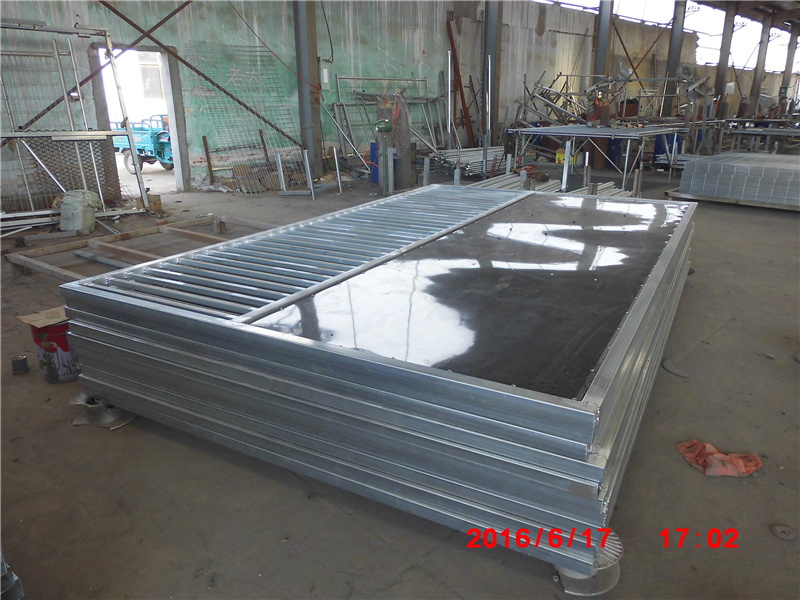
NZ Stable Import Cost Breakdown
Your landed cost per stall is not the FOB price. It is the FOB price plus five destination line items that CIF quotes systematically exclude.
Total Landed Cost Components
Calculate your bid using this exact line-item structure. Omit any single variable and your fixed-price contract absorbs the loss directly.
- FOB Factory Price: Base cost of flat-pack hot-dip galvanized steel frames and 10mm UV-resistant HDPE boards ex-works China.
- Sea Freight: Quoted as CIF, covering transit to the destination port. This figure excludes all discharge and handling costs at arrival.
- 15% GST: Calculated on the total CIF value (FOB plus sea freight), not the FOB factory price. Miscalculating this base erodes margin immediately.
- DTHC (Destination Terminal Handling Charge): NZD 350-600 per 40HQ container. This is the single most common hidden fee in CIF quotes from suppliers.
- Broker Fees and MPI Fees: Customs brokerage for entry processing plus Ministry for Primary Industries biosecurity clearance charges.
Flat-pack kits achieve a 40% CBM reduction, loading 30-45 sets per 40HQ container. This directly reduces the per-unit sea freight and DTHC allocation across your order, giving you a measurable margin advantage over importers buying bulkier configurations.
Financial Impact of Documentation Errors
A vague Bill of Lading triggers an MPI physical inspection. Writing “galvanized steel” without specifying “hot-dip galvanized” fails to distinguish the processing method and flags the shipment for manual examination. This adds NZD 200+ in direct inspection fees per container.
Direct fees are the minor cost. The real damage is time. You have a 20-day mandatory window to lodge import entries after container arrival. An MPI hold stops your timeline dead. If you have a crew scheduled for installation, idle crew wages exceed NZD 4,200 per day. A two-day hold costs more than the entire customs brokerage fee for the shipment.
Declare the material as “hot-dip galvanized steel frames (HS Code Chapter 94) with 10mm HDPE polymer wall boards, zero structural timber.” This specific phrasing eliminates the biosecurity ambiguity that causes physical inspections. Flat-pack steel kits contain no structural timber in the walls or framing, which bypasses the ISPM-15 untreated timber ban entirely. Verify that all timber dunnage inside the container carries ISPM-15 HT/MB stamps with photographic proof before the container leaves origin.
| Cost Component | Rate / Metric | Trigger Condition | Bid Impact |
|---|---|---|---|
| NZ Customs GST | 15% of total CIF value | Standard import entry under Chapter 94 tariff classification | Systematically underestimated when calculating landed cost from FOB factory price |
| Destination Terminal Handling Charge (DTHC) | NZD 350 – 600 per 40HQ container | Always excluded from standard CIF supplier freight quotes | Creates a hidden cost gap that directly erodes contractor margins on fixed-price bids |
| MPI Physical Inspection Fees | NZD 200+ direct fees per container | Vague bills of lading using the word galvanized without specifying hot-dip | Requires exact HS code declaration phrasing to prevent unpredictable clearance delays |
| Site Idle Crew Wages | Exceeds NZD 4,200 per day | Container holds caused by missing ISPM-15 dunnage stamps or documentation errors | Instantly destroys fixed-price labor budgets if origin compliance fails |
| ISPM-15 Dunnage Compliance | Zero structural timber risk | Importing flat-pack steel frames and HDPE boards instead of traditional wooden stables | Eliminates primary biosecurity risk vector; requires photographic proof of HT/MB stamps on dunnage only |
| Flat-Pack Freight Optimization | 30-45 sets per 40HQ (40% CBM reduction) | Utilizing prefabricated flat-pack kits over assembled structures | Lowers per-stall CIF value, which proportionally reduces the 15% GST liability |

MPI Biosecurity Declaration Rules
Vague material descriptions on your Bill of Lading trigger MPI physical inspections costing $200+ per container. Use exact polymer and coating specifications or absorb the fee.
Enforcement of the Biosecurity Act 1993
The New Zealand Ministry for Primary Industries enforces the Biosecurity Act 1993 at the border with zero tolerance for ambiguous import documentation. When your container arrives, MPI officers assess risk based solely on what is declared on the Bill of Lading and commercial invoice. If the declared materials fall into high-risk categories or use generic terminology, MPI mandates a physical inspection before releasing the container.
A physical inspection adds a minimum $200 direct fee per container. More critically, your 20-day window to lodge import entries starts ticking while the container sits in hold. Idle crew wages during that hold exceed $4,200 per day if your installation team is already on site. The Act does not accept “supplier error” as grounds for fee reversal. You, the importer of record, pay.
Hot-Dip vs Electro-Galvanized Steel Declaration
The word “galvanized” on a Bill of Lading is the single most common trigger for MPI physical inspections. It fails to distinguish between hot-dip galvanizing and electro-galvanizing, two fundamentally different processes with different biosecurity risk profiles. MPI treats unspecified galvanized steel as potentially carrying residual zinc flakes or processing contaminants requiring visual verification.
Declare the exact process and coating thickness. Our specification is hot-dip galvanized steel with a minimum 42-micron zinc coating thickness. This specific phrasing satisfies MPI material classification requirements and removes the inspection trigger because hot-dip processing at 42+ microns falls under a recognized low-risk category for steel structural imports.
HDPE Polymer Classification
Declaring wall boards as “plastic panels” on your import documentation creates immediate problems. Generic plastic terms force MPI to classify the material under broad polymer categories that may require chemical composition verification or origin certificates for restricted plastic resins. This adds processing time and risks referral to a technical officer.
Our wall boards are 10mm UV-resistant HDPE, which is a zero biosecurity risk classified polymer. State “10mm UV-resistant High-Density Polyethylene (HDPE) wall boards” on the Bill of Lading. This exact classification bypasses the generic plastic risk category entirely because HDPE in solid sheet form above 5mm thickness does not require further polymer risk assessment under MPI import standards.
Copy-Paste Bill of Lading Declaration Phrasing
Use the following line-item descriptions for your flat-pack horse stable kits to achieve zero-day port clearance:
- Steel framing: Hot-dip galvanized steel tubing, minimum 42-micron zinc coating thickness
- Wall boards: 10mm UV-resistant High-Density Polyethylene (HDPE) solid sheets
- Timber dunnage: ISPM-15 HT/MB certified and stamped with photographic proof available
Do not abbreviate HDPE. Do not substitute “galvanized” without the “hot-dip” prefix. Do not list “plastic” anywhere on the commercial invoice or packing list. Each deviation re-opens the inspection risk window and puts your fixed-price bid margin directly at stake.

FOB vs CIF Freight Terms Compared
CIF quotes systematically exclude Destination Terminal Handling Charges, creating a hidden cost gap of NZD 350-600 per 40HQ that directly erodes your fixed-price bid margins.
FOB Terms: Contractor Control and Transparent DTHC Projections
FOB (Free On Board) transfers freight control to you at the Chinese origin port. Calculate your exact landed cost by locking in your own ocean freight and pre-negotiating DTHC rates with your New Zealand destination agent. With flat-pack stable kits loading 30-45 sets per 40HQ container, knowing your exact per-stall freight component allows you to submit competitive, profitable bids. You control the transit time, the carrier, and the destination terminal selection.
CIF Terms: Bundled Freight Masking Destination Fees
CIF (Cost, Insurance, and Freight) quotes are a margin trap for contractors submitting fixed-price project bids. The supplier bundles ocean freight and insurance into the unit price, masking the breakdown of destination port costs. Your 15% GST is calculated on this total CIF value, meaning artificially inflated freight costs directly increase your tax liability at the border. The supplier’s designated forwarder operates on destination agent kickbacks, not your project’s cost efficiency.
DTHC Fee Risks on CIF Shipments
Destination Terminal Handling Charges are never included in a CIF quote. When you import horse stables to New Zealand, DTHC fees range from NZD 350 to NZD 600 per 40HQ container. If you quoted a fixed-price installation based on a CIF factory price, you absorb that difference directly from your labor budget.
- Margin Erosion: Unbudgeted NZD 350-600 per 40HQ wipes out per-stall profit on bulk orders.
- Cash Flow Delays: Destination agents hold container release documentation until DTHC is paid in full.
- Crew Idle Costs: Delayed container releases from fee disputes trigger idle crew wages exceeding $4,200 per day.
Submit bids on FOB terms. Require your freight forwarder to provide a line-item quote including DTHC, MPI examination fees, and local cartage before you finalize your client pricing.
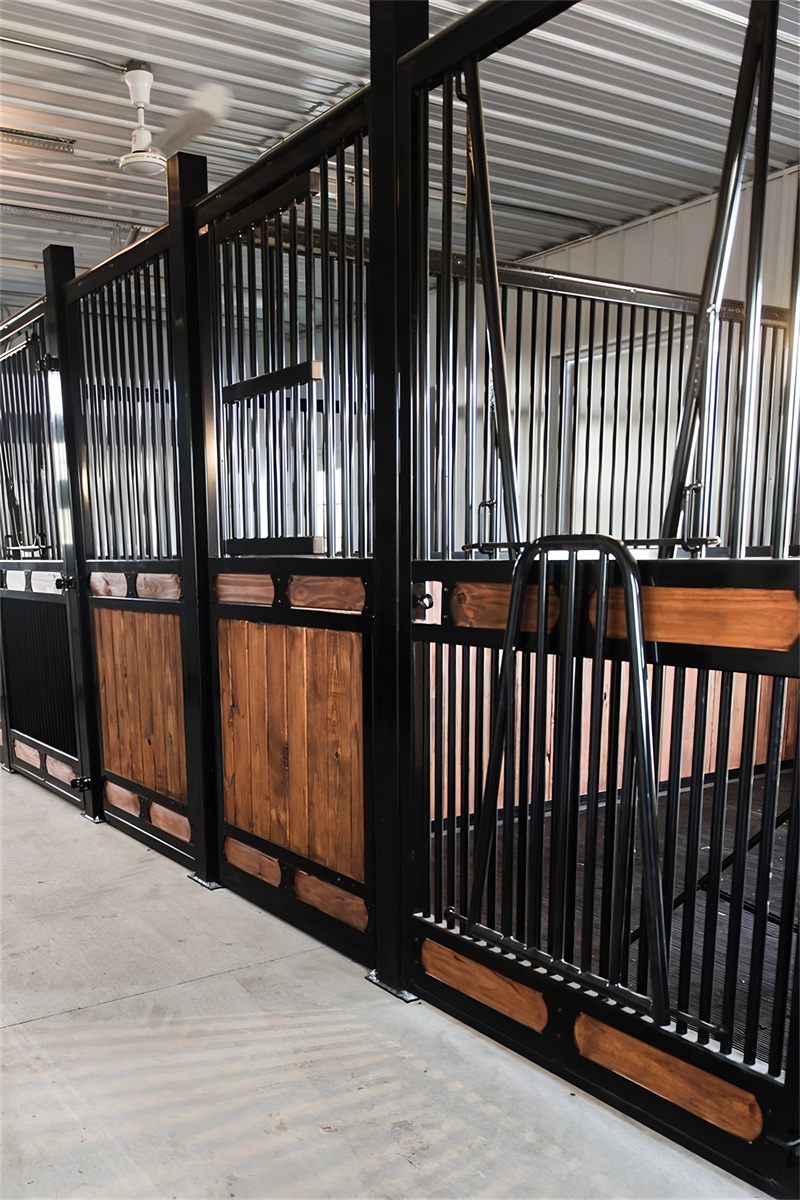
40HQ Container Loading Capacity
Flat-pack horse stable kits achieve a 40% CBM reduction over pre-assembled units, loading 30-45 sets per standard 40HQ container. This eliminates open-top containers and the MPI scrutiny they trigger.
CBM Reduction and Per-Unit Freight Cost
Flat-pack configuration collapses the hot-dip galvanized steel frames and 10mm UV-resistant HDPE wall boards into layered, part-numbered component stacks. Pre-assembled horse stables ship with significant void space around the structural frame and roof pitch. Our flat-pack method eliminates that dead volume, yielding a consistent 40% CBM reduction per stall set.
This compression directly lowers your per-unit freight allocation. A standard 40HQ container holds 30-45 flat-pack stall sets depending on configuration—single standalone units with roofs occupy more cubic volume than back-to-back quadruple configurations sharing dividing walls. Calculate your exact landed cost per stall by dividing the total FOB freight quote by the set count, then add the NZD 350-600 DTHC fee split across those same units.
Elimination of Open-Top Container Requirements
Pre-assembled or partially assembled stables exceed the 2.59m internal height of a standard 40HQ dry container. Shippers work around this by booking open-top containers, which carry a premium surcharge over standard dry boxes and severely restrict vessel availability out of Chinese ports. Flat-pack component stacks fit within standard 40HQ dimensions without exception.
Eliminating open-top containers removes a line-item cost from your project spreadsheet and locks in standard equipment availability. You no longer depend on specialized container positioning at the origin port, which frequently causes rolling delays and pushes your 20-day MPI import entry lodgment window to the limit.
MPI Scrutiny Reduction Through Container Type
Open-top containers require canvas tarpaulin covers sealed with steel strapping. This non-standard closure method flags differently in the MPI risk profiling system than standard dry container doors sealed with tamper-evident bolts. MPI physical inspections triggered by vague bills of lading add $200+ in direct fees per container, and idle crew wages during container holds exceed $4,200 per day.
Standard 40HQ dry containers present a conventional sealing profile that MPI officers process through normal unloading protocols. Combine the standard container with a precise Bill of Lading description—listing “prefabricated galvanized steel shelter components, HS Code 9406” rather than the generic word “galvanized”—and you remove both the container-type anomaly and the terminology trigger that cause physical inspections. Zero structural timber in the flat-pack frame further eliminates the primary ISPM-15 biosecurity risk vector, provided your dunnage timber carries compliant HT/MB stamps with photographic proof before the container leaves origin.

ISPM-15 Timber Packing Requirements
Missing ISPM-15 stamps on dunnage triggers mandatory re-export or on-site fumigation at your expense. Demand photographic proof before the container leaves origin.
Mandatory ISPM-15 HT/MB Stamps for All Shipping Dunnage
Flat-pack steel horse stable kits contain zero structural timber in the walls or framing, which eliminates the primary biosecurity risk vector. Dunnage timber used to secure the load inside the 40HQ container is a separate matter entirely. New Zealand MPI requires every piece of timber dunnage touching your shipment to carry a valid ISPM-15 stamp.
The stamp must display the IPPC logo, the country code (CN for China), the treatment code (HT for Heat Treatment or MB for Methyl Bromide), and the certified facility registration number. Stamps missing any of these four elements fail compliance on arrival. Verify this with your supplier before they load the container, not after it lands at Ports of Auckland or Tauranga.
Penalties for Missing or Illegible Stamps
MPI treats unstamped, partially stamped, or illegible dunnage as untreated wood. There is no margin for interpretation and no appeals process at the port. The consequences hit your fixed-price contract directly.
- Re-export order: MPI forces the entire container back to origin at the importer’s freight cost.
- On-site fumigation: If MPI allows treatment at port, expect NZD 800-1,500 in fumigation charges plus the associated delay fees.
- Crew idle costs: A container hold triggered by dunnage non-compliance stops your installation crew. Idle crew wages exceed NZD 4,200 per day while you wait for MPI clearance.
A smudged stamp is treated identically to no stamp. Print quality on the dunnage brand matters as much as the treatment itself.
Photographic Proof in Pre-Shipment Documentation
Require your factory to provide clear, date-stamped photographs of ISPM-15 branding on every dunnage piece before the container seals. These photographs must be part of your pre-shipment inspection package, not sent as an afterthought via email after loading.
This documentation is your sole evidence if MPI disputes stamp legibility during a physical inspection. Without photographic proof tied to the specific container and bill of lading, you have no recourse to argue the timber was compliant at origin. Specify this requirement in your purchase order terms. Make it a condition of payment release, not a polite request.
Customs Broker Selection Steps
Engage your NZ-registered customs broker before the container leaves origin. Post-arrival engagement guarantees MPI holds that burn $4,200/day in idle crew wages.
Pre-Shipment Engagement Requirement
Do not wait until the vessel reaches New Zealand waters. Your broker must receive all documentation during the ocean transit period to pre-clear the electronic import entry. The primary reason is the Bill of Lading phrasing. If the B/L lists “galvanized steel” without specifying “hot-dip galvanized steel frames, HS Code 9406,” MPI will flag the container for a physical inspection. That inspection adds $200+ in direct fees and delays container release by 24 to 48 hours, directly impacting your fixed-price labor budget.
Required Documentation Submission
Submit these four documents to your broker within 48 hours of the vessel departing the loading port. Missing or inconsistent data across these documents is the root cause of 90% of MPI holds on prefabricated building imports.
- Commercial Invoice: Must state CIF value in NZD, itemize “hot-dip galvanized steel frames (42+ micron zinc coating)” and “10mm UV-resistant HDPE wall boards” separately, and reference HS Code Chapter 94.
- Packing List: Must list individual carton dimensions, total gross weight, and flat-pack configuration confirming 30-45 sets per 40HQ container.
- Bill of Lading: Must read “Prefabricated flat-pack horse stable kits, hot-dip galvanized steel and HDPE polymer.” Never use the standalone word “galvanized.”
- ISPM-15 Dunnage Declaration: Photographic proof of HT/MB stamps on all timber dunnage inside the container, even though the stable structure contains zero structural timber.
Broker Responsibilities
Your broker’s core function is submitting the electronic import entry through the New Zealand Customs Service system and facilitating MPI biosecurity clearance. Critically, the broker calculates and remits the 15% GST. This GST is calculated on the total CIF value, not the FOB factory price. If your supplier quoted you FOB and you are arranging freight separately, ensure your broker receives the accurate ocean freight and insurance costs to compute the correct GST liability. Underpayment triggers post-clearance audits that stall future imports.
20-Day Mandatory Lodgment Window
New Zealand Customs enforces a strict 20-day window from the date the container arrives at the port to the date the import entry is lodged and cleared. Failure to lodge within this window results in the container being moved to a bonded storage facility. Storage penalties and DTHC fees at NZ ports range from NZD 350 to 600 per 40HQ container, and these costs escalate daily. For contractors on fixed-price bids, this is unrecoverable margin loss. Confirm your broker has submitted the entry and received a clearance number before the container lands.
Post-Clearance Delivery Logistics
Routing errors after MPI clearance cost more than the inspection itself. Confirm every logistical node before the container lands.
Post-MPI Clearance Container Routing
Once MPI issues the clearance, the container must move immediately to either the final site or a de-stuffing warehouse. Leaving a cleared container at the port terminal accrues daily storage charges that compound rapidly. Direct-to-site delivery eliminates double-handling costs but requires confirmed site readiness before you instruct the carrier.
De-stuffing into a commercial warehouse adds NZD 300-500 in handling fees but protects your flat-pack kits from weather exposure during multi-day site preparation. For contractors running fixed-price bids, warehouse de-stuffing provides a controlled environment to verify part numbers against the packing list before dispatching components to site. Factor this handling cost into your landed cost per stall calculation.
Minimum Unloading Equipment Specifications
DB Stable ships flat-pack horse stable kits on heavy-duty steel pallets. Standard 1.5-tonne telehandlers will not safely lift these loads. Specify a 2-tonne minimum capacity forklift on site before scheduling container delivery. The fork carriage must reach the full depth of a 40HQ container to extract rear-positioned pallets without manual re-stacking.
- Minimum lift capacity: 2-tonne rated forklift
- Fork length: 1.8m minimum to clear container rear
- Mast height: 3.5m minimum for safe stacking of unloaded pallets
- Ground surface: Compact gravel or sealed surface rated for loaded forklift traffic
Arriving with underspecified equipment triggers a failed delivery. The carrier will apply a waiting time charge, return the container to the terminal, and you absorb the re-delivery fee plus additional port storage. Confirm equipment specifications in writing with your site crew 48 hours before the scheduled delivery window.
Pre-Delivery Site Access Confirmation
Last-mile access failures generate the most predictable and avoidable surcharges in the entire import process. Container trucks require a minimum 3.5m wide clearance, a turning radius of at least 25m, and vertical clearance of 4.5m for overhead power lines or tree canopies. Rural equestrian properties frequently fail one or more of these thresholds.
If the site cannot accommodate a 40HQ container truck, arrange a tilt-tray or flatbed transfer at a nearby commercial yard. This adds NZD 150-300 per trip but prevents a full failed delivery charge. Document site access dimensions with photographs and submit them to your freight forwarder as a condition of the delivery instruction. Do not rely on verbal confirmations from property managers.
Conclusion
Spec flat-pack hot-dip galvanized steel with HDPE boards for your next tender. Timber imports trigger MPI holds that burn $4,200 a day in idle crew wages. Steel flat-packs load 30-45 sets per 40HQ and kill the ISPM-15 rejection risk.
Demand the exact Chapter 94 HS code and DTHC fee ranges in the initial quote. Reject any CIF price lacking written ISPM-15 dunnage confirmation with photos. Lock in those landed costs before you bid the job.
Flat-pack steel eliminates timber biosecurity holds and cuts freight per stall. Demand exact DTHC fees and ISPM-15 dunnage proof before quoting your client.
Frequently Asked Questions
Do I pay import tax in NZ?
Yes, all commercial goods imported into New Zealand attract a 15% GST calculated on the total CIF value, which includes the cost of goods, insurance, and freight. For prefabricated steel stables from manufacturers like DB Stable, this tax applies to the full landed cost rather than your initial FOB factory price. Additionally, commercial shipments exceeding NZD 1,000 may incur further import duties depending on their specific HS code classification under Chapter 94 for prefabricated buildings.
What items are banned in NZ?
New Zealand enforces strict biosecurity laws that absolutely prohibit the importation of untreated timber and raw wood products. When importing flat-pack horse stables, any structural timber or wooden dunnage lacking valid ISPM-15 HT/MB stamps will immediately trigger a container hold or a costly re-export order. Furthermore, organic materials, seeds, and plant-based packing materials are strictly banned and must never be included in your shipping containers to ensure smooth customs clearance.
How much to import a horse?
This specific cost relates to live animal transport rather than the commercial importation of prefabricated stable structures. Transporting a live horse between locations like Auckland and Sydney typically costs approximately NZD 5,900 plus GST and broker fees. In contrast, importing commercial horse stables follows a distinct process governed by MPI biosecurity rules for steel and polymer materials, requiring only the standard 15% GST on the CIF value.
What is the 20% rule?
The 20% rule is a valuation metric that applies strictly to live horse imports in certain jurisdictions and has no relevance to stable structure imports. When calculating the landed cost for prefabricated portable stables, buyers must instead account for a 15% GST applied directly to the CIF value. You should also factor in any applicable tariffs based on the HS code for prefabricated buildings, along with standard destination terminal handling charges and customs broker fees.
How many stalls fit in a 40HQ?
A standard 40-foot high cube (40HQ) container can efficiently load between 30 and 45 flat-pack horse stall sets, depending heavily on the specific stable configuration. Single stables with individual roofs naturally consume more container volume than highly efficient back-to-back quadruple layouts. By utilizing flat-pack steel pallet loading methods, B2B buyers can maximize their shipping investment and entirely avoid the expensive open-top container surcharges required for pre-assembled units.