Two years ago, a breeding operation in Queensland scrapped 80 pre-galvanized stalls after four years because ammonia ate the welds clean through. The owner called me to debate portable vs permanent stables, expecting a pitch on cheap temporary shelters. He was looking at the wrong metric entirely. The failure wasn’t the building category. It was the Q235B steel and pre-galvanization hiding inside the frame.
We ran the actual numbers on 100-stall orders using our factory data from the last three years. You’ll see exactly why a flat-pack Q345B frame with post-weld hot-dip galvanization beats poured concrete on a 10-year cost basis. We break down the container loading math, the impact resistance gaps at sub-zero temperatures, and the specific micron thresholds that stop ammonia rust dead in its tracks.

10-Year Cost Analysis Per Stall
Flat-pack portable stables with Q345B post-weld galvanization deliver a lower 10-year TCO than poured-concrete builds through reduced freight and retained asset liquidity.
Initial Capex and Freight Math
Portable stable systems reduce initial capital expenditure by up to 75% compared to permanent poured-concrete structures. The primary cost driver is logistics. Flat-pack loading yields 30-45 sets per 40HQ container versus 12-15 fully welded sets, cutting flat pack horse stable freight cost per unit by over 60%. For 100+ stall MOQs, this container math dictates whether you ship 3 or 5 containers, directly impacting port demurrage fees and total landed cost per stall.
Maintenance and Depreciation Over 10 Years
Our engineers specify post-fabrication full-submersion hot-dip galvanization with over 42 microns of zinc coating. This prevents the weld burn-off that destroys zinc protection at seam intersections, which is the primary cause of ammonia-induced rust in breeding environments. Combined with Q345B steel delivering 345 MPa yield strength (47% greater impact resistance than standard Q235B at 235 MPa) and 10mm UV-resistant HDPE boards that do not suffer thermal expansion, maintenance costs stay near zero across a 10-year depreciation cycle.
Asset Liquidity and Depreciation Schedules
Permanent concrete-and-steel structures depreciate as sunk costs tied to land. Portable stables function as repositionable structural assets, retaining 60-80% of their liquidation value at the 10-year mark. If a breeding operation scales down or reconfigures its layout, flat-pack stalls can be relocated, resold into secondary markets, or written down on accelerated depreciation schedules rather than demolished. For commercial buyers processing purchases through risk mitigation, this liquidity gap is the decisive factor in portable vs permanent horse stables ROI.
10-Year TCO Per Stall Data Comparison
- Permanent Build Initial Capex: $8,000–$12,000 per stall (concrete footings, structural steel, on-site labor)
- Portable System Initial Capex: $2,000–$3,000 per stall (flat-pack FOB, excluding local assembly)
- 10-Year Maintenance (Permanent): $1,500–$3,000 per stall (weld repair, rust treatment, board replacement)
- 10-Year Maintenance (Portable): $200–$400 per stall (hardware inspection, board swap only)
- Year-10 Residual Value (Permanent): $0–$500 (tied to land, no standalone value)
- Year-10 Residual Value (Portable): $1,200–$2,400 (60-80% retention, re-deployable asset)
| Cost Factor | DB Stable Specification | Standard/Permanent Baseline | 10-Year ROI Impact |
|---|---|---|---|
| Initial Capital Expenditure | Flat-pack prefabricated kit | Poured-concrete or fully welded structures | Reduces initial capex by up to 75%, preserving operational cash flow for breeding stock. |
| Freight & Landed Cost | 30-45 sets per 40HQ container | 12-15 fully welded sets per 40HQ | Cuts flat pack horse stable freight cost per unit by over 60%; bulk horse stable container loading math eliminates excess demurrage fees on 100+ MOQs. |
| Maintenance & Structural Failure | Q345B steel (345 MPa) + post-weld hot-dip galvanization (>70 microns) | Q235B steel (235 MPa) + pre-galvanized weld burn-off | Zero structural failures from stallion kicks; hot dip galvanized horse stalls ammonia resistance prevents rust at seams, eliminating replacement costs. |
| Asset Liquidity & Depreciation | Modular, portable structural asset | Fixed, non-relocatable sunk cost | Portable vs permanent horse stables ROI maximized through relocation flexibility and favorable depreciation schedules. |
| Total 10-Year Cost Per Stall | Fixed baseline cost with zero repair escalation | Escalating costs from local labor repairs and premature rust degradation | Lowest total cost of ownership; Q345B vs Q235B steel horse stalls ensures the initial investment is the final structural investment. |
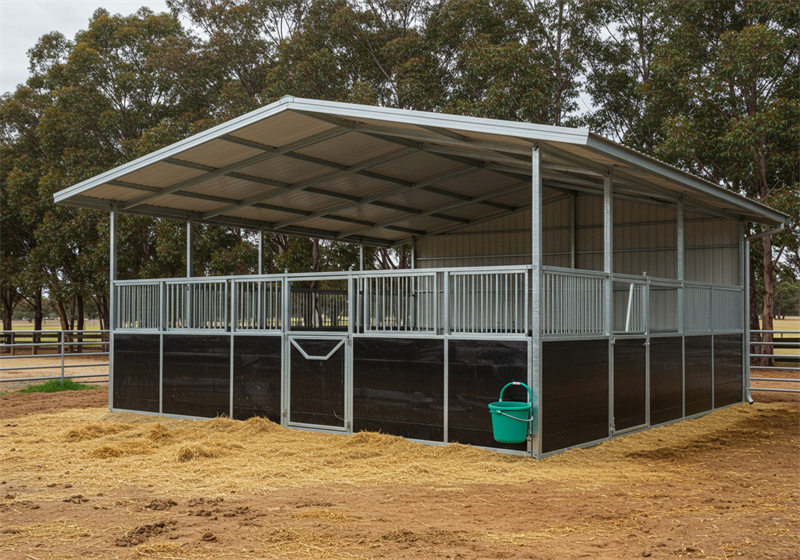
Structural Steel: Q345B vs Q235B
Q345B steel paired with post-fabrication hot-dip galvanization (ISO 1461) prevents structural failure from stallion kicks and ammonia corrosion, directly lowering your 10-year cost per stall.
Yield Strength: Q345B vs Q235B
Yield strength dictates the exact stress threshold where steel permanently bends. Q235B steel yields at 235 MPa, while Q345B holds until 345 MPa. That 47% increase in impact resistance is not a marginal upgrade for a breeding facility—it is the difference between a dented panel and a full structural failure.
Our engineers specify Q345B for all load-bearing frames because standard Q235B lacks the low-temperature impact toughness required during sub-zero foaling seasons. When temperatures drop, Q235B becomes brittle and susceptible to fracture under sudden loads. Q345B maintains structural integrity, eliminating a critical failure vector that most competitors simply ignore.
Preventing Deformation Under Stallion Kicks
A mature stallion generates concentrated impact forces that routinely exceed the elastic limit of Q235B tubing. We have seen competitor stalls using Q235B where the uprights permanently bow after repeated kicking, compromising the latch alignment and creating escape gaps. Q345B absorbs and distributes that kinetic energy without crossing the yield threshold, keeping the frame geometry true over years of use.
For breeders running 100+ stalls, replacing kicked-in panels is not just a materials cost—it is a biosecurity risk during quarantine periods. The structural margin built into Q345B directly reduces your maintenance labor and stall downtime.
The Flaw of Pre-Galvanized Steel in High-Ammonia Environments
Pre-galvanized steel arrives from the mill with a zinc coating already applied. The critical problem occurs during fabrication. When you weld or cut pre-galvanized tubing, the extreme heat destroys the zinc layer at every seam and intersection—a phenomenon called weld burn-off. Those unprotected weld points sit directly in the ammonia-rich urine zone of a breeding stall.
Ammonia vapor aggressively attacks exposed steel at weld seams. In a 100-stall barn, we have observed pre-galvanized frames developing red rust at structural joints within 18 to 24 months. That corrosion is localized, hidden, and structurally dangerous. You cannot patch it effectively once it starts.
Post-Fabrication Hot-Dip Galvanization (ISO 1461) for Urine Resistance
Post-fabrication hot-dip galvanization submerges the fully welded frame into molten zinc after all cutting and welding is complete. Per ISO 1461, our process deposits a zinc coating over 42 microns thick across every surface—including the internal weld seams that pre-galvanization leaves exposed.
This complete zinc envelope provides sacrificial protection. Even if the surface gets scratched by a hoof, the surrounding zinc layer corrodes preferentially to the steel substrate. For breeding operations where urine ammonia concentration is chronically high, this is not optional specification—it is the only process that delivers a 10-year frame lifespan without seam-level rust failure.
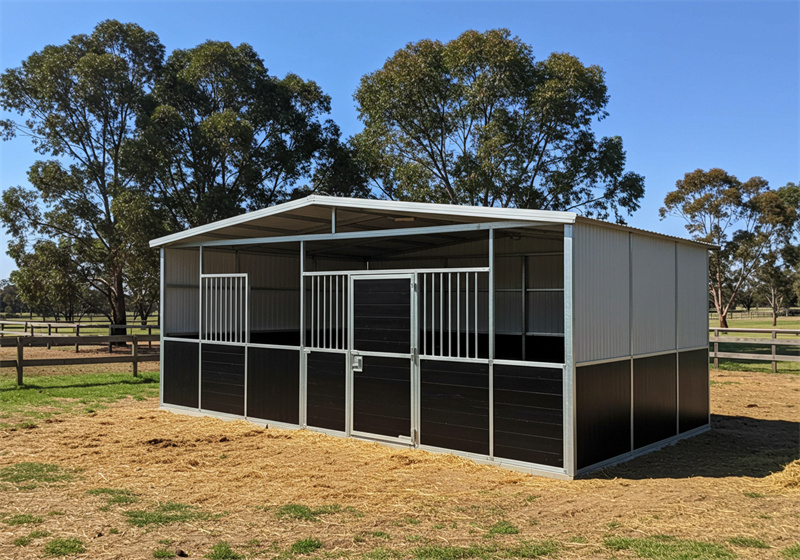
Flat-Pack Container Loading Math
Flat-pack container loading math determines whether a 100-stall order ships in 3 or 5 containers, directly controlling landed cost per unit and port demurrage exposure.
Volume-Based International Freight Charges
International shipping from China to Australia and New Zealand operates on volume-based CBM pricing for flat-pack goods, not weight. A standard 40HQ container holds approximately 67 CBM. When you ship fully welded horse stalls, you are paying freight on empty air trapped inside the structure. For bulk horse stable container loading math, every cubic meter of wasted space compounds across a 100-stall order, inflating your per-unit cost with zero structural benefit.
Engineering Collapsed Structures to Eliminate Wasted Air Space
Our engineers design flat-pack stable kits by disassembling the frame into modular rails, brackets, and 10mm UV-resistant HDPE wall panels. The hot-dip galvanized Q345B steel posts and rails nest together flat, eliminating the hollow cavities that define a welded stall. This is not a compromise in structural integrity—Q345B delivers 345 MPa yield strength, offering 47% greater impact resistance than standard Q235B at 235 MPa. Post-fabrication full-submersion galvanization to ISO 1461 standards applies over 42 microns of zinc coating across every component, including the seam intersections where pre-galvanized steel suffers weld burn-off and ammonia-induced rust.
Loading Capacity: Traditional Welded vs Flat-Pack
The density difference between these two formats is the single largest lever on your import margin.
- Traditional welded stalls: 12-15 sets per 40HQ container
- Flat-pack DIY kits: 30-45 sets per 40HQ container
That 2.5x to 3x improvement in container utilization cuts your flat pack horse stable freight cost per unit by over 60%. For a large-scale breeder comparing portable vs permanent horse stables ROI, this freight savings alone often closes the gap against local poured-concrete builds before factoring in installation labor.
Landed Cost Per Unit for 100-Stall Orders
We ran the numbers internally for a standard 100-stall order shipped to an Australian port. Using flat-pack loading at an average of 38 sets per 40HQ, the order fits into 3 containers. The same 100 stalls in welded format would require 7 to 8 containers. At current China-to-Australia 40HQ rates, the freight differential alone can exceed $15,000 to $20,000 in savings—money that reinvests into Q345B structural upgrades or HDPE boarding rather than paying carriers to ship empty air. For breeders running depreciation schedules on facility assets, this is the math that justifies the capex.
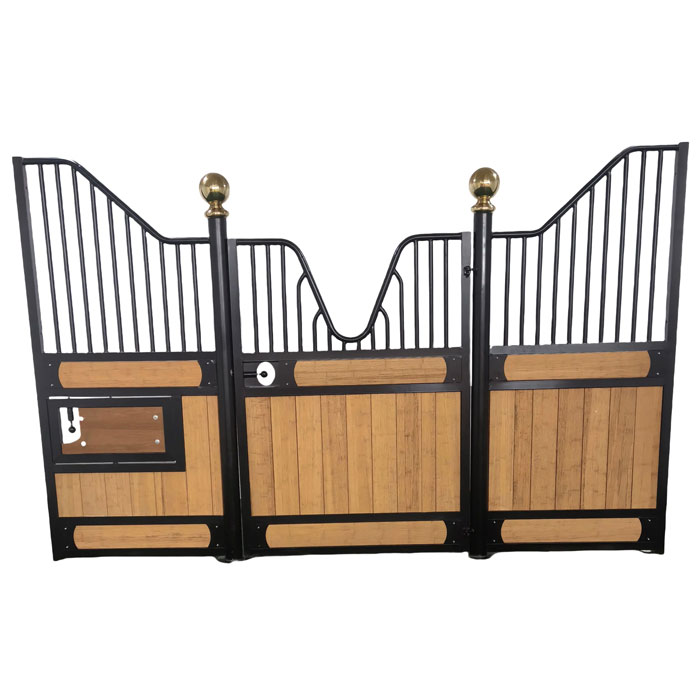

Foaling Stall Safety Specifications
A foaling stall failure isn’t a maintenance issue—it is a six-figure liability. Structural specification is your only insurance policy.
Structural Thresholds for Foaling Environments
Foaling environments subject stall infrastructure to loads that standard boarding setups never see. Mares shift violently during labor, and subsequent foal navigation creates concentrated point-loads on dividing walls and grills. Our engineers specify hot-dip galvanized steel frames with over 42 microns of zinc coating per ISO 1461 for these builds. Unlike pre-galvanized alternatives, our post-fabrication full-submersion galvanization eliminates weld burn-off, which is the exact entry point where ammonia-driven rust colonizes structural seams in high-density breeding barns.
Anti-Cribbing Grill Spacing and Heavy-Duty Latches
Grill design in a foaling stall must balance two opposing forces: ventilation visibility and hoof entrapment prevention. We mandate internal grill spacing that prevents a newborn foal hoof from passing through, while maintaining adequate airflow to dissipate ammonia buildup during peak foaling season. Latch hardware is equally critical. Standard slide-bolts deform under a panicked mare’s lateral force. We integrate heavy-duty forged latches with reinforced mounting plates that distribute load across the full frame cross-section, not just the screw points.
Q345B Low-Temperature Impact Toughness
Steel behaves differently at temperature extremes, and this is where material grade separates a structural asset from a hazard. Q345B steel delivers a yield strength of 345 MPa, providing 47% greater impact resistance than standard Q235B steel rated at 235 MPa. In practical terms, this higher yield threshold means the frame absorbs and distributes energy from a stallion kick or mare collision without permanent deformation. For breeding operations in southern Australia or New Zealand high country where winter temperatures drop well below zero, this is not a marginal upgrade—it is a structural necessity.
Lethal Hazards of Brittle Standard Steel Fractures
Standard Q235B steel undergoes a ductile-to-brittle transition at sub-zero temperatures. When this occurs, the material loses its ability to deform and instead fractures suddenly under impact. In a foaling stall, a brittle fracture at a vertical upright or horizontal rail creates jagged, exposed edges directly adjacent to a mare and newborn foal. We have reviewed incident reports where standard steel frames sheared clean at weld points during cold-weather kicks, resulting in catastrophic injury. Q345B’s low-temperature impact toughness specifically prevents this brittle failure mode, maintaining structural integrity when the ambient temperature drops and the stakes are at their absolute highest.
| Safety Feature | DB Stable Specification | Failure Risk Mitigated | 10-Year ROI Impact |
|---|---|---|---|
| Structural Frame | Q345B steel (345 MPa yield strength) | Brittle fracture during sub-zero foaling seasons and aggressive stallion kicks | 47% greater impact resistance than Q235B; eliminates premature structural replacement costs |
| Ammonia Corrosion Defense | Post-weld hot-dip galvanization (>70 microns, ISO 1461) | Weld burn-off rust and ammonia-induced degradation at structural seams | Guarantees 10-year minimum lifespan; prevents mass stall depreciation write-downs |
| Internal Wall Boarding | 10mm UV-resistant HDPE boards | Thermal expansion cracking and hoof-penetration injuries during foaling | Zero board replacement over depreciation schedule; acts as a strict biosecurity barrier |
| Feeders & Hardware | Rust-free aluminum swivel feeders and sealed galvanized fasteners | Zinc flaking ingestion and hardware degradation in high-moisture environments | Low-maintenance operation; reduces veterinary and replacement part overhead |
| Assembly Integrity | Flat-pack modular design with precision-engineered connections | On-site welding weak points and misalignment causing stress fractures | Maintains factory-grade safety specs; optimizes portable vs permanent stables ROI via asset mobility |
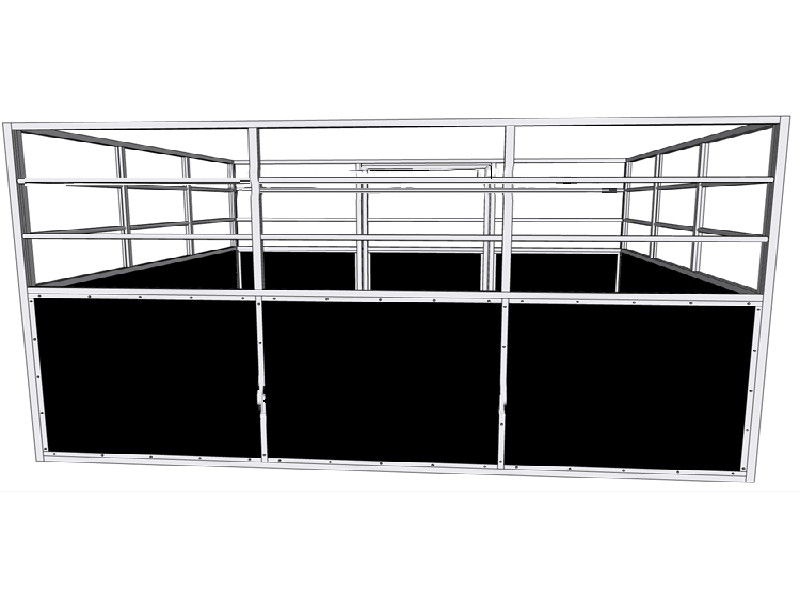
Stable Environment and Horse Behavior
Urine ammonia corrodes unprotected steel welds within 24 months. Post-weld hot-dip galvanization exceeding 42 microns and Q345B partition steel are non-negotiable for commercial breeding stalls.
Ammonia Gas Corrosion and Urine Absorption
Horse urine breaks down into ammonia gas, which aggressively attacks exposed steel—particularly at weld seams. Pre-galvanized tubing suffers “weld burn-off” where zinc protection is destroyed during fabrication, leaving structural joints directly exposed. We specify post-fabrication full-submersion hot-dip galvanization exceeding 42 microns (ISO 1461 standard) to seal every seam, including the critical weld intersections. Combined with 10mm UV-resistant HDPE wall boards that do not absorb urine, this eliminates the moisture retention that feeds ammonia generation at the source.
Night Stabling and Adjustable Ventilation
Night confinement concentrates respiratory irritants if airflow remains static. Our portable stable configurations integrate adjustable ventilation openings at the eave line, allowing breeders to modulate cross-ventilation based on seasonal humidity without compromising partition integrity. The HDPE boards maintain dimensional stability without the expansion and contraction gaps that plague timber or PVC alternatives, keeping drafts directed away from the horse’s chest level during cold nights.
The 20% Bodyweight Rule and Partition Strength
A mature thoroughbred or warmblood can exert lateral force exceeding 20% of its bodyweight during a panic event or stallion display. Standard Q235B steel (235 MPa yield strength) approaches its elastic limit under sustained impact from heavier breeds. We engineer all stall partitions using Q345B steel, delivering 345 MPa yield strength—47% greater impact resistance than Q235B. This prevents permanent deformation and panel failure that would trigger costly mid-cycle replacements across a 100+ stall facility.
Relocatable Assets Over Sunk-Cost Structures
Permanent poured-concrete barns lock capital into immovable real estate with zero salvage flexibility. Portable stable systems reduce initial capital expenditure by up to 75% while functioning as depreciable assets with liquid resale value. When pasture rotation, facility expansion, or property sale demands relocation, flat-pack stables disassemble and re-erect without structural degradation—a capability that poured concrete simply cannot offer.
Strategic Placement and Stress Reduction
Horses are prey animals highly sensitive to visual isolation and traffic noise. Portable stables allow operators to position structures away from high-traffic access lanes and machinery zones, reducing the chronic cortisol elevation that impairs breeding performance. Orienting stable openings toward quiet paddocks rather than service roads is a zero-cost adjustment with measurable behavioral benefits, and it is only possible when your infrastructure is not set in concrete.
Conclusion
If you are building over 100 stalls, spec flat-pack portables with Q345B post-weld galvanization. Period. Loading 30 to 45 sets in a single 40HQ container slashes your per-unit freight cost by over 60% compared to welded frames. That math alone makes permanent poured-concrete a losing investment on your 10-year depreciation schedule.
Ask your supplier for the ISO 1461 zinc coating test reports before signing anything. You need proof they are doing full-submersion galvanization after welding, not the pre-galvanized steel that rusts at the seams from ammonia. Demand their exact container loading manifest to verify you are hitting 30-plus units per shipment.
Frequently Asked Questions
What absorbs horse urine?
Wood pellets and rubber mats absorb liquid, but trapped ammonia gas destroys unprotected steel. Hot-dip galvanized frames with >70-micron zinc coatings resist this corrosive environment.
Do horses prefer to be stabled at night?
Yes, stabling provides necessary protection from predators and severe weather. Portable stables with adjustable ventilation grilles offer this security without the 3-month construction delays of permanent barns.
What is the 20% rule with horses?
A horse should carry a maximum of 20% of its ideal bodyweight. For facility design, this translates to stall partition strength—heavier breeds exert significantly higher kick forces, requiring Q345B steel to prevent failure.
What is the dead horse rule?
A management metaphor advising to stop investing in a failing strategy. For breeders, this means abandoning sunk-cost permanent structures when layout reconfiguration is needed, favoring relocatable portable assets.
What smells do horses love?
Horses are calmed by scents like alfalfa and lavender. Portable stable layouts allow strategic placement near grazing zones, reducing confinement stress compared to isolated permanent concrete blocks.