Agistment stables Australia-wide work harder than any private stable on the property. Horses come and go, every new arrival chews, kicks and paws, and each vacancy turnaround starts with a wash-down. If the land is leased, the stables themselves may need to move when the lease ends. The specification you sign off before the deposit decides whether the block survives that duty cycle for years — or turns into a maintenance liability by the second season.
This guide sets out what to specify before you buy, drawn from DB Stable’s factory specification for the ANZ market: panel fill, frame and galvanising, row configuration maths, hygiene hardware, roofs and ordering at commercial scale. It is written for agistment operators, equestrian centre managers and the builders who supply them.
Key takeaways
- Panel fill: specify 10mm HDPE board — UV-resistant, antibacterial, washable, chew-resistant, with kick cushioning.
- Frame: Q235 steel, 50×50×2.0mm square tube, fully welded, hot-dip galvanised to at least 42 microns under AS/NZS 4680.
- Configuration maths: a 6-stall back-to-back row uses 11 side panels and 6 gates — the shared spine is where multi-stall value comes from.
- Relocatable by design: tool-free corner pins, 2–3 people, around 30 minutes per stable — the asset can follow your lease.
- Ordering scale: minimum order is 10 sets, with factory capacity of about 20 sets per week.
- Turnover hardware: rust-free aluminium swivel feeders, stainless steel door latches, water bowls, rug rails and wash bay positions are all available as accessories.
What agistment duty does to a stable
A privately owned stable houses one known horse. An agistment stable houses a rolling cast of strangers: the wind-sucker who tests every edge with his teeth, the paddock bully who kicks the back wall when dinner runs late, the newcomer who paws at the gate. Multiply that across a full row and a year of turnovers, and the failure points concentrate in exactly two places — the panel fill and the frame joints.
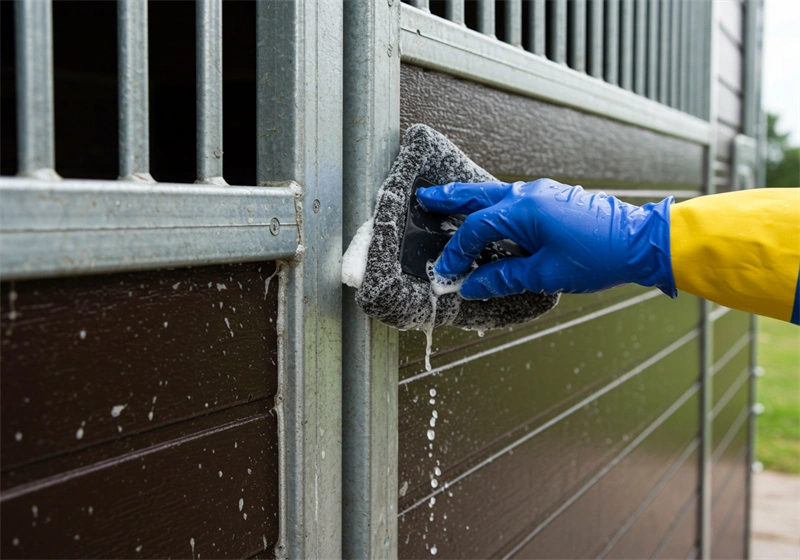
Then there is the washing. Between horses, and under most property biosecurity routines, walls get hosed and scrubbed. Timber linings swell, sheet steel rusts at the screw lines, and both grow a cleaning burden the operator pays for every single turnover. The fill material is the single biggest driver of how that cycle feels after year two.
The most expensive agistment stable is the one specified like a private stable. Every dollar saved on panel thickness comes back as maintenance hours at commercial turnover rates.
Leased land adds one more requirement: the stables are business plant, and business plant should be able to leave with the business. A flat-pack stable on tool-free corner pins is an asset you can relocate; a slab-fixed, site-welded shed is a landlord negotiation.

The specification that decides service life
Two components carry nearly all of the duty in an agistment row: the panel fill and the steel frame. DB Stable’s factory specification for the ANZ market is built around exactly this load profile, and the numbers below are the ones to hold any quote against.
| Component | Factory specification | Why it matters for agistment |
|---|---|---|
| Panel fill | 10mm HDPE board, 2844×1194mm or 3494×1194mm | Chew-resistant, washable, antibacterial, kick cushioning |
| Frame | Q235 steel, 50×50×2.0mm square tube, fully welded | Rigidity under repeated kicking and leaning |
| Surface treatment | Hot-dip galvanised, min. 42 microns, to AS/NZS 4680 | Corrosion protection for outdoor rows and wash-down moisture |
| Front mesh | 4.0mm wire, 50×50mm apertures | Airflow and horse-to-horse visibility without climb-out gaps |
| Front wall / doors | 2200mm high; 1150mm or 1300mm wide; door HDPE 1024×1054×10mm | Safe handler access; solid lower door panel resists pawing |
The HDPE fill deserves the closest attention, because it is what your hose meets at every turnover. High-density polyethylene board does not rot, does not need repainting, withstands UV exposure, resists chewing, and gives a degree of cushioning when a horse kicks — timber and plain sheet steel do none of those things together. It comes in black, white or green. When comparing quotes, treat any panel fill thinner than 10mm as a different product class, not a discount.
Configuration maths: plan the row before you order
Portable stables are sold as panels and gates that combine into rows, and the combination table is where the per-stall cost curve lives. Adjacent stalls share side panels, and a back-to-back row shares an entire spine. The official configuration count looks like this:
| Configuration | Side panels | Gates |
|---|---|---|
| 1 stable | 3 | 1 |
| 2 stables (adjacent) | 5 | 2 |
| 3 stables | 7 | 3 |
| 4 stables | 9 | 4 |
| 5 stables | 11 | 5 |
| 6 stables (back-to-back) | 11 | 6 |
Read the last two rows twice. A 6-stall back-to-back block needs the same 11 side panels as a single row of 5 — the shared spine is what makes it the efficient layout for agistment paddocks. Bodies run 2200mm high, in 3000mm or 3600mm lengths, with double-unit joining for wider bays, so the row can be tuned to the site rather than the site bulldozed to fit the row.
Doors are a configuration decision in their own right. Swinging double doors are the standard; sliding doors on a 2950mm double-wheel track and barn-style doors are options, and a high-traffic agistment aisle is exactly where sliding doors stop horses and handlers sharing a swing arc. Decide the door map for the whole row before ordering, because retrofitting door types later means new front walls.
Hygiene hardware for horse turnover
Between-horse cleaning is where agistment stables earn or lose their keep, and it extends past the wall panels to every fitting a horse’s muzzle and a hose can reach. Specify hardware that survives water and stable chemistry on day one.
- Feeder: the swivel feeder is available in rust-free aluminium rather than galvanised steel — aluminium does not shed rust streaks onto a washed wall, and it swings clear for cleaning and filling from the aisle.
- Latches: stainless steel door latches stand up to wash-downs and daily use without the seizing and staining that plated hardware develops.
- Water and hay: water bowls and hay racks mount on the same panel system, keeping fittings inside the washable envelope rather than on ad-hoc brackets.
- Handler fittings: rug rails and tie rings organise the daily routine; a wash bay position can be planned into the row from the start.
Put together, the point is simple: the 10mm HDPE walls are washable and antibacterial, so fit them out with hardware that is equally happy being hosed. A washable wall with rusting steel fittings is a half-finished biosecurity routine.

Roofs, shade and airflow
For most Australian and New Zealand agistment sites, a roof is less about rain and more about summer shade and dry feed. The standard roof option is Colorbond. The raised steel roof option takes body clearance to 2.65m, runs 4.6m long, and pushes the front eave 70cm out over the aisle — that overhang shades the front of the stall through the middle of the day and keeps the door area usable in rain.
Airflow is the quieter half of the roof decision. The 4.0mm wire mesh fronts on 50×50mm apertures let air move through the row while keeping the visual and physical contact between horses where you want it. Decide orientation early — roof, runoff and prevailing wind all read off the same site plan, and rotating the row on paper is cheaper than after the first summer.
Ordering at agistment scale
Agistment buying is buying in rows, not units, and the commercial terms reflect that. DB Stable’s minimum order is 10 sets, with production capacity of about 20 sets per week — enough for a staged rollout where row one goes in, occupancy builds, and rows two and three follow. Enquiries are answered within 6 hours, and drawings or reference photos turn into a quoted plan within 24 hours, so configuration options can be costed before committing. Third-party QC inspection is available before dispatch, and flat-pack packing keeps sea freight volume — and therefore landed cost per stall — down.
If you are early in the process, our guides on choosing a China portable horse stable manufacturer and the 12-point supplier vetting checklist cover the factory-side questions worth asking before a deposit. For the product itself, the portable horse stable range page sets out the full specification, and the same panel system extends into yards and shelters if the master plan calls for them.
Frequently Asked Questions
What is the minimum order for agistment stables?
The minimum order is 10 sets. At commercial capacity of about 20 sets per week, a staged rollout — one row first, further rows as occupancy builds — fits the same production line.
Can I relocate the stables to another property?
Yes. The tool-free corner pin system means 2–3 people assemble a stable in around 30 minutes, and the reverse works the same way. Each panel runs about 200kg, so plan machinery or a handler for moving a full row.
Are HDPE panels hygienic for shared facilities?
Yes. The 10mm HDPE board is antibacterial and washable, does not rot, and needs no repainting — it is specified for exactly the hose-down routine shared agistment facilities run between horses.
Do agistment rows need roofs?
Not always, but for most AU sites shade pays for itself in horse comfort and feed condition. A Colorbond roof is the standard option; the raised roof option gives 2.65m clearance with a 70cm front eave overhang for aisle shade.
How fast can I get a quote for a full row?
Send drawings or reference photos with your stall count and layout. Enquiries are answered within 6 hours and a quoted plan comes back within 24 hours, so configuration options can be costed before committing.
Conclusion
An agistment row is a working asset, and its whole-life cost is set in the specification: 10mm HDPE fill on hot-dip galvanised Q235 frames, a back-to-back layout that shares its spine, wash-down-rated hardware, and a roof plan matched to the site’s summer. Get those right and the row survives turnover, weather and a lease change; get them wrong and every saving resurfaces as maintenance.
Before you commit to any supplier, hold every quote for agistment stables Australia-wide to the same numbers: 10mm fill, 42-micron galvanising, and the configuration table above. DB Stable answers enquiries within 6 hours and returns a quoted plan from your drawings within 24 hours.