Search for DIY horse stable kit tools and you will mostly find spanner lists written for bolt-together stables. A DB Stable kit takes a different route: the panels join on tool-free corner pins, and a crew of two to three people assembles one stable in around 30 minutes. No drills. No fastener bags to count. The tools that decide your build day sit on the ground around the kit, not inside the box.
Each side panel lands at roughly 200 kg in two HDPE sizes (2844×1194×10 mm and 3494×1194×10 mm), and a six-bay back-to-back run puts 11 panels and 6 gates on your pad. Sort the site tools, handling gear and PPE before the truck arrives. Skip them, and the day vanishes somewhere between the tailgate and the footprint.
Key Takeaways
- No assembly tools: corner pins join everything — 2–3 people, around 30 minutes per stable, no spanners or fasteners.
- Panel weight is the real issue: each side panel weighs about 200 kg (2844×1194×10 mm or 3494×1194×10 mm HDPE on a Q235 frame), so plan mechanical lifting.
- Protect the coating: frames are hot-dip galvanised to 42 μm or more under AS/NZS 4680 — lift with soft slings, not chains.
- Configuration drives handling: runs scale from 1 bay (3 side panels + 1 gate) to 6 bays back-to-back (11 panels + 6 gates).
- Minimum order is 10 sets: the smallest consignment is still a full lifting and staging job.
The Real DIY Horse Stable Kit Tools List Starts with Site Prep
The kit needs no tools to build, but your site needs tools to receive it. Every item here has one job: getting a flat-packed consignment from the truck onto a square, level footprint. Get the geometry right and the corner pins handle the rest.

Three cheap tools do most of that work. A spirit level tells you whether the pad is flat before a 200 kg panel lands on it. A string line squares the footprint — an out-of-square row only shows up at the last gate, where it costs most to correct. Marking paint transfers the string line onto the pad so the crew can stage panels straight off the truck, bay by bay.
Add a tape measure. The standard bay height is 2200 mm, gates come in 1150 mm or 1300 mm widths, and the raised steel roof option lifts the profile to 2.65 m. Check those clearances against shed doors and power lines before the truck books its slot, then paint the bay positions and leave a lane for the lifting machine.
Delivery-Day Site Checklist
| Item | Purpose | When to Do It |
|---|---|---|
| Spirit level | Confirm pad flatness before panels land | 1–2 days before delivery |
| String line | Square the footprint and wall lines | Day before delivery |
| Marking paint | Mark bay positions and staging area | Day before delivery |
| Soft slings | Lift 200 kg panels without marking the coating | Delivery day |
| Gloves and hi-vis | PPE for unloading near plant and trucks | Delivery day |
| Packing list and camera | Count and photograph panels on arrival | Delivery day |
Unloading and Handling 200 kg Panels
This is where flat-packed deliveries are won or lost. A side panel weighs about 200 kg, which is beyond safe manual handling for any crew — plan a forklift or telehandler, and confirm it can reach the truck bed before the driver arrives.
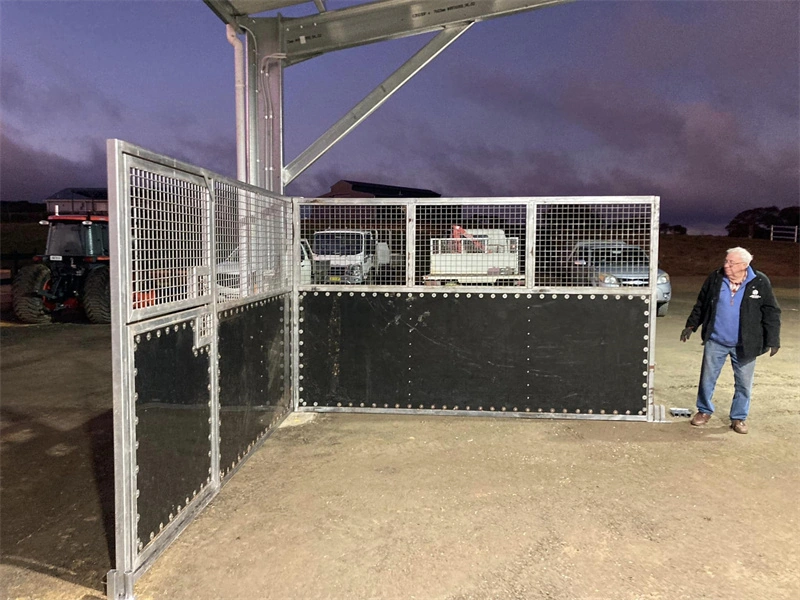
Use soft slings, not chains. The frames are Q235 steel, 50×50×2.0 mm square tube, hot-dip galvanised to 42 μm or more under AS/NZS 4680, the joint Australian and New Zealand standard for hot-dip galvanised structural steel. A chain can score that coating, and a scored coating is where rust starts. Wide soft slings spread the load and keep the finish intact.
Stage panels flat on timber bearers, in build order, close to their painted positions. Never drag a panel across concrete or gravel. The 10 mm HDPE infill shrugs off kicks and bites, but the galvanised frame is the part worth protecting.
PPE for the unload is non-negotiable:
- Gloves: panel edges and corner pins get handled all day.
- Steel-cap boots: a dropped corner pin is a nuisance; a dropped 200 kg panel is an incident report.
- Hi-vis vests: the truck driver and lifting operator share a tight pad.
- Hard hats: wear one whenever panels swing overhead on slings.
Match Your Crew and Gear to the Configuration
The site tool list scales with panel count, so start from the official configuration table. One bay is 3 side panels and 1 gate. A six-bay back-to-back run is 11 side panels and 6 gates — the two rows share the centre wall line, which is why 6 bays need only 11 panels.
Run the order maths before anything else. The minimum order is 10 sets: ten single-bay kits mean 30 side panels and 10 gates arriving together. At roughly 200 kg a panel, that is around six tonnes of panels alone — before you count the gates. Plan the pad, the machine hours and the crew for the consignment you actually ordered.
| Configuration | Side Panels | Gates | Handling Focus |
|---|---|---|---|
| 1 bay | 3 | 1 | One staging area beside the bay position |
| 2 bays (adjacent) | 5 | 2 | Stage panels along one straight wall line |
| 3 bays | 7 | 3 | Two staging points keep the row clear |
| 4 bays | 9 | 4 | Keep a full-length access lane beside the row |
| 5 bays | 11 | 5 | Leave swing room to rotate panels into position |
| 6 bays (back-to-back) | 11 | 6 | Stage both rows; build the shared centre wall first |
What Speeds Up a Multi-Bay Build Day
Assembly itself is quick: two to three people, around 30 minutes per stable, corner pins only. On a ten-set order that is roughly five hours of assembly in total. The build is not the bottleneck — everything around it is.
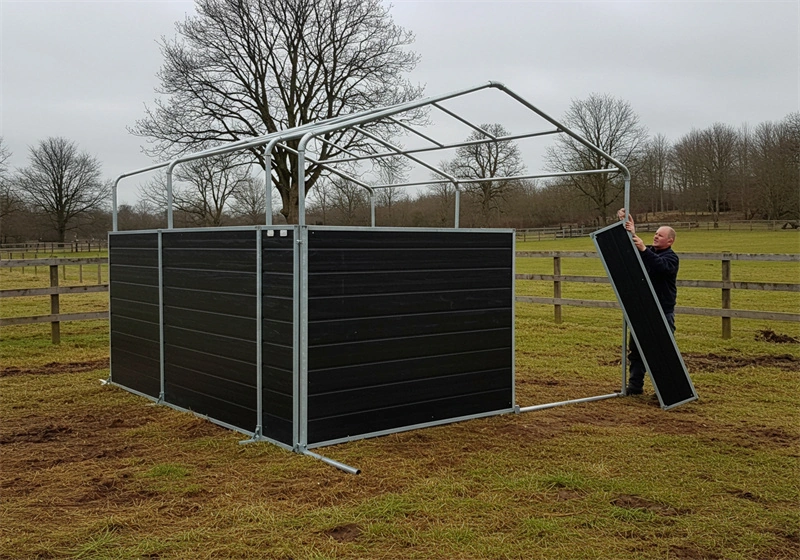
A few cheap items earn their keep on multi-bay runs. A second set of soft slings keeps one lift cycle from waiting on the next. A broom matters more than it sounds — sweeping gravel off the pad between lifts stops coating damage under staged panels. For the crew plan itself, our two-person stable assembly walkthrough covers roles, sequence and timing in detail.
Book third-party QC at the factory before the consignment ships if you want an independent set of eyes on it. On site, count every panel and gate against the packing list on the day — a shortfall found at 4 pm is a phone call; found next week it is a dispute.
The Tools You Don’t Need — and Why That Matters
Compare this with a bolt-together stable and the difference shows up fast. A bolted system arrives with fastener bags, needs tension checks on every joint and typically re-checking once the structure settles. One missing bag stops the build while someone drives to town. None of that applies here: corner pins, no fasteners, no power tools, no return visits.
For distributors and retailers, that changes the resale story. A farm customer with no tool inventory can still install the kit they bought from you — two to three people, half an hour, done. Fewer loose parts means fewer missing-part claims once a container has been opened.
Our position is blunt: if a portable stable needs a torque wrench, it is not really portable. The tool-free joint is the feature. The tool list around the truck is just good site management.
Frequently Asked Questions
What tools do I need to assemble a DIY horse stable kit from DB Stable?
None for the assembly itself. DB Stable kits join on tool-free corner pins, so a crew of two to three people builds one stable in around 30 minutes without spanners, drills or fasteners.
How heavy are the panels in a flat-packed stable consignment?
Each side panel weighs approximately 200 kg. Panels come in two HDPE sizes — 2844×1194×10 mm and 3494×1194×10 mm — on Q235 steel frames, so plan mechanical lifting rather than manpower.
Can I arrange quality inspection before the consignment ships from China?
Yes. Third-party QC inspection at the factory is available on request, and DB Stable answers enquiries within 6 hours and returns drawing-based quotes within 24 hours.
Do I need a forklift to unload a stable kit?
For 200 kg panels, plan for mechanical lifting — a forklift or telehandler with soft slings is the practical choice. Soft slings protect the hot-dip galvanised coating, which is applied to 42 μm or more under AS/NZS 4680.
Conclusion
A DB Stable kit asks almost nothing of your toolbox and a great deal of your site prep. Square the footprint, plan the lifting for 200 kg panels, protect the AS/NZS 4680 galvanised finish with soft slings, and scale the crew to the configuration table. Do that, and the 30-minute-per-stable assembly figure stops being a factory claim and becomes your schedule.
Before your next order, run through our checklist for choosing a portable horse stable supplier from China, or send your drawings straight to DB Stable — enquiries get a reply within 6 hours and drawing-based quotes within 24 hours. The earlier the configuration is locked, the earlier your site tool list writes itself.