Specifying recycled HDPE panels for stable infill sounds straightforward — until you ask a supplier what is actually in the board. “HDPE” on a datasheet names the polymer family, not whether the sheet was extruded from virgin resin, regrind, or an undisclosed blend. For importers and stable builders ordering from overseas, resin source sits behind the failure modes that matter: fading under Australian sun, brittleness after a cold winter, cracking where a kick lands. This is a specification checklist, not a material-science debate — honest comparative test data on recycled versus virgin HDPE in stable-panel service is thin on the ground, and any supplier quoting precise failure rates is guessing on your behalf.
The practical move is simpler than a lab report: pin the resin specification down in writing before the deposit leaves your account. Below is what DB Stable specifies on its own panels, the questions to put to any supplier, and why those questions matter — operator reasoning, not invented statistics.
Key Takeaways
- Panel spec, fixed: DB Stable uses 10mm thick HDPE infill — UV-resistant, antibacterial, washable, rot-proof, chew-resistant, with kick cushioning — in black, white or green.
- Sheet sizes: 2844×1194×10mm and 3494×1194×10mm side panels; 1024×1054×10mm door boards, all inside Q235 steel frames.
- Core question: “HDPE” does not disclose resin source. Ask any supplier to state virgin-versus-regrind content, UV package and thickness tolerance in writing.
- Why it matters: regrind can carry contaminants and alter melt flow between batches; UV stabiliser packages vary widely. Where a number is unknown, ask your supplier to state it in writing — never accept an “industry typical” figure.
- Our position: for export consignments, written resin specifications belong in the purchase order. Verbal assurances do not survive a warranty claim.
What DB Stable Specifies in Its HDPE Infill Panels
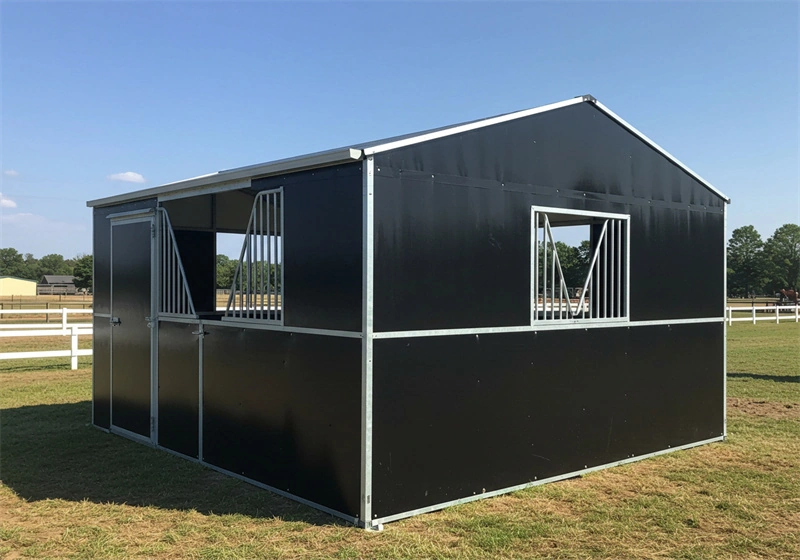
Start with the numbers we can stand behind, because they anchor everything that follows. Our side panels carry 10mm thick HDPE infill in two standard sizes: 2844×1194×10mm and 3494×1194×10mm. Doors use a 1024×1054×10mm HDPE board. The infill sits inside a fully welded Q235 steel frame of 50×50×2.0mm square tube, with 4.0mm wire mesh at 50×50mm openings. A single panel weighs roughly 200kg. The sheet itself is specified UV-resistant, antibacterial, washable, rot-proof and chew-resistant, with enough give to cushion kicks and protect hooves and legs — offered in black, white and green.

Those are the attributes we quote and the baseline for measuring any competing quote; the full configurations these panels slot into are on our portable horse stable page. Notice what is not on the list: a published virgin-versus-regrind ratio. That omission is honest, and it is the gap you should interrogate with every supplier — including us.
Recycled HDPE Panels: What We Will and Won’t Claim
Here is the uncomfortable truth about most recycled-versus-virgin content online: it quotes numbers nobody can trace. Lifespan differences, percentage strength losses, exact price deltas — if the source cannot show the test report behind the figure, the figure is marketing. We hold no comparative test data on recycled versus virgin HDPE in stable-panel service, and we will not manufacture any for a punchy paragraph.

What we can say is hedged and directional. Recycled HDPE is not one material — it is a family of inputs whose quality depends on how the feedstock was collected, sorted and reprocessed. Well-sorted, single-stream regrind can perform well; poorly sorted regrind can carry contaminants from other polymers, dirt or residues, and each pass through reprocessing can shift how the material flows and bonds when extruded into sheet. Virgin resin arrives with a consistent, documented composition. Neither statement is a performance guarantee — it is a statement about predictability, and predictability is what you are buying for a board that spends years in a stall. Whichever resin a supplier uses, the burden of proof sits with them, and the proof belongs in writing on the purchase order.
Why Resin Source Matters More Than the Label
Two properties of the sheet drive most real-world panel failures, and both trace to resin and additive choices rather than the “HDPE” label itself.
UV exposure. Australian and New Zealand UV loads are among the harshest on earth, and HDPE needs an adequate stabiliser package to survive them without chalking, fading or embrittling. Packages vary between resin suppliers, and recycled feedstock can complicate the picture — prior processing history may affect how stabilisers behave in the new sheet. A supplier who cannot describe their UV package is asking you to bet a multi-year installation on an unknown.
Batch consistency. A consignment is dozens or hundreds of panels, and customers notice if two in the same aisle differ in colour or finish. Documented virgin formulations tend to hold consistency more easily; regrind blended at varying ratios can drift. That is process-control reasoning, not a claim that one resin always wins — but it matters, because a brittle panel that cracks under a kick is a laceration risk, not a cosmetic issue. Chew resistance and impact give were reasons we specified 10mm HDPE in the first place; those attributes only hold if the sheet is what the datasheet says it is.
The Spec Questions to Put in Your Purchase Order
Stop debating resin philosophy with sales staff and put questions in the PO. A supplier’s reaction tells you as much as the answers — hesitation on any of these is a red flag in its own right.
| Question | Why it matters | Red flag answer |
|---|---|---|
| Is the resin virgin, regrind, or a blend — and at what ratio? | Contaminants and melt-flow variation in regrind can affect how the sheet ages and holds impact. | “It’s all premium HDPE” with no ratio disclosed. |
| What UV stabiliser package is used, and is it rated for AU/NZ sun? | Under-spec’d UV protection leads to chalking, fading and embrittlement over time. | “UV-resistant” as a bare phrase, no package named. |
| What is the thickness tolerance on the 10mm sheet? | Under-thickness at the low end erodes impact resistance and kick cushioning. | No tolerance stated, or “approximately 10mm”. |
| How is colour consistency held across batches (black/white/green)? | Distributors resell matched sets; batch drift shows up immediately in an installed aisle. | “Minor colour variation is normal” with no control process named. |
| What warranty applies to cracking and fading, and for how long? | The warranty is where a supplier’s resin confidence becomes enforceable. | Warranty excludes UV fading, or is verbal only. |
| What compliance and QC documentation ships with the consignment? | Written specs and inspection records are what you lean on if a claim arises. | “We can email something” — nothing attached to the PO. |
Ask the frame questions alongside these. Our Q235 frames are hot-dip galvanised to AS/NZS 4680 with a coating of 42 microns or more — that belongs in the same PO conversation as the resin spec, because the best HDPE infill in a poorly coated frame still fails at the welds. Scratched galvanising after landing gets a zinc-rich paint touch-up; the cheapest maintenance is the one done the week the scratch appears, not the year the rust blooms.
Writing Resin Specs Into the PO: Our Position
Here is where we stop being balanced. For export consignments — container loads of flat-packed panels crossing an ocean to an AU or NZ port — verbal resin assurances are worthless. By the time fading or cracking shows up in service, the container is long cleared and a verbal “it’s virgin material” has no purchase in a warranty discussion. The only specification that exists is the one written into the purchase order before production starts.
The clause is not complicated: resin source or blend ratio, UV stabiliser package, nominal thickness and tolerance, colour standard, and warranty terms on cracking and fading. Every supplier in this market says their HDPE is “high quality” — the phrase means nothing without the written spec behind it. A supplier who cannot fill in those blanks is telling you how they will behave when something goes wrong. We accept third-party QC inspection and answer enquiries within 6 hours; a buyer who cannot verify specifications in writing cannot hold a factory to them. And if a batch question arises after installation, the PO is what you compare delivered goods against — not a memory of a video call.
Frequently Asked Questions
Are recycled HDPE panels always lower quality than virgin?
Not necessarily — quality depends on how the feedstock was sorted and reprocessed, and no honest universal ranking exists without test data. Ask your supplier to state the resin source, blend ratio and UV package in writing, then judge the answer on its specificity.
How thick should HDPE stable infill panels be?
DB Stable specifies 10mm HDPE infill — 2844×1194×10mm and 3494×1194×10mm side panels, 1024×1054×10mm doors. Whatever a supplier quotes, confirm the thickness tolerance in the purchase order; nominal thickness without a tolerance is not a specification.
What colours does HDPE stable infill come in?
DB Stable offers black, white and green HDPE infill. If you resell matched sets, also ask how colour consistency is controlled between production batches — drift between delivery lots is what distributors notice first in an installed aisle.
What warranty should I ask for on HDPE panels?
Ask what the warranty covers on cracking and fading, and for how long — a warranty that excludes UV fading barely covers the main way HDPE panels age. Get the terms in the purchase order, not in an email thread.
Does the steel frame specification matter as much as the resin?
Yes — the frame carries the structural load. DB Stable uses fully welded Q235 steel, 50×50×2.0mm square tube, hot-dip galvanised to AS/NZS 4680 with a coating of 42 microns or more. Specify frame steel and galvanising in the same PO clause set as the resin.
Conclusion
The recycled-versus-virgin question has no honest single answer, and any article that hands you one is inventing it. What protects your consignment is specificity: 10mm UV-resistant, antibacterial, washable HDPE in a Q235 hot-dip galvanised frame, with resin source, UV package, thickness tolerance and warranty terms in the purchase order before the deposit is paid. Written specs turn a supplier’s confidence into something you can enforce.
Put the six PO questions in front of each supplier and compare the answers side by side. Then send your drawings to the factory that answered in writing — we answer enquiries within 6 hours and return costed proposals within 24.