An import documents checklist is what stands between a flat-pack stable consignment and a container sitting on the wharf. The core file is short — commercial invoice, packing list, bill of lading or air waybill — but each document has to agree with the others and with the physical cargo. The certificates that ride alongside them, ISPM 15 treatment records for any timber packaging and the inspection files you collect from the factory, are what your customs broker actually works from at clearance.
This guide walks through the import documents checklist for a stable consignment into Australia or New Zealand: what each core document does, which certificates apply to a steel-and-HDPE kit, and how the packing list should map to a panel-based order. The working examples are the flat-pack stable kits DB Stable has manufactured since 2013 for Australia and New Zealand customers, shipped in a flat-pack format that reduces sea freight volume container by container.
Key Takeaways
- Three documents clear most consignments: the commercial invoice, the packing list and the bill of lading or air waybill.
- Any solid timber packaging or dunnage must be treated and stamped to ISPM 15 — in Australia the conditions are enforced by DAFF through BICON.
- A timber-free kit (welded steel frames, HDPE panels) carries no timber in the goods themselves; the packaging declaration still needs to be in writing.
- The packing list should mirror the panel configuration exactly — a 3-stall row is 7 side panels and 3 gates, a 6-stall back-to-back row is 11 panels and 6 gates.
- Collect inspection and compliance documentation before dispatch, not at clearance — third-party QC inspection is available at the factory.
- Requirements vary by consignment; confirm the current position with your customs broker before the goods ship.
Your Import Documents Checklist: Invoice, Packing List, Bill of Lading
Commercial clearance runs on three documents, and every other piece of paper either supports or explains one of them. The commercial invoice records the transaction — who sold what to whom, at what value. The packing list records the physical consignment — what is in the container, bundled and counted, without pricing. The bill of lading (for sea freight) or air waybill (for air freight) records the carriage contract and is the document against which the cargo is released. Mismatch any two of the three and the clearance slows to the speed of the explanation.
| Document | What it records | Who produces it |
|---|---|---|
| Commercial invoice | The sale: parties, goods, values, terms | The seller / exporter |
| Packing list | The cargo: items, bundles, counts, weights | The seller / exporter |
| Bill of lading / air waybill | The carriage: shipper, consignee, route | The carrier / freight forwarder |
Two practical rules keep the core three consistent. First, fix the invoice wording before goods are packed — the description on the invoice is what the packing list enumerates and what the bill of lading summarises, so a late change to one ripples through all three. Second, check names and addresses character by character across the set, because the importer of record, the consignee and the invoice buyer are three roles a broker has to reconcile. The invoice value is the starting point for the customs value your GST is calculated on, so it is not a detail.

ISPM 15 and Timber Packaging Certificates
The certificate most stable importers get wrong is the one they never ordered. Under the international plant protection standard ISPM 15, solid timber packaging and dunnage — pallets, crates, bearers, bracing — must be treated and stamped with the official mark before it enters most biosecurity regimes, and in Australia the Department of Agriculture, Fisheries and Forestry enforces those conditions through BICON, its import conditions system. Unstamped timber packaging can trigger inspection and treatment regardless of what the BICON case said about the goods themselves.
A steel-and-HDPE kit takes most of the timber question out of the goods: welded Q235 frames, hot-dip galvanised with a factory-specified coating of 42 microns or more and the process run to AS/NZS 4680, clad in 10mm HDPE boards — there is no structural timber for a condition to attach to. But packaging is a separate question from product, so the specification to insist on is a written declaration from the factory covering both: what materials will pack the consignment, and confirmation that any solid timber in it is ISPM 15 treated and stamped. One specification option re-introduces timber on the product side — the hardwood front-wall facing — and our comparison of timber versus all-steel HDPE kits under BICON covers why importers shipping into Australia generally specify the plastic-coated facing instead.
QC Reports and Compliance Files
Beyond the clearance minimum sits the file that protects you commercially: inspection and compliance documentation. Third-party QC inspection at the factory is available on DB Stable orders — inspectors check the goods before dispatch while problems are still the factory’s to fix — and the time to ask what inspection and testing documentation the supplier can provide is before you pay the balance, not after the container is opened in Melbourne or Auckland. Ask for the specific list your market and your broker expect, and hold the shipping until the file matches it.
System certifications sit in the same folder. DB Stable operates under ISO and EN system certifications for its manufacturing, and the declaration belongs in your supplier file alongside the QC records — ask for the current certificates during supplier vetting rather than reconstructing the paper trail at clearance. Where any certificate’s exact scope or validity matters to a decision, verify it against the original document with your broker; a summary in a quotation is a pointer, not a record.
Make the Packing List Match the Consignment
Panel-based stables make the packing list easy to verify, because the arithmetic of a configuration is fixed. Every stall row is a known count of side panels and gates, so the packing list for your order can be checked line by line against the official configuration table before the goods leave the factory.
| Configuration | Side panels | Gates |
|---|---|---|
| 1 stall | 3 | 1 |
| 2 stalls (adjacent) | 5 | 2 |
| 3 stalls | 7 | 3 |
| 4 stalls | 9 | 4 |
| 5 stalls | 11 | 5 |
| 6 stalls (back-to-back) | 11 | 6 |
The check runs in both directions. Before dispatch, the packing list should reconcile to the table for your configuration, plus the accessories on your order — feeders, hay racks, drinking bowls, corner posts and the rest. On arrival, the same list becomes your receiving document: count the bundles before you sign, because a shortage found at unloading is a claim, and the same shortage found three weeks later is an argument. The flat-pack design that reduces sea freight volume also makes bundles compact and easy to miscount, so count against the list, not against the eye.
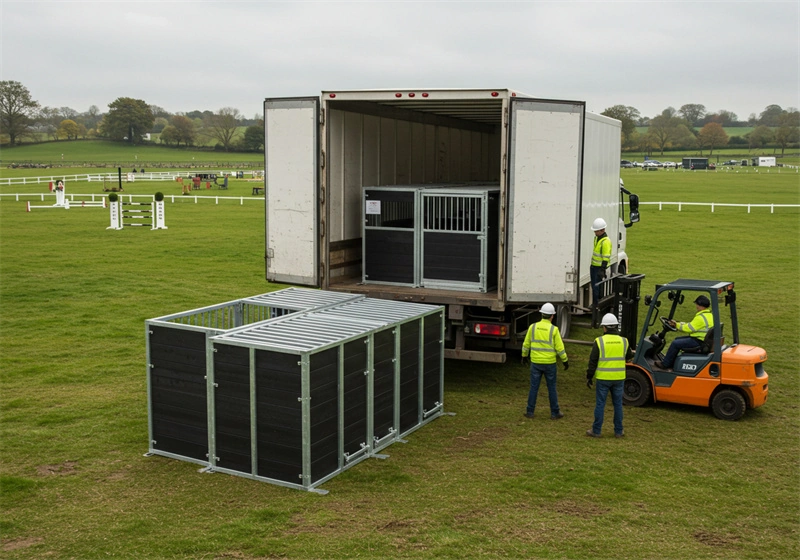
The transport document follows the freight mode. Sea freight carries a bill of lading; urgent orders can move by air freight at additional cost, in which case the air waybill replaces it and the rest of the file is unchanged. For the Australian side of the process after biosecurity clearance, our walkthrough of the import declaration for horse stables covers the lodging sequence in detail.
The Broker Handoff
Your broker clears cargo with the file you give them, so assemble it as one package: the core three documents, the packaging declaration with ISPM 15 confirmation for any timber, the QC and inspection records, and the supplier certificates. Send the file before the goods arrive rather than when the container is already on the wharf — a broker who has the documents in advance can tell you what is missing while the problem is still fixable by email.
Work the checklist backwards from the shipping date. At quote stage — DB Stable returns drawings-based quotes within 24 hours — confirm the packaging specification and the document set in writing. Before the balance payment, collect the QC and inspection file. Before dispatch, reconcile the packing list against the configuration table. Before arrival, hand the complete file to the broker. Each step takes minutes when it is scheduled and days when it is not.
Frequently Asked Questions
What documents do I need to import horse stables into Australia or New Zealand?
The core set is a commercial invoice, a packing list and a bill of lading or air waybill. Add ISPM 15 treatment certification for any solid timber packaging, plus any compliance or inspection records your broker requires — confirm the current specifics per consignment.
Does ISPM 15 apply if my stables are all steel and HDPE?
It applies to the packaging, not just the product. A steel-and-HDPE kit carries no timber in the goods, but any solid timber pallets, crates, bearers or bracing must still be treated and stamped to ISPM 15.
What is the difference between a bill of lading and an air waybill?
The bill of lading covers sea freight; the air waybill covers air freight. They serve the same role in the document set — recording the carriage contract — and air freight is available for urgent stable orders at additional cost.
Who prepares the packing list for a stable import?
The exporter prepares it, but the importer verifies it. Check the list against your panel configuration before dispatch — for example, a 3-stall row should show 7 side panels and 3 gates — and use the same list as your receiving document at unloading.
Do I need QC reports to clear customs?
QC reports are usually a commercial safeguard rather than a clearance requirement, but some consignments and markets require inspection documentation — ask your broker what applies to yours. Either way, collect the inspection file before you pay the balance.
Conclusion
The documentation for a stable import is a short list handled in the right order: agree the invoice description before packing, verify the packing list against the panel configuration before dispatch, secure the ISPM 15 and packaging declaration for anything timber, collect the QC and compliance file before the balance payment, and hand the complete package to your broker before the goods arrive. Every step is an email at the right time or a delay at the wrong one.
When you are ready to plan a consignment, request a quote from the DB Stable factory — send your drawings or reference images, receive the quotation within 24 hours, and settle the packaging and documentation specification in writing before production begins.