Sustainable equine construction rarely arrives as a philosophy. It arrives as a line on a tender sheet: recycled content, end-of-life pathway, coating system, and whether the supplier can evidence any of it. On a block in regional New South Wales or the Waikato, three materials carry almost the whole answer — the galvanised steel frame, the HDPE infill panel and the roof sheet.
Look at what a published specification actually states. A wall panel is a 50×50×2.0 mm square tube frame, fully welded in Q235 steel, holding a 10 mm HDPE sheet, and it weighs about 200 kg. Not one of those figures is a green claim, and every one of them decides how much maintenance the block burns through over its working life.
Key Takeaways
- Recyclable describes a material family; recycled content describes a batch. A tender line needs the second one, in writing.
- Coating claims should read as a factory specification of at least 42 microns, with the galvanising process run to AS/NZS 4680 — not as a value the standard requires.
- Fully welded Q235 frames reach a scrap stream as one material rather than a bolted assembly to sort; the infill still has to come out first.
- 10 mm HDPE is specified as UV-resistant, antibacterial, washable, rot-proof and bite-resistant, which deletes the repaint and preservative cycles that dominate timber upkeep.
- Freight per stall is the emissions figure an importer can audit, because flat pack, a 4 m box body and a bill of lading already exist.
What a green spec is actually asking
Green wording sorts into three columns: what the material becomes at end of life, what the block consumes in service, and what was spent moving it to site. Which one a council, a club or a government facility weights heaviest depends on its own policy. Read the specification you are handed rather than a generic checklist, and confirm current requirements with the authority or specifier before you price against it.
The service column is where a modern kit beats a timber build on plain arithmetic, and it needs no marketing. A 10 mm HDPE panel carries no paint system to strip and re-apply, no preservative to hose on each season, no treated timber leaching into a yard where horses stand and chew. Panel sizes of 2844×1194×10 mm or 3494×1194×10 mm are what a maintenance schedule gets written against. The end-of-life column is the one most often over-claimed. Recyclable is a property of a material family; recycled content is a fact about a specific batch of resin or steel. Bidders conflate the two constantly, and one who cannot separate them in writing has no business quoting a green spec.
The frame: coating, welds and the scrap stream
Steel is the easy half of the argument. Hot-dip galvanised structural sections are accepted by mainstream scrap steel recycling, and the zinc coating is not treated as something that disqualifies the melt. If a tender demands a recovery rate, take that figure from the recycler’s own documentation rather than from a supplier brochure.
What matters on the supply side is how the coating is written down. The defensible sentence reads: a factory specification of at least 42 microns, with the galvanising process run to AS/NZS 4680. It does not read “42 microns as required by AS/NZS 4680”. For steel in the 1.5 to 3.0 mm wall thickness range, that standard’s own minimum values are 45 microns local and 55 microns average, so a supplier claiming the standard demands 42 has either mis-read it or invented it. That single confusion is the fastest way for a coating claim to fall over in a technical review.
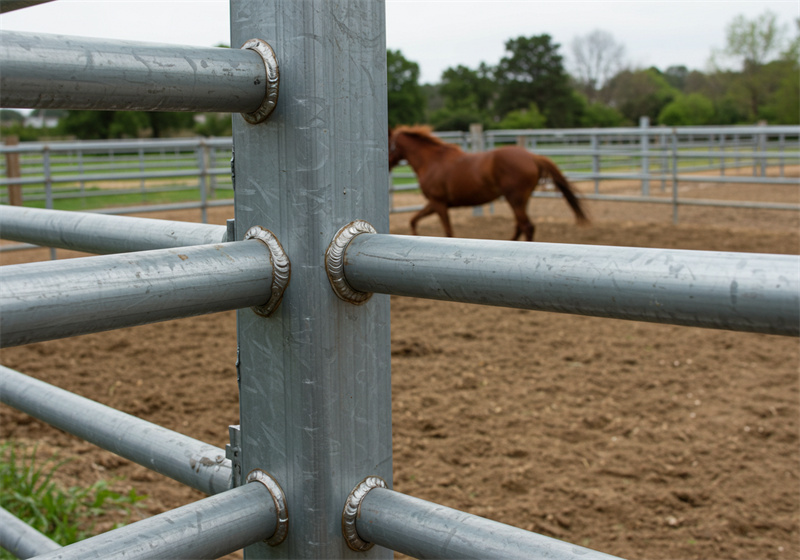
The joint deserves a line too. Frames here are fully welded — 50×50 mm square tube, 60×30 mm oval tube or 32 mm round tube in Q235 steel — rather than bolted from drilled pieces, so a retired frame is one material. The infill still has to be lifted out before the section goes to scrap, which is the practical advantage of a tool-free pin joint over a permanently fixed one.
Infill panels: maintenance beats the resin column
HDPE is resin identification code 2, one of the more widely collected plastics in Australia and New Zealand. On its own that tells a specifier nothing useful about a panel. A used sheet reaches a recycler only if somebody takes it out of the frame intact, keeps it out of mixed waste, and finds a reprocessor willing to handle UV-stabilised material aged by sun. Ask what happens to production offcuts and rejected panels before accepting a recyclability sentence; those streams already have a collection route.
The case that holds up is operational. The published specification lists the infill as UV-resistant, antibacterial, washable, rot-proof and bite-resistant, and as cushioning a kick in a way that protects the horse’s legs. Each property removes a recurring input a timber block keeps buying: paint, preservative, replacement boards sawn out of a chewed rail. The same washable surface is why turnover cleaning between horses is a hose-and-sponge job rather than a chemical cycle, covered in cleaning and disinfecting HDPE panels between horses, and the material trade-off sits in HDPE versus wood versus steel for DIY horse stables in Australia.
| Element | What a specification can state | What to demand in writing |
|---|---|---|
| Frame | Q235 tube, fully welded; at least 42 microns as a factory specification, process to AS/NZS 4680 | Coating basis recorded against your order, plus the third-party QC report |
| Infill | 10 mm HDPE, UV-resistant, antibacterial, washable, rot-proof; black, white or green | Resin grade, and the route for offcuts and rejected sheets |
| Roof | Colorbond option, or raised steel roof 2.65 m high, 4.6 m long, 70 cm front eave | Coating system and fixings, item by item, plus stainless latches and the aluminium swivel feeder |

Freight, service life and tender numbers
The third column is the one an importer can actually compute. A flat-pack kit moving in a standard container gives you a bill of lading, a shipped volume and a freight invoice. Portable construction and flat pack exist in the first place to cut shipped volume, and a calculation built on documents you already hold persuades a reviewer where a supplier’s environmental sentence does not. The published figures feeding it are the 4 m box body, a minimum order of 10 sets, capacity of about 20 sets a week, and air freight as the paid escape valve on urgent jobs.
Here is the position. If a specifier insists on choosing between a recycled-content sentence and a coating-thickness sentence, the coating thickness is the better environmental purchase. A frame re-coated early, or a panel replaced out of sequence, wastes far more than a slightly higher recycled fraction returns — and only one of those two figures is written into a specification you can hold anybody to.
Siting follows the same logic. A portable kit is often placed on prepared ground rather than a full slab, removing the concrete and earthworks a permanent building carries before the first horse arrives. Ground conditions change that answer — see rubber mats versus bare ground in portable stables before writing a ground spec.
Frequently Asked Questions
Are HDPE stable panels actually recyclable?
In principle, yes: HDPE is resin code 2 and is widely collected in AU/NZ. In practice a used panel has to come out of the frame intact, stay out of mixed waste and find a reprocessor willing to take sun-aged material, so recovery depends on the route you arrange, not on the resin alone.
Does hot-dip galvanising stop a steel stable frame being recycled?
No. Galvanised structural steel is accepted by mainstream scrap recycling and the coating is not treated as disqualifying. Write the coating basis into the order instead: at least 42 microns as a factory specification, with the process run to AS/NZS 4680.
What green documents can a stable supplier provide today?
Begin with what a published specification already states: material grades, section sizes, coating basis, and third-party QC inspection carried out at the factory. A general ISO and EN compliance statement carries no published certificate numbers, so ask for the specific document before a tender relies on it.
How should a green spec line be worded so it survives review?
One measurable figure per line, plus the evidence you will accept for it: coating of at least 42 microns as a factory specification under an AS/NZS 4680 process, 10 mm HDPE of a stated grade, fully welded Q235 sections, and a written answer on offcuts and rejected panels.
Conclusion
Sustainable equine construction holds up as a purchasing argument only where the claim is measurable. Coating thickness written as a factory specification against an AS/NZS 4680 process, panel figures a maintenance schedule can be written against, and freight volume already printed on shipping documents — those survive a reviewer. A recycled-content adjective does not.
Put the figures you need evidence for into the enquiry while drawings are still being quoted, and ask every bidder the same question: which of these sentences can you record against my order, batch by batch.