Sample approval horse stables importers sign off before mass production is a step the published ordering flow does not include — and that gap is where the risk sits. A flat pack is easy to approve on a drawing and hard to argue about once eleven panels are pinned up.
The documented sequence runs from your drawings to a quotation, then from a deposit into production and shipping. Nothing in it obliges a factory to put a physical unit in front of you first. That is a contract term you add, not a service you assume.
Key Takeaways
- The published flow is enquiry with drawings, a quoting response inside 24 hours, then mass production and shipping arranged after a deposit. A sample gate has to be written into the order because it is not in the flow.
- A single stall is three wall panels and one door, so one set is the cheapest physical reference you can buy. The published minimum order is ten sets, which makes a lone sample a negotiated line, not a default.
- Approve the sample against figures you can hold: 10 mm HDPE at 2844×1194×10 mm or 3494×1194×10 mm, 50×50×2.0 mm frame tube, 4.0 mm mesh wire at a 50×50 mm aperture, and doors at 1150 mm or 1300 mm.
- The coating claim is a factory specification of at least 42 microns with the galvanising process run to AS/NZS 4680. On a sample you can measure against that sentence; after a container you cannot.
- Capacity is about 20 sets a week, so a sample decision that stalls costs you a production slot, not just a day.
The gate you have to write in
Three documented facts set the shape of this problem. Quoting from drawings is answered inside 24 hours. Production and shipping are arranged after a deposit. The minimum order on this line is ten sets.
Put those together and the sample stage sits in the only window where you still have leverage: after the drawing is priced and before the deposit is paid. Once money has moved, a change to a door width or a panel colour batch is a variation, not a correction. Importers who want a physical reference should say so in the enquiry, get the sample costed as its own line, and treat the deposit as the date the specification freezes. Our list of questions to ask before you pay a stable factory deposit covers the commercial half of that conversation; this article covers the physical half.
What to order as the sample
One stall is three wall panels and one door on the configuration table, which makes a single set the cheapest full reference you can buy — and the cheapest that tests assembly as well as materials. Specify it as the configuration you intend to repeat, not a catalogue default.
- Bay length as you will order it — 3000 mm or 3600 mm, with 4.0 m and 4.2 m on the option list, and 2200 mm fronts.
- The door width you will actually use — 1150 mm or 1300 mm, in the door type ordered: hinged as standard, sliding or barn.
- The front you will judge hardest — mesh at 4.0 mm wire and a 50×50 mm aperture, with 10 mm HDPE below.
- At least one accessory fitted, not boxed — the aluminium swivel feeder, a water bowl or a rug rail, so you see how a fixture lands in a panel opening.
- The roof decision — no roof, Colorbond, or the raised steel roof at 2.65 m with a 4.6 m length and 700 mm front eave.
Ask for it shipped the way production units ship. A sample that arrives in soft packaging tells you nothing about what fork tines and strapping do to a 200 kg panel inside a container.
What a sample shows that a drawing cannot
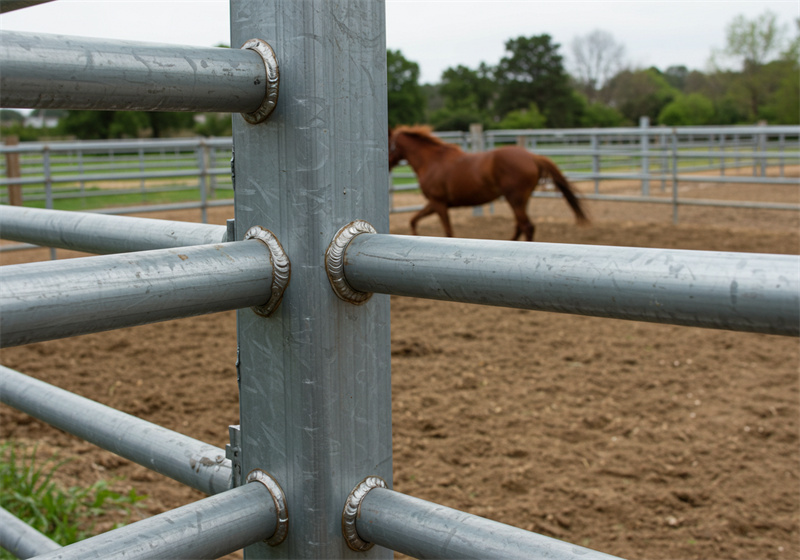
Six findings are only available on a physical unit.
- Coating at the welds. Frames are fully welded Q235, and a weld is where a coating claim gets tested against your ordered wording: at least 42 microns as a factory specification, with the process run to AS/NZS 4680. A third-party inspection at the plant is the report to ask for alongside the sample, not instead of it.
- Panel response. HDPE is sold on being washable, chew-resistant and a buffer under a kick. Press it and lean on it; stiffness at 10 mm is a feel a spec sheet does not carry.
- Pin fit. Tool-free corner pins should seat by hand. A pin that needs a mallet is a tolerance story that repeats across every set in the run you order.
- Hardware in gloves. Work the latch and the sliding door on its 2950 mm track with the gloves your yard actually uses.
- Colour in your light. Black, white and green read differently under a workshop floodlight than under a shed. Photograph the sample in the light you will judge the shipment in.
- Accessory fit. A bowl or feeder sitting in a panel opening tells you whether the cut-out and the fitting were designed together.

| Item on the sample | Figure to check against | Method on site |
|---|---|---|
| Wall panel | 2844 or 3494 × 1194 × 10 mm | Tape length, thickness at a cut edge |
| Frame tube | 50×50×2.0 mm square | Calliper at a joint, not mid-run |
| Mesh | 4.0 mm wire, 50×50 mm aperture | Gauge the wire, count ten openings |
| Door | 1150 mm or 1300 mm, infill 1024×1054×10 mm | Open and latch it ten times |
| Weight | About 200 kg per panel | Plan the lift before you sign the spec |
Documenting the sign-off so production cannot drift
A sample that is approved verbally is a sample that will be reinterpreted. Four items make the approval stick through a ten-set run.
- A sign-off sheet with figures, not adjectives. Panel size and which one was used, door width per bay, front type, colour, coating wording as ordered, roof option, accessories fitted.
- A dated photograph set — the whole unit, the weld corners, the mesh corner, the door infill, the accessory in its opening, and the packaging it arrived in.
- The QC reference for the same unit, since third-party inspection at the plant and your own sign-off describe one object at two moments.
- The retained unit itself, or the panels from it, stored flat and labelled. Production is compared against something physical when the next order is quoted.
Then attach that file to the deposit. The point where money moves is the point where your sheet stops being a preference and becomes the reference the factory is building to.
Where sample approval goes wrong
Four failure patterns repeat, and three of them are documentation failures rather than material ones.
- Approving a shop-built unit and receiving production units. A sample assembled slowly by whoever built it is not evidence of how a line behaves. Ask which frames came from the run you are buying.
- Approving a configuration you will not order. Five stalls in a row and six stalls back-to-back are both eleven wall panels, so a sample row that teaches you nothing about shared partitions can still leave the block drawing wrong.
- Approving colour, then changing the batch. Colour and panel length are the two figures a factory can quietly re-specify between orders; they belong on the sheet in the same line as the door widths.
- Approving late. At about 20 sets a week, a sample decision that drifts costs the queue, not the drawing. Air freight can shorten the arrival of a late sample, at extra cost, and does nothing for the slot you gave up.
Trade terms, payment structure and production lead time are not published specifications on this line, so they get confirmed on the quotation for your order rather than assumed. Supplier screening before the sample stage is covered in our checklist for choosing a portable horse stable supplier in China.
Frequently Asked Questions
Is a sample set included when the minimum order is ten sets?
Not by default. The published minimum is ten sets, so a single sample sits below that line and is negotiated as its own order item. Raise it in the enquiry, before the 24-hour drawing quote is converted into a deposit.
What is the minimum worth approving physically?
One stall: three wall panels and one door. It exercises the frame, the panel, the mesh, the door, the pins and one accessory, which is everything a container will repeat.
Should the sample be built to the same specification as the run?
Yes, in every figure you intend to repeat — panel size, frame tube, wire gauge, door width, colour and roof option. A sample built to a higher standard than the order approves the wrong object.
What happens to the approved sample afterwards?
Keep it, or keep its panels, flat and labelled with the sign-off sheet. The next reorder gets quoted against a physical reference and a photograph set rather than against a memory of one.
Conclusion
Sample approval is the one part of an imported stable order that turns a drawing into an obligation. Order the configuration you will repeat, measure it against the figures on your own sheet, photograph it, and keep the unit.
Write the gate into the enquiry while quoting from drawings still takes 24 hours and the deposit has not moved. After that, the same change is a variation and the queue is about 20 sets a week without you in it.