Most Australian yards already own the expensive part of a stable block: fencing, a working water point, and ground settled under years of hoof pressure. A day yard conversion puts overnight stabling onto that base instead of starting the bill again from bare ground — and the variable a converter actually controls is the panel count. The published documents carry no price list, so cost per horse is a drawing-based quote question.
The published configuration table makes that visible. One bay needs three side panels and one gate; six back-to-back need eleven panels and six gates. Same horses, different geometry, and every horse after the first costs half a wall rather than a whole one.
Key Takeaways
- A paddock fence is not a stall wall. The overnight panel is a fully welded Q235 frame in 50×50×2.0 mm square tube carrying a 10 mm HDPE sheet, 2200 mm high.
- Shared walls are the whole arithmetic: 1 bay = 3 panels/1 gate, 3 bays = 7/3, 5 bays = 11/5, and 6 bays back-to-back = 11 panels/6 gates.
- Each panel is close to 200 kg, so the carry from truck to corner is a layout decision.
- Gates are 1150 mm or 1300 mm; a sliding gate runs a 2950 mm track on twin wheels, which fixes the clear run in front of it.
What the yard hands you
Walk the perimeter before you draw anything. Three things carry over from daylight use: a fence line to build a block against, a water point that keeps a trough running, and ground already compacted under traffic. Those are real money. A yard that drains and a yard that ponds look identical in February and behave very differently in June.
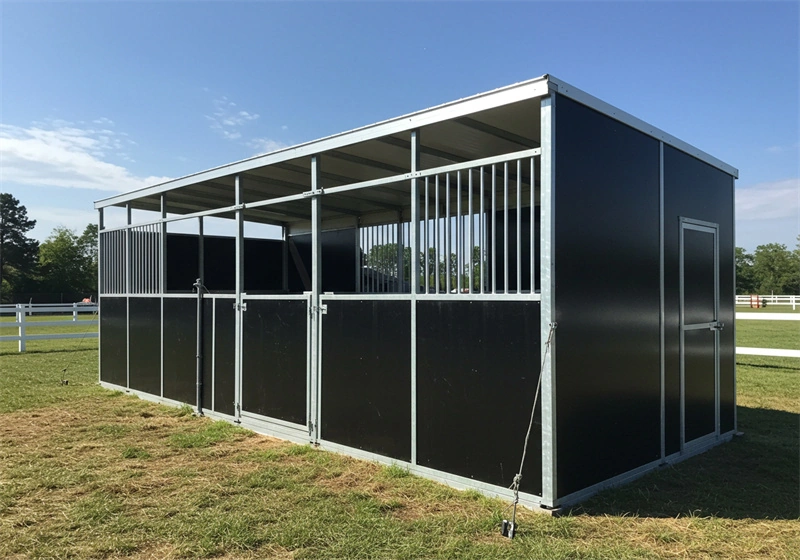
What does not carry over is containment. Paddock tape or a round-of-pipe line keeps horses in a paddock; an overnight wall has to stop a kick and a bite. The specified panel is a fully welded frame in 50×50×2.0 mm square tube carrying 4.0 mm wire at 50×50 mm mesh above a 10 mm high-density polyethylene sheet, 2200 mm high. That solid lower section is what takes the strike at chest and kick height. HDPE is specified as rot-proof, UV-resistant, washable and chew-resistant, and it cushions a blow rather than passing it into a hoof.
Shade is the other half-credit. A line of gums shades a day yard for free, and the same roof that keeps weather off a gate line in winter throws low sun onto it in summer. Roof decisions are easier to take before the first bay is set than after.
Count panels, not horses
Buyers count bays; the panel supply counts walls. Side panels come in 2844×1194×10 mm or 3494×1194×10 mm, so the enquiry question is how many walls the layout needs.
| Configuration | Side panels | Gates |
|---|---|---|
| 1 bay | 3 | 1 |
| 2 bays (adjacent) | 5 | 2 |
| 3 bays | 7 | 3 |
| 4 bays | 9 | 4 |
| 5 bays | 11 | 5 |
| 6 bays (back-to-back) | 11 | 6 |
Read the single-run series and the pattern is plain: each extra bay on one line adds two panels and one gate, so six in a line would need thirteen if that series continues. Six back-to-back needs eleven, because the rows share a spine wall. That is the only reason a spine block carries fewer panels per horse, and it is worth more than any discount conversation.
Stall lengths run 3000 mm or 3600 mm on a standard 4 m box, with 3 m, 3.6 m, 4.0 m and 4.2 m also published. Lengths come from the horses; panel counts come from the shape. Weigh the second one first. Then note the unit weight: close to 200 kg per panel. Eleven of them across a paddock is a handling job — plan the carry path against the fence you already have.

One run, or a shared spine
Two layouts absorb a day yard. A single run sits against an existing fence line, every gate facing one way, one aisle to maintain. A spine block is two rows sharing one wall, turned so all gates open onto a single aisle.
On a yard you already use, build the spine block. The gain is structural: eleven panels carry six horses because the rows share one spine wall, rather than the thirteen a single run implies if the two-panel-per-bay pattern continues. What the two shapes cost per stall is compared in single versus back-to-back blocks; here the question is how many walls an existing yard still has to buy.
The aisle is where the geometry gets tight. Gates are 1150 mm or 1300 mm; a sliding gate runs a 2950 mm track on twin wheels, so you need clear run for the door panel plus room to turn a float. Doors use 1024×1054×10 mm HDPE in the same frame language as the walls. Working widths are covered in aisle width standards for commercial blocks — read it before marking the first corner.
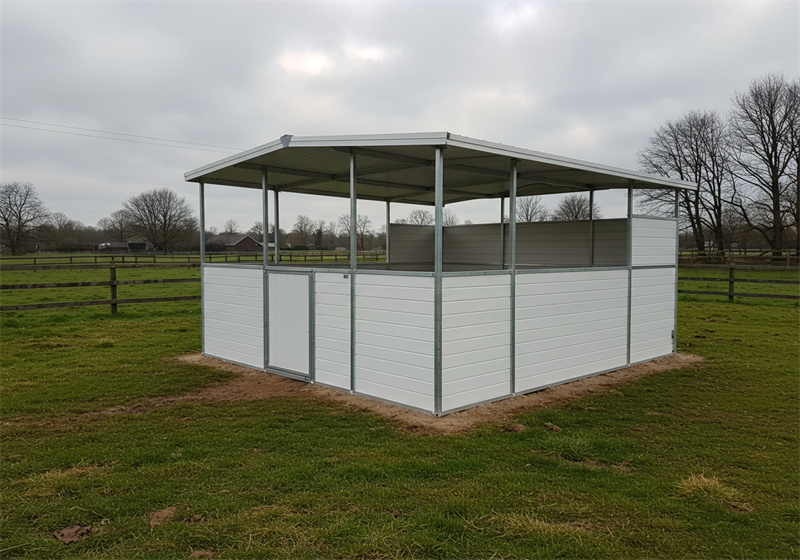
Roof the aisle or roof the bays, not both on the first order. Colorbond is a published option; the raised steel roof stands 2.65 m high and runs 4.6 m long with a 700 mm front overhang — the detail that keeps weather off the gate line rather than onto it.
Before the flat pack lands
The sequence that fails is the one where panels arrive first. Settle base, services and order size while drawings are still being priced. Trade and payment terms appear nowhere in the published documents, and bulk production lead time is not stated either — both are questions to have answered in writing, not assumptions to build a season around.
Two numbers shape a phased plan: order quantity starts at 10 sets and stated capacity runs to about 20 sets a week. A buyer converting one yard sits inside both; a distributor rolling out several sites in one season is buying against a weekly output, which is why the order calendar matters more than the unit price.
Gravel or compacted sand that already carries stock usually takes a block without new slabs. Standing water at a corner post is the first thing to fix: it is how a block goes out of square, and the movement shows up as a binding door. Base choice under the horses is weighed in rubber mats against bare ground; the first month of settling is covered in retensioning corner pins after the first month.
Assembly is the short part: tool-free corner pins, two to three people, around 30 minutes to put a unit up. Site drilling for a bracket or a latch through a galvanised member can leave cut surfaces unprotected, so ask in writing what repair-coating or fixing specification applies to a site-drilled hole — and keep those fixings on the drawing. Frames are specified at a factory minimum of 42 microns with the galvanising process run to AS/NZS 4680; the standard’s own figure for steel in the 1.5 to 3.0 mm wall range is 45 microns local and 55 microns average. Those are different commitments and should not be quoted as one thing. Third-party inspection is an in-plant service, which is where coating and section questions stay cheapest to correct. Air freight is offered at extra cost when a piece is urgent.
Frequently Asked Questions
Can a portable stable block go straight onto an existing day yard?
Usually, if the ground already drains and holds stock without poaching. Gravel and compacted sand take a block directly. Where water stands at the corner line, fix the fall before the panels arrive — the block will follow whatever the base does.
How many panels does a six-bay block need?
Eleven side panels and six gates back-to-back, per the published table. Six in one line would need thirteen, since each added bay takes two more.
Do I need approval to put stabling in a paddock?
It depends on your council or planning authority, the zone, and whether the structure is classed as temporary — and rules change between states and across the Tasman. A portable block may still need a check before overnight use. Confirm requirements locally rather than on a supplier’s assurance.
Is a 30-minute assembly time a fair planning figure?
It is the published figure for two to three people on one unit with tool-free corner pins. It does not cover site levelling, services or moving a unit later. Budget the ground work separately — that is where conversions spend their time.
Conclusion
A day yard conversion is decided by panel counts and base conditions, not by options lists. Share the walls, hold the aisle wide enough for the gate track and a turning float, and let the fence line and water point you already have do their work.
Draw the layout, mark where water stands after rain, then get the panel number quoted against the drawing while questions about site fixings and lead time still cost nothing to ask.