Most sourcing email templates written for hard goods assume the supplier will fill in the blanks. You send “we need portable horse stables, please quote”, and a factory in Anping answers inside six hours with a number you cannot compare with anything. The reply speed is not the variable in this trade. The request is.
Suppliers that publish a 24-hour drawing-quote turnaround answer fastest when the email carries the measurable parts of the job: stall length, sheet thickness, frame section, coating language, quantity against the published minimum of 10 sets. The three templates below are built that way, and each is short enough to adapt and send today.
Key Takeaways
- A first enquiry email should carry measurements, not adjectives: 3.0 m or 3.6 m stall lengths, 2200 mm height, 10 mm HDPE sheet, 50×50×2.0 mm welded frame.
- State galvanising as two separate claims — a factory coating minimum of at least 42 microns, and the process executed to AS/NZS 4680 — and ask the supplier to confirm both in writing.
- Quoting against the published 10-set minimum keeps prices comparable across suppliers; asking well below it can push you to the back of the queue.
- A QC email should pin down what the in-plant third-party inspection covers, because the report scope list is not published.
- Certificate numbers are not published here, and marketing pages rarely carry them. Ask for copies and verify originals yourself before a tender relies on them.
Why your first email decides the quote
Suppliers price what they can see. An email written in adjectives gets a generic answer; an email written in measurements gets a drawing-based quote — the only kind you can set line by line against another factory’s. A quote you cannot compare is not a bargain; it is a risk you have not costed yet.
Write the first email as a small specification sheet the supplier can tick back. Five blocks do the work.
| Email block | What to write | Why it earns its space |
|---|---|---|
| Subject line | Market, product, starting quantity | A specific ask lands in the quoting queue, not the greetings one |
| Who you are | One line: dealer, equestrian centre or stable builder | Buyer type changes which configuration table the factory proposes first |
| Measurements | Stall length 3.0 m or 3.6 m, height 2200 mm, 10 mm HDPE, 50×50×2.0 mm tube, 4.0 mm wire at 50×50 mm mesh | Adjectives get priced as guesses; millimetres get priced as a build |
| Coating wording | Hot-dip galvanised; factory minimum 42 microns; process executed to AS/NZS 4680 | Two separate claims, both verifiable later against the coating test report and the delivered paperwork |
| The reply you want | Panel-and-gate counts per bay, a quote at 10 sets, lead time in writing | Answers come back in comparable form, or you learn they never will |
Nothing in those rows asks for a favour: each maps to a published figure the factory already stands behind. A supplier that publishes a 24-hour drawing-quote turnaround should answer all five inside that window — confirm the clock in writing, and let the reply pattern tell you what a year of working together looks like.
Template 1: the first enquiry
Here is the shape that gets a usable reply. Swap the bracketed lines, keep the measurements.
Subject: Enquiry — portable horse stables, [NZ/AU] market, 10-set starting order
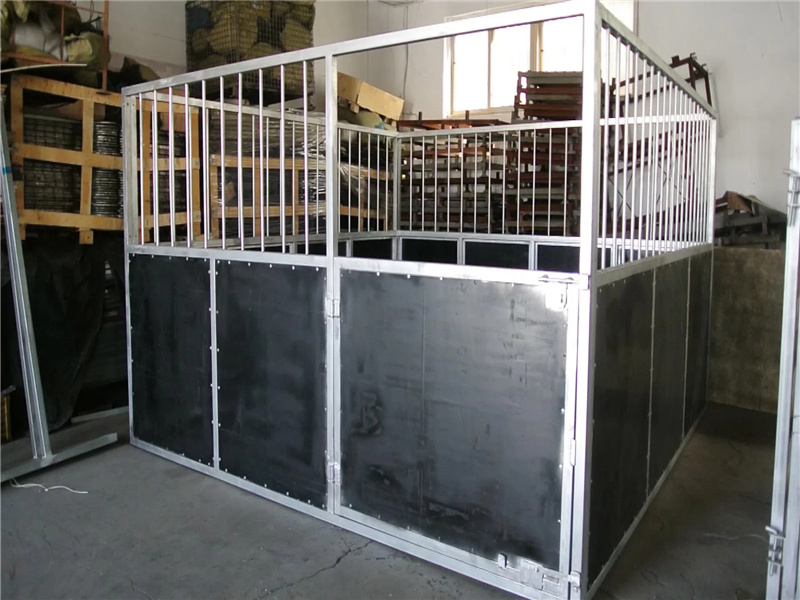
We are a [market] stable equipment dealer requesting a drawing-based quote for portable horse stables to this specification: stall lengths 3.0 m and 3.6 m, height 2200 mm; 10 mm HDPE panels (2844×1194×10 mm or 3494×1194×10 mm — please confirm which applies to each stall length), fully welded Q235 frames in 50×50×2.0 mm square tube; mesh upper sections in 4.0 mm wire at 50×50 mm; hot-dip galvanised to a factory coating minimum of at least 42 microns, with the process executed to AS/NZS 4680.
Please reply with: the side-panel and gate counts for 1- to 6-stall configurations, a quote at 10 sets (the published minimum), front-wall gate widths of 1150 mm and 1300 mm priced separately, and your current production lead time in writing.
[Name], [Company], [City]
Two details do more work than they look. Asking for panel-and-gate counts per bay pulls the official configuration table into the thread — one stall is 3 panels and 1 gate, two adjacent stalls are 5 panels and 2 gates, six back-to-back are 11 panels and 6 gates — and that table is what keeps later quotes honest. Leaving trade terms and payment out of round one is deliberate: neither is published, and both belong in a written confirmation before money moves.
Template 2: the QC request before mass production
The approved sample sits between the quote and the production run, and it is the right moment for the second email. This site’s guide to sample approval before production covers that stage in depth; the template below assumes the sample is signed and the run not yet released.
Subject: Pre-production QC points — order [PO number]
Before we release mass production, please confirm these points in writing:
1. Coating — a test report against the factory minimum of 42 microns, and confirmation that the galvanising process was executed to AS/NZS 4680. Send copies of any certificates you reference; we verify originals on our side.
2. Frames — fully welded 50×50×2.0 mm square tube, 25×25×1.6 mm under-door sections; one photographed panel per batch.
3. Panels and doors — 10 mm HDPE in the agreed colour (black, white or green), gate panels 1024×1054×10 mm, twin-roller slide tracks of 2950 mm where specified.
4. Inspection — written confirmation of what your in-plant third-party inspection covers on this order.We will release the run against the signed sample and the above replies.
Every line above is verifiable later against a report or a document, and that is the test a good QC email passes: it never asks a supplier to volunteer a judgement, only to confirm a measurement or send a copy. Where paperwork is involved, remember the asymmetry — certificate numbers are not published here, so ask for copies and put the originals under the same scrutiny as the factory audit red flags you would check in person.
Template 3: pre-shipment and paperwork
The last email is the cheapest insurance in the order, sent when production is done and the container is not yet sealed.
Subject: Pre-shipment checklist — order [PO number]
Before the container is sealed, please send:
— the packing list mapped to the configuration table, so every bay set is identifiable on site by its panel and gate counts;
— photographs of the flat-packed load, strapped and dunnaged, with panel weights noted for unloading planning;
— confirmation that the QC points in our earlier email were completed against the approved sample;
— the agreed shipping documents, with all names matching the commercial invoice exactly.Flag anything that differs from the approved sample before sealing, not after.
One line deserves emphasis: the panel weight. A single panel runs close to 200 kg, so unloading gear and dunnage layout are site-planning facts, not courier details. And because flat pack is what cuts the shipping volume you pay for, a packing list tied to the configuration table turns an arriving container into ten identifiable stalls rather than a pile of galvanised steel. In the same thread, ask how the 24×7 after-sales line handles a missing gate, and whether air freight is quoted as an extra-cost option rather than a promise.

Frequently Asked Questions
How many emails should a stable import need before payment?
Three: the enquiry, the QC scope before mass production, and the pre-shipment check. Each one closes a specific unknown — price basis, verification coverage, load identity — before money moves.
Should the first email ask for a price list?
Ask for a quote at your quantity instead. Lists go stale as steel and zinc move, and a drawing-based quote against the 10-set minimum is the number you can compare with another factory’s.
How should galvanising be worded in an email?
Separate the two claims: the factory coating specification is at least 42 microns, and the galvanising process is executed to AS/NZS 4680. Do not write 42 microns as if the standard itself sets that value.
What do I do when a supplier will not state the QC scope?
Treat the hesitation as the answer and move the question to a third-party inspection quote. In-plant third-party checks are offered in this category, so silence on one desk is not a category problem.
Conclusion
Sourcing can fail at the email stage, not only at the dock: vague asks produce vague quotes, and vague quotes become vague responsibilities. Three short emails, each anchored to a published figure, change that arithmetic — and they cost nothing but the hour you spend filling in brackets.
Send the first this week with your market, measurements and starting quantity in place; the suppliers who answer it properly are the ones worth a second round.