Ten sets. That is the minimum order quantity horse stables dealers meet when they ask this Chinese plant where to start, and small dealers tend to read it as a wall. It is not a wall; it is an allocation. At a plant stating about 20 sets of output a week, one order at the floor takes roughly half a week of the line.
Read that way, the first purchase stops being “can I afford ten” and becomes “what should the ten be”. This piece runs the arithmetic: where the floor comes from, how panel sizes combine into sellable rows, and what a mixed starter order actually looks like when it lands on your yard.
Key Takeaways
- The published floor is 10 sets against stated output of about 20 sets a week, so a starter order is roughly half a week of one plant’s capacity.
- Both HDPE wall sizes — 2844×1194×10 mm and 3494×1194×10 mm — are 1194 mm tall and 10 mm thick, so one panel system covers both the 3.0 m and 3.6 m bay.
- Shared walls cut panel counts: four bays in a row need 9 panels and 4 gates; six back-to-back need 11 panels and 6 gates.
- One order can carry two gate widths (1150 mm or 1300 mm), three door styles and three panel colours — spread it on purpose.
- A single panel runs close to 200 kg, so offloading gear is a starter-order decision rather than a dockside improvisation.
Why ten sets is the floor
Minimum order quantity is not a policy invented against small buyers. A 10-set floor usually tracks full-batch galvanising and container fill rather than any single product’s setup — the plant’s own reasoning is worth asking for in writing. The published pairing — a 10-set minimum against about 20 sets a week of output — is the number to plan your queue around.
Below that floor, treat a smaller quantity as a question to put to the plant, not an assumption: minimum-order exceptions and their terms are not published. The workable lever is inside the ten. The same frame system is published at 3.0 m and 3.6 m stalls (with 4.0 m and 4.2 m in the wider range), all at 2200 mm high, so a single order can carry a spread instead of ten copies of one bay.
Buy time before you buy steel, too. The stated service is an enquiry reply within six hours and a drawing-based quote within 24 — fast enough to put three different ten-set mixes in front of the plant on the same day and have each quote back inside a day of asking. The flow after that is the standard one: specifications confirmed, deposit in, production scheduled, shipment arranged. Bulk production lead time is not published for this category; get it in writing against your own mix before you commit a season.
The panel maths of a mixed order
The configuration table is the most under-used document in stable importing. It counts walls, not wishbones: every shared party wall removes a panel from your order, and rows are what make ten sets stretch.
| Configuration | Side panels | Gates |
|---|---|---|
| 1 stall | 3 | 1 |
| 2 stalls (adjacent) | 5 | 2 |
| 3 stalls | 7 | 3 |
| 4 stalls | 9 | 4 |
| 5 stalls | 11 | 5 |
| 6 stalls (back-to-back) | 11 | 6 |
Read it as a dealer and “ten sets” stops being a number. Two four-bay rows plus a pair is 9 + 9 + 5 = 23 side panels and 10 gates. A six-bay back-to-back block plus a four-bay row is 11 + 9 = 20 panels and the same 10 gates. Same ten bays of stock, two different shapes of selling floor — one heavy on display fronts, one heavy on shared walls.
Extension arithmetic falls out of the same table: from four bays to five adds 2 panels and 1 gate, because the new bay converts your neighbour’s end wall into the shared party wall and adds only its own outer panel, its back panel and a gate. A customer who starts at four and grows to five is ordering two walls and a gate, not another kit — the logic a real bay-scaling order is walked through in this panel-count scaling case wrap.
Where the variety goes: fronts, colours, roofs
Gate openings come at 1150 mm or 1300 mm; door styles are double doors as standard, a slide door running a 2950 mm twin-roller track, or a barn door. Gate panels are the same 10 mm HDPE (1024×1054×10 mm), so the spread stays inside one panel system and one spare-part pool.
A defensible ten-set spread for a first order: seven bays in the double-door layout because that is the published standard, two slide-door bays for yards that need the swing path clear, and one barn-door bay as the piece every visitor asks about. Adjust the split to your own enquiry log rather than to anyone’s rule of thumb.
Panels come in black, white or green, and the whole order should carry one coating wording regardless of mix: a factory specification of at least 42 microns galvanising, with the process executed to AS/NZS 4680. Keep those as two statements — the first is the plant’s promise, the second is the standard the work follows — and never merge them into “42-micron AS/NZS galvanising”, which is not what either document says.
Roofing is the last display lever inside the ten. Colorbond roofing is an option, and the raised steel roof runs 4.6 m long, stands 2.65 m high and throws a 700 mm overhang past the front. Two roofed bays out of ten let a prospect feel the shade difference on the same day they walk the open ones.

What arrives, and how it goes up
A starter order travels as flat pack, and flat pack is the reason a stall-shaped structure is affordable to ship at all: it exists to cut the volume each set occupies at sea. Ask for the packing list mapped to the configuration table — panel and gate counts per bay — so the arriving stack sorts into ten identified stalls on the yard instead of an unlabelled pile.
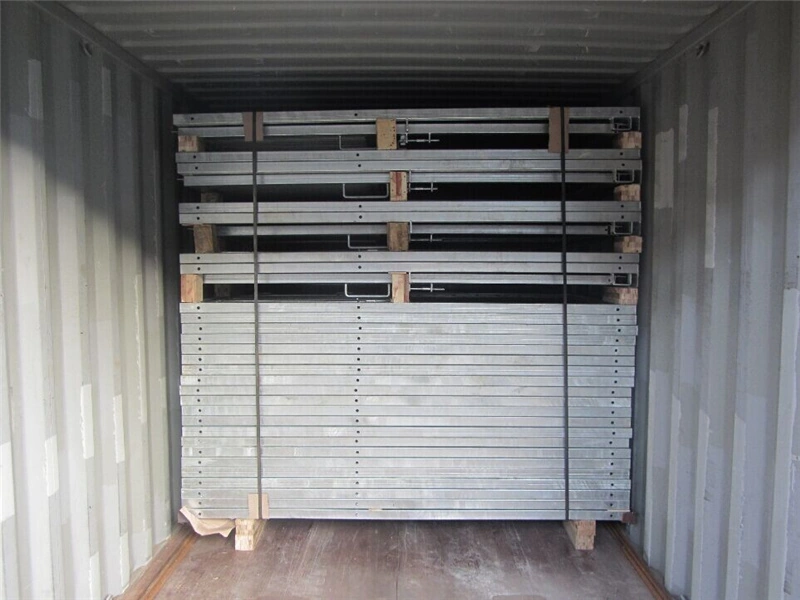
Plan the offload around the panel itself. Close to 200 kg each puts even a ten-set consignment into forklift territory for most dealers; arranging it before the doors open is cheaper than improvising after. The sea-freight packaging standards guide covers the strapping and dunnage to expect while the load is still in the box.
On site, the assembly is the sales pitch: corner pins need no tools, and two or three people can put a set up in about 30 minutes. Ask the plant to quote urgent replacement pieces as an extra-cost air option before you need one — a gate panel flying is a different conversation from a container waiting.
Frequently Asked Questions
Can a first order start below 10 sets?
Not on published terms — the minimum order is 10 sets. The productive question is what goes inside the ten: a spread of bay lengths, door styles and colours that tests two segments of your market at once.
Which bay lengths should a starter mix carry?
The published system covers 3.0 m and 3.6 m bays from the same 2200 mm-high wall family, with 4.0 m and 4.2 m options in the wider range. Build the volume bays on the shorter length and reserve a couple of longer ones for display.
How heavy is one panel, and does that matter at delivery?
Close to 200 kg. That is forklift territory on a ten-set order, so book the gear and check the dunnage layout before the container is opened, not while it sits on your driveway.
Can the same system grow beyond the first ten?
Yes — that is what the shared-wall table is for. The next bay in a row adds two panels and a gate rather than a new kit, and back-to-back blocks keep the ratio tighter still.
Conclusion
A minimum order of ten is a starting line, not a tax. Treated as a mixing exercise — row shapes from the configuration table, variety from the fronts and colours, display value from two or three roofed bays — it buys a year of evidence about your market before a second container commits.
Draft your ten as panels and gates first and bay labels second. The quote you get back is the one worth comparing.