A six-kit block went up over a weekend on a commercial Australian property, and we documented that build in the original site report. The next question buyers ask is about portable horse stable panel counts: what does the order look like when the same row becomes a block? It is not the same purchase. A six-stall row and a twelve-stall row differ in panel count before they differ in anything else, and panel count is what sets your door count, your bundle list and the tonnage your crews have to move.
This wrap runs that arithmetic from the configuration table, using the documented build only as the starting point.
Key Takeaways
- The official configuration table gives a six-stall back-to-back row 11 side panels and 6 doors; two such rows give 22 panels and 12 doors.
- The panel count, not the stall count, is what you order — and it is what sets the bundle count your forwarder prices.
- Each module is a two to three person, roughly 30 minute assembly using tool-free corner pins, so a bigger block scales by adding crews, not by extending the day.
- Panels are about 200kg each at 10mm HDPE in galvanised Q235 framing, so an 11-panel row is roughly 2.2 tonnes of side panels and twelve stalls is roughly 4.4 tonnes.
- Capacity is about 20 sets a week with a 10-set minimum order, so a doubled block is usually one factory week and one container decision, not two.
What carries a six-stall row
Three product characteristics carry the row, and all three are on the specification rather than on the site. The frames are Q235 steel in 50×50mm square tube, fully welded in the factory and hot-dip galvanised to a factory specification of at least 42μm with the galvanising process executed to AS/NZS 4680. The infills are 10mm HDPE panels cut to 2844×1194mm and 3494×1194mm, listed as UV-resistant, chew-resistant and shock-absorbing at the hoof. The connections are tool-free corner pins.
That combination is why the assembly claim holds at any size: two to three people, roughly 30 minutes per set. Everything outside those three lines — site drilling, roof detailing, foundation work — is decided with the supplier at quotation, not assumed from someone else’s build.
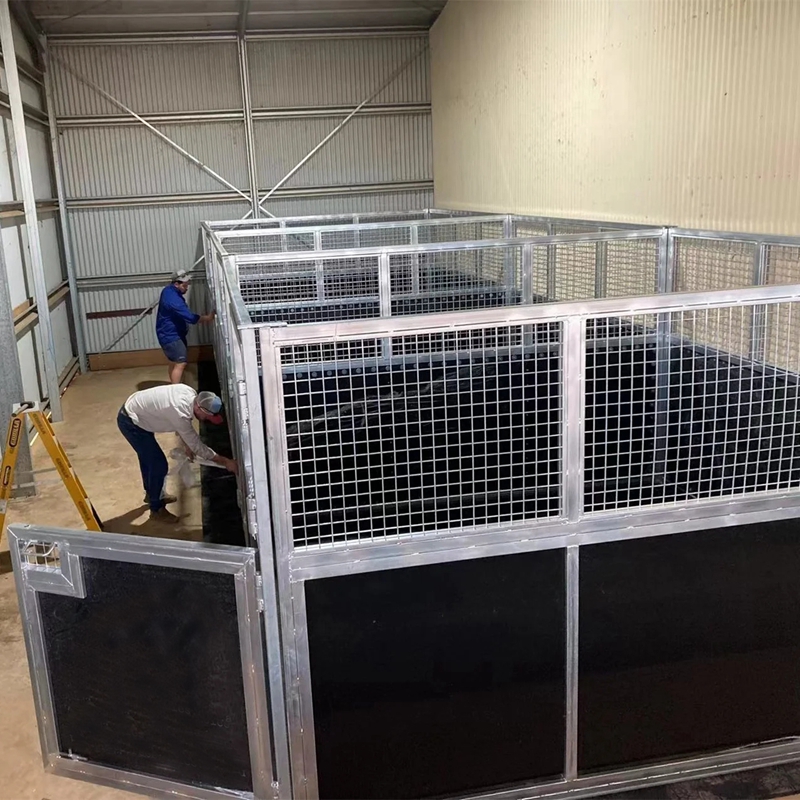
One caution on that figure. Thirty minutes is an assembly time, not a teardown or relocation time, and it assumes the pad is ready and the boxes are open before the clock starts.
The panel maths that change first
Scaling starts on the configuration table, not on the site. Shared side panels are what make a row cheaper than the same number of free-standing boxes, and they are also what make a bigger order structurally different rather than merely longer.
| Configuration | Side panels | Doors |
|---|---|---|
| 1 stall | 3 | 1 |
| 2 stalls, adjacent | 5 | 2 |
| 4 stalls | 9 | 4 |
| 6 stalls, back-to-back | 11 | 6 |
Double the row and the door count doubles with it — twelve front ends, twelve latch lines, twelve swing arcs to check against the neighbour. Front walls run 2200mm high with doors 1150mm or 1300mm wide, while mesh infills are built from 4.0mm wire in 50×50mm squares. Per stall, the panel ratio holds at about 1.8 side panels while the door count stays at one each, so a doubled block is not cheaper per stall — it is simply longer, with twice the front ends to detail.
Weight follows the same arithmetic. At roughly 200kg per panel, the 11 side panels of a six-stall row are about 2.2 tonnes of material to lift, position and keep plumb, and two rows take that to roughly 4.4 tonnes. Front walls, doors and roofing are additional and are specified separately, so total consignment weight and bundle count should be confirmed on your own quote. The point is directional: doubling the block doubles the tonnage your crews handle, whether or not the assembly day gets longer.
How the sequence changes at 10 bays
At six stalls the pad, the frames and the roof can be one continuous event. At ten or twelve bays it becomes a staged job, and the staging is what our 10-bay block planning guide sets out: prepare the bearing surface, stand the frames, close the roof, then fit out. Skipping straight to fit-out is how a block ends up with feeders bolted to panels that still need packing removed.
Crew logic changes too. Roughly 30 minutes per set with two to three people is a fixed unit of work; you buy time by running a second crew on a second row, not by putting five people on one frame. That only holds if the site can absorb two crews — which is a layout question you answer before the container is opened, not at 10am on Saturday.
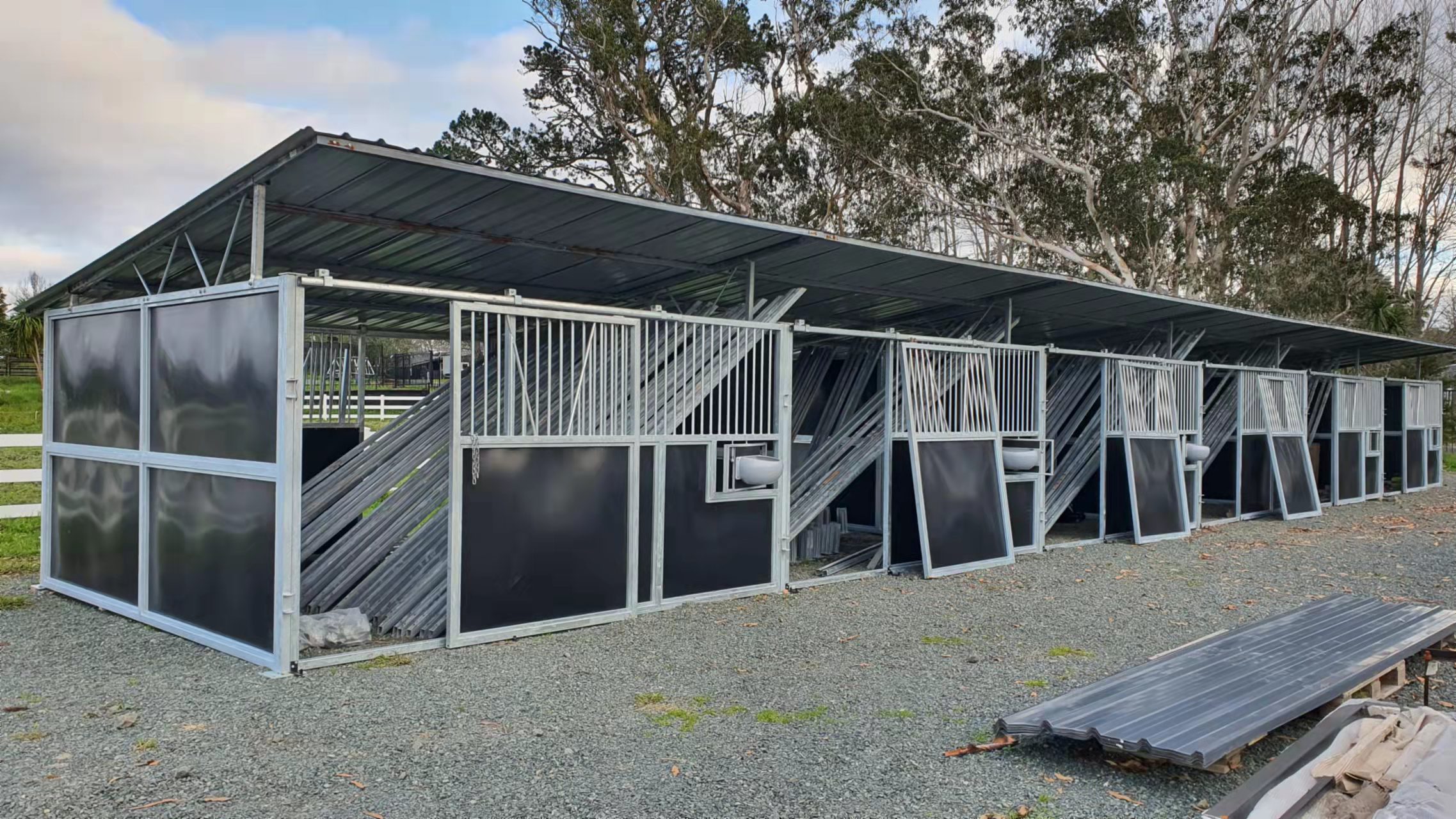
Order mechanics change with it. Capacity here is about 20 sets a week with a 10-set minimum order, and a full block stays inside one factory week, so the constraint is rarely the manufacturing queue. It is the shipping window and your own pad preparation.
For a distributor reselling rather than installing on their own property, the second block is also a stock question: a doubled order is one production slot and one packing list to reconcile, not two invoices arriving weeks apart. That is where the configuration table earns its keep — it lets you quote the same row twice without re-measuring anything.
What a buyer scaling up should carry
Take four instructions from the six-kit row before you order twelve.
- Order from the configuration table. Specify the row, get the panel and door count written against it, and let the supplier’s packing list match that arithmetic bundle for bundle.
- Specify the roof as one element, not six. A raised steel roof runs 2.65m high and 4.6m long with a 70cm front eave; confirm the span, drainage line and shade behaviour for your own layout on the quote before ordering the second row.
- Put the coating in writing. Ask for the factory galvanising specification of at least 42μm, the AS/NZS 4680 process statement, and third-party inspection before dispatch.
- Plan the aisles before the panels. Twelve doors on two aisles is a traffic problem before it is a build problem; feed and muck routes are what make the second row worth having.
The honest limit of this case: one documented six-stall build does not prove your twelve-stall weekend. What it does prove is that the assembly method — welded frames, pinned corners and 10mm HDPE infills — carries the scaling, and that everything else is planning you can finish in an email before the deposit clears.
Frequently Asked Questions
Can a 12-stall block really be assembled in one weekend?
With two crews it is plausible: twelve stalls at roughly 30 minutes of assembly each is about six hours of assembly work. Pad preparation and roof timing decide whether the weekend holds.
Why does a back-to-back row use fewer panels than two single rows?
Neighbouring stalls share side panels. Six stalls sharing walls take 11 side panels; six free-standing units would need six sets of side panels, which is why panel count is the real order line.
Does the 30 minute assembly time apply to taking a stable down?
No. The figure is an assembly time for two to three people using tool-free corner pins; the documented process says nothing about disassembly speed.
What should a supplier confirm before a scaled order ships?
Panel and door counts against your configuration, the galvanising specification, third-party inspection before dispatch, and a packing list whose bundle count matches the quote.
Conclusion
The documented six-kit weekend is useful because its method scales: welded galvanised frames, pinned corners and HDPE infills remove the site fabrication that makes a longer block a longer job. What does not scale automatically is the door count, the weight to be moved, and the number of crews your aisles can hold.
Put your target block on the configuration table before you ask for a price, then compare the panel, door and bundle counts each option produces. That comparison, not the assembly speed, is where a scaled order is won or lost.