There is no national index for agistment prices in Australia, so the agistment price trend Australia buyers actually follow lives in fee notices, rate guides and the spread between paddock care and full board. One published rate guide puts typical horse agistment at $100 to $1,500 a month for 2026, depending on care level and location. That spread is not noise. It is the clearest public statement of what land, care labour and stabling are worth in your district — and it is the number to read before committing capital to a stable block.
This piece pulls apart what the published range covers, which inputs push a board fee up, and what that means for a boarding operator deciding whether to add stables, a horse owner weighing board against owning, and the dealers who supply both.
Key Takeaways
- One published rate guide puts typical Australian horse agistment at $100–$1,500 a month (2026), spanning self-care paddocks to full care near the city.
- In that guide’s model, full care prices at about 2.2× its part-care baseline and city-fringe locations at about 1.6× outer-metro ones.
- Its cost model splits a typical grazing bill roughly 50% land, 35% care and feeding, 15% facilities — shelter is the cheapest lever on the bill, land the dearest.
- Stable capacity is what lets a yard sell up the care tiers; the guide’s shelter add-on of about $80 a month sits against a care tier priced at roughly 2.2×.
- For an owner, the weekly board you stop paying becomes the return on your own stable block — flat-pack modules keep that capital small and moveable.
- Quoted on a 10-set minimum, with about 20 sets a week of output and drawing-based quotes inside 24 hours.
What published agistment rates say
Start with the only public anchor that quotes numbers. GoingRate’s published agistment cost guide, with pricing reviewed in November 2026, puts horse agistment at $100 to $1,500 a month and prices the care tiers in multiples: a paddock, do-it-yourself arrangement at about 0.5× its part-care baseline, full care at about 2.2×. Location carries its own multiples — rural and regional properties at about 0.75×, properties close to a capital city at about 1.6× outer-metro.
The same guide’s cost model splits a typical grazing bill roughly 50% land, 35% care and feeding, and 15% facilities, and adds about $80 a month for stable or shelter access on top of a paddock rate. Treat all of it as a frame, not a survey: these are modelled asking rates from a rate guide, and no national agistment index exists to check them against. Price your own district from live listings before acting on any of it.
Why board rates move — and what moves them most
A board fee is three invoices in one: land, hands, and feed. When the fee moves, the guide’s own split says which invoice usually moved first. Land is half the model bill, and it is the input that tracks property values on the city fringe. Care and feeding is about a third, and it tracks wages — a full-care horse needs daily hands whether feed is cheap or dear. Facilities sit in the last 15%, which is why the shelter add-on in the model is small: about $80 a month.
So if the fee notice from your own yard has moved this year, the published model says the likeliest drivers are land and labour, not the shed. Read the other way, that is the opportunity for anyone who already controls land and wants more from it: the expensive inputs are already owned, and the missing piece — covered, safe stabling — is the cheapest part of the bill to add.
What it signals for stable capex
For a boarding operator, the spread between care tiers is the whole business case. If the guide’s multipliers hold in your district, the distance between a 0.5× paddock rate and a 2.2× full-care rate is a great deal more than the $80 a month of shelter that model prices. Stables are the bridge across that gap: a yard with covered bays can sell the higher tiers at all. The arithmetic per yard — stall count against weekly income — sits in how many portable stables turn a profit; this piece reads the signal, that piece runs the numbers.
For a horse owner, the same spread reads as a rent line. Board at the top of the local range for long enough and the paid fees become a benchmark for what owning is worth: the stable block you build stops a bill that recurs every month. Flat-pack modules keep that capital small, and they move with you — a fixed stable complex cannot. For dealers and importers, both of those readers are the customer: yards adding capacity and owners stepping out of board. Where demand itself is heading is covered separately in the AU/NZ market outlook.
One caution applies to every reader: the guide’s multipliers are a model, not your postcode. Pull three live listings at each care level in your district, and let the real spread — not the national frame — set the budget.
Specifying portable stables for boarding yards
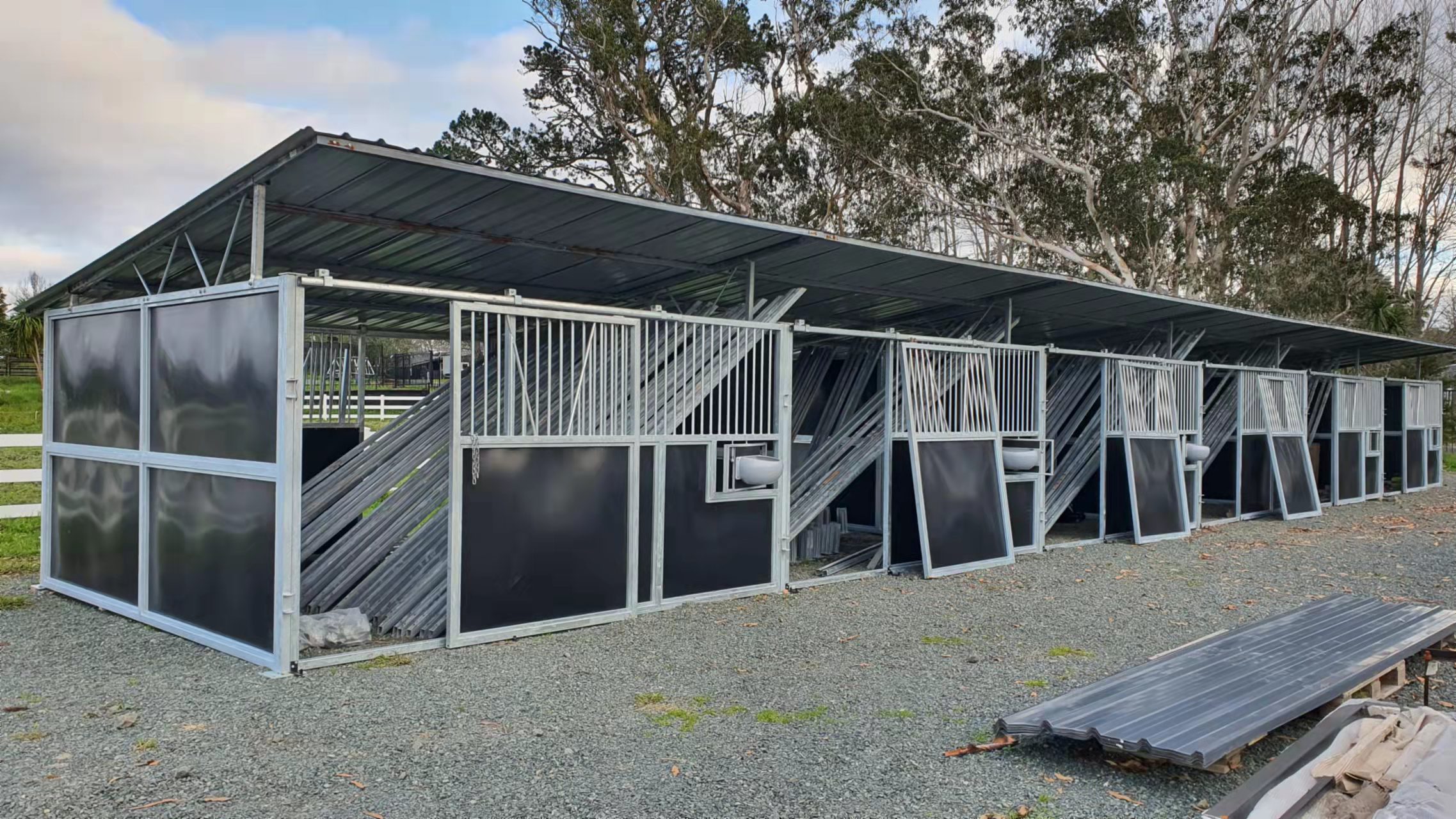
If the capex case clears, specify from documented numbers, not from a catalogue photo. The factory’s published module data: bays 3000 mm or 3600 mm long with a 2200 mm front wall, front openings 1150 mm or 1300 mm wide; side panels in 10 mm HDPE at 2844 × 1194 × 10 mm or 3494 × 1194 × 10 mm, framed in 50 × 50 × 2.0 mm galvanised square tube with full welds, each panel about 200 kg. Joints close on tool-free corner pins, and a set is an assembly job for two or three people in about 30 minutes — assembly only, not site works or teardown.
Coating and roof decide how the block wears. Frames leave the works hot-dip galvanised to a factory coating commitment of 42 microns and above, with the process run to AS/NZS 4680; the 10 mm HDPE boards wash down, resist chewing and cushion kicks, so a full-care bay presents clean after every turnover. Roofs run to Colorbond, with a raised steel roof option at 2.65 m clearance, 4.6 m long and a 70 cm front eave — the difference between a shelter horses tolerate and a bay a paying client photographs. The full specification walkthrough for agistment businesses sits in what to specify before you buy.
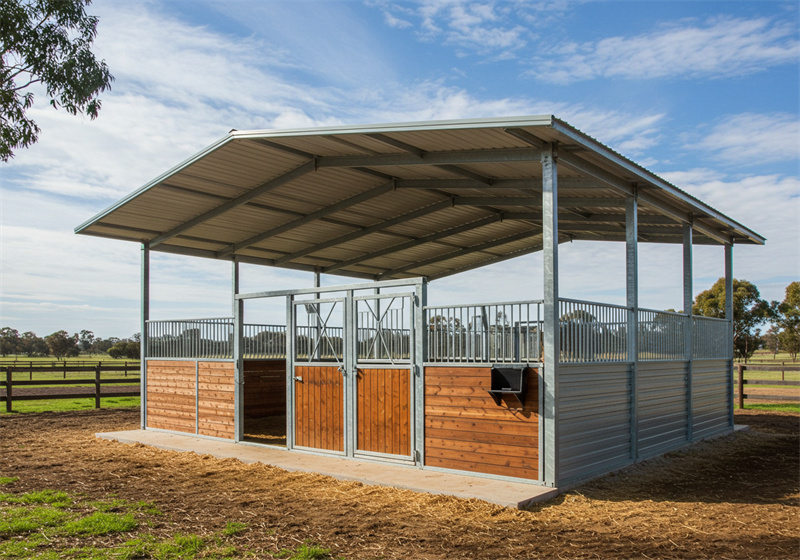
Modules join into rows, and the published configuration table makes quoting a block straightforward:
| Configuration | Side panels | Doors |
|---|---|---|
| 1 stall | 3 | 1 |
| 2 stalls (adjacent) | 5 | 2 |
| 4 stalls | 9 | 4 |
| 6 stalls (back to back) | 11 | 6 |
Supply runs on a 10-set minimum against output of about 20 sets a week, enquiries answered inside 6 hours and drawing-based quotes inside 24, with third-party inspection available during production. A 4-stall starter block sits inside one order with room for spare panels.
Frequently Asked Questions
What does full-board agistment typically cost in Australia?
Published rate guidance for 2026 puts horse agistment anywhere from $100 to $1,500 a month, with full care at the top of that range and plain paddock care near the bottom. Treat the figures as asking rates — price your own district from live listings.
Is adding stables worth it for an agistment business?
The published model prices facilities at about 15% of a grazing bill and shelter at about $80 a month, while full care prices at roughly 2.2× the part-care baseline. Whether that spread clears your capital cost depends on the rates your district actually commands, so run your own numbers first.
How big does a starter stable block need to be?
Modules join into rows: a 4-stall block takes 9 side panels and 4 doors, and a 6-stall back-to-back takes 11 panels and 6 doors. Sourcing starts at a 10-set minimum, so one order covers a starter block plus spare panels.
What upkeep do galvanised stables with HDPE boards need?
The 10 mm HDPE boards wash down between horses and are not chewed or rotted the way timber is. Check corner pin tension in the first months, and after any hard impact inspect the zinc at the frame — touch-up beats rust-through.
Conclusion
Board rates are the fastest public read on what land, labour and stabling are worth in a district. The published range is wide, its model puts land and care ahead of facilities by a wide margin, and that arithmetic is the signal: the stable block is the cheapest part of the bill to add and the piece that unlocks the higher care tiers.
If the numbers in your district hold up, send the bay count and site sketch and ask for the drawing-based quote — it comes back inside 24 hours, and the 10-set minimum makes a starter block a single decision.