A twin roller stable door track is one of the few lines on a horse stable quotation that you can test with a tape measure before you pay. Most buyers do not. They read the door width, nod at the word galvanised, and discover at installation that the rail has nowhere to run. This article is about reading that line the way a purchaser should — before production, when changing it is still free.
If your door has already left the rail, this is the wrong page; that is a repair job, and our guide to fixing a derailed sliding stable door covers alignment, checking and what to do on site. What follows is the purchasing side of the same hardware: which dimensions belong in writing, how the run length relates to the opening, and what a photograph of a closed door cannot tell you.
Key Takeaways
- Three different numbers get called a door size on a quote: the opening (documented at 1150 or 1300 mm wide), the door leaf (formed from a 1024×1054×10 mm HDPE board) and the rail it travels on (documented at 2950 mm). Ask which is which.
- A 2950 mm run beside a 1300 mm opening reads as travel allowance rather than a second door — confirm with the supplier what the extra length carries, and ask where the leaf sits when open and what stops it.
- Our sliding fronts are documented as a twin-roller set. Ask a supplier quoting a single roller what that changes, and get any substitution written down and dated before production.
- The rail needs wall to fix to. A sliding front on a return corner or beside a neighbouring door may not have clear run, and that is a layout question settled at drawing stage.
- Ask for the track to be quoted as a replaceable item with a spare set, alongside the door hardware the specification does name — stainless bolts and corner posts.
What the 2950 mm line describes
The published front wall is 2200 mm high, with openings in two widths — 1150 mm and 1300 mm. The sliding door option runs on a 2950 mm track with twin rollers. Read those three numbers together and one of them is doing a different job from the other two: the opening is where the horse and the wheelbarrow pass, and the track is where the leaf goes when it is out of the way.
A buyer who treats 2950 as a door dimension will misorder. A buyer who treats it as travel will ask the two questions worth asking: how much of that run is occupied by the leaf when open, and what stops it at either end. On our own kits the leaf is built from a 1024×1054×10 mm HDPE board in a frame, so the relationship between leaf, opening and rail is fixed by the drawing rather than left to an installer on site. Ask to see that drawing.
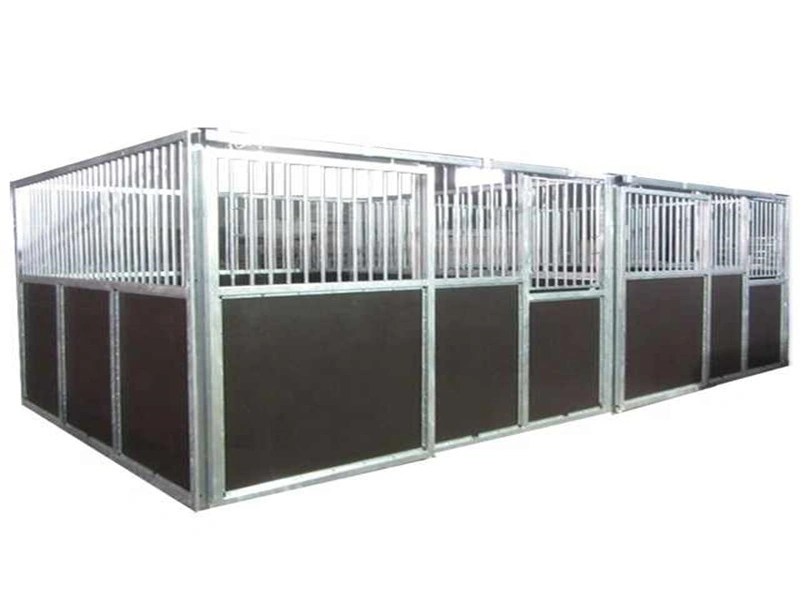
Then compare quotes on those three numbers rather than on the headline price. Two suppliers can both write “sliding door, galvanised” and mean a rail cut shorter, a leaf built to a different board, or an opening taken from the wrong side of a 1150 mm wall. When a quotation is meaningfully cheaper, the saving usually sits in one of those three places, and none of them becomes visible until the door is hanging.
Four things a door spec should state
Door lines on quotations are usually one line long. Four items are worth insisting on before you compare two suppliers’ prices, because a cheaper quote is often the one that left something out rather than the one that found a saving.
| Line item | What should be written | If it is missing |
|---|---|---|
| Opening versus leaf | Both figures, separately, not one dimension labelled door. | You may be comparing a 1150 mm opening against a 1300 mm one. |
| Track length and fixings | Rail length, how it fixes to the frame, and end stops. | Cutting and drilling happens on site, with nobody accountable. |
| Roller set | Twin rollers per leaf, and whether spares are available later. | A substitution agreed at production becomes your problem later. |
| Finish | Named process and a coating figure, not the word galvanised alone. | You cannot put a corrosion claim to anyone later. |
The rail needs wall to fix to
A sliding front is a layout decision disguised as a hardware choice. The leaf travels across whatever is next to the opening, so the panel beside that opening must be clear, straight and fixed — not a return corner, not the space another door is using. Frame members are documented as 50×50×2.0 mm square tube, fully welded in Q235 steel, which is what gives the rail something rigid to sit against; on a kit that has been packed and unpacked more than once, that rigidity is the thing to check first.
Two layout questions decide most of these orders. First, which door type each bay gets: the hinged double door is the standard fit, with sliding and barn styles as options, and each wants something different from the wall beside it. Second, what the front wall is made of above the panel — mesh or vertical bar. Our write-up of front wall opening sizes sets out how the two widths behave; the door type is the other half of that same conversation.
Shared walls are where this shows up. A six-bay back-to-back block is documented as 11 side panels and 6 doors, so on a typical back-to-back layout many doors in that run have another door’s opening on the wall beside them rather than a blank panel — subject to your drawing. Slide two fronts towards the same corner and one of them stops early. That is a drawing-stage fix: swap a bay to a hinged front, or move the sliding bays to the ends of the line.

What a closed-door photograph hides
Catalogue pictures show doors shut. Everything that decides whether a sliding front still slides after years of daily use is invisible in that frame: the roller, the rail, the stop, and the coating on all three. On coating, our specification is a factory commitment of 42 microns and above, with the galvanising process run to AS/NZS 4680; that is a written number to put beside a competitor’s, not an adjective. Ask what the rail is finished to, since it wears where the roller rides.
Then ask for the parts that wear. A door is the element you will open most often, and replacement hardware is a separate supply question from replacement panels — who ships parts, and how fast is its own conversation. Assembly is not the risk here: two or three people and about 30 minutes per set is the documented assembly figure for a kit built to drawing, and a track specified correctly is part of why that holds.
Conclusion
Reading a door line properly is cheap. Getting it wrong is a rail cut on site, a leaf that fouls a corner post, and a hardware substitution nobody agreed to — all of which arrive after the money has moved.
Send the bay layout with your door types marked, and ask for opening, leaf, rail length and roller set written separately on the drawing. If the four numbers do not appear, that is the answer about the quote.
Frequently Asked Questions
Is a 2950 mm track for a 1300 mm door?
Not automatically. The documented run is 2950 mm against openings of 1150 or 1300 mm, so ask the supplier what the extra length carries and where the leaf sits when open.
Why twin rollers rather than one?
Our sliding fronts are documented as twin-roller. What a single-roller version changes is a question for the supplier rather than something to guess, and if a quote quietly says otherwise, treat that as a change to the specification.
Should every bay have a sliding front?
No. The hinged double door is the standard fit and needs no clear run beside it. Sliding fronts suit bays where the wall next to the opening is unbroken, which is a layout question rather than a preference.
Can I order spare rollers and a rail later?
Ask before you order. The documented accessory list names stainless bolts and corner posts but not rollers, so have the rail and roller set confirmed as available spares and written on the parts list beside the door.