Skip to content
DIY stable kits Australia look cheap right up until the first reseller calls about warped boards, missing fasteners, or a roof pack that blew your container maths to pieces. I’ve seen importers lose margin on a “good” order because the quote stopped at EXW, the galvanizing claim had no test evidence behind it, and nobody checked how the pallet count, stall height, and roof geometry would hit landed cost per bay. Then the supplier goes quiet, the end customer wants answers, and you wear the claim. That’s the part glossy brochures never mention.
Here’s what you actually need before you place an order: proof of steel finish, proof the 10 mm HDPE will hold up in Australian sun, a packing plan that makes sense in a real container, installation drawings your dealer can hand to a customer without drama, and a warranty that says exactly what corrosion and hardware failures mean in month 11. I’m going to walk through the checks that protect gross margin, the specs I would reject on sight, and the small shipping and documentation details that do more to cut claim rates than any sales promise about “easy assembly.”
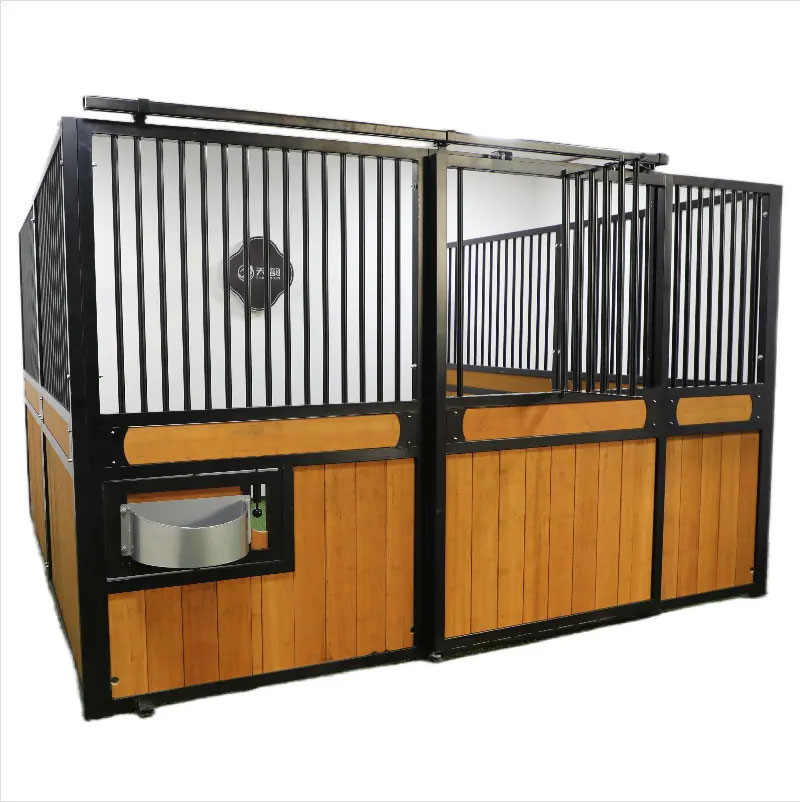
Kit Specs
For B2B buyers, kit specs are a margin-control issue. The wrong steel finish, vague hardware counts, or inefficient roof format will show up later as claims, delays, and avoidable landed cost.
Frame materials
Start with the frame, because this is where vague supplier language usually hides. DB Stable states hot-dip galvanized steel with coating above 42 microns for core structural protection. That is the number buyers should anchor on, then verify against the finish declaration or galvanization evidence before placing a production deposit.
Tube dimensions also need to be written into the quote, not left in a drawing note or a sales message. In competitor listings, 50 x 50 mm RHS galvanized tube is a common reference point, but buyers should not assume every panel uses the same wall section or the same steel grade. If the supplier cannot map tube size to each panel type, you are not really buying a controlled kit.
Weld consistency matters just as much as the steel itself. Clean, even welds reduce fit-up problems during installation and lower the risk of rework on site. For distributors and builders in Australia and New Zealand, that translates directly into fewer installer complaints and fewer arguments about whether the fault came from freight, assembly, or fabrication.
- Steel finish: Confirm the frame is hot-dip galvanized, not just zinc-sprayed or lightly coated after fabrication.
- Coating threshold: DB Stable states a galvanizing thickness above 42 microns; buyers should request documentary proof.
- Tube dimensions: Require each frame member size to be listed on the quote and drawings, especially uprights and door frames.
- Weld quality: Ask for close-up production photos or shipment photos showing repeatable weld finish across multiple panels.
Panel options
Panel choice should follow use case, not habit. Upper-mesh and pipe-upper formats are usually selected where airflow and visibility matter most. Full-HDPE configurations make more sense where kick resistance, visual screening, and wash-down simplicity are higher priorities.
DB Stable states 10 mm UV-resistant HDPE boards as a standard material choice for kickboards and panels. That is commercially useful because it gives importers a measurable spec to compare. If a competing offer just says “plastic board” or “UV board” without a thickness, treat that as unfinished procurement, not a real specification.
Airflow is the real dividing line between panel styles. Upper-mesh and pipe-upper panels provide more open ventilation, which can be attractive in warmer Australian conditions. Full-HDPE reduces open exposure and can take more punishment at kick height, but buyers should think through heat load, internal airflow, and cleaning routine before locking the spec.
- Upper-mesh: Better ventilation and sight lines; suited to buyers prioritizing airflow and open feel.
- Pipe-upper: Similar airflow benefit with a different visual and structural format; buyers should compare animal behavior and cleaning access.
- Full-HDPE: Stronger visual barrier and easier wash-down surface; more suitable where kick contact and panel wear are a concern.
- Board thickness: DB Stable states 10 mm UV-resistant HDPE; thinner, unspecified boards often create long-term claim risk.
- Cleaning practicality: Smooth HDPE surfaces are easier to hose down than more open panel areas that trap dust and bedding.
Buyers should confirm mesh spacing, edge finish, and panel labeling before shipment. Those details sound minor until a reseller receives mixed panels, a horse facility questions safety, or an installer loses time sorting parts on site.
Door hardware
Door hardware is where “easy assembly” claims often fall apart. A stable kit can look good in photos and still create jobsite friction if the sliding door track is inconsistent, latch points are misaligned, or the bolt packs arrive mixed together. This is why experienced buyers ask for a hardware map, not just a total fastener count.
Sliding doors are popular because they help conserve front clearance and work well in modular layouts. But the practical questions are simple: does the door travel cleanly, are the latch points obvious, and is the feeder position compatible with the chosen front panel? If those answers are vague before shipment, the support burden lands on the distributor after delivery.
- Door type: Confirm whether the kit uses sliding doors and whether the guide and stop details are shown on installation drawings.
- Hinges and tracks: Ask for close-up photos of hinge points or sliding assemblies from actual production, not only renderings.
- Latch points: Verify latch position, closing logic, and whether any lock provision is included.
- Feeder compatibility: DB Stable offers rust-free aluminum swivel feeders, so buyers should confirm the front panel and door layout are designed to accept them cleanly.
- Bolt pack organization: Numbered fastener packs, panel labels, and a hardware map reduce assembly mistakes and post-sale disputes.
From a reseller margin perspective, hardware control is not a small issue. It is one of the easiest ways to reduce missing-part claims, installer call-backs, and the usual blame cycle between warehouse, freight forwarder, and factory.
Roof choices
Roof format changes more than weather protection. It affects heat management, runoff direction, container volume, and installation labor. Buyers comparing flat pack horse stable kits Australia wholesale offers should look at roof geometry with the same skepticism they apply to steel specs.
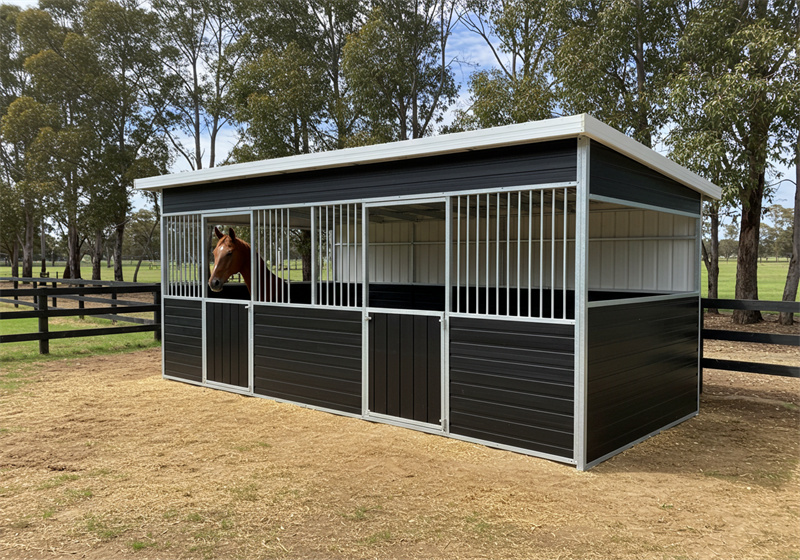
A no-roof configuration is the simplest to ship and usually the easiest way to improve container loading efficiency. That can make sense for distributors serving customers who already have a cover structure or who want the lowest entry price. The trade-off is obvious: the buyer takes on the weather solution elsewhere.
Single-slope roofs usually strike the best balance between weather protection and install simplicity. They are easier to understand on site, easier to explain in resale documentation, and generally less punishing on labor than more complex layouts. Multi-bay roof systems work well for larger runs, but they need tighter planning around runoff, alignment, and packing sequence.
- No-roof: Lowest shipping burden and simpler installation, but no integrated weather cover.
- Single-slope: Practical middle ground for protection, runoff control, and manageable assembly labor.
- Multi-bay roof: Efficient for larger stable rows, but buyers should check packing logic, alignment tolerances, and roof sheet sequencing.
- Heat and ventilation: Roofed configurations need airflow planning, especially where panel style already reduces openness.
- Container volume: Roof members and sheets can materially affect container fill rate, so buyers should request pallet count and loading logic before comparing prices.
- Install labor: More roof complexity usually means more site hours, more lifting steps, and more room for assembly error.
This is where many competitor quotes stay shallow. They talk about easy installation, but they do not break out how roof choice changes freight cost per stall, labor on site, or the number of packs an installer must control. That missing detail is exactly where importer margin gets damaged.
Measurable checks buyers should put on the quote
If you want a DIY horse stable kit with roof Australia offer that is actually comparable across suppliers, put the measurable checks in writing. Do not rely on brochure language. Buyers should request these items in the quotation set, packing list, and installation documents before approving production.
- Frame finish: Hot-dip galvanized steel stated clearly on the quote and drawings.
- Coating thickness: DB Stable states above 42 microns; request finish declaration or test evidence.
- Board thickness: DB Stable states 10 mm UV-resistant HDPE; ask for material confirmation.
- Overall height: Require the finished height to be stated; competitor material commonly references 2.4 m, so compare on the same basis.
- Bay footprint: Confirm the exact bay width and depth in the commercial drawing so landed cost can be calculated per stall, not per vague set.
- Roof inclusion: State whether the roof is excluded, optional, or included as standard for the quoted unit.
- Panel style: Identify upper-mesh, pipe-upper, or full-HDPE clearly, with no mixed terminology.
- Door format: Confirm sliding door specification, latch arrangement, and feeder compatibility.
- Hardware control: Require numbered fastener packs, panel labels, and an installation hardware map.
- Shipment control: Request packing list, pallet count, and loading photos to reduce receiving disputes.
For importers and resellers, the point is simple: portable horse stable kit supplier for Australia decisions should not be made on unit price alone. The better kit is the one with verifiable steel protection, controlled hardware, sensible roof geometry, and documentation strong enough to protect your margin after the container arrives.

Included Components
Included components are where quote clarity lives or dies. If the supplier does not define what is standard, buyers should assume margin risk, install delays, and avoidable warranty disputes.
For B2B buyers comparing DIY stable kits Australia, the practical question is not whether a kit is called portable or easy to assemble. The real question is what is physically included in the shipment, how the hardware is controlled, and whether the paperwork is strong enough to protect the importer after the container lands.
We recommend verifying inclusions line by line before comparing EXW, FOB, or landed pricing. Too many quote comparisons fail because one supplier includes roof members and documented hardware packs, while another quietly leaves them as extras.
Standard inclusions buyers should expect
A proper flat pack horse stable kit should define the core structural package in writing. For DB Stable portable configurations, buyers should expect the main shipment scope to clearly identify the steel frame set, the 10 mm UV-resistant HDPE boards, the stall front assembly, the roof members where a roofed model is quoted, and the full hardware and fastener pack required for installation.
- Frames: Main structural steel components, typically supplied for flat-pack loading and site assembly. DB Stable states hot-dip galvanized steel with a coating above 42 microns for core structural protection.
- Boards: Kickboards or infill panels using 10 mm UV-resistant HDPE, which should be listed by quantity and panel location.
- Stall fronts: Front assemblies, including the defined door or opening style shown on the approved drawing.
- Roof members: Rafters, purlins, or other roof-support components, but only if the quoted configuration is a roofed model.
- Hardware packs: Brackets, plates, joining items, and connection pieces required for the supplied layout.
- Fasteners: Bolts, nuts, washers, screws, and fixing items matched to the drawing set and packed by installation logic.
That sounds basic, but this is where buyers get caught. A supplier can advertise a complete diy horse stable kit with roof Australia search term language, then quote only partial roof steel or exclude site fasteners from the commercial offer. If the quote does not spell out each component family, it is not ready for serious comparison.
Why labeled hardware matters more than generic “easy installation” claims
Competitors often talk about fast installation, but many under-document hardware control. That is a problem for distributors and stable builders, because most install mistakes do not come from the frame itself. They come from mixed fasteners, unclear bracket use, and installers working from incomplete pack identification.
- Numbered bolts: Bolt packs should be labeled against the installation drawing so the crew does not guess length, diameter, or location.
- Grouped brackets: Brackets should be packed by assembly stage or frame zone, not dumped together as loose mixed hardware.
- QR-linked drawings: A QR code on the hardware carton or pallet label should lead directly to the relevant drawing set, which reduces install errors and cuts back-and-forth after delivery.
For the Oceania import distributor, this is not a small operational detail. Better hardware control reduces installer confusion, lowers post-sale claims, and protects reseller confidence. In plain terms, a clean hardware map is more useful than vague promises about “simple installation” on YouTube or product pages.
The document pack should travel with the order, not arrive after the problem
A professional supplier should issue a document pack that supports receiving, assembly, and after-sales handling. Buyers should request this before production finishes, not after shipment, because missing paperwork creates disputes that are expensive to unwind once the goods are on the water or at the destination depot.
- Packing list: Itemized shipment contents, pallet count, and package reference for receiving checks.
- Installation drawings: Assembly drawings that match the shipped configuration, hardware map, and panel orientation.
- Dimensions: Confirmed overall and component dimensions for planning, resale accuracy, and site fit checks.
- Finish statement: Written declaration of the frame finish, including the stated hot-dip galvanized protection level where applicable.
- Warranty terms: Defined coverage for structure, corrosion, and hardware, with start point and claim conditions stated clearly.
- Shipment photos: Pre-loading or pre-dispatch photos showing packed condition, labels, and pallet logic to reduce receiving disputes.
This document pack is part of commercial risk control. It helps the importer confirm what left the factory, gives installers a clean reference, and gives the distributor a paper trail if an end customer later claims something was missing or misrepresented.
Standard versus optional items must be separated in black and white
One of the most common quote comparison errors is mixing standard scope with optional scope. Buyers should insist that each quote separates what is included by default from what is available at extra cost. If that split is not visible, the cheaper quote may simply be missing critical content.
In practice, roof members, door upgrades, feeders, special fittings, and some layout-specific accessories are the usual danger zone. A supplier may present a clean rendering of a complete stable, while the commercial sheet only covers the base panel package. That is how landed cost blows out and how reseller margins disappear after the PO is signed.
We recommend verifying four points before approving any portable horse stable kit supplier for Australia or New Zealand: first, the exact standard component list; second, the exact optional component list; third, the hardware and fastener scope; and fourth, the supporting documents issued with shipment. If those four items are clear, quote comparison becomes much more honest and much less painful.

Site Prep
Most installation problems start with the base, not the stable kit. Poor drainage, bad levels, and misaligned anchors create more door and panel complaints than genuine manufacturing defects.
For buyers evaluating DIY stable kits Australia, site prep is not a minor installation detail. It directly affects horse health, corrosion exposure, board life, and your claim rate after handover. We recommend treating the base as part of the product system, because even a well-made portable stable with hot-dip galvanized steel above 42 microns and 10 mm UV-resistant HDPE boards will underperform on a bad foundation.
Ground drainage is a commercial issue, not just a civil works issue
If water sits under or around the stable, horses stand in damp conditions for longer, and that is the wrong starting point for hygiene and hoof management. From a procurement standpoint, trapped moisture also increases the time that steel components, fixings, and lower contact areas stay wet. Galvanizing slows corrosion, but constant water exposure is still unnecessary abuse.
Drainage also affects board longevity. DB Stable uses 10 mm UV-resistant HDPE boards as standard, which is the right material choice for portable horse stable applications because HDPE does not suffer from the same swelling issues as timber. That said, if mud, manure, and standing water collect around the lower panel zone, you still create a dirtier, harder-to-maintain environment and more abrasion at the base over time.
- Horse health impact: Wet footing increases contamination and makes daily stable management harder.
- Corrosion exposure: Persistent moisture extends wet time on steel, anchors, and hardware.
- Board service life: HDPE is durable, but poor drainage still increases dirt loading, splash-back, and maintenance burden.
- Warranty risk: Buyers often blame the kit when the real issue is water sitting where the stable should have stayed dry.
Foundation options should be judged by cost, portability, and drainage
There is no single perfect base for every Australian or New Zealand site. The right choice depends on whether the buyer values lowest upfront cost, easiest relocation, or the cleanest long-term operating surface. What matters is being honest about the trade-off instead of pretending every base performs the same.
- Compacted road base: Usually the lowest-cost option and common for portable layouts. It can work well if properly compacted and crowned or sloped for runoff, but quality varies heavily with site preparation discipline.
- Concrete slab: Higher upfront cost, lower ambiguity. It gives a clean, stable platform for door operation and wash-down, but portability is reduced and drainage must be designed properly so water does not pond against the stable line.
- Anchored portable setup: Suits buyers who want relocation flexibility and lower civil works than a full slab. It only works well when the ground is firm, level, and drained, and when anchor positions are set out accurately before installation.
For distributors and stable builders, this is where margin gets protected or lost. A cheap base that causes callbacks is not cheap. We recommend verifying how the selected foundation affects installation labor, future relocation, and end-customer expectations before the order is locked.
Level checks must happen before panels go up
A surprising number of installation disputes come from rushing the set-out. If the base is out of square, has the wrong fall, or the anchors are not aligned, the installer ends up forcing panels into position. Then the first complaint arrives as a “bad door,” a “twisted panel,” or a “factory tolerance issue,” when the geometry was wrong before unpacking started.
- Squareness: Check diagonal measurements before fixing the first panel. If the footprint is not square, door openings will not behave properly.
- Fall: Confirm the base drains intentionally in the right direction. Too little fall encourages ponding; inconsistent fall creates panel twist and uneven bearing points.
- Anchor alignment: Mark and verify every anchor point against the installation drawing before drilling or fixing. Misplaced anchors force rework and create avoidable stress in the frame.
This is basic discipline, but it is exactly where many field problems begin. Buyers should request installation drawings and hardware mapping in advance, then make the installer sign off the base before assembly starts. That single step reduces blame-shifting later.
Many door and panel complaints are really base failures
Here is the blunt version: a poor base drives a lot of complaints that get misfiled as product defects. If a sliding door drags, a swing door does not sit cleanly, or a panel line looks stressed, the first inspection should be the slab or ground preparation, not an automatic claim against the factory.
We have seen buyers focus heavily on panel style, roof option, and freight format, then under-specify the groundworks. That is backwards. In portable horse stable projects, especially flat-pack imports where installers are working to drawings on local sites, base quality often determines whether the job finishes cleanly or turns into a warranty argument.
- If doors bind: Check level, opening squareness, and anchor pull before blaming the door set.
- If panels look misaligned: Check the base plane and fixing points before questioning manufacturing accuracy.
- If corrosion appears prematurely: Check whether runoff, mud retention, or standing water is keeping the lower structure wet.
- If the buyer wants fewer claims: Make base approval part of the installation process, with recorded level checks and confirmed anchor positions before the crew proceeds.
That is the practical filter for DIY stable kits Australia: do not judge the kit in isolation. Judge whether the site prep gives the kit a fair chance to perform the way it was designed to perform.

Assembly Workflow
A two-person crew can install a flat-pack portable stable kit efficiently if parts are staged first, bolts stay loose during alignment, and final torque happens only after doors run correctly.
Two-person build sequence
For most DIY stable kits Australia buyers evaluate, the cleanest workflow is not complicated. One person controls panel position and level, while the second person handles hardware, temporary support, and fastener checks. That division cuts handling mistakes and reduces the chance of scratched galvanized surfaces or damaged 10 mm HDPE boards during assembly.
- Unloading: Unload by labeled bundle or bay sequence, not randomly. Buyers should request a packing list, pallet count, and hardware map before the container arrives.
- Staging: Lay out front panels, side panels, posts, roof members, and fastener packs in the install order. Keep door components separate so they do not get mixed into the wrong bay.
- Panel standing: Stand and brace the base frame and wall panels first. Build the main rectangle before chasing roof parts.
- Roofing: Fit roof members only after the wall frame is square and stable. If the frame is out, the roof will expose it immediately.
- Final tightening: Apply final torque only after door travel, frame squareness, and panel line-up are confirmed across the full bay.
This matters commercially because rework burns labor fast. A flat-pack system is good for container loading efficiency, but only if the install sequence is controlled. We recommend verifying that each shipment includes numbered fastener packs and panel labels, because that is what reduces field confusion and post-sale warranty arguments.
Use the loose-bolt method before final torque
Do not fully tighten each connection as soon as it is assembled. That is the fastest way to lock misalignment into the frame. The better method is to install all bolts finger-tight or only lightly snugged, align the bay, check door operation, then tighten in a controlled final pass.
In practical terms, the wall panels, front frame, and roof members need a small amount of movement while the structure finds square. Once one corner is pulled hard too early, the rest of the frame starts fighting itself. That is where sliding doors drag, hinge gaps appear, and crews waste time blaming the wrong component.
- Early stage: Fit all primary bolts loosely so the frame can shift into position.
- Mid check: Confirm posts are plumb, panel edges meet cleanly, and top lines are even before tightening roof connections.
- Final pass: Tighten from the base structure upward, then re-check door travel at the end.
For import distributors and builders, this is not just an installation tip. It is a claim-reduction tactic. Many “door problem” complaints are assembly-sequence problems, not manufacturing defects.
Door alignment troubleshooting
If the door does not run correctly, stop and inspect the frame before adjusting hardware aggressively. In most cases, the issue is not the door itself. It is a sign that the opening is out of square, the front frame is racked, or one side was tightened before the rest of the bay settled into alignment.
- Sliding door drag: Usually caused by a racked opening, uneven top rail position, or one post sitting out of plumb. Loosen the affected frame connections, square the opening, then re-tighten.
- Frame racking: If the bay looks twisted or one diagonal is effectively longer, check base position and panel sequence first. A roof member forced into place can hide the problem until the door starts binding.
- Hinge-side gaps: On hinged doors, an uneven gap usually points to post alignment or premature tightening on one side. Reset the frame, confirm plumb, and then adjust the hinges only after the opening is true.
The blunt truth is this: if the frame is wrong, door adjustment becomes fake progress. Buyers should train crews to correct structure first and hardware second. That saves time and avoids unnecessary replacement requests against otherwise sound galvanized steel components.
Set realistic install timing and reduce rework and safety risk
Do not promise end customers a fantasy install time based on marketing claims alone. Competitor pages often push “easy assembly” hard, but they rarely account for unloading delays, hardware control, roof handling, or correction time when a slab is not perfectly ready. Realistic planning protects project margin and reseller credibility.
A two-person crew works well for normal panel standing and bolt-up, but roof installation and awkward lifts still need proper handling discipline. Keep the work area clear, stage components close to the bay being assembled, and avoid carrying loose parts back and forth across the site. That lowers trip risk and prevents damage to coated steel surfaces.
- Best-case timing: A straightforward bay on a prepared site moves quickly when parts are labeled and hardware is complete.
- Common delay factors: Mixed hardware packs, missing staging space, uneven base conditions, and tightening too early.
- Risk control: Request installation drawings, shipment photos, and a hardware map before dispatch so the crew is not guessing on site.
For B2B buyers, the real win is predictable installation, not just fast installation. If the supplier can support clear labeling, documented packing logic, and a stable assembly sequence, you reduce rework, cut safety exposure, and protect margin after the container lands.

Weather Performance
For Australian and New Zealand buyers, weather performance comes down to four checks: anchoring, UV-stable boards, galvanizing quality, and maintenance at high-wear hardware points.
If you are screening DIY stable kits Australia-wide, do not treat weather performance as a marketing phrase. For B2B buyers, it is a claim-risk issue. We recommend verifying how the unit is anchored, how the roof behaves under uplift, whether the boards are genuinely UV-stable HDPE, and whether the steel protection is hot-dip galvanized rather than just painted.
Wind Anchoring and Roof Uplift Exposure
Portable does not mean you can ignore wind loads. In exposed Australian and New Zealand sites, the roof is usually the first part that creates trouble because uplift can be more aggressive than buyers expect. A roofed unit needs a different anchoring conversation than a non-roofed yard panel layout.
- Anchor choice: Buyers should request the recommended anchoring method for their base condition, such as concrete slab fixing or ground anchoring for prepared sites.
- Roof uplift review: Any roofed configuration should be assessed more carefully than open panel systems because uplift exposure increases with roof area and site openness.
- Site exposure: Open paddock edges, ridge lines, and coastal locations usually need a more conservative anchoring approach than sheltered internal farm positions.
- Approval path: Buyers should ask early whether local council review or an engineer’s confirmation may be required for the intended installation.
- Documentation: Request installation drawings, hardware maps, and anchoring guidance before placing the order, not after the container lands.
This is where vague “easy install” claims fall apart. Import distributors need enough documentation to protect reseller confidence and avoid the usual argument after a windy week: was it a product issue or an installation issue? Buyers should request that point to be made clear in writing.
UV Resistance: 10 mm UV-Resistant HDPE vs Timber or Lower-Grade Boards
For sun exposure and daily stable abuse, board material matters more than glossy photos. DB Stable specifies 10 mm UV-resistant HDPE boards as a standard material choice for kickboards and panels. That is a more commercially predictable spec than untreated timber or lower-grade plastic boards that can fade, crack, swell, or become harder to clean over time.
- Heat behavior: DB Stable states its 10 mm UV-resistant HDPE boards do not suffer from thermal expansion in the way buyers often worry about with cheaper board options.
- Chew resistance: HDPE is generally a better fit than timber where horses are hard on internal surfaces and edges.
- Washdown: HDPE is easier to hose down and maintain than timber, which can hold moisture, stain, or degrade faster in dirty stable conditions.
- Color stability: Buyers should request UV-resistance documentation rather than accepting generic claims about outdoor suitability.
- Commercial consistency: For distributors, standardized 10 mm HDPE is easier to quote, explain, and warranty than mixed-material specifications.
This is not a small detail. Board failure becomes a visible end-customer complaint fast, especially in hot climates. If you are importing for resale, a documented HDPE spec is easier to defend than vague language like “plastic board” or “weatherproof panel.”
Corrosion Control: Hot-Dip Galvanizing vs Painted Finishes
Stable environments are hard on steel. You have moisture, urine, manure, washdown cycles, and repeated abrasion at touch points. That is why finish type matters. DB Stable states hot-dip galvanized steel with a coating above 42 microns for core structural protection, which is a more credible corrosion-control approach than relying on painted finishes alone.
- Core protection: Hot-dip galvanizing protects the steel itself, while paint mainly protects the surface until it chips or wears through.
- Stable suitability: In horse housing, corrosion risk is not theoretical. The environment is wet, dirty, and mechanically abrasive.
- Specification threshold: DB Stable states a galvanizing coating above 42 microns, and buyers should request finish declarations or galvanization evidence during procurement review.
- Painted alternatives: Painted frames may look clean at dispatch, but they usually create more touch-up work and more dispute risk once hardware starts rubbing through high-contact areas.
A lot of suppliers blur the line between “galvanized-look” and actual corrosion protection. Do not guess. Buyers should request a clear finish description, warranty definition for corrosion, and written confirmation of what is structural protection versus what is cosmetic coating.
Maintenance Focus: Chipped Areas Around Hinges and Latch Points
Most weather-related maintenance problems do not start in the middle of a panel. They start at moving hardware. Hinges, latch zones, and repeated contact points take the first hit because they combine movement, abrasion, moisture, and dirt.
- High-wear zones: Inspect hinges, latch points, gate edges, and fastener contact areas first during receiving and routine maintenance checks.
- Chipped finish response: If a surface area is chipped during use or handling, buyers should address it early rather than waiting for rust staining or wider deterioration.
- Receiving protocol: Importers should document hardware areas with shipment photos on arrival to separate transit damage from installation damage or site misuse.
- After-sales control: Clear maintenance guidance reduces avoidable warranty arguments between supplier, distributor, and end customer.
This is the practical view: weather performance is not just about surviving sun and rain. It is about whether the system keeps looking serviceable, structurally sound, and commercially defensible after transport, installation, and daily use. For B2B buyers, that is the difference between a workable product line and a warranty headache.
Explore Flat-Pack Horse Stable Kits for Australia & New Zealand.
Freight Math
For importers, the real decision is not unit price. It is freight cost per sellable stall, lead-time reliability, and whether landed cost still leaves enough margin after delivery and assembly.
If you are sourcing DIY stable kits Australia, start with freight math before you argue over a few dollars on EXW price. We have seen too many quotes look competitive on paper and then fall apart once roof volume, pallet count, destination charges, and install labor are added back in. Buyers should evaluate the shipment as a containerized system, not as a pile of parts.
Flat-pack density decides freight per stall
Flat-pack density is where importer margin is won or lost. A supplier can talk all day about easy installation, but if the roof profile wastes container height or the pallet strategy creates dead space, your freight per stall climbs fast. That is why we recommend verifying container utilization by configuration, not by generic product category.
- Container utilization: Ask how many complete stalls fit per container by exact layout, including roofed and non-roofed versions. Do not accept a mixed answer like “depends on loading.”
- Freight per stall: Divide total ocean freight by the number of complete, saleable stalls in that shipment. This is the number that matters for resale pricing.
- Bay count: Single-bay, double-bay, and back-to-back multi-bay sets load differently. More bays can improve density, but only if the component sizes are standardized.
- Roof profile: Roofed kits usually create the biggest cube penalty. Buyers should request loading logic for roof sheets, ridge components, and frame stacking before approving the quote.
- Pallet strategy: Request pallet count, pallet dimensions, and whether hardware is packed in numbered fastener packs. Poor pallet logic increases receiving errors and local handling cost.
This is exactly where flat-pack modular systems earn their keep. DB Stable’s portable layouts are designed for flat-pack shipment, which is commercially more useful than broad claims about convenience. For import distributors in Australia and New Zealand, the right question is simple: how many complete bays can I land and resell from one container without creating a warehouse headache?
Lead time bands should be quoted as ranges, not promises
Lead time needs to be broken into bands. “Fast delivery” is not a planning tool. Buyers should separate factory production, ocean transit, destination handling, and final inland delivery, then stress-test the quote against peak-season booking pressure and port congestion.
- Production: Confirm the factory window for standard configurations versus custom options. Roof changes, non-standard bay runs, and accessory changes can extend the schedule.
- Ocean transit: Ask for the shipping assumption by port pair, not just “to Australia” or “to New Zealand.” Transit risk varies by route.
- Local delivery: Destination unpacking, customs clearance, and inland haulage often add more delay than buyers expect, especially for regional sites.
- Custom options: Any deviation from stocked dimensions, panel style, or roof package should be treated as a separate lead-time band.
- Peak-season booking: If you are buying for spring demand or project deadlines, book earlier than the production-ready date. Vessel space can become the bottleneck.
- Port congestion: Build contingency into your resale promise. A clean factory dispatch does not guarantee clean arrival timing.
DB Stable has operated since 2013, which matters because documented trading history is useful in supplier vetting. But even with an established exporter, buyers should request a timeline that shows each stage separately. That gives your sales team a realistic promise to the customer and reduces the chance of margin-damaging expediting later.
Landed cost is a stack, not a single line
The biggest mistake importers make is treating EXW price as the deal value. It is not. The true number is landed and, for many resellers, installed cost. Competitor pages often stay vague here because once the stack is visible, the cheap quote does not always stay cheap.
- EXW: The factory price only. Useful for comparison, but incomplete on its own.
- Freight: Ocean freight must be tied to actual container loading efficiency and complete stall count.
- Customs: Include import clearance, duties, taxes where applicable, and broker fees.
- Inland delivery: Port-to-warehouse or port-to-site trucking can materially change your cost per stall, especially for remote Australian and New Zealand destinations.
- Assembly labor: A low product price can be wiped out by difficult local installation. Buyers should request drawings, hardware maps, and packing-list accuracy before assuming labor savings.
- Optional accessories: Feeders, roof packages, door upgrades, and other add-ons must be priced separately so your resale margin is visible by configuration.
We recommend verifying a few documents before you trust the landed-cost model: the packing list and pallet count, installation drawings, hardware map, and warranty scope for structure, corrosion, and hardware. On the technical side, DB Stable states hot-dip galvanized steel above 42 microns and 10 mm UV-resistant HDPE boards as standard material choices. Those specs matter because durability claims affect warranty exposure, which is a real cost even if it does not appear on the initial quote.
Evaluate importer margin using operational landed-cost math
Headline price is a vanity metric. Operational landed-cost math is what tells you whether the deal works. If two suppliers are close on EXW but one loads more bays per container, provides cleaner hardware control, and reduces install friction, that supplier may leave you with better gross margin and fewer post-sale claims.
- Step 1: Calculate total landed cost for the shipment, not just unit EXW.
- Step 2: Divide by the number of complete sellable stalls to get landed cost per stall.
- Step 3: Add expected local assembly labor per stall if you sell installed packages or support dealer installs.
- Step 4: Add a realistic reserve for claim risk, missing hardware, or replacement parts.
- Step 5: Compare that final operational cost against your target resale price and required gross margin.
This is the discipline many suppliers avoid because it strips away marketing fog. A quote with weaker container density, vague roof packing, or poor after-sales documentation can quietly erode reseller confidence even if the EXW number looks attractive. For a risk-aware Oceania importer, the better supplier is usually the one that makes freight math, pallet logic, and landed-cost visibility easy to audit before the purchase order is signed.
Compliance Proof
Portable status can reduce site complexity, but it does not automatically remove approval, insurance, or engineering checks. Serious buyers should verify documents, not promises.
Portable does not mean exempt
This is where a lot of buyers get burned. A portable horse stable may be easier to install and relocate, but that does not automatically mean it is exempt from local approval, insurer review, or engineering requirements in Australia or New Zealand.
We recommend verifying the actual use case, not just the supplier label. If the structure will be roofed, connected to services, fixed to footings, or used in a commercial equine operation, buyers should assume someone may ask for drawings, anchoring details, wind suitability, or site-specific sign-off.
Import distributors should also think one step ahead. If your reseller or end customer cannot get comfortable with compliance paperwork, the warranty claim usually lands back on you, even when the real issue is missing documentation rather than bad hardware.
What material proof a real supplier should provide
Marketing phrases like “heavy duty” and “Australian quality” are not evidence. Buyers should request documents that tie the quote to the actual production batch and shipped configuration. That is how you reduce disputes over downgraded material, finish inconsistency, and missing parts.
- Galvanization evidence: Ask for a finish declaration, coating evidence, or test documentation for the steel frame. DB Stable states hot-dip galvanized steel above 42 microns for core structural protection, so the paperwork should support that claim.
- Board specification: Request confirmation that the kickboards or panels are 10 mm UV-resistant HDPE, not a thinner substitute. If UV performance is claimed, ask for the relevant product documentation.
- Finish detail: Clarify whether the frame is hot-dip galvanized after fabrication or another finish route. Buyers should not accept vague wording when corrosion resistance is part of the sales argument.
- Production photos: Ask for in-process and pre-packing photos showing panel labels, weld areas, board fit, hardware packs, and pallet condition. This matters more than polished brochure images.
- Test reports: If a supplier refers to strength, coating, or UV durability, request the actual report or declaration. If the data is from internal testing, they should say so clearly.
- Tolerances: Ask what dimensional tolerance is accepted on panel width, hole alignment, and board fit. Installation problems often come from tolerance drift, not from design.
- Installation pack: Request drawings, a hardware map, packing list, and pallet count before shipment. This is basic control for flat-pack horse stable kits Australia wholesale programs.
The point is simple: if a supplier cannot document the finish, board spec, and shipment logic, they are asking you to underwrite their ambiguity. For an importer, that is not procurement. That is gambling.
Warranty terms buyers should pin down before the PO
A warranty is only useful if the scope is defined in plain language. Buyers should not accept “10-year quality guarantee” style wording without knowing what is covered, what is excluded, and how fast the supplier responds when parts fail in the field.
- Structural issues: Confirm whether the warranty covers frame failure caused by normal intended use, and whether misuse, impact, poor installation, or site conditions are excluded.
- Corrosion under normal use: If galvanized finish is a core selling point, ask exactly how corrosion claims are assessed and what counts as normal environmental exposure.
- Hardware defects: Clarify coverage for latches, hinges, fasteners, and feeder fittings. Small hardware failures create a disproportionate number of reseller complaints.
- Spare-part response: Ask for a written response window for missing or defective parts, plus the replacement process. A cheap kit becomes expensive fast if one missing hinge stalls installation for a week.
- Evidence required for claims: Confirm whether claim submission needs photos, installation records, part numbers, or batch references. Good suppliers already have a process.
For distributors, the practical issue is claim containment. You are not just buying a product. You are buying the speed and clarity of the supplier’s after-sales system. That directly affects gross margin, reseller confidence, and brand damage in the first 12 months.
Use documented evidence, not sales language, to vet suppliers
The market is full of easy-assembly claims, portable claims, and rugged-use claims. That is noise. Buyers screening a portable horse stable kit supplier for Australia should build the decision around what can be checked before deposit and again before dispatch.
We recommend a simple rule: if a spec affects warranty exposure, landed cost, installation time, or compliance risk, get it in writing. That includes the galvanization declaration, 10 mm UV-resistant HDPE confirmation, installation drawings, hardware map, packing list, pallet count, and warranty definition.
DB Stable has operated since 2013, which gives buyers a documented trading history to review, but trading history alone is not enough. Serious procurement still comes down to evidence discipline. The best supplier is the one whose documents match the quote, the production photos, and the goods that arrive in the container.
That is the standard we would use for galvanized HDPE horse stables Australia import decisions: documented material proof, defined warranty scope, and enough shipment control to keep installation errors and post-sale disputes off your balance sheet.
Buyer Checklist
Buyer Checklist
For DIY stable kits Australia buyers, the real risk starts at delivery, not at quoting. A disciplined receiving checklist, spare-parts policy, and support SLA protect margin far better than vague “easy installation” claims.
If you import flat pack horse stable kits into Australia or New Zealand, you need a checklist that reduces claim disputes before they start. We recommend verifying pallet count, visible freight damage, board quality, hardware completeness, and panel straightness on arrival, then confirming the supplier can support missing parts and installation questions without delay. Buyers should request proof, not promises: packing lists, hardware maps, finish declarations, warranty scope, and a defined replacement-parts process.
Arrival QA
Do not sign off a shipment based on outer packaging alone. For portable horse stable kits, most expensive disputes come from small receiving misses: one missing pallet, one split hardware bag, one bent panel, or one damaged HDPE board that was never documented at unloading. If your team sells onward to dealers or installers, weak arrival QA becomes your problem, not the factory’s.
- Pallet count: Match the delivered pallet quantity against the packing list before unloading is closed out. If pallet numbers are marked, photograph each pallet ID.
- Shipping damage: Record dents, torn wrap, crushed corners, fork punctures, water exposure, and any signs of load shift. Take time-stamped photos before unstrapping.
- Board condition: Check the 10 mm UV-resistant HDPE boards for cracks, gouges, edge damage, warping, and color inconsistency. Buyers should request any issue be logged pallet by pallet.
- Hardware pack integrity: Confirm bags or boxes are sealed, labeled, and consistent with the hardware map. Missing fasteners create installation delays that are far more expensive than the part itself.
- Panel straightness: Sight down the frame members before assembly. Bent door frames, twisted posts, or out-of-square panels will show up immediately during fit-up.
For B2B importers, the discipline is simple: no undocumented arrival issue should make it into installation. We recommend creating a receiving form that ties each defect to pallet number, SKU, and photo set. That gives procurement, warehouse, and supplier support one version of the truth.
Spare Parts
On paper, missing low-value parts look minor. In practice, they are what stall installers, annoy resellers, and trigger back charges. Buyers should request a standard spare-parts buffer for remote support, especially when supplying regional Australia or New Zealand where same-week replacement is not always realistic.
- Hold latches: Keep spare hold latches for door and panel retention points. These parts are small, easy to misplace, and critical for usable handover.
- Rollers: Sliding-door systems need backup rollers in the shipment or in local stock. One failed or missing roller can stop the entire front assembly from being commissioned.
- Brackets: Spare mounting brackets matter because bracket damage often appears after rough handling, not at factory dispatch.
- Extra fasteners: Request surplus bolts, nuts, washers, and fixings in clearly numbered packs. Competitors talk about easy assembly, but hardware control is what actually cuts installation errors.
For flat pack horse stable kits Australia wholesale, the right question is not “Do you supply spare parts?” The right question is “Which parts are included as contingency, how are they labeled, and what is the reorder process if a remote installer needs support?” If the answer is vague, expect avoidable after-sales cost.
Support SLA
Import distributors should push for a written support SLA before the PO is approved. This matters more than generic reassurance about service. For DIY horse stable kit with roof Australia projects, support delays can hold up installers, damage reseller confidence, and turn a profitable shipment into a margin leak.
- Response-time commitment: Ask for a stated first-response window for technical questions, missing parts claims, and freight damage reports. Buyers should request this in writing, not verbally.
- Install support channels: Confirm whether support is handled by email, phone, video call, or annotated installation drawings. For remote jobs, photo-based troubleshooting and live video support are far more useful than generic manuals.
- Replacement-part lead times: Ask how long it takes to dispatch replacement hardware versus replacement panels. Small parts and structural parts should not be treated as the same service case.
- Escalation path: Confirm who owns the case when front-line support cannot resolve it. Procurement teams need one accountable contact.
- Document support: Request installation drawings, hardware map, packing list, and warranty definition covering structure, corrosion, and hardware.
DB Stable’s B2B positioning is strongest when support is tied to the shipment itself: flat-pack logic, documented hardware mapping, and responsive follow-up. Since the company has operated since 2013, buyers should expect a mature process, not improvised case handling. That is the standard procurement teams should hold any portable horse stable kit supplier for Australia to.
Supplier-Evaluation Checklist for Procurement Teams and Resellers
Most procurement mistakes happen because buyers compare brochure language instead of operational risk. Competitors often push “fully welded” or “easy installation,” but those claims do not tell you enough about freight efficiency, pallet logic, hardware control, or replacement support. For distributors and resellers, the real test is whether the supplier helps you protect gross margin and reduce claims within 12 months.
- Trading history: Verify how long the supplier has been operating. DB Stable states operation since 2013, which is relevant for supplier vetting and continuity.
- Structural finish: Request galvanization evidence or a finish declaration. DB Stable states hot-dip galvanized steel with coating above 42 microns for core structural protection.
- Board specification: Confirm exact board material and thickness. DB Stable states 10 mm UV-resistant HDPE boards as standard, which is more useful than vague “durable board” language.
- Shipping format: Ask how the kit is packed for container loading and whether the layout improves container loading efficiency. Flat-pack logic affects landed cost per stall.
- Hardware control: Require numbered fastener packs, hardware map, and shipment photos before dispatch. This is one of the easiest ways to cut post-sale disputes.
- Arrival protocol: Confirm the supplier accepts pallet-level receiving evidence for claims. If they do not, claims can become subjective very quickly.
- Support scope: Check whether after-sales support covers installation questions, missing parts, freight damage review, and replacement-part dispatch.
- Commercial clarity: Ask the supplier to separate EXW price from freight, destination charges, inland haulage, and installation labor assumptions. Hidden landed-cost variables are what erode margin after the PO is signed.
- Warranty definition: Request a written breakdown for structure, corrosion, and hardware. If the warranty is broad but undefined, it is not procurement-grade.
For buyers sourcing galvanized HDPE horse stables Australia import projects, the shortlist should go to suppliers who can prove material specification, explain flat-pack shipment logic, and support the install without drama. That is what gives resellers confidence. Everything else is noise.
Conclusion
I’d buy the flat-pack portable kit with hot-dip galvanized steel and 10 mm UV-resistant HDPE, not the cheaper welded-looking offer that hides freight waste. The reason is simple: freight, claims, and install errors kill margin faster than unit price, and a kit with stated galvanizing above 42 microns plus clear packing logic gives you far better control after the container lands.
Next move: ask for two written quotes on the same layout, one EXW and one delivered, then request the galvanizing evidence, HDPE UV document, packing list, pallet count, installation drawings, and the exact warranty wording. Put those side by side with container loading per stall and assembly labor hours, because that will tell you in one pass which supplier is selling steel and which one is selling you future problems.
Frequently Asked Questions
Build Your Own Horse Stable?
Yes, if the kit is truly modular, pre-drilled, and supplied with a complete hardware map, install drawings, and a level base. For B2B buyers, the real test is not whether a stable can be assembled, but whether it can be assembled repeatedly with low rework and low claim risk across multiple customer sites.
How to Build a Basic Horse Shelter?
The core sequence is site selection, drainage prep, level foundation, anchor layout, frame assembly, roof installation, and final door/hardware adjustment. For commercial-grade outcomes, the base must be square, fasteners should stay loose until full alignment is achieved, and all parts should be checked against the packing list before assembly starts.
Is Your Property Ready?
A site is ready when it has all-weather vehicle access, a level and drained pad, clear unloading space, and verified local approval requirements. Buyers should also confirm wind exposure, proximity to washdown runoff, and whether the delivery truck can reach the final unload point without secondary handling.
What’s in the Professional’s Toolbox?
At minimum: impact driver, socket set, spirit level, tape measure, clamps, rubber mallet, step ladder or safe access platform, and PPE including gloves, eye protection, and steel-toe boots. On multi-bay jobs, add line marking tools and torque-check procedures so frame alignment stays consistent across the full run.
What foundation type best?
For most portable stable installations, compacted road base offers the best balance of drainage, cost, and relocatability. Concrete suits permanent, high-traffic applications but can increase heat retention and cost, while anchor-only setups are only suitable on firm, well-drained ground with low movement risk.