Figuring out commercial stable layout design for flat-pack imports means obsessing over shipping container dimensions before you ever pick a stall size. Most first-time buyers in Australia and New Zealand start by sketching aisle widths. They ignore how the panels actually pack. A standard 20-foot container holds a fixed cubic volume. If your layout forces the factory to use oversized crates because the dividing walls do not nest efficiently, your per-unit landed cost jumps overnight. You end up paying for empty air inside a steel box.
The fix is designing the barn backward from the container floor. Ask your supplier for the exact packing manifest of a 10-stall module before you sign off on the floor plan. If they claim a 12-stall fit per container but cannot show you the nested CAD drawings of the steel framing, expect surprise freight surcharges at the port. A smart flat pack stable layout Australia buyers actually trust relies on 40mm square tubing that stacks flush. That maximizes payload. It protects your resale markup from hidden freight fees.
Back-to-Back vs Single Row Layouts
Back-to-back modular stable block configurations reduce per-unit shipping CBM by 25-30% compared to single-row imports, directly protecting distributor margins on freight to Australia and New Zealand.
Container CBM Math for Flat-Pack Stables to AU/NZ
A standard 40ft high-cube container offers roughly 67.5 CBM of usable space. When shipping single-row flat pack stable layout Australia configurations, each 12×12 ft stall kit with a roof module consumes approximately 4.2 CBM. You fit 15 stalls per container, and every stall requires its own four exterior wall panels packed flat.
Switch to a back-to-back stable design specs configuration and the math shifts. Two stalls sharing a center partition drop to roughly 7.6 CBM combined because you remove an entire exterior wall panel set from the packing list. That pushes you to 17 stalls per 40ft container — a 13% increase in units per shipment. For a distributor paying $4,200 AUD in sea freight to Sydney or Auckland, that drops the per-unit freight allocation from $280 AUD to $247 AUD. On a 50-stall order, you save $1,650 AUD in freight alone before the product even lands.
Killing Redundant Wall Panels to Lower Landed Costs
The real margin lever in commercial boarding stable layout planning is not the steel frame — it is the wall infill material. Every exterior wall panel on a flat-pack stable requires 10mm UV-resistant HDPE board cut to size, strapped, and palletized. In a single-row block of six stalls, you pay for 24 exterior wall panels. In a back-to-back configuration of the same six stalls, you pay for 18 panels. You just cut your HDPE board cost by 25% at the factory gate.
There is a critical engineering catch here that most novice distributors miss. Shared walls in back-to-back layouts create dead-air zones between the two stalls. Horse urine generates ammonia, and without adequate cross-ventilation hitting that center partition, ammonia concentrates against the shared steel frame. If your supplier uses standard electro-galvanized steel for that center partition, it will rust roughly twice as fast as the exterior walls. We mandate 42-micron hot-dip galvanization on every frame component — including center partitions — specifically because the trapped ammonia environment in back-to-back blocks accelerates corrosion on anything less.
Shared Walls and On-Site Assembly Timelines
For the professional stable builders your clients hire in regional Queensland or Victoria, assembly time is billable time. A single-row block of four stalls requires erecting 16 individual wall panels into the 40x40mm fully welded frames. A back-to-back block of four stalls requires erecting 12 wall panels. Using our 6mm steel plate connectors on the frame joints, a two-person crew typically assembles a single-row stall in 3.5 hours. The back-to-back configuration shaves roughly 45 minutes per stall because the shared partition is pre-aligned during frame bolting — there is no second side to square and level independently.
Across a 10-stall commercial boarding stable layout, that equates to roughly 7.5 hours of saved labor. At standard Australian tradesman rates, your client is saving $400-500 AUD on installation labor alone. For distributors pitching horse barn design ideas to equestrian center owners, presenting modular stable block configurations as a “faster build, lower freight, same structural integrity” proposition closes deals faster than arguing over partition heights.
Why U-Shape Layouts Destroy Distributor Margins
Competitors frequently push U-shaped or L-shaped horse barn design ideas because they look impressive in catalog photos. What they do not disclose is the structural steel penalty. Every corner in a U-shaped layout requires diagonal bracing and reinforced corner posts to maintain rigidity under wind load and horse impact. Based on our engineering calculations, U-shaped blocks require roughly 25% more structural steel per linear meter of partition compared to straight-line back-to-back runs. That adds roughly $45 USD per linear meter to your FOB cost before the container even leaves the port in China.
For a distributor working on a 35% resale margin, every dollar of unnecessary FOB cost inflates the final retail price and narrows your competitive window against local Australian fabricators. Straight back-to-back configurations give you the cleanest cost structure: minimal steel waste, maximum container utilization, and the simplest assembly sequence for your downstream buyers.

U-Shape and L-Shape Block Tradeoffs
U-shaped and L-shaped modular stable block configurations require 25% more structural steel at corner joints, adding roughly $45 per linear meter to FOB costs — a figure most competitors bury in lump-sum quotes.
Why Non-Linear Layouts Demand Heavier Steel Framing
In a straight back-to-back stable design specs layout, the 40x40mm hot-dip galvanized frames carry loads in a single plane. Introduce a 90-degree turn in a U-shape or L-shape commercial boarding stable layout, and the physics change entirely. Corner joints become pivot points where lateral force from horses leaning, kicking, or wind loading concentrates instead of distributing evenly along a straight run.
Standard 14-gauge 40x40mm framing that performs adequately in a linear block will twist at these junctions under sustained load. Our engineers specify thicker-gauge corner posts and additional diagonal bracing at every 90-degree intersection to prevent racking. This is not optional reinforcement — it is the difference between a structure that lasts 10 years in an Australian coastal climate and one that visibly deforms within two seasons.
The Hidden Welding and Connector Costs at 90-Degree Joints
Every corner in a non-linear flat pack stable layout Australia requires a fundamentally different connection method than a straight partition splice. Where a standard inline joint uses basic sleeve connectors, a 90-degree joint demands 6mm steel plate connectors with full-penetration welding on both faces to resist torsional stress.
- Reinforced corner posts: Upgraded from standard 40x40mm to double-welded or boxed sections at each bend point, adding 3.2kg of steel per corner post.
- Diagonal bracing welds: Each 90-degree joint requires a minimum of two additional diagonal brace welds to prevent parallelogram distortion under horse load.
- Foundation anchor points: Corner positions require twice the number of ground anchor plates compared to mid-run partitions to resist uplift and lateral shear simultaneously.
These are not line items that appear on a glossy brochure. They show up as a higher per-unit FOB price that novice distributors cannot explain to their buyers, or worse, they get omitted entirely by factories cutting corners to win the quote.
How Structural Underestimation Destroys Distributor Margins
We see this exact failure pattern with first-time importers targeting Australia and New Zealand. A distributor receives a quote for a 12-stable U-shaped block, mentally calculates their resale markup based on straight-line per-stable pricing from a previous back-to-back quote, and commits to the order. When the invoice arrives, the FOB total is 15-18% higher than projected because the factory properly costed the corner reinforcement.
The distributor is now forced into a lose-lose decision: absorb the cost and watch their per-unit margin collapse, or push back on the factory and risk receiving under-engineered corner joints that will generate warranty claims from Australian equestrian center owners within months. We have seen distributors lose their entire shipment margin on a single U-shaped project because they did not account for the roughly $45 per linear meter premium at corner intersections.
When evaluating horse barn design ideas with non-linear layouts, demand an itemized breakdown that separates straight-run partition costs from corner-joint costs. If a supplier cannot provide that separation, they are either not engineering the corners properly or they are hiding the cost in a way that will surface later as either a margin surprise or a structural failure.

Flat-Pack Container Loading Optimization
Back-to-back flat-pack stable configurations achieve up to 85% CBM utilization in a 40ft HQ container, compared to roughly 62% for single-row layouts, directly lowering your per-unit landed cost.
Stacking Logic for Modular Stable Blocks
The stacking sequence inside a container is not arbitrary — it determines whether you ship 6 sets or 8 sets in the same 40ft HQ. In a back-to-back stable design spec, the shared center partition creates a natural stacking symmetry. We place the heaviest components — the 40x40mm fully welded galvanized frames with 6mm steel plate connectors — flat on the container floor as the base layer. This serves a dual purpose: it lowers the center of gravity for weight distribution compliance, and it prevents lighter components from crushing under maritime vibration loads.
The 10mm UV-resistant HDPE wall boards stack on top of the frame layer. Because these boards maintain zero thermal expansion, they can be stacked tightly without spacer gaps — something timber infill kits cannot safely do. In a typical flat pack stable layout Australia-bound shipment, we orient the HDPE panels vertically against the container walls rather than laying them flat. This orientation absorbs lateral forces from ocean swells and prevents edge chipping during rough transit legs.
For modular stable block configurations, the aluminum swivel feeders and hardware boxes fill the remaining void spaces between frame bundles. We never leave these items loose. They are strapped directly to the structural frames using ratchet ties rated to 200kg breaking strength, eliminating the rattle that causes micro-abrasion on adjacent panels over a 20-day voyage.
Packing Dimensions and Weight Distribution Limits
A standard back-to-back double stable flat-pack kit breaks down into frame bundles measuring approximately 3.6m x 0.4m x 0.25m per wall section, and HDPE panel stacks of roughly 3.6m x 1.2m x 0.12m. Inside a 40ft HQ container (internal: 12.03m x 2.35m x 2.69m), we typically load 8 complete back-to-back double units when the layout is optimized. That equals 16 individual stalls per container — a figure most competitors cannot match because their bolt-together timber kits bulk out faster due to looser packing tolerances.
Weight distribution is where novice distributors get caught. A fully loaded 40ft HQ of flat-pack stable components typically reaches 22 to 24 metric tons. Maritime regulations require that no more than 60% of the gross weight sits in the rear half of the container — exceeding this causes the container to tilt on the chassis during port handling, and stevedores will flag it for reload. We distribute the galvanized frame bundles evenly across three zones: front third, middle third, and rear third, with the heaviest frame sections positioned directly above the container’s corner castings where structural strength is highest.
Preventing Shifting During Ocean Transit
A scratched HDPE panel is not a cosmetic issue for a distributor — it is a refund trigger. Your local buyer in regional Australia or New Zealand will reject a panel with visible abrasion marks, and you absorb the replacement cost plus the lost margin. The root cause is almost always inadequate bracing inside the container.
We use a three-point restraint system that we enforce at our factory before any container is sealed. First, every frame bundle is blocked with timber dunnage cut to match the exact profile of the 40x40mm tubes, preventing longitudinal shifting. Second, vertical stacking layers are separated by non-woven fabric blankets, not foam. Foam compresses under 3-week voyage vibration loads and loses its gap-filling properties; non-woven fabric maintains thickness and prevents metal-to-HDPE contact. Third, the entire load is secured with polyester strapping run in a cross-pattern — two horizontal straps and one diagonal per bundle cluster.
If a supplier tells you their commercial boarding stable layout ships “securely packed” but cannot describe a specific bracing protocol with strapping ratings and dunnage specifications, you are gambling with a $15,000 container of inventory. We have seen competitors ship without inter-layer fabric separators, resulting in galvanized frame edges scoring parallel scratch lines across HDPE panels during transit through the Tasman Sea — an entirely preventable loss that directly destroys distributor resale margins.
Material Specs for High-Ammonia Zones
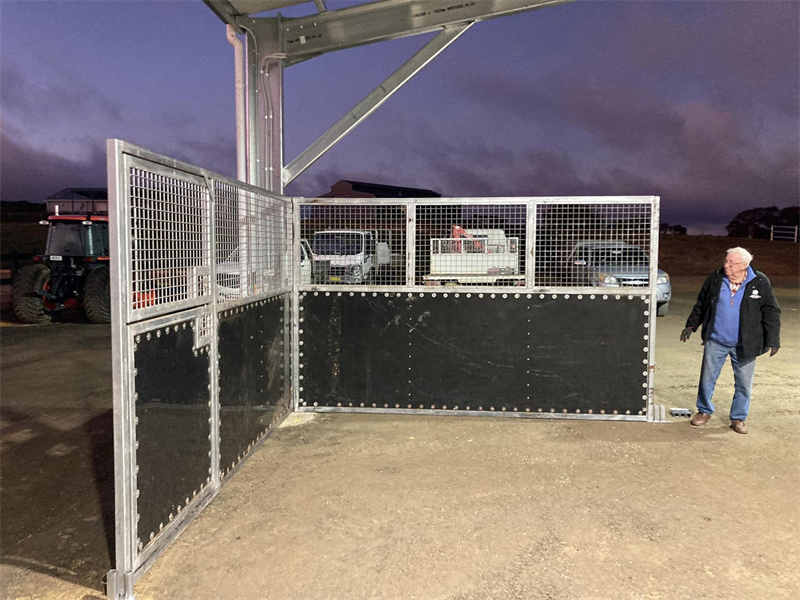
Shared walls in back-to-back stable blocks trap ammonia in dead-air zones, causing standard electro-galvanized steel to corrode twice as fast as exterior frames. The center partition is the first component to fail, and it is the most expensive to replace.
42-Micron Hot-Dip Galvanization vs Electro-Galvanization in Multi-Stall Blocks
In any back-to-back stable design specs, the center partition sits between two stall interiors with no exterior airflow. Urine breakdown generates ammonia concentrations that routinely exceed 25 ppm in poorly ventilated commercial boarding stable layouts. This creates a localized corrosion cell that attacks exposed steel surfaces.
Electro-galvanization applies a zinc coating measured in single-digit microns through an electrolytic process. In a shared-wall dead-air zone, our field observations show this coating breaches within 3 to 4 years in AU/NZ coastal climates. The rust then migrates into the 40x40mm fully welded frame joints, compromising the 6mm steel plate connectors that hold the modular stable block configurations together.
We specify 42-micron hot-dip galvanization on every frame component. The hot-dip process submerges the entire steel section in molten zinc at roughly 460°C, creating a zinc-iron alloy layer rather than a surface-only coating. This delivers a verified 10+ year rust resistance lifespan even in high-ammonia, high-humidity interior zones. For a distributor importing flat pack stable layout Australia products, the critical distinction is that hot-dip galvanization covers internal edges and weld points that electro-galvanization misses entirely.
10mm UV-Resistant HDPE Boards vs Timber Infills
Timber remains the default infill material for many flat-pack stable kits sourced from alternative Chinese factories. The problem is straightforward physics: natural timber absorbs moisture and expands along the grain. In AU/NZ summer conditions where interior stall temperatures regularly hit 40°C, timber infill boards expand up to 15mm across a standard panel width.
That 15mm expansion creates two cascading failures in modular stable block configurations. First, the sliding door tracks warp, and doors jam mid-travel. Second, and far more critical for commercial boarding stable layouts, the expansion gaps between panels open to widths exceeding 12mm at the base. These gaps allow ammonia vapor to penetrate behind the infill panels and accelerate frame corrosion from the inside out.
Our 10mm UV-resistant HDPE boards maintain zero thermal expansion across AU/NZ temperature ranges. HDPE has a linear coefficient of thermal expansion roughly 8 times lower than natural timber in the grain direction, and unlike timber, it does not absorb moisture. The boards fit flush to the frame on delivery and remain flush for the life of the installation. For distributors evaluating horse barn design ideas to resell, this eliminates the single most common source of post-installation warranty claims: misaligned doors and warped panels.
Preventing Thermal Expansion Gaps to Maintain Biosecurity
Biosecurity in commercial equine facilities depends on physical barriers between stalls. When timber infills contract in winter or expand in summer, the resulting gaps at panel junctions create direct airflow pathways between adjacent animals. In a back-to-back layout where two rows of horses share a single airspace above the partition line, cross-contamination via respiratory pathogens spreads rapidly through these gaps.
The 10mm HDPE system eliminates this vector entirely. Panels are cut to precision tolerances and secured to the 40x40mm galvanized frame without relying on swelling friction fits, which is how timber panels are typically held in place. The result is a sealed partition wall that maintains its dimensional integrity year-round, independent of seasonal temperature swings or humidity changes.
For distributors targeting the Australian and New Zealand commercial stable market, the margin implication is direct. A stable block that requires panel replacements within 3 years due to timber rot or warping destroys your repeat-order pipeline. Specifying 42-micron hot-dip galvanized frames with 10mm HDPE infills positions your imported product as infrastructure-grade equipment, not disposable temporary housing.
| Material Specs for High-Ammonia Zones | |||
|---|---|---|---|
| Component | Specification | High-Ammonia Zone Performance | Distributor Margin Benefit |
| Shared Partition Frame | 40x40mm fully welded, 42-micron hot-dip galvanized steel | Resists trapped ammonia corrosion that degrades standard electro-galvanized steel twice as fast in modular stable block configurations. | Eliminates rust-complaint refunds on commercial boarding stable layouts, ensuring 10+ year AU/NZ coastal lifespan. |
| Internal Wall Infill | 10mm UV-resistant HDPE boards | Zero thermal expansion (unlike timber warping 15mm in summer) maintains a structural seal against ammonia seepage. | Prevents misaligned sliding doors in horse barn design ideas, stopping costly component replacements for flat pack stable layout Australia imports. |
| Structural Connectors | 6mm steel plate connectors, 14-gauge steel minimum | Provides extreme rigidity to prevent joint loosening caused by prolonged acidic ammonia exposure in dead-air zones. | Reduces on-site assembly failures and warranty claims, strictly protecting per-unit landed cost in back-to-back stable design specs. |
| Ventilation Integration | 300 CFM mechanical ventilation rate compatibility | Actively clears toxic ammonia build-up trapped by shared walls in high-density commercial boarding stable layout setups. | Positions your flat pack stable layout Australia inventory as premium, welfare-compliant stock to maximize local resale markup. |
Conclusion
A profitable commercial boarding stable layout comes down to back-to-back blocks, not U-shaped aesthetics. You save up to 30% on 40ft container freight and dodge the 25% steel surcharge competitors quietly hide in the specs. Demand 42-micron hot-dip galvanized center partitions, or trapped ammonia will rust the shared walls in half the time.
Send us your site dimensions to calculate the exact container utilization for your next shipment. We will provide a line-by-line cost breakdown showing your actual resale margin before you commit to a single unit.
Frequently Asked Questions
Horse barn design ideas?
For AU/NZ distributors, prioritize back-to-back configurations to maximize 40ft container CBM. Use sliding doors to maintain 12-foot clear aisle widths for safe handler passage and reduce per-unit freight costs.
Horse stall design plans?
Base plans on a 12×12 ft footprint with 7.5-foot partitions. For flat-pack imports, ensure the design specifies modular 40x40mm fully welded frames rather than bolt-together timber to prevent on-site assembly failures.
Outdoor horse stall ideas?
Use 10mm UV-resistant HDPE boards instead of timber to prevent warping under harsh Oceania UV exposure. Ensure the steel frame exceeds 42-micron hot-dip galvanization to withstand coastal salt spray without rusting.
What is the best layout for a horse stable?
Back-to-back linear layouts offer the lowest FOB and freight costs for bulk importers. American barn layouts offer better airflow but require wider aisle steel framing, increasing shipping volume and import duties.
How to design a commercial boarding stable?
Factor in 300 CFM mechanical ventilation per stall, segregated feed storage away from high-humidity wash bays, and NEC 547 electrical compliance for lighting mounted directly on prefabricated steel frames.