Three months ago, a distributor in Queensland lost his entire margin on a shipment of welded horse stables because DTHC fees at the port came in at $2,200 above quote—and then customs flagged the timber packing for ISPM-15 compliance. That $4,200/day inspection delay ate the rest of his profit. He’s now trying to figure out how to import flat pack horse stables without repeating the same mistakes. If you’ve ever opened a container and found yourself paying storage while waiting for a fumigation certificate, you already know why the flat-pack model with zero structural timber changes the equation for the ANZ market.
This article walks you through exactly what changes: container density, freight savings, customs clearance, and which HS code keeps you out of biosecurity purgatory. We’ll compare the numbers—30 to 45 sets per 40HQ versus 12 to 15 for welded frames—and show how taking FOB terms and choosing a 42-micron hot-dip galvanized steel pallet system cuts your per-unit freight cost by over 60%. You also get a compliance checklist so your first import doesn’t end up like that Queensland distributor’s. Let’s start with the one thing every novice buyer misses: the warehouse-to-port cost trap.

Why Flat Pack Stables Dominate Australian Imports
Flat pack horse stables load 2.5–3x more units per container than welded equivalents, slashing per-stall freight by over 60% and eliminating ISPM-15 biosecurity delays entirely.
Freight Density: Welded vs. Flat Pack Per 40HQ
Every dollar you save on shipping drops straight to your margin. That’s the single biggest lever for an importer. Let’s look at the numbers that matter for a standard 40HQ container:
- Welded stables (pre-assembled): 12–15 sets per 40HQ. Bulky, air-filled space, and heavy steel frames welded into rigid shapes that cannot nest.
- Flat pack (knock-down kits): 30–45 sets per 40HQ. Steel components are bundled, HDPE boards stack flat, and the entire package is strapped onto steel pallets.
- Volume reduction: A flat pack system saves roughly 40% cubic metre (CBM) per stall compared to a welded unit.
That difference isn’t theoretical. We’ve shipped both configurations to distributors in Sydney and Auckland. A typical 40HQ container of welded stalls weighs about the same as flat pack, but the flat pack carries three times the salable inventory.
Result: 60% Freight Savings Per Stall — And No Biosecurity Surprises
Translate the density advantage into hard cash. If ocean freight from China to Melbourne runs roughly $4,000–$6,000 per 40HQ (spot rates fluctuate), you are splitting that cost across 12–15 stalls for welded versus 30–45 for flat pack. That’s a per-stall freight cost reduction of 60% or more — from about $300 down to $100–120.
But there’s a second hidden benefit that hits your bottom line even harder: no timber, no ISPM-15, no inspection delays.
Welded stalls frequently include timber framing or timber pallets, triggering mandatory Australian biosecurity inspection under ISPM-15. That inspection adds $4,200 per day of detention charges if your container gets pulled. Flat pack stalls from DB Stable use zero structural timber — the frames are hot-dip galvanized steel, the panels are HDPE, and the pallets are steel. The consignment clears customs without quarantine holds.
Finally, by buying on FOB terms, you control the shipping contract. You pick the carrier, the rate, and you avoid the “Destination Terminal Handling Charge” (DTHC) surprises that can run $200–$500 per container. Combined, the flat pack model gives you predictable landed costs, higher container density, and faster customs clearance. That’s how you protect margin and lead time — the two KPIs that matter most for an ANZ distributor.
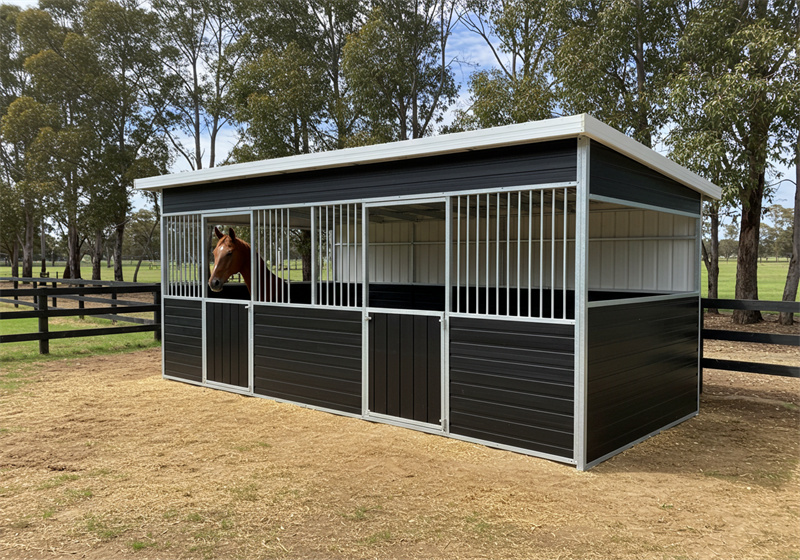
FOB vs CIF: Which Protects Your Margins?
FOB terms hand you control over shipping and let you kill hidden DTHC fees that eat into your per‑stall margin.
CIF Hides Destination Terminal Handling Charges (DTHC) That Erode Profit
When a supplier quotes CIF (Cost, Insurance, Freight) to Australia or New Zealand, the price looks clean — but it never includes the Destination Terminal Handling Charges (DTHC) that hit you after the vessel arrives. Those fees can run anywhere from $200 to $500 per container, and because they’re not quoted upfront, they land straight on your invoice after the fact. For a distributor importing flat‑pack horse stables, that $200–$500 per container shrinks the margin you calculated when you agreed on the CIF price. Worse, some suppliers add a markup on the shipping leg itself, because they control the forwarder. You end up paying for their logistics inefficiency.
FOB Gives You Control Over Shipping and Avoids Hidden Fees
FOB (Free On Board) shifts that risk to you — in a good way. You choose the freight forwarder, you negotiate the DTHC upfront, and you see exactly what each container costs from dock to your warehouse. With DB Stable’s flat‑pack system loading 30–45 sets per 40HQ container, you can calculate your landed cost per stall with precision. There’s no supplier margin baked into the shipping, and no surprise terminal charges. You also gain the ability to consolidate with other imports or choose a carrier that understands ISPM‑15 biosecurity requirements — something CIF sellers often overlook, costing you $4,200 per day in inspection delays.
The bottom line for a distributor in the ANZ market: FOB puts the margin in your hands. You control the freight cost, you avoid hidden DTHC, and you ensure your stable kits arrive on time and on budget.
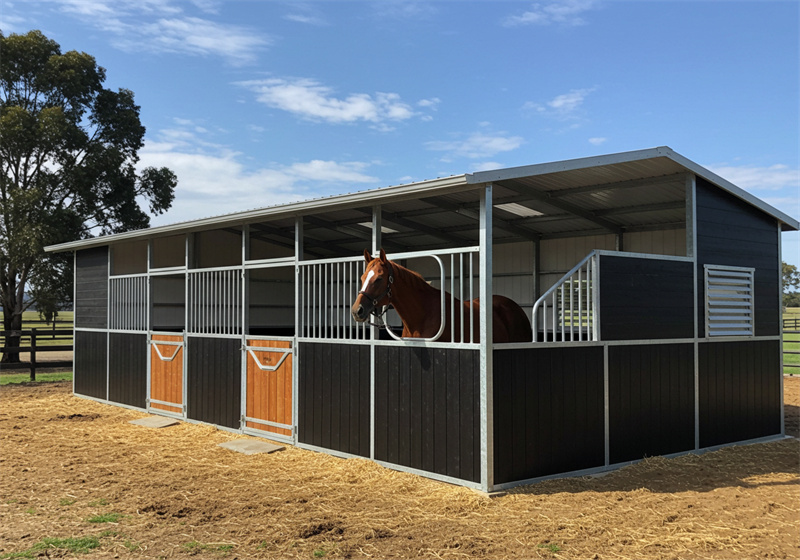
Flat Pack Container Loading: 30-45 Sets per 40HQ
Flat pack systems deliver 30–45 stall sets per 40HQ container—double the density of welded units—and eliminate ISPM-15 timber risks entirely.
The Steel Pallet System: How It Packs 30-45 Sets
Forget loose parts chaos. DB Stable’s flat pack method uses steel pallet racks that layer every hot-dip galvanized frame member and HDPE board into part-numbered stacks. Each stack corresponds to a single stall configuration, and the entire load is strapped to a 40HQ footprint. This approach achieves a 40% CBM reduction per stall set compared to welded assemblies, which typically max out at 12–15 units per container.
- Frame density: 2.0mm-thick steel with 42+ micron galvanization is stacked flat, not welded into rigid cages.
- Board stacking: 10mm UV-resistant HDPE panels slot into designated levels—zero thermal expansion issues during transit.
- Biosecurity upside: Zero structural timber means no ISPM-15 heat treatment or inspection delays crossing into Australia or New Zealand.
A 40HQ loaded with 35 stall sets saves more than 60% on ocean freight per unit versus welded equivalents. Every set arrives as a numbered kit, so your end customers—whether commercial clubs or farm owners—can assemble without guesswork.
How to Calculate Per-Stall Landed Cost
Distributors in the ANZ market live and die on landed cost accuracy. Here is the exact formula to run before placing a PO:
(FOB price + ocean freight + DTHC + insurance + customs duties) ÷ number of stalls
- FOB price: Per-stall cost ex-factory. DB Stable ships on FOB terms, so you control the carrier and negotiate freight directly.
- Ocean freight: A 40HQ from China to Sydney or Auckland runs roughly $3,000–$5,000. Divide by 35 stalls = $85–$143 per stall.
- DTHC: Destination terminal handling charges range $200–$500 per container. That’s $6–$14 per stall if you pack 35 sets.
- Insurance + duties: Marine insurance at 0.3% of cargo value, plus customs duties under HS code 9406 (typically 5% on prefab structures).
Example: A 35-set container with $30,000 FOB value, $4,000 freight, $350 DTHC, $90 insurance, and $1,500 duties works out to roughly $1,028 per stall landed. Compare that to a welded competitor shipping 15 sets at the same freight rate—their per-stall cost jumps to ~$1,800. That’s the difference of 45% margin erosion or healthy profit.
By taking FOB control, you also eliminate DTHC surprises. You choose the forwarder, you see the invoice. No hidden “admin fees” baked into a CIF quote. For ANZ distributors, that single choice can save $5,000–$8,000 per container over a year of steady reorders.
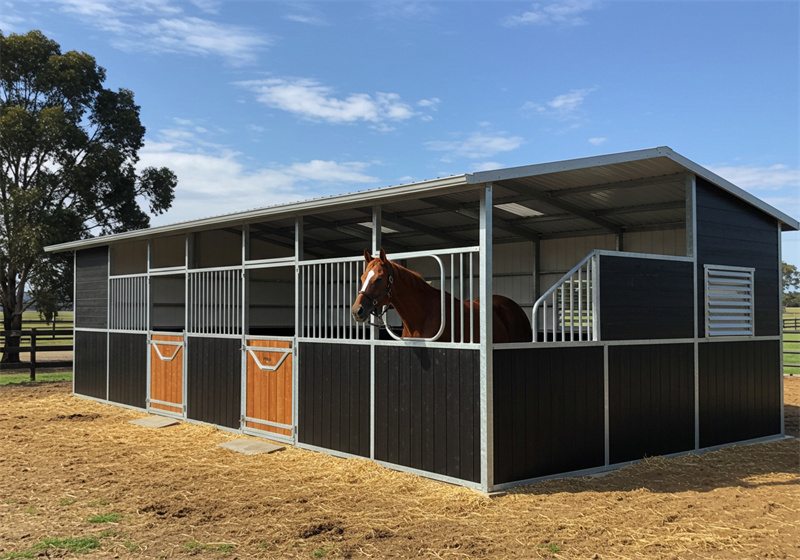
Australian Biosecurity Compliance

Australian Biosecurity Compliance
Timber dunnage is the single fastest way to turn your container into a biosecurity incident.
The True Cost of Timber Dunnage in Horse Stable Imports
Australian biosecurity law under the Biosecurity Act 2015 treats any timber not marked with the IPPC (ISPM-15) stamp as a quarantine risk. If your container arrives with unmarked or insufficiently heat-treated dunnage, the Department of Agriculture, Fisheries and Forestry (DAFF) can hold your shipment for inspection, fumigation, or repatriation. Industry data shows these delays average $4,200 per day in demurrage, storage, and lost sales—on top of the declared value of your horse stables. For a distributor importing 30–45 sets per 40HQ container, a four-day hold wipes out your entire margin on that shipment.
Why Our Flat-Pack System Eliminates Biosecurity Risk
DB Stable’s flat-pack horse stable kits use zero structural timber in the frame, walls, or packaging. The frames are hot-dip galvanized steel (2.0mm, 42+ microns per ISO 1461), the panels are 10mm UV-resistant HDPE, and the entire system ships on steel pallets. There is no timber to inspect, no bark to test, and no ISPM-15 documentation to chase. This design alone removes the most common trigger for DAFF biosecurity holds. Your container clears customs based on invoice and packing list—not on an officer’s inspection of timber stamps.
Actionable Step: Verify Your Supplier’s Dunnage
If you are sourcing from any supplier that uses timber dunnage—even if the stable itself is steel—you are gambling on compliance. Before you issue a purchase order, request photographic proof of the heat-treated dunnage with the IPPC stamp clearly visible on each piece. Ask for a copy of the supplier’s timber supplier certificate and the heat treatment certificate. A reputable factory will send these photos within 24 hours. If they hesitate or send generic images, treat that as a red flag. With DB Stable, you don’t need to ask—our steel pallet system is documented in every container loading photo we provide. You get a clean biosecurity path, zero timber risk, and no surprise inspection costs.

Shipping Documentation & HS Codes
Correct shipping documentation saves you thousands in delays. Use the right HS code and cargo description to avoid customs holds.
Bill of Lading: Use the Exact Description “Prefabricated Galvanized Steel Shelter Components”
Your Bill of Lading (B/L) is the first document customs officers see. If the description is vague or generic, you trigger a manual inspection — and that costs you time and money. For flat pack horse stables from DB Stable, always use this precise phrase: “prefabricated galvanized steel shelter components.”
Why it matters:
- Matches what’s inside: The container holds disassembled steel frames, HDPE panels, and hardware — all components of a prefabricated building, not raw steel.
- Avoids ISPM-15 risk: DB Stable’s flat packs contain zero structural timber. Using “shelter components” rather than “wooden stable” eliminates unnecessary biosecurity questions for Australia and New Zealand.
- Keeps freight forwarders happy: A clear, unambitious description speeds up carrier acceptance and reduces the chance of a DTHC (Destination Terminal Handling Charge) dispute. Typical DTHC fees run $200–$500 per container — correct documentation avoids surprise surcharges.
HS Code 9406 – Prefabricated Buildings: Your Best Friend at Customs
The correct HS code for modular stall kits is 9406.90.00 (prefabricated buildings). Many importers mistakenly use 7308 (structures of iron or steel) or 7326 (other articles of iron or steel). That mistake flags your shipment for intensive review because those codes imply raw materials subject to anti-dumping duties or quality checks.
With HS code 9406, your shipment is classified as a complete building system — exactly what it is. Australia and New Zealand apply this code to flat pack horse stables, giving you:
- Lower inspection rates: Prefabricated building codes are low-risk for biosecurity and quality when the product is steel-and-HDPE with no timber.
- Duty eligibility: 9406 often qualifies for preferential tariff treatment under free trade agreements (e.g., China–Australia ChAFTA) — check with your broker.
- Clear physical description: A 40HQ container holds 30–45 sets of stall components. The code 9406 directly matches that function, so customs officers see “prefabricated building parts” and release the shipment faster.
Avoid Generic “Galvanized” – It Triggers Inspection
Never use “galvanized” alone or “galvanized steel parts” on any customs document. That language signals “raw material import” and can trigger a physical inspection, a steel tariff review, or a requirement for material certificates — all of which cause delays. One day of inspection costs roughly $4,200 in demurrage, storage, and missed sales.
Instead, pair the coating description with the end-use. DB Stable’s frames are hot-dip galvanized to ISO 1461 (42+ microns), but the B/L should say “prefabricated galvanized steel shelter components” — not “galvanized steel frames.” The full phrase tells customs this is a finished product, not a commodity.
A real-world example: A distributor in New Zealand once shipped “galvanized steel gates” (HS 7308) and faced a two-week hold because the code triggered a steel quota check. The same shipment described as “prefabricated galvanized steel shelter components” under 9406 cleared in under 2 hours. Use the exact wording, use the right HS code, and let DB Stable’s flat pack system do the rest. No timber, no ISPM-15, no surprises.
Flat Pack Horse Stable Buying Tips
Your margin depends on container density and avoiding customs surprises. Ask these three questions before placing an order.
Can they load 30+ sets per 40HQ container?
This is your single biggest lever on freight cost. A standard welded stable system typically loads only 12 to 15 sets per 40HQ container. That eats your margin before the goods even leave port. A proper flat pack system—specifically one designed on steel pallets—should load between 30 and 45 sets per 40HQ. That is a 60% reduction in per-unit freight cost compared to welded alternatives.
When you ask this question, do not accept a vague “yes.” Ask for the exact packing list per container. Confirm the dimensions of each packed stall and verify the total cubic meter (CBM) utilization. If the supplier cannot provide a specific loading plan with numbered steel pallets, they likely do not have a mature flat pack system. You should also push for FOB terms. When you control the freight booking, you eliminate the risk of hidden Destination Terminal Handling Charges (DTHC), which can run $200 to $500 per container and are often inflated when the seller arranges shipping.
Do they supply CAD drawings for customs clearance?
Customs clearance for prefabricated buildings in Australia and New Zealand hinges on correct classification under HS code 9406.00. Without proper engineering drawings, your shipment can be held for inspection. The correct HS code determines duty rates and triggers biosecurity checks. A significant risk for importers is the ISPM-15 standard for timber packaging. Many competitors use timber pallets or structural timber in their stables. If any wood is present without proper heat treatment certification, your container faces inspection delays that cost roughly $4,200 per day.
A flat pack system built entirely on steel pallets and using zero structural timber avoids this risk entirely. The manufacturer should supply CAD drawings showing the steel frame structure, material specs (hot-dip galvanized steel, HDPE panels), and the flat pack layout. These drawings serve as your primary documentation for customs to verify the goods match the HS code declaration. Do not work with a supplier who cannot provide this documentation promptly. It is a red flag for a factory that is not experienced with export clearance.
What is the galvanization thickness and after-sales warranty?
Your clients in Australia and New Zealand expect stables that withstand harsh sun, coastal salt, and high-usage environments. The material standard must be non-negotiable. We use 2.0mm steel with a hot-dip galvanized coating exceeding 42 microns, certified to ISO 1461. This is the benchmark for corrosion resistance in equine applications. Many cheaper suppliers use electro-galvanized steel (often called “pre-galv”) with coatings under 20 microns. That coating will fail within two to three years in a stable environment where horses urinate and kick.
When speaking to a manufacturer, ask for a galvanization thickness test certificate from an independent lab. Do not rely on a “factory standard” claim without documentation. On the after-sales side, the warranty should cover structural integrity (frame and panels) for a minimum of 10 years. DB Stable pre-stocks high-runner components like HDPE panels and sliding door rails specifically to support fast warranty replacements. Ask the supplier if they hold local stock in Australia or New Zealand, or if you must wait for a sea shipment for every defective part. That lead time difference can make or break your relationship with your end customer.
Conclusion
Skip the welded stables. Flat pack loads 30–45 sets per 40HQ — that’s 60% lower freight cost per stall. And because our frames use zero structural timber, you bypass ISPM-15 biosecurity inspections. On a 50‑stall container, that single feature saves you $4,200 per day of delay. Every welded competitor will quote you lower unit price; none of them quote your freight and customs risk. The flat‑pack system wins on total landed cost, period.
Next step: ask us for a container loading plan and a mock FOB quote. You’ll see exactly how many sets fit, which HS code applies, and what DTHC costs you control. Once you have those numbers, compare them against any welded quote you’re holding. Then call me.
Frequently Asked Questions
How much does a single horse stable cost?
Pricing for a single horse stable from DB Stable varies based on configuration and materials. As a B2B manufacturer, we offer competitive pricing that balances high quality with the lowest cost, typically ranging from AUD 2,000 to AUD 5,000 for a basic flat-pack kit, excluding shipping and taxes. For an exact quote tailored to your specifications and volume, we recommend requesting a quick quote through our professional network.
What is the 25 year rule in Australia?
The 25-year rule in Australia refers to the Department of Agriculture, Fisheries and Forestry (DAFF) requirement for certain imported goods to be free of biosecurity risk. For flat pack horse stables, this rule does not directly apply; however, all timber and wood packaging must comply with ISPM 15 standards to prevent pest introduction. DB Stable ensures all our products are manufactured with treated materials and provide documentation to meet Australian biosecurity import conditions.
Do I have to pay import tax from the USA to Australia?
Importing goods from the USA to Australia does incur customs duties and GST. For horse stables, the general rate of customs duty is 5% under the Harmonized System code for prefabricated buildings, plus 10% GST on the total value including freight and insurance. As DB Stable is based in China, shipments from China to Australia may fall under different trade agreements; we advise consulting a licensed customs broker to confirm applicable tariffs for your specific order.
How long does it take to import a horse?
Importing a horse stable from DB Stable typically takes 4 to 6 weeks from order confirmation to delivery at your nearest Australian port. This includes manufacturing time for our flat-pack kits and sea freight transit from China to major ports like Sydney or Melbourne. Customs clearance and inland transport can add an additional 1 to 2 weeks, depending on your location and biosecurity inspections.
Can you import horses into Australia?
Yes, you can import horse stables into Australia, and DB Stable specializes in shipping flat-pack, portable stables that meet Australian standards. Our products are designed for easy international shipping and comply with local building and biosecurity requirements. For live horses, separate regulations apply through the Australian Department of Agriculture, but our expertise is solely in the stable structures.