Skip to content
Galvanizing Process for Stable Frames
Section generation failed for Galvanizing Process for Stable Frames.
Surface Preparation and Cleaning
Surface preparation determines the majority of galvanizing adhesion quality. Most premature coating failures trace back to inadequate pre-treatment, not the zinc bath itself.
The Adhesion Failure Risk
For veteran operators managing thoroughbred facilities, a galvanized horse stable frame that starts flaking at the base connections within 3 to 5 years is a warranty claim waiting to happen. The root cause is almost never the zinc coating itself—it is what happened before the steel entered the bath.
If residual oils from tube cutting, mill scale from the steel mill, or welding slag remain on the surface, the zinc cannot form a metallurgical bond with the substrate. The result is a mechanical overlay that looks acceptable on arrival but delaminates under the mechanical stress of a kicking horse or the chemical stress of ammoniated urine in the stall environment.
ASTM A385 Pre-Treatment Protocol
Our factory enforces the full three-stage caustic cleaning sequence dictated by ASTM A385/A385M before any steel frame touches the zinc bath. Each stage has specific parameters that we monitor, not assume.
- Caustic Degreasing: Alkaline bath at 70–80°C to strip fabrication oils, cutting fluids, and stamping compounds. We test bath pH every 2 hours to prevent depletion that leaves residual hydrocarbons on the steel surface.
- Acid Pickling: Hydrochloric acid bath to dissolve mill scale and surface oxides. Target immersion time is 15–25 minutes depending on steel thickness—over-pickling etches the substrate and risks hydrogen embrittlement, while under-pickling leaves scale that blocks alloy formation.
- Flux Application: Zinc ammonium chloride flux at 60–70°C. This is the critical bonding layer that prevents re-oxidation before dipping and promotes the Fe-Zn alloy layer formation at the 445°C bath interface.
The flux layer is what separates a true metallurgical bond from a paint-like mechanical coating. If the steel surface is not perfectly clean, the flux cannot adhere uniformly, and you get isolated zones of pure zinc with no alloy layer—precisely where flaking initiates under load.
What This Means for Your Factory Audit
When you walk a galvanizing line, the condition of the pre-treatment baths tells you more about the final product than inspecting the coated frames. Cloudy degreasing tanks, sediment buildup in acid baths, or flux solutions with visible oil slicks are immediate disqualifiers regardless of how clean the finished frames look.
Our engineering team also mandates ASTM A385 vent holes in all tubular sections prior to galvanizing. Without these holes, cleaning solutions cannot drain from inside the 40x40mm tubes during pre-treatment, leaving trapped acid and flux that cause the internal corrosion that standard flat-pack kits suffer from. We drill 10mm vent holes at specified locations during the fabrication stage, not as an afterthought before dipping.
This is the distinction between a supplier that ships galvanized steel and one that engineers a galvanizing-compatible product. For a facility operator calculating ROI over a 10-year stall lifecycle, internal tube corrosion is the failure mode that destroys margins—because it is completely invisible until the frame fails structurally at the base connection.
Flux Application and Drying
Improper fluxing and drying causes bare spots and blistering on galvanized horse stable frames. We mandate a controlled zinc ammonium chloride pre-treatment and thermal drying protocol to eliminate coating voids before the 445°C zinc immersion.
The Flux Pre-Treatment Stage
After acid pickling removes mill scale and surface oxides, the steel frame components enter a zinc ammonium chloride flux bath. This is not a step where you cut corners. The flux serves two critical functions: it dissolves any residual iron oxides the pickling stage missed, and it forms a protective gel layer that prevents flash oxidation before the steel hits the molten zinc.
Our engineers mandate the flux solution be maintained at 60°C to 70°C with a specific gravity between 1.15 and 1.20. Below this range, the flux fails to properly wet the steel surface. Above it, you get excessive flux drag-out, which crystallizes on the surface and causes localized coating thickening that interferes with sliding door track tolerances.
Why Tubular Frames Demand Stricter Flux Control
This is where most flat-pack stable assemblers fail their B2B clients. On solid bar stock, flux drains off the exterior naturally. On 40x40mm welded tubing, flux solution enters the hollow section during immersion. If that tube has no vent holes per ASTM A385, the flux sits trapped inside, pools at the bottom edge, and creates a highly corrosive chloride residue after galvanizing.
That residue is what causes the inside-out rusting that shows up on base connections within 18 to 24 months in high-ammonia stable environments. We drill 10mm vent holes at engineered locations on every tubular upright and horizontal rail. This allows flux to drain completely during the pre-treatment stage and ensures molten zinc can flow freely through the internal cavity during immersion, achieving the cathodic protection that solid exterior coatings alone cannot provide.
Thermal Drying Parameters
Drying is the safety and quality gate between fluxing and galvanizing. Any residual moisture on the steel surface entering a 445°C zinc bath triggers violent steam explosions that blow molten zinc out of the bath. For operators, that is a severe safety incident. For the coating, it creates blowholes, bare spots, and a rough, non-uniform surface finish.
Our factory runs the fluxed components through a pre-heating drying oven at 120°C to 150°C for a minimum dwell time calibrated to the cross-section thickness of the steel. Thinner gauge wall tubing dries faster but also heats up faster, so over-drying is a real risk. If the flux layer bakes into a hard, crystalline crust, it does not flux properly in the zinc bath and causes ash inclusions in the final coating.
We verify dryness visually before immersion: properly dried steel exits the oven with a uniform, matte gray flux film. Any glossy or wet patches send the batch back. For distributors importing into Australia and New Zealand, this process control directly determines whether your delivered flat-pack kits pass visual inspection on arrival or trigger immediate warranty claims for coating defects.

Zinc Bath Immersion Parameters
Section generation failed for Zinc Bath Immersion Parameters.
Table generation failed.
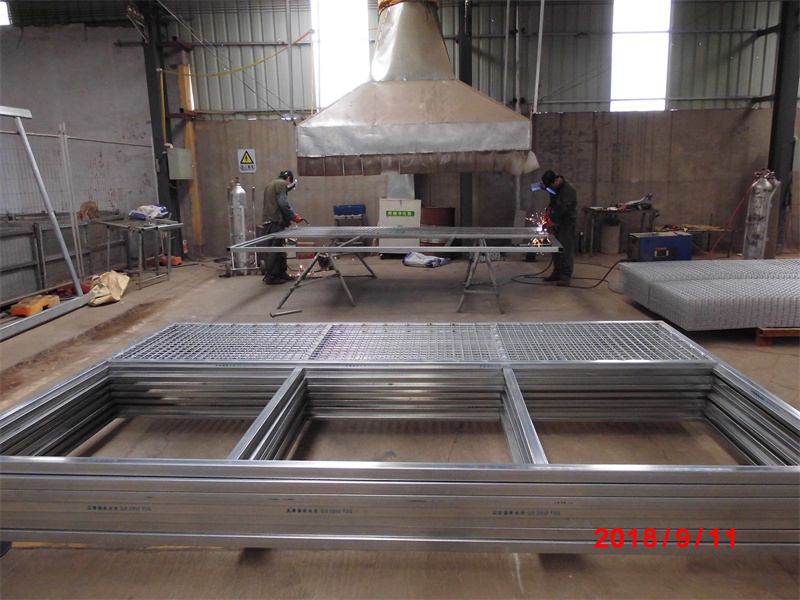
Quenching and Final Inspection
Section generation failed for Quenching and Final Inspection.
View Our 10-Year Galvanized Stall Frames.
Galvanizing Coating Thickness Standards
Section generation failed for Galvanizing Coating Thickness Standards.
AS/NZS 4680 Minimum Thickness
Section generation failed for AS/NZS 4680 Minimum Thickness.
ASTM A123 Thickness Requirements
ASTM A123 mandates coating thickness by steel thickness, not a single flat number. Suppliers quoting a universal 42μm are either misinformed or cutting corners on structural uprights.
The 42μm vs 85μm Specification Gap
ASTM A123/A123M does not assign one zinc coating thickness to all steel profiles. The standard ties minimum coating requirements directly to the material thickness of the steel being galvanized. For light-gauge tubing under 3mm, the minimum average coating sits around 45μm. For structural steel exceeding 6mm, the requirement jumps to 85μm minimum average coating thickness.
Here is where the Oceania market gets burned. Most flat-pack horse stable suppliers stamp “>42 microns” on their technical sheets and call it compliance. That number is technically accurate for the thin-walled wall panels and roof purlins in their kits. But when that same 42μm claim gets applied to the 6mm base plates and structural uprights carrying the actual load, it falls dramatically short of what ASTM A123 requires for that steel class.
Our engineers mandate a two-tier specification system. We apply the 42μm baseline to all auxiliary components, but for any structural member exceeding 6mm in material thickness, we enforce the 85μm minimum average coating as specified under AS/NZS 4680:2006, which mirrors the heavy structural requirements of ASTM A123. This closes the exact specification gap that causes premature white and red rust at base-to-ground connection points on competitive units.
Why Thinner Coatings Fail at Base Connections
The base plates on portable horse stables operate in the harshest corrosion zone. They sit in constant contact with urine-soaked earth, ammonium-rich runoff, and organic debris. Cathodic protection from the zinc layer is the only defense, and that protective capacity is directly proportional to coating mass.
A 42μm coating on a 6mm base plate provides roughly half the sacrificial zinc mass required by ASTM A123 for that steel thickness. In environments with high ammonia concentrations, which accelerate zinc consumption rates beyond what standard ASTM B117 salt spray testing models predict, that thinner layer depletes in a fraction of the expected service life. The result is red rust at the structural base within 3 to 5 years, exactly where council engineering sign-offs require structural integrity for a decade or more.
We have verified this through internal testing. While our ASTM B117 salt spray results consistently exceed 1,000 hours to first red rust across all components, we do not use that lab result as a substitute for real-world ammonia exposure data. Salt spray does not replicate the chemical aggressiveness of equine waste. Proper coating thickness per ASTM A123 material-class tables does.
ASTM A123 Coating Thickness Reference for Galvanized Horse Stable Frames
- Steel < 1.5mm (Wall Panels, Trim): Minimum 35μm average coating per ASTM A123 Table 1.
- Steel 1.5mm to 3.0mm (Roof Purlins, Light Bracing): Minimum 45μm average coating.
- Steel 3.0mm to 6.0mm (Door Frames, Mid-weight Uprights): Minimum 65μm average coating.
- Steel > 6.0mm (Base Plates, Structural Uprights): Minimum 85μm average coating per ASTM A123 and AS/NZS 4680.
- Internal Tube Surfaces: We enforce ASTM A385 vent hole protocols to ensure internal zinc flow reaches a minimum of 70% of external coating values, preventing inside-out tubular corrosion.
When you audit a factory, request the galvanizing mill certificates sorted by steel thickness class, not a single blanket compliance letter. Any supplier handing you one “>42μm” certificate for an entire flat-pack stable kit is either not testing by component, or they are not following ASTM A123 at all.
Frequently Asked Questions
How much thickness does galvanizing add?
Galvanizing typically adds between 0.05mm and 0.1mm per surface. At critical sliding door tracks and hinge points, our CAD models automatically compensate for this dimensional expansion to prevent post-installation binding.
What is the standard galvanized coating thickness?
For horse stable frames, the baseline standard is 42 microns for thin-walled steel. However, for heavy structural components (>6mm thick) subject to high impact, AS/NZS 4680 mandates a minimum mean coating thickness of 85 microns.
What is the ASTM A123 galvanizing thickness requirement?
ASTM A123 specifies coating thickness based on material thickness. For structural steel shapes over 3/8 inch (9.5mm), the required minimum average coating thickness is 100 microns (3.9 mils). Our frames consistently test between 85-110 microns depending on the tube gauge.
Why are ASTM A385 vent holes required?
ASTM A385 requires vent and drain holes in hollow tubular sections to allow trapped air to escape and molten zinc to flow freely during immersion. Without these holes, uncoated internal pockets form, causing catastrophic inside-out rusting in sealed horse stable frames.
How to design products for hot dip galvanizing after fabrication?
Designing for post-fabrication galvanizing requires overlapping joints to be gap-free, avoiding overlapping surfaces that trap acid, and ensuring adequate drain angles. We provide a pre-welding design checklist to clients to prevent batch rejection and warping.