Pony club portable stables are not a ponies-only purchase. A club that runs rallies for young members’ ponies also stables instructors’ horses, and the kit needs to hold its value when the herd changes. That makes sizing a fleet decision rather than a pony decision. The tempting shortcut — assuming ponies need a smaller, cheaper box — misses that the standard portable stable module, 2200mm high and available in 3.0m and 3.6m lengths, houses a pony and a full-size horse in the same structure. For a mixed herd, one uniform size is the simpler procurement call.
The differences that actually matter between pony and horse housing are narrower than most buyers expect: door width, roof clearance and chew resistance — not floor area. This guide works through each one against DB Stable’s factory specifications — the company has manufactured portable stables for export to Australia and New Zealand since 2013 — so a committee can specify its order with numbers rather than guesswork.
Key Takeaways
- A pony is generally any mature equine under 14.2 hands (about 148cm) at the withers; the standard 2200mm stable height suits ponies and full-size horses alike.
- Standard lengths are 3000mm and 3600mm, and the factory can custom-build at 3.0m, 3.6m, 4.0m and 4.2m — a pony needs no smaller box.
- Front walls come 1150mm or 1300mm wide; 1300mm is the width that matters once full-size horses join the row.
- 10mm HDPE infill is chew-resistant, washable and rot-proof — the specification that matters most around ponies.
- Hot-dip galvanising carries a factory specification of 42 microns or more, with the galvanising process run to AS/NZS 4680.
- Orders start at 10 sets; a documented NSW project ran 12 back-to-back stalls with installation completed in three days.
What Actually Changes Between a Pony and a Horse
By the usual convention, a pony is a mature equine measuring under 14.2 hands — about 148cm — at the withers, and everything taller counts as a horse. That line drives three practical differences. Withers height sets clearance at the door and under the roof. Body length sets how much floor the animal needs to lie down and stretch out. Barrel width sets how wide the door opening must be.
What does not change is the damage profile. Ponies kick, lean and chew at least as enthusiastically as horses, so frame strength, chew-resistant infill and honest corrosion protection matter just as much at 12 hands as at 16. A shelter built lightly because “they’re only ponies” is the one that fails first.
Our position, stated plainly: a club with a mixed herd should buy one module size for the whole fleet, not a pony run and a horse run. Individual wall panels weigh roughly 200kg, so nothing gets swapped around casually; spare parts only interchange within one size; and a uniform row reconfigures freely as the herd changes. Splitting sizes halves that flexibility for no real saving.
One Standard Module Covers Pony Club Portable Stables at Either Size
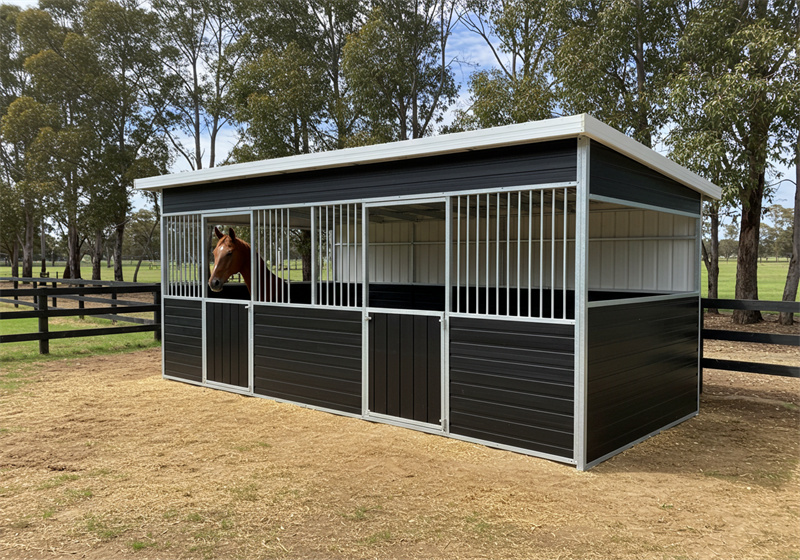
The starting point is the standard stable body, built with or without a roof: 2200mm in height, with standard lengths of 3000mm and 3600mm, and factory custom builds available at 3.0m, 3.6m, 4.0m and 4.2m. Front walls stand 2200mm high and come in widths of 1150mm or 1300mm. Side and rear walls are HDPE panels of 2844×1194×10mm or 3494×1194×10mm, set in fully welded frames of Q235 steel — 50×50×2.0mm square tube — with the HDPE door panel measuring 1024×1054×10mm.
| Dimension | Factory specification | For a pony | For a full-size horse |
|---|---|---|---|
| Overall height | 2200mm | Well above a pony’s head | Same 2200mm front wall as the full-size row |
| Body length | 3000mm or 3600mm (options 3.0m to 4.2m) | Roomy at either length | 3600mm is the safer pick |
| Front wall width | 1150mm or 1300mm | Either width suits | 1300mm recommended |
| Door panel | Gate panel within the 1150mm or 1300mm front wall (HDPE, 1024×1054×10mm) | Easy passage | Comfortable passage |
| Wall panels | HDPE, 2844×1194×10mm or 3494×1194×10mm | Chew-resistant lining | Chew-resistant lining |
| Frame | Q235 steel, 50×50×2.0mm square tube, fully welded | Same structure | Same structure |
Read the table as a floor, not a ceiling. A 3.0m box gives a pony more floor than it strictly needs, and that surplus is not waste — it absorbs bedding, a swivel feeder and a rug rail. The horse side is where the decision bites. A horse that cannot lie down and stretch out is a welfare problem the club does not want. That is why 3.6m is the safer default for any row that will hold full-size horses, even occasionally. Weighing the purchase the way a commercial operator would? The same logic runs through what to specify before buying portable stables for agistment.
Door width is the quiet decision in the specification. A pony walks through a 1150mm front without noticing it; a broader horse can brush the frame. The 1300mm front wall exists for exactly this reason — order it across the whole row and the question never comes up again.
Height, Roofs and Airflow
At 2200mm, the wall and front height sits well above a pony’s head and around the height where a full-size horse can see over the front without getting a leg over it. Height is rarely the constraint in a portable stable; weather is. The optional raised steel roof stands 2.65m at its highest point and runs 4.6m long. It throws the front eave 70cm beyond the front line — enough overhang to keep the door line, the feed and the handler out of driving rain. Colorbond cladding is available as an option.
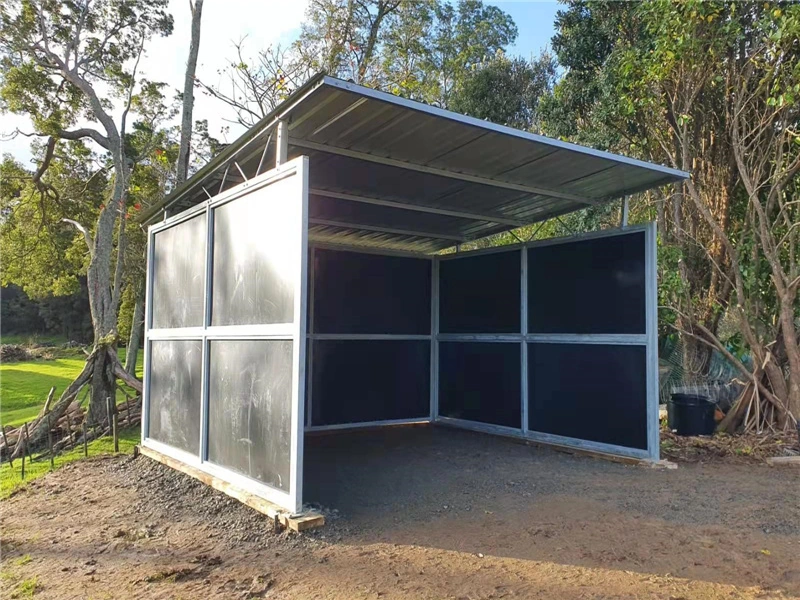
Front construction controls airflow. Fronts can be specified mesh or tubular rather than solid HDPE, with plastic-coated or hardwood finishes also available. For rally-day rows this matters: a bank of solid fronts facing the afternoon sun turns the aisle into a heat trap, while mesh or tubular fronts keep air moving across the stalls — and keep young members in sight of their ponies.
Chew Resistance: The Spec That Matters Most Around Ponies
Any club that has replaced timber edges knows the pattern: ponies chew, and they chew persistently. Painted timber, plywood sheeting and hardwood rails lose that argument to chewing and wet weather. The 10mm high-density polyethylene (HDPE) infill used across the panel range is the countermeasure. Chew-resistant, UV-stable and antibacterial, it washes with a hose and will not rot or hold moisture the way timber does. It also gives slightly under a kick, which protects legs and hooves.
The steel side of the panel deserves the same scrutiny. Frames are hot-dip galvanised to a factory specification of 42 microns of zinc or more, and the galvanising process is run to AS/NZS 4680, the Australian and New Zealand standard for hot-dip galvanised structural steel. One point of precision, because it comes up in supplier conversations: AS/NZS 4680 itself requires an average coating of 55 microns, and 45 microns at any local point, on steel between 1.5mm and 3mm wall thickness. The 42-micron figure is the factory’s own specification for this product line, not a restatement of the standard — and a supplier who blurs that distinction on paper will blur others.
Test it before any deposit moves: asking how HDPE thickness and galvanising claims are documented is one of the checks in our 12-point vetting checklist for portable stable suppliers, and the answer separates factories from traders.
Planning the Club Installation: Panels, Gates and Quantities
Portable stables arrive flat-packed and assemble with tool-free corner pins: a crew of two or three people builds one stable in about 30 minutes. For an organisation that runs on volunteer labour, that is the whole installation story — no crane, no welding, no specialist contractor. Rows extend by adding panels and gates, so day one’s configuration does not cap year three.
| Configuration | Side panels | Gates |
|---|---|---|
| 1 stable | 3 | 1 |
| 2 stables (adjacent) | 5 | 2 |
| 3 stables | 7 | 3 |
| 4 stables | 9 | 4 |
| 5 stables | 11 | 5 |
| 6 stables (back-to-back) | 11 | 6 |
A documented NSW project ran 12 stalls in a back-to-back layout with the installation completed in three days. On the supply side, orders start at a minimum of 10 sets and the factory produces up to 20 sets per week, so a full club row is one production run rather than one queue position. Enquiries are answered within 6 hours and drawing-based quotes within 24.
Frequently Asked Questions
What size portable stable does a pony need?
A pony is comfortable in the standard module: 2200mm high and 3000mm or 3600mm long. No smaller pony box exists in the range, and none is needed — the standard dimensions already give a pony more floor and clearance than it uses.
Can ponies and full-size horses share the same stable design?
Yes. The same 2200mm-high module houses both. The only specifications worth upgrading for horses are the 1300mm front wall width and, if horses will stay in the boxes for long spells, the 3600mm length.
Do pony club shelters need a roof?
A portable stable functions without one, but the raised steel roof adds all-weather cover. It stands 2.65m, runs 4.6m long and overhangs the front line by 70cm, keeping the door, the feed and handlers out of driving rain, with Colorbond cladding optional.
How many stables can a pony club order at once?
Orders start at a minimum of 10 sets, and the factory produces up to 20 sets per week. Configurations from a single stall to six in a back-to-back row are standard, and rows extend later by adding panels and gates.
Are HDPE panels really chew-proof for ponies?
The 10mm HDPE infill is chew-resistant rather than chew-proof in absolute terms, but it gives ponies nothing to grip the way a timber edge does. It is also washable, UV-stable and will not rot, which is why it replaces timber edges on high-traffic yards.
Conclusion
The sizing question resolves cleanly. The standard 2200mm-high module in 3.0m or 3.6m houses ponies and full-size horses in the same structure, so the decisions that actually differentiate a pony club portable stables order are the 1300mm front width, the raised roof and the chew-resistant 10mm HDPE infill. Specify one module size across the fleet, keep the configuration table open for extension, and get the galvanising and HDPE claims in writing when comparing suppliers.
When the committee is ready to put numbers on paper, request a quote from the DB Stable factory — drawing-based quotes come back within 24 hours, sized to the mix of ponies and horses the club runs.