A horse stable production line is a sequence, not a single machine. Steel tube arrives, is cut to length, is welded into frames, is hot-dip galvanised, meets its HDPE boards, passes a test assembly and quality check, and leaves the floor as a flat pack kit. Each stage either leaves evidence in the finished stable or it does not — and an importer who knows the sequence can read a workshop the way a mechanic reads an engine.
This walkthrough follows that sequence from tube to flat pack — what a buyer should expect at each stage. Our reference line: DB Stable builds portable stables in Anping, Hebei — China’s fence and wire mesh belt — with engineering experience since 2009, portable stables since 2013, output up to 20 sets a week. Visit or audit from your desk; the checks stay the same.
Key Takeaways
- The sequence: tube stock → cutting → frame welding → hot-dip galvanising → HDPE board fitting → test assembly and QC → flat pack packing. Welding comes before galvanising so zinc covers the welds.
- Frames: Q235 steel in 50×50mm square, 60×30mm oval or 32mm round tube, fully welded; stable panel frames run 50×50×2.0mm.
- Coating: hot-dip galvanising to a factory spec of at least 42 microns, process run to AS/NZS 4680.
- Boards: 10mm HDPE in black, white or green; standard sheets 2844×1194×10mm or 3494×1194×10mm; a single panel, about 200 kg.
- Proof of fit: ask for one set assembled and checked before packing; tool-free corner pins, 2–3 people, about 30 minutes; third-party QC resident inspection available on request.
- Volume: up to 20 sets per week, minimum order 10 sets, packed flat to cut sea freight volume to Australia and New Zealand.
Where the Line Starts: Tube Stock and Cutting
Every stable begins as raw tube, and the first thing a real line shows you is the stock itself. Anping grew up as a fence and wire mesh county; a genuine workshop holds inventory in the profiles it quotes, not a single generic rack. For our portable stables that means Q235 steel — a common structural grade — in 50×50mm square tube, 60×30mm oval tube or 32mm round tube depending on the component.
Wall thickness is where shortcuts hide. Stable panel frames run 50×50×2.0mm; the lighter 25×25×1.6mm section is reserved for order-department frames, not for panels that hold horses. Put calipers on the stock before it is cut, because no inspection further down the line can add steel that was never there.
Frame Welding: Where Stable Strength Is Decided

Our frames are fully welded — every joint on a panel frame is a continuous weld, not a bolted or tack-welded connection. The difference shows up over years: a single panel weighs about 200 kg and carries kick loads through its joints, and a tack weld that looks fine on delivery works loose under exactly that treatment.
What to look for on the floor: continuous welds along the joint line, and a finished frame that matches the drawing you were quoted, tube for tube. Ask to see the same design mid-weld and finished. A frame built to someone else’s drawing is a frame your order will not fit.
Our position is blunt: the welding stage decides more about a stable’s ten-year life than any certificate in the front office. Certificates describe intent; continuous welds are the product.
Hot-Dip Galvanising: The Coating Stage
After fabrication, welded frames go for hot-dip galvanising — the stage that decides how the steel ages in an Australian or New Zealand paddock. Our factory specification is a coating of at least 42 microns, and the galvanising process is run to AS/NZS 4680, the joint AU/NZ standard for hot-dip galvanised structural steel. Keep those two statements separate: 42 microns is our works figure, while the standard itself sets minimums by steel thickness — for 1.5–3mm steel, 45 microns local and 55 microns average. A supplier who blurs the two is quoting a brochure, not a process.
Sequence matters as much as thickness. Because frames are dipped after welding, zinc covers the welds and the cut tube ends — the exact points where rust starts on a lesser finish. Pre-galvanised tube with a powder coat is a legitimate lower-cost route, but the dip tank is where a hot-dip claim is proved or lost — bare metal at welds and cut ends is the tell. Zinc and steel markets also move your quote at this stage; our piece on how steel price cycles affect stable quotes explains where the exposure sits.
HDPE Board Fitting: The Infill Stage
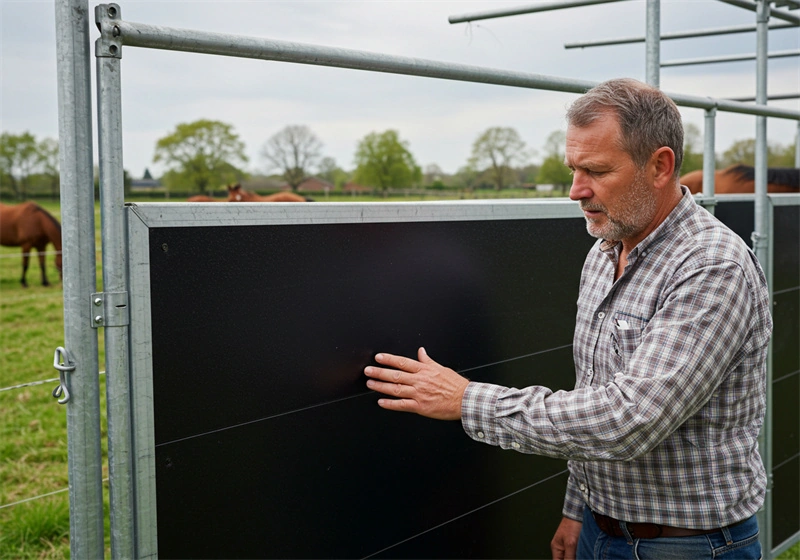
The infill on our stables is 10mm high-density polyethylene — HDPE — in black, white or green. It is UV-stable, antibacterial, washable, will not rot, resists chewing, and cushions kicks. Standard boards come in 2844×1194×10mm and 3494×1194×10mm sizes; a single panel, about 200 kg.
Thickness is the spec buyers most often get talked down on. A 10mm board stands stiff in the frame; a thinner sheet flexes when pushed, and a flexing board works its fixings loose within a season. On the line, watch boards seated in frames without forcing — the fit your customer’s crew inherits on assembly day is decided here.
The Horse Stable Production Line at a Glance
The table below compresses the walk into a checklist — each stage with one thing it must show and one number that settles the argument.
| Stage | What a qualified line shows | The number that settles it |
|---|---|---|
| Tube stock and cutting | Q235 stock in quoted profiles, cut lengths staged for live orders | 50×50×2.0mm on panel frames |
| Frame welding | Continuous full welds at every joint, frames built to the quoted drawing | Fully welded, no tack-only joints |
| Hot-dip galvanising | Frames dipped after fabrication; zinc over welds and cut ends | ≥42μm factory spec, process to AS/NZS 4680 |
| HDPE board fitting | Boards seated in frames without forcing, colour consistent across the batch | 10mm thickness, black/white/green |
| Test assembly and QC | One set built and checked before packing, on request; third-party QC permitted on site | Corner pins by hand, 2–3 people, ~30 minutes |
| Flat pack packing | Panels stacked flat, kits counted against the order, packing list matched | MOQ 10 sets, up to 20 sets a week |
One limit worth stating: a table lists what each stage should show, but only a visit or a live camera walk proves it. We cover that verification side separately, in our guide to auditing a portable horse stable factory through a video call.
Test Assembly and Quality Control
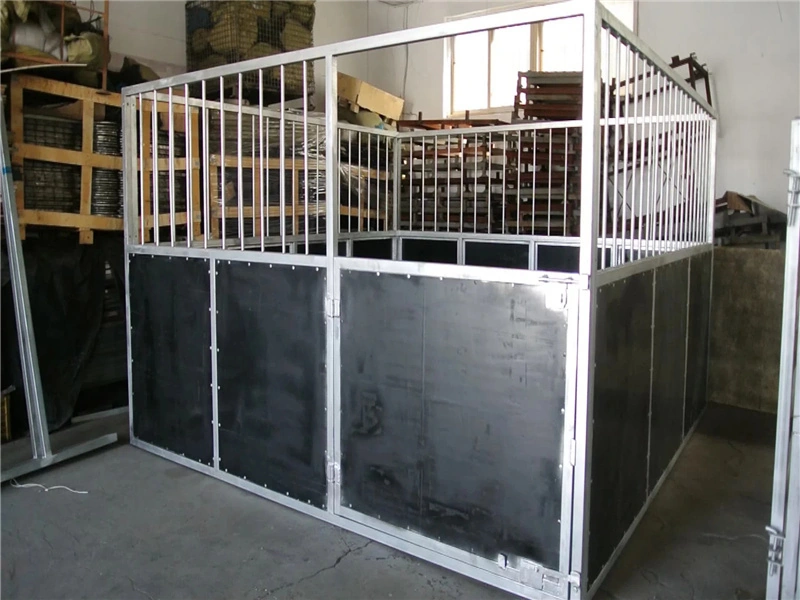
A line that packs without first building is guessing. Our stables join on tool-free corner pins, so a two- or three-person crew should have one set up inside half an hour — a figure that holds only if the frames and boards leaving the line fit each other. Ask that one set be built and checked before packing — a misfit caught at the factory costs days; the same misfit caught on your site costs weeks.
Independent eyes matter more than the factory’s own. Third-party QC resident inspection is available on request, before shipment, so your inspector can check tube walls, coating readings and board thickness against the order. Ask any supplier one question early: will you accept resident inspection before dispatch? The answer sorts workshops from showrooms faster than any catalogue.
Flat Pack Packing and Container Loading
The last stage is where the line earns its freight. Portable stables ship as flat pack kits — panels stacked flat rather than assembled — which is what makes sea freight to Australia and New Zealand workable for a steel product. A well-run packing area shows panels stacked and counted against the order, fixings listed, and each kit’s contents matched to a packing list your customs broker will later need.
The minimum order is 10 sets and output runs up to 20 sets a week, so a first container and a repeat order sit in the same rhythm. If a supplier cannot show you a packed kit — panels, fixings and list together — treat the freight saving as a slogan.
Frequently Asked Questions
What stages make up a horse stable production line?
Tube stock and cutting, full frame welding, hot-dip galvanising, HDPE board fitting, quality control, then flat pack packing; you can ask for one set to be assembled and checked before packing. The order is not decorative — welding before galvanising is what puts zinc over the welds.
How many portable horse stables can the line produce per week?
At DB Stable, output runs up to 20 sets per week, with a minimum order of 10 sets. A first order and a repeat container sit inside the same weekly production rhythm.
Why does galvanising come after welding?
Because dipping the finished frame coats the welds and cut tube ends in zinc — the exact points where rust starts. Pre-galvanised tube with powder coat leaves those points bare, which is why it is a different, lower-cost product rather than a substitute.
What coating thickness should galvanised stable frames carry?
Our factory specification is at least 42 microns, with the process run to AS/NZS 4680. The standard itself sets minimums by steel thickness — 45 microns local and 55 microns average for 1.5–3mm steel — so ask for gauge readings on the actual frames.
Can I verify a production line without travelling to China?
Yes. A live camera walkthrough with calipers and a coating gauge in frame verifies the measurable specs, and third-party QC can inspect goods at the factory before shipment. Our factory video audit guide covers the method in detail.
Conclusion
A real horse stable production line is a chain of evidence: Q235 tube in the quoted profiles, continuous welds on fully welded frames, a hot-dip coating of at least 42 microns run to AS/NZS 4680, 10mm HDPE seated without forcing, a test assembly requested to prove the corner-pin design, and a flat pack that earns its freight saving. Break any link and the finished stable quietly carries the break to your customer’s paddock.
Use the stage table as your walk-through checklist on your next factory visit or live call, and ask for the numbers at every stage. When you are ready to put a specific configuration against that line, start on the DB Stable manufacturer page — enquiries are answered within 6 hours and drawings quoted within 24.