Weld quality inspection on imported stables is your last checkpoint while the goods are still at the factory — and the only one that counts. A portable stable frame is fully welded: Q235 steel in 50×50mm square tube, 60×30mm oval tube and 32mm round tube, with every structural connection in each panel a weld rather than a bolt you can retorque later. The defect that matters most is the cold weld — a joint where the weld metal sat on the surface without fusing to the steel underneath. It passes a glance and fails under a kick.
Most cold welds leave visible evidence — bead shape, spatter patterns, undercut — that a trained eye can catch before the container is sealed. This guide covers what a cold weld is, the visual signs, where to look on a stable frame, and how to build inspection into the order. The working examples are the flat-pack stable kits DB Stable has manufactured in Anping, China for Australia and New Zealand since 2013.
Key Takeaways
- A cold weld (lack of fusion) is a joint where weld metal rests on the steel without fusing to it — it carries almost no load.
- DB Stable frames are fully welded Q235 steel: 50×50mm square tube, 60×30mm oval tube and 32mm round tube.
- Visual signs: interrupted bead, rope-like bead sitting proud of the joint, undercut at the weld toe, heavy spatter clusters.
- Hot-dip galvanising coats over a fusion defect rather than revealing it. Factory spec: at least 42μm, process to AS/NZS 4680.
- Door hardware mounts, post-to-rail corners and 4.0mm mesh wire welds — inspect them first.
- Third-party QC at the factory is part of DB Stable’s service commitments; agree acceptance criteria at quote stage.
Why Welds Decide a Stable Frame’s Service Life
A bolted frame lets you re-tension a problem joint after landing. A welded frame gives you no second chance — the weld is the joint, so its quality was fixed at the factory and will never be revisited. That is why pre-shipment weld inspection carries more weight on a welded stable kit than on almost any other component check you will run.
The frames are Q235 steel — a structural carbon steel covered in detail in our Q235 steel horse stables guide — formed from 50×50mm square tube, 60×30mm oval tube and 32mm round tube, with every connection fully welded. Assembly on site is tool-free: two to three people join complete welded panels with corner pins in around 30 minutes per set. The welds were made in Anping, and that is where they have to be judged.
Weight raises the stakes. Stable panels run to 2844×1194mm or 3494×1194mm in 10mm HDPE board, and a single panel weighs in the order of 200kg. Panels get lifted, stacked and container-loaded before a horse ever leans on them. A marginal joint that survives the weld shop may still be the one that cracks at a door post two seasons in.
What a Cold Weld Actually Is
A cold weld — welders also call it a cold lap or lack of fusion — forms when the arc never delivers enough heat for the weld metal and the parent steel to melt together. Instead of fusing, the filler metal rests on the surface like a bead of glue. The joint looks finished from a metre away, but only a thin skin of contact is doing the work. Under load, that skin lets go.
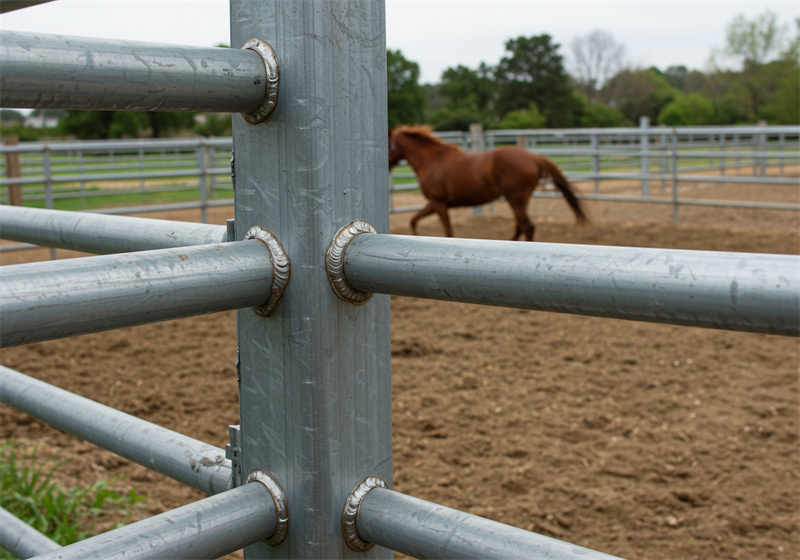
Why does it happen? Welding parameters drift — current too low, travel speed too fast. Joint faces arrive misaligned or carrying mill scale that blocks fusion. None of it shows up on an invoice. All of it shows up in the bead — a cold weld is a visual defect before it is a structural one.
Visual Signs of Weld Quality Inspection on Stable Frames
Weld quality inspection at pre-shipment is mostly geometry and pattern reading: comparing the bead against what a fused joint should look like, and identical joints against each other across the batch. The table below sets out the signs that matter on galvanised stable frames.
| Visual sign | What it looks like | What it can indicate |
|---|---|---|
| Interrupted bead | Weld stops and restarts where a continuous run was specified | Low heat input at each restart; a weak spot every stop |
| Rope-like bead | Bead sits proud like a laid rope, with a sharp step to the tube wall | Lack of fusion — filler never washed into the parent metal |
| Undercut | A groove melted into the tube wall along the weld toe | Base metal thinned where the weld meets it |
| Heavy spatter | Clusters of frozen metal globules stuck around the joint | Unstable arc or contaminated surfaces — both fusion killers |
| Flat, lifeless bead | No ripple pattern; dull, uniform grey (pre-galvanising only) | Heat input too low for proper fusion |
| Inconsistent joints | The same post-to-rail joint differs visibly from panel to panel | Parameter drift during the batch — check the odd ones out first |
Does galvanising hide any of this? No. The zinc coat follows the bead profile, so undercut, rope-like beads and spatter stay readable after galvanising. What it cannot do is tell you anything about fusion — a coating thickness gauge confirms the zinc, not the weld beneath it.
Where to Inspect on a Stable Frame
Not all welds carry equal risk, so an efficient inspection works by priority. Inspect three zones first on a portable stable.
- Door hardware mounts: front walls stand 2200mm high, and doors hang off hardware mounted into the frame — sliding doors run on 2950mm tracks with twin wheel sets. Every open-and-close cycle puts load into the welds around those mounts. Check every gate in the consignment, not just the first.
- Post-to-rail corners: where the 50×50mm square posts meet the rails. These corners absorb horse impacts and the racking loads of stacking, and they are often the hardest angle to hold — precisely when cold laps creep in.
- Mesh wire welds: panel infill uses 4.0mm wire at 50×50mm mesh spacing, and the joints to watch are where the mesh meets the frame. A cold weld here does not drop the panel — it lets a wire pop loose, a horse-safety issue long before it is a structural one.
Sample smart: inspect doors and corners on a random selection of panels, then eyeball the mesh welds across the batch. Inconsistency between identical joints is the strongest cold-weld signal you will get.
Getting Inspection Into the Ordering Process
Inspection only protects you if it is agreed before production starts. The ordering sequence at DB Stable runs: submit your requirements or drawings, receive a quote within 24 hours, pay the deposit, then production and shipping proceed. Build your weld acceptance criteria into that first exchange — a written checklist covering the signs and zones above gives an inspector something objective to pass or fail against.
DB Stable’s service commitments include third-party on-site QC; whether you can nominate your own inspection agency to attend during production or before shipment should be confirmed in writing at the quote stage. Orders start at 10 sets and capacity runs to 20 sets per week — enough volume that a sampling plan is worth defining in advance rather than improvising on the factory floor.
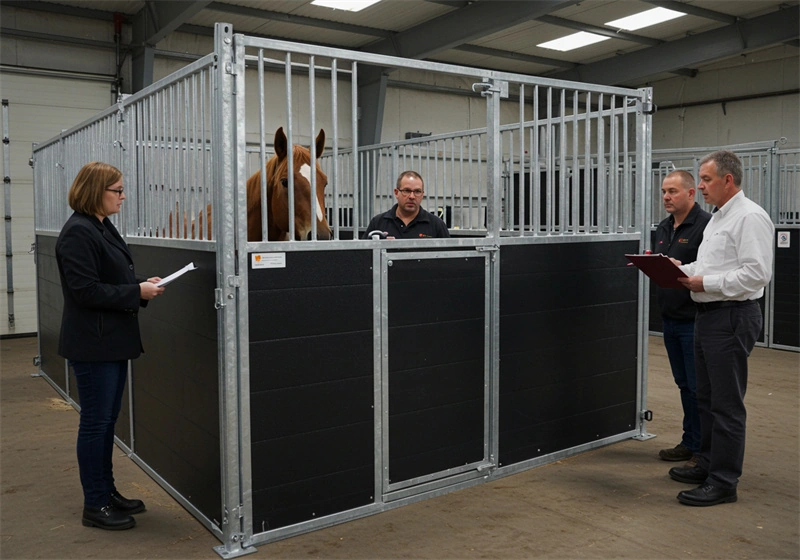
Our position is blunt: a written acceptance checklist agreed at quote stage is worth more than any certificate after the container lands. Remediation on site costs you freight, downtime and a welder in a regional area; remediation at the factory costs the supplier an afternoon. That gap is the entire economic argument for pre-shipment inspection.
Surface treatment belongs in the same conversation. The factory specification for DB Stable frames is a hot-dip galvanised coating of at least 42μm, with the process carried out to AS/NZS 4680 — the joint Australian and New Zealand hot-dip galvanising standard. The standard itself sets minimum coating requirements for steel in the 1.5–3mm band at 45μm local and 55μm average, and the 2.0mm wall of the 50×50mm panel frame tube sits inside that band. A coating thickness check confirms the zinc side of the spec; the visual weld pass covers the fusion side.
One closing loop: a cold-weld repair strips the zinc from that spot, leaving bare steel at the joint. Zinc-rich touch-up paint restores the barrier — our guide to galvanising touch-up with zinc-rich paint covers the procedure.
Frequently Asked Questions
What is a cold weld on a stable frame?
A cold weld is a joint where the weld metal rested on the steel without fusing to it — usually from insufficient heat input. It looks finished but carries almost no load, and can fail under a horse’s impact.
Can hot-dip galvanising hide a cold weld?
No. The zinc coat follows the bead profile, so undercut, rope-like beads and spatter stay visible after galvanising. What galvanising cannot do is confirm fusion — a coating thickness gauge measures the zinc layer, not the weld beneath it.
Which welds should I inspect most closely on a horse stable?
Door hardware mounts, post-to-rail corners and where the mesh meets the frame. Doors cycle load into their mounting welds, corners absorb impacts, and a loose mesh wire is a horse-safety issue before it is a structural one.
How do I arrange weld inspection before shipping?
Agree a written weld acceptance checklist at quote stage, then nominate a third-party QC inspection agency to attend the factory — on-site third-party inspection is part of DB Stable’s service commitments. Define the sampling plan before production starts.
Does a repaired weld need galvanising touch-up?
Yes. Grinding out and rewelding a joint strips the zinc coating locally, leaving bare steel at the repair. Zinc-rich touch-up paint restores the protective barrier and should be part of any accepted weld repair.
Conclusion
A fully welded stable frame makes pre-shipment weld quality inspection your only real control over joint quality. Cold welds announce themselves visually: interrupted beads, rope-like profiles, undercut, spatter clusters, inconsistency between identical joints. Focus on door hardware mounts, post-to-rail corners and mesh wire welds, pair the visual pass with a coating check against the ≥42μm factory specification and the AS/NZS 4680 process, and get the checklist agreed at quote stage with third-party QC attending the factory.
Ready to put a specific configuration through that process? Request a quote from the DB Stable factory — drawings are turned around within 24 hours, and your inspection criteria can travel with the order from day one.