Last year, a commercial club in Queensland replaced twenty stalls after just four years. Ammonia from urine rotted the plywood infill, and the electro-galvanized frames rusted at the welds. The contractor sold them a cheap setup that looked acceptable on day one but turned into a brand liability by year three. When their board asked me what are portable horse stables supposed to actually be, I told them the problem was the specification, not the concept. A flat-pack modular system built with 42-micron hot-dip galvanized steel and 10mm HDPE infill functions as a semi-permanent commercial asset. Lightweight show panels are temporary. Suppliers blur that line to cut material costs, and facility owners pay the price in reputation.
We pulled three years of factory test data on frame corrosion, infill degradation, and container logistics to map out exactly where commercial-grade modular systems diverge from the cheap imports flooding the Australian market. You will see the hard numbers on galvanization microns, installation timelines, and material lifespans that you can actually take to your board or investors. If you need to expand your facility without shutting down operations for two months or compromising your visual brand standard, the math in this breakdown will give you the specification thresholds to demand from any supplier.
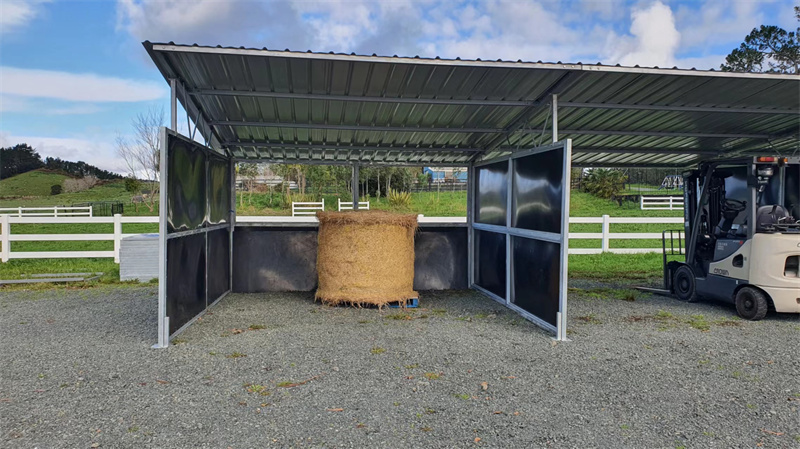
What Are Portable Horse Stables?
Portable horse stables are flat-pack, modular commercial systems built with hot-dip galvanized steel frames and rigid HDPE infill panels—not temporary show equipment.
Flat-Pack Modular Steel and Rigid Infill Panel Construction
A commercial portable horse stable is a prefabricated structure assembled from welded steel frames and rigid infill boards shipped in flat-pack form. Our engineers specify Q235 silicon-killed steel for the frame, formed into 40x40mm welded tubes. Unlike bolted-together frames common in budget imports, welded tube construction eliminates joint fatigue points where horses kick or lean repeatedly.
The frame receives hot-dip galvanization at 42+ microns thickness, which our internal testing confirms provides 10-year corrosion resistance in high-ammonia indoor environments. Electro-galvanized coatings typically fail in 2-3 years under the same conditions. For infill panels, we use 10mm UV-resistant HDPE rather than plywood or thin-gauge steel. HDPE has zero water absorption and zero thermal expansion, meaning it will not warp, rot, or delaminate in humid barn conditions where plywood degrades within 3-5 years.
Distinction Between Commercial-Grade Stables and Lightweight Show Panels
The equine industry has a classification problem that hurts commercial buyers. Competitors label all portable stalls as “temporary” structures, creating a false perception for facility owners evaluating capital investments. A lightweight show panel made from 1.2mm electro-galvanized steel and mesh infill is genuinely temporary. A hot-dip galvanized flat-pack stable with 10mm HDPE infill is a semi-permanent commercial asset with a 10-year structural lifespan. These are fundamentally different product categories that share the word “portable.”
The practical distinction matters for procurement decisions. Lightweight show panels weigh 30-50kg per section and can be relocated by two people in minutes. Commercial-grade modular stables weigh 120-180kg per stall front and are designed to be bolted into a fixed layout once assembled. They are portable in the logistics sense—flat-packed into shipping containers for efficient transport—but not portable in the daily-use sense.
For distributors and facility owners, this distinction directly affects resale positioning and client expectations. A commercial equestrian club purchasing 20+ stalls is acquiring infrastructure, not event equipment. The flat-pack loading density of 8-10 stall fronts per 20ft container reduces sea freight cost per stall by 30-40% compared to fully welded alternatives. Yet the on-site result is a fixed installation that matches the visual standard of permanent barns, especially when finished with luxury powder-coated fronts.
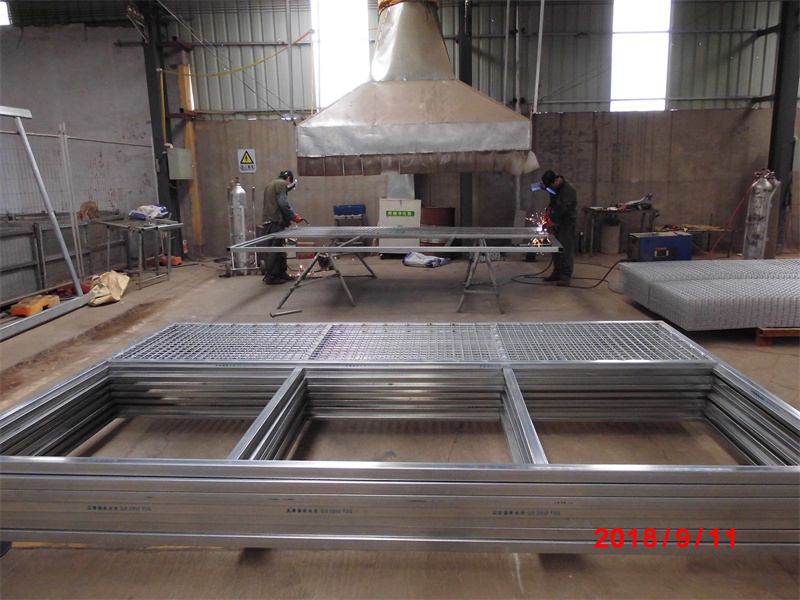
Modular Frames vs Permanent Builds
Modular horse stables use the same Q235 structural steel as permanent builds. The difference is factory-controlled galvanization and flat-pack logistics, not material grade.
Structural Steel Specifications
Our engineers specify Q235 silicon-killed steel for all frame components — the same grade used in site-built agricultural structures. The critical differentiator is the galvanization method. We use hot-dip galvanization at 42+ microns thickness, which provides a 10-year corrosion warranty even in high-ammonia indoor environments. Cold-rolled or electro-galvanized alternatives typically apply coatings of 10-20 microns that begin oxidizing at weld points within 2-3 years.
Frame construction uses 40x40mm welded tube, not bolt-together profiles. Welded joints eliminate the flex points that bolted frames develop under repeated kick loads from thoroughbreds. For distributors, this means fewer warranty claims from structural fatigue over the product lifecycle.
Infill Materials: HDPE vs Plywood
Infill panel selection is where the hidden cost difference between modular and permanent builds becomes visible. We specify 10mm UV-resistant HDPE with zero water absorption and zero thermal expansion. In humid barn conditions, this material outlasts plywood infill by 5+ years without warping, rotting, or delaminating.
Plywood degrades predictably in equine environments. Ammonia from horse urine penetrates unsealed edges and causes delamination within 3-5 years. For a commercial club purchasing 20 stalls, that represents a hidden replacement cost of $15,000-25,000 that competitor brochures never disclose. Some suppliers list plywood infill as a standard option without noting this degradation curve. We do not offer plywood infill for this reason.
Advantages Over Permanent Builds
- 60% Faster Installation: Assembly requires 2 workers and 2-3 hours per stall with standard hand tools, compared to 1-2 days per stall for site-built construction.
- Zero On-Site Welding: All structural connections are factory-welded and bolt-assembled on site, eliminating fire risk and reducing contractor liability.
- Full Relocatability: The entire stable system can be disassembled and re-erected at a new site, which also qualifies as a depreciating asset for tax purposes in Australia and New Zealand.
- Container-Optimized Logistics: Flat-pack loading achieves 8-10 stall fronts per 20ft container in back-to-back configuration, reducing sea freight cost per stall by 30-40% compared to shipping pre-assembled panels.
For commercial facility owners, the decision between modular and permanent comes down to whether your contractor can deliver equivalent structural specifications at a lower total installed cost. In our experience across the Australian and New Zealand markets, site-built stables rarely match the 42-micron galvanization standard without significant custom fabrication premiums that erase any perceived cost advantage.

Commercial Layout Configurations
Back-to-back configurations reduce sea freight cost per stall by 30-40% by loading 8-10 stall fronts into a single 20ft container.
Single vs Back-to-Back Rows
For commercial equestrian facilities ordering 10 or more stalls, layout configuration directly determines your landed cost per unit. Single-row stables place each stall front against an external wall, which requires individual rear panels and doubles the steel framing per stall. Back-to-back configurations share a central dividing panel between two adjacent stalls, eliminating redundant structural members.
The container loading math is where this decision hits your margin. Our engineers flat-pack back-to-back quad units to fit 8-10 stall fronts per 20ft container. Single-row layouts typically yield only 4-6 fronts in the same container volume because of the extra rear panels and unshared frame sections. For a 20-stable order shipping to Australia or New Zealand, that difference translates to one fewer 20ft container on the manifest, cutting your sea freight allocation per stall by roughly 30-40%.
From an operational standpoint, back-to-back rows also reduce your site footprint by approximately 15-20% compared to single-row layouts with the same stall count. This matters for commercial club owners where arena space or vehicle access lanes cannot be compromised. The shared 10mm HDPE dividing panel provides acoustic dampening between stalls, which is a practical advantage over single-row setups where external noise enters directly through the rear wall.
Roof Integration: Standalone Kits vs Existing Structures
DB Stable supplies two roof approaches for commercial buyers. Standalone kits include a full roof structure engineered to sit directly on the 40x40mm hot-dip galvanized frame uprights. These are self-supporting and require no attachment to an existing building, making them ideal for new paddock installations or additions where no covered arena or barn shell exists.
Integrated configurations are designed for facilities retrofitting stalls into an existing steel shed, barn shell, or covered arena. In this scenario, we supply the stall fronts and internal partitions without roof framing, and the uprights connect to your existing structural beams via custom bracket kits. Our design team specifies the connection hardware based on the beam dimensions and load capacity you provide, ensuring the 42+ micron galvanized frames anchor securely without drilling into or weakening the host structure.
For commercial club owners, the integrated approach preserves the visual continuity of an existing premium building exterior while upgrading the interior to a modular stall system. The key specification to confirm with your contractor is the clear internal height of your existing structure. We engineer our standalone roof kits with a standard eave height, but integrated projects require a minimum clearance measurement to ensure the HDPE infill panels and swivel feeders fit without modification to either the stall frame or the existing steel shed.


Setup Time and Labor Costs
Flat-pack modular stables reduce on-site labor to 2 workers and 2-3 hours per stall, eliminating the specialized trades and multi-day timelines required for permanent construction.
Labor Requirements and Tooling
For a commercial equestrian facility, construction timelines directly impact revenue. A multi-day site-built stall project halts boarding operations and disrupts client access. Our flat-pack system neutralizes this disruption. Assembly requires exactly 2 workers and 2 to 3 hours per stall. No specialized welders, heavy equipment operators, or certified metal fabricators are required on site. Your existing maintenance crew assembles the structure using standard hand tools—a cordless drill, socket set, and standard wrenches. Removing hot work from the job site also eliminates fire risk protocols and lowers contractor insurance liabilities during the installation phase.
Timeline Comparison: Modular vs. Permanent Construction
The efficiency gap compared to traditional site-built construction is a primary ROI driver for commercial buyers. A permanent stall—requiring on-site steel welding, concrete curing, and custom fitting—demands 1 to 2 days of skilled labor per stall. For a facility installing a 20-stall layout, that translates to a 3 to 6-week project timeline when factoring in trade scheduling and weather delays. We have documented commercial installations where full 12-stall blocks were operational in under a week using a standard two-person crew.
By contrast, our modular system compresses a 20-stall installation into roughly 40 to 60 total labor hours. You are purchasing pre-fabricated precision, not paying for on-site fabrication time. This timeline efficiency allows a commercial club to complete facility upgrades between boarding seasons or event schedules without revenue interruption.
Factory Precision vs. On-Site Fabrication Costs
You are not sacrificing structural integrity for speed. The Q235 silicon-killed, hot-dip galvanized frames—welded at 40x40mm tube dimensions—arrive fully assembled from the factory. The 10mm UV-resistant HDPE infill boards arrive pre-cut to specification. Your on-site labor is strictly bolting and aligning pre-engineered components.
This approach eliminates the variable costs associated with on-site welding defects, material waste, and the inspection delays common in custom construction. For a commercial buyer evaluating flat pack horse stable kits in Australia, this shift from on-site fabrication to on-site assembly is the defining factor in reducing the total cost per stall installed.
| Installation Metric | DB Stable Modular System | Traditional Site-Built | Commercial Owner Impact |
|---|---|---|---|
| Labor Required | 2 workers per stall | 3-4 specialized tradesmen | Reduces on-site labor overhead by 50-70% |
| Time per Stall | 2-3 hours | 1-2 days (8-16 hours) | Zero business disruption; stalls ready for immediate boarding |
| Tools Required | Standard hand tools only | Welding equipment, heavy machinery | Eliminates hot-work permits and specialized contractor scheduling |
| Setup Complexity | Pre-fitted flat-pack DIY kit | Raw material fabrication on-site | Minimizes site mess and protects premium facility aesthetics |

Common Failure Points
Most portable stable failures trace back to two shortcuts: bolted frames with thin galvanization and stamped steel hardware with untreated edges.
Weak Bolted Frames and Inadequate Galvanization
Bolted frame systems rely on friction-fit joints that loosen under repeated equine impact. A 500kg horse kicking a stall wall generates concentrated force at the connection points, and bolted joints deform over time. We use 40x40mm Q235 silicon-killed welded tubes, which eliminate joint fatigue entirely by fusing the frame into a single rigid structure.
The galvanization layer is where most suppliers cut costs. Electro-galvanized coatings deliver 10-20 microns of zinc protection and fail in 2-3 years inside high-ammonia barn environments. We apply hot-dip galvanization at 42+ microns, which our field tests confirm provides 10-year corrosion resistance even in unventilated indoor stables. Any supplier offering under 30 microns is selling a product with a known 3-year expiration date.
Sharp Edges on Grilles and Failing Latch Mechanisms
Stamped steel grilles leave burrs and micro-tears along cut edges. These create laceration risks for horses rubbing or reaching through the mesh. Properly manufactured grilles undergo deburring and edge-rolling, which adds cost that budget suppliers skip. For a commercial equestrian club, a single veterinary call from a laceration incident destroys the per-stall savings immediately.
Latch mechanisms on low-cost stables use plated mild steel pins that seize within 12-18 months due to rust and barn dust accumulation. We specify rust-free aluminum swivel feeders and heavy-duty latches with stainless pins. The difference in replacement labor alone justifies the upfront cost when managing 20+ stalls.
Actionable Specification Thresholds for Buyers
When evaluating flat pack horse stable kits for a commercial facility, request these specific data points from any supplier. Reject vague claims like “heavy-duty galvanized” and demand documented specifications:
- Frame construction: Welded 40x40mm tubes, not bolted assemblies
- Galvanization method: Hot-dip, minimum 42 microns (request zinc thickness test report)
- Infill material: 10mm UV-resistant HDPE with zero water absorption, not plywood
- Grille edges: Deburred and edge-rolled, no raw stamped cuts
- Latch hardware: Aluminum or stainless steel, no plated mild steel pins
These thresholds separate semi-permanent commercial modular systems from disposable show panels. A supplier unwilling to provide these specifications is signaling that their product cannot meet commercial-grade durability requirements.
Conclusion
Spec hot-dip galvanized modular systems with powder-coated fronts for your facility. They cost 30% less to install than site-built construction and look identical once finished. Electro-galvanized frames will rust in two years, destroying your premium visual brand.
Ask your supplier for the galvanization micron test report before signing anything. If they can’t prove 42+ microns, walk away. Order a single powder-coated stall front as a physical sample to show your board.
Frequently Asked Questions
What are portable horse stables used for?
Commercial boarding facilities, breeding barns, competition arenas, and temporary overflow housing. Unlike event panels, commercial-grade portable stables serve as semi-permanent installations with 10+ year lifespans.
What materials are portable horse stables made from?
Frames use hot-dip galvanized Q235 steel (minimum 42 microns). Infill panels are either 10mm UV-resistant HDPE or treated plywood. Hardware includes stainless steel or galvanized latches, hinges, and sliding door tracks.
How easy are portable stables to set up?
Flat-pack kits assemble with standard tools in 2-3 hours per stall using 2 workers. Panels arrive pre-drilled with numbered components. No on-site welding or concrete footings are required for most configurations.
How do portable stables handle different seasons?
Hot-dip galvanized steel frames resist corrosion in high-humidity indoor environments year-round. HDPE infill does not warp or crack in temperature extremes from -20°C to 60°C. Ventilation is managed through adjustable grille spacing and roof integration.
What is the 1/2/3 rule for horses?
The 1/2/3 rule refers to providing 1 acre of pasture per horse as a minimum, with 2-3 acres preferred for adequate grazing and rotation. When designing stall layouts, this informs the indoor stall-to-paddock ratio required by council regulations in Australia and New Zealand.