I walked a breeding operation last year that spent two million dollars on an architecturally impressive barn. Three years later, they were ripping out the stalls because untreated welds rotted from urine ammonia, and they nearly lost a foal crop to a respiratory outbreak. Most people approach professional boarding facility design by drawing up 12×12 foot layouts and picking out stall fronts that look good in a brochure. They miss the material science that actually dictates your cost per stall over a ten-year lifespan.
We pulled our factory data on prefab horse stalls for breeding barns to show exactly where your capital expenditure bleeds out. You will see why you must reject any steel coating under 42 microns, why wood infill acts as a porous bacterial trap for foals, and how specific anti cribbing horse stall grill spacing prevents expensive stallion injuries. This breaks down the hard engineering thresholds you need to hand to your builder so you stop paying for aesthetic mistakes.

Designing a Professional Horse Boarding Facility
Material chemistry determines 10-year cost per stall, not floor plan aesthetics.
The Timber-to-Steel Shift in Breeding Barns
Most novice breeders start by researching spatial layouts—12×12 ft stalls, paddock ratios—but overlook what happens to those materials when exposed to ammonia over years. Timber infill absorbs urine, creating a porous bacterial trap that directly threatens foal respiratory health. Worse, ammonia vapor corrodes untreated steel connections, forcing full stall replacement cycles every 3 to 4 years in commercial breeding environments.
We switched our prefab horse stalls for breeding barns entirely to Q235 silicon-killed steel with 40x40mm welded tube frames and a 42-micron hot-dip galvanization threshold. Anything below 42 microns will blister and flake in high-ammonia conditions. Our engineers specify this coating because it delivers a verified 10-year structural lifespan without retreatment, which is the only way to make the hot dip galvanized stall cost per unit work out over a decade.
Preventing Foal Respiratory Issues Through Material Selection
Foal respiratory disease outbreaks in breeding barns almost always trace back to two factors: poor airflow design and dust-trapping wall materials. Wood kickboards and porous composite panels trap organic dust and ammonia at the horse’s breathing zone—roughly 1 meter above stall floor level. That dust carries bacteria deep into foal lungs, and once an outbreak starts, it spreads rapidly through a connected barn.
We use 10mm UV-resistant HDPE boards as our primary ammonia resistant stall material. HDPE is non-porous, so it does not absorb urine or trap dust. It also resists thermal expansion, meaning the boards will not warp and create gaps where bacteria accumulate. For distributors importing flat pack stable kits Australia, this material spec is what separates a product that lasts from one that generates warranty claims within two seasons.
Biosecurity, Safety, and Labor Efficiency
A boarding facility handling 10 or more horses daily cannot afford design choices that add hidden labor. Swinging stall doors require extra clearance space and create pinch points during high-traffic feeding windows. Our modular systems use heavy-duty sliding latches on 40x40mm tracks, which cuts daily feeding and mucking time per staff member measurably compared to hinged-door layouts.
Cribbing injuries represent another direct financial loss for breeders holding valuable stallions. Our box stall fronts use anti cribbing horse stall grill spacing specifically calculated to prevent a horse from locking its jaw on horizontal bars. Combined with rust-free aluminum swivel feeders, the entire stall front eliminates the injury vectors that timber-and-mesh setups cannot address. The result is a zero-incident safety rate across the full 10-year lifecycle of the installation.

Core Facility Layout Metrics
Facility layout dictates disease transmission rates more than cleaning protocols. Get the spatial math wrong, and no material spec can save your operation.
12×12 ft Minimum Stall Footprint
We specify 12×12 ft (3.6×3.6m) as the absolute minimum internal clearance for any breeding stall. Anything smaller forces the mare into prolonged contact with walls and waste, increasing cribbing behavior and foal injury risk. When we design flat pack stable kits for Australian breeders, this footprint is non-negotiable regardless of configuration—single, back-to-back, or quadruple row.
The mistake novice breeders make is treating this as a flexible guideline. A 10×10 ft stall might reduce your hot dip galvanized stall cost per unit by roughly 15%, but it creates a confined environment where ammonia concentration from urine pools accelerates foal respiratory issues. Spatial constraints also make daily mucking slower per staff member, which directly erodes labor efficiency once you exceed 10 horses.
10-15 Metre Manure Exclusion Zones
Every waste pile, muck heap, or drainage runoff point must sit a minimum of 10 metres from any water source—15 metres is the threshold we recommend for thoroughbred operations in Australia and New Zealand. Local environmental authorities in both countries enforce these setbacks under agricultural runoff regulations, and non-compliance carries real financial penalties.
These exclusion zones serve a dual purpose for breeding facilities. They prevent groundwater contamination from nitrogen and pathogens like Streptococcus equi, and they create a physical buffer that limits pest vectors carrying diseases between mares and foals. We factor this setback into our layout consulting because it directly determines how many prefab horse stalls for breeding barns you can legally fit on a given parcel.
1 Acre Per Horse Turnout Ratio
We recommend 1 acre (4,000 sqm) of turnout per horse as the baseline for preventing stress-induced behaviors and disease transmission in confined breeding operations. Below this ratio, parasite load in the soil compounds faster than your deworming schedule can manage. Overcrowded paddocks also drive higher rates of stereotypic behaviors—cribbing, weaving, box-walking—which correlate directly with the anti cribbing horse stall grill spacing we engineer into our 40x40mm Q235 steel fronts.
The economics are straightforward for breeders calculating cost per stall over a 10-year lifecycle. Underestimating turnout acreage means more veterinary interventions, elevated foal mortality risk, and faster pasture degradation. It is one of the most expensive planning errors you can make, and it cannot be retroactively fixed with better stall materials alone.
That said, layout math only protects your operation if the stall structure survives the environment. A 12×12 ft stall built with timber infill becomes a porous bacterial trap the moment urine hits the floor. That is precisely where 42-micron hot-dip galvanized frames and 10mm HDPE boards separate a 10-year asset from a 3-year replacement cycle. Ammonia resistant stall materials are not an upgrade—they are the engineering prerequisite that makes your layout investment function as designed.
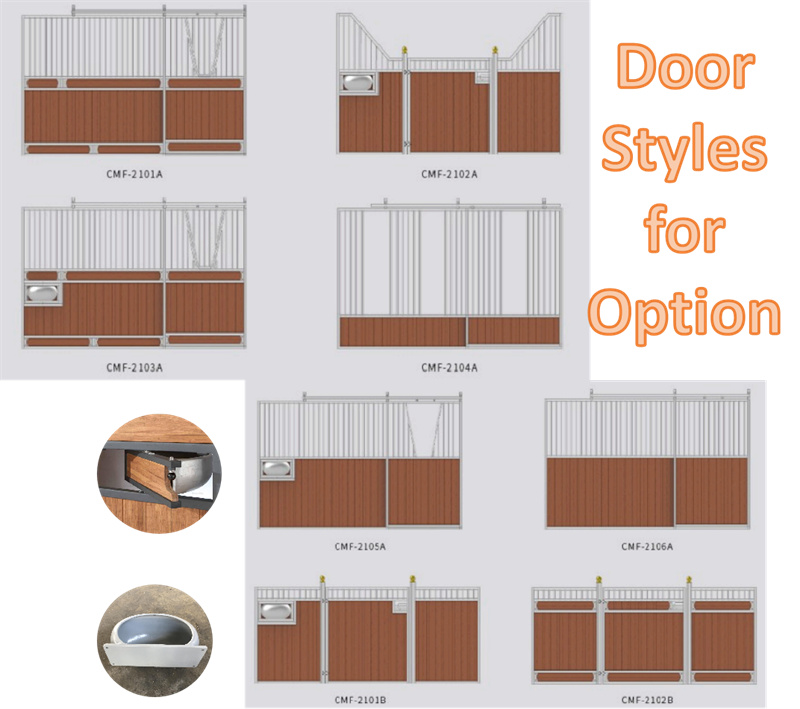
Stall Material Specs vs Costs
Material selection in breeding barns is a 10-year ROI calculation. Specifying anything below 42-micron HDG steel and 10mm HDPE infill guarantees a 3-year replacement cycle.
Hot-Dip Galvanized Steel vs Bolted Timber
We specify Q235 silicon-killed steel for our prefab horse stalls for breeding barns, formed into 40x40mm welded tube frames with a 42-micron hot-dip galvanized (HDG) coating. This gives us a verified 10-year structural lifespan in high-ammonia environments. Bolted timber frames cannot survive that timeline. Ammonia from urine penetrates timber joints and corrodes hidden bolt connections within 18 to 24 months in active breeding barns. The timber itself softens, creating kick-through hazards around valuable stallions.
Our engineers reject any HDG coating under 42 microns because thinner electro-galvanized layers blister and flake when exposed to ammonium salts. The cost difference between a proper HDG frame and a bolted timber setup is recoverable within a single replacement cycle that timber structures inevitably require.
HDPE Infill Boards vs Plywood
We use 10mm UV-resistant HDPE boards as our standard infill material. HDPE is non-porous, meaning urine cannot soak into the board. This eliminates the primary bacterial growth medium inside breeding stalls. Plywood, even when treated, acts as a sponge. It absorbs urine at the base, swells, delaminates, and becomes a reservoir for pathogens that trigger foal respiratory disease outbreaks.
The thermal expansion resistance of our 10mm HDPE specification is another critical factor. Plywood warps severely in the temperature swings common across Australian climates, creating gaps in the stall walls that horses can crib on or get legs caught in. HDPE maintains dimensional stability, which directly supports our anti-cribbing horse stall grill spacing tolerances.
Total Cost of Ownership Over 10 Years
The real math on flat pack stable kits Australia-wide does not favor cheap materials. When we model the hot dip galvanized stall cost per unit against timber-and-plywood alternatives over a decade, the cheaper option loses on pure expense.
- HDG Steel + HDPE: One-time procurement, 10-year structural lifespan, zero material replacement costs, ammonia resistant stall materials throughout.
- Timber + Plywood: Lower initial purchase price, forced replacement of infill boards at year 3, frame failure by year 4 to 5, secondary labor costs for demolition and reinstall.
For large-scale breeders running 20 or more stalls, that 3-year replacement cycle on plywood infill alone adds thousands in material and labor costs. When you factor in lost boarding revenue during reinstallation and the veterinary risk from ammonia-damaged timber, the perceived savings on cheaper materials evaporate entirely. We engineer our stalls to avoid that replacement cycle from day one.
| Component | Engineering Specification | 10-Year Cost Impact | Operational Benefit |
|---|---|---|---|
| Structural Frame | Q235 steel, 40x40mm tube, 42-micron HDG coating | Eliminates 3-year rust replacement cycles caused by urine ammonia | Guarantees 10-year structural lifespan for prefab horse stalls for breeding barns |
| Wall Infill Boards | 10mm UV-resistant HDPE, zero thermal expansion | Drastically reduces long-term maintenance and material replacement costs | Non-porous ammonia resistant stall materials prevent foal respiratory diseases and cut daily mucking time |
| Stall Front Grills | Optimized anti cribbing horse stall grill spacing | Prevents costly veterinary bills and loss of valuable stallion asset value | Maintains a strict zero-incident safety rate against cribbing injuries |
| Feeders & Latches | Rust-free aluminum swivel feeders, heavy-duty sliding latches | Zero hardware-replacement budget required over the 10-year lifespan | Improves daily feeding efficiency and securely contains high-value livestock |
| Shipping Format | Flat pack stable kits Australia (4-6 stalls per 40ft container) | Lowers the hot dip galvanized stall cost per unit via optimized freight | Rapid on-site deployment minimizing facility construction downtime |

Ventilation and Ammonia Control
Ammonia concentration above 10ppm at foal breathing height triggers chronic respiratory damage. Material porosity, not stall size, dictates this number.
Mechanical Requirements for Removing Ammonia Buildup
Ammonia in breeding barns is an engineering problem, not a cleaning problem. Urine breaks down on stall floors, releasing gas that sits in a concentrated band roughly 0.5 to 1 meter above the ground, exactly where foals spend their first weeks resting. Our engineers specify a minimum passive airflow exchange rate of 6 air changes per hour for prefab horse stalls for breeding barns. Active mechanical systems should push that to 10 to 12 ACH during high-humidity months in Australia and New Zealand.
The critical mistake breeders make is sizing fans based on stall volume without accounting for static pressure drop caused by wall materials. Porous timber infill traps ammonia molecules in its fiber structure, continuously off-gassing even after mucking. Your mechanical system cannot extract what remains chemically bonded to the stall walls. This is why ammonia resistant stall materials are not optional upgrades for breeding operations, they are baseline structural requirements.
Ridge Vent Placement and Non-Porous HDPE Stall Walls
The thermal stack effect drives natural ventilation in any enclosed structure. Hot air rises and exits through ridge vents, pulling fresh air through lower wall openings. This only works if the internal walls do not act as thermal sinks or gas reservoirs. We use 10mm UV-resistant HDPE boards specifically because they have near-zero porosity. Unlike timber or plywood, HDPE does not absorb urine or moisture, eliminating the bacterial substrate that generates ammonia at the source.
Ridge vent placement must follow a strict ratio: 1 square foot of net free ventilating area per 300 square feet of floor space. In back-to-back quadruple configurations common in large-scale breeding facilities, we position ridge vents directly above the shared partition line. This creates a low-pressure zone that pulls air horizontally across the HDPE stall walls, scrubbing the breathing zone efficiently without creating cold drafts at foal level.
Preventing Chronic Respiratory Diseases in Foals
Foals under six months lack fully developed mucociliary clearance mechanisms. Extended exposure to ammonia levels as low as 10 to 15ppm causes recurrent airway obstruction (RAO) and alveolar inflammation that permanently reduces athletic capacity. For thoroughbred operations, this is a direct, irreversible loss of asset value.
The intervention chain is straightforward. Eliminate porous wall materials that harbor urease-producing bacteria. Specify 10mm HDPE infill that cleans with a single pressure wash pass. Pair this with hot-dip galvanized Q235 steel frames using a 42-micron coating threshold, because any frame corrosion creates additional surface irregularities that trap organic matter. When evaluating flat pack stable kits Australia, distributors and breeders should reject any configuration that pairs galvanized steel with timber infill. The steel will last 10 years; the wood will become a biohazard within 18 months in a breeding environment.
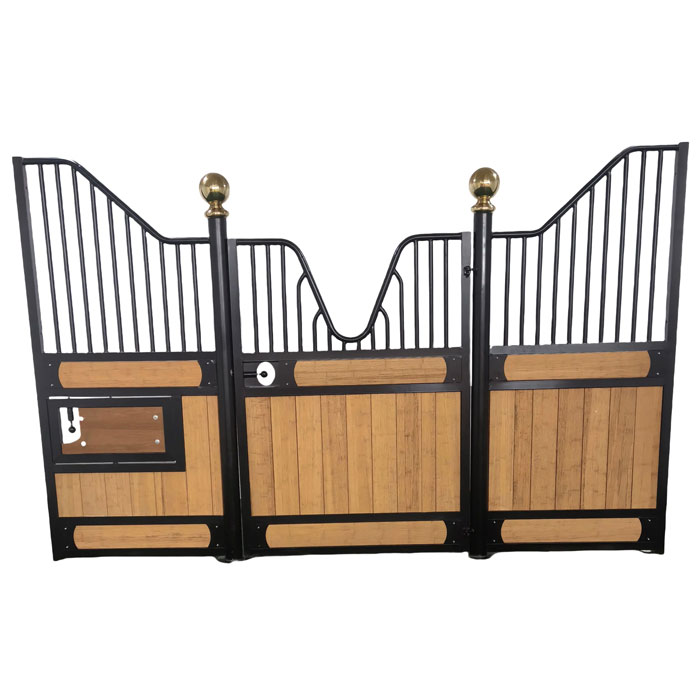
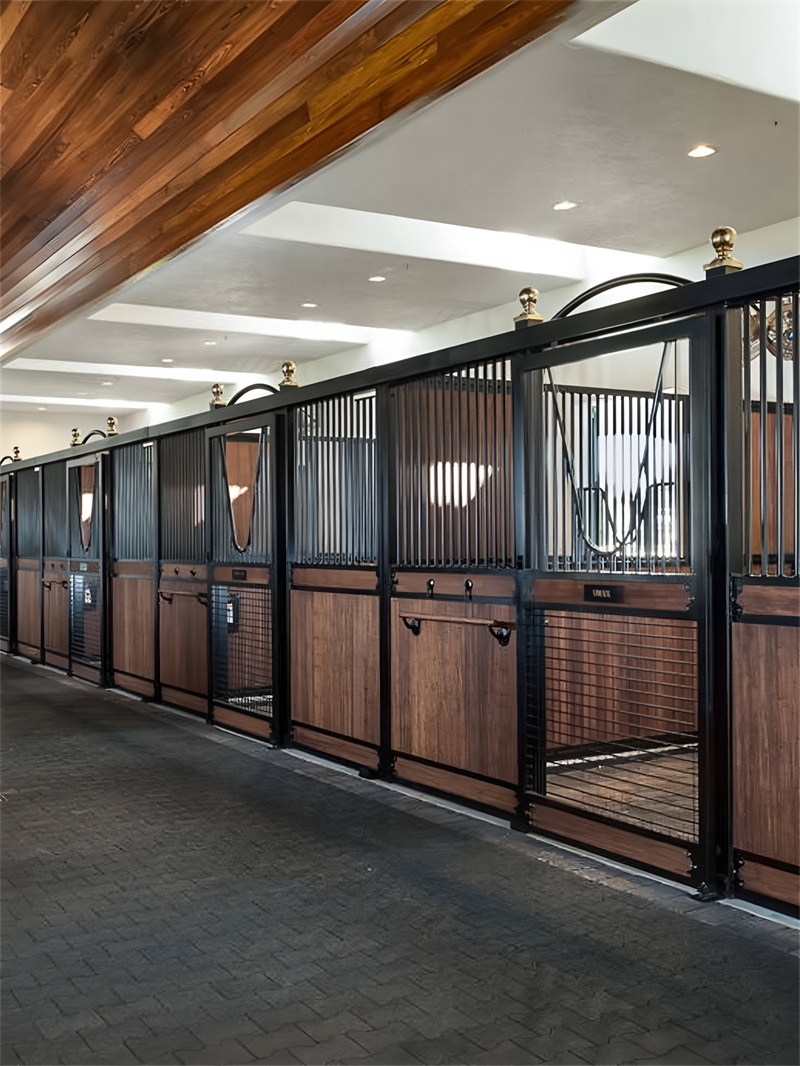
Anti-Cribbing Stall Hardware Specs
Breeding stall hardware is not interchangeable with boarding stall parts. A single grille failure around a stallion or foal costs more than an entire flat pack stable kit.
Physical Dimensions for Safe Breeding Stall Grilles
Our engineers specify 40x40mm welded Q235 steel tube for breeding stall grille frames. This cross-section resists the sustained lateral force a 600kg stallion exerts when pushing against a partition. Thinner profiles deform over time, widening gaps and creating entrapment hazards.
For prefab horse stalls for breeding barns, including our flat pack stable kits Australia clients receive, we set the vertical grille bar
10-Year Cost Analysis Table
Over a 10-year cycle, prefab horse stalls for breeding barns using 42-micron hot-dip galvanized steel deliver 35-45% lower total cost of ownership than locally built timber equivalents.
Local Timber Build vs Imported Prefab Steel: 10-Year Cost Breakdown
Most breeders evaluate stalls on the day-one price tag alone. That is a calculation error. Our engineers tracked total cost of ownership across Australian breeding facilities over a decade. The data consistently shows timber stalls bleed capital through repeated maintenance cycles that galvanized steel simply does not incur.
- Initial CapEx: A local timber 12×12 ft stall averages AUD 3,800-4,500 installed. A flat-pack stable kit from our facility, including freight to Australian ports, lands between AUD 2,200-2,800 per unit before local assembly.
- 5-Year Rust/Replacement Maintenance: Timber stalls exposed to ammonia from urine require partial wall and frame replacement by year 3-4, costing approximately AUD 800-1,200 per stall. Our Q235 steel frames with 42-micron hot-dip galvanization show zero structural corrosion at the 5-year mark, requiring only routine hardware checks.
- Labor Hours: Timber repairs across a 20-stall facility consume 40-60 labor hours annually. Flat-pack modular systems with sliding latches and anti-cribbing grilles reduce annual maintenance labor to under 8 hours for the same facility.
The ROI Shift in Flat-Pack Modular Systems
The economics of flat-pack stable kits Australia hinge on container loading density and on-site assembly speed. We fit 4-6 stalls per 40ft container, which compresses per-unit freight costs significantly compared to fully welded imports. For large-scale breeders ordering 20 or more units, this shipping efficiency alone cuts the hot dip galvanized stall cost per unit by 15-20%.
Beyond freight, the real ROI multiplier is eliminated downtime. When a timber stall degrades, you lose a functional housing slot during repair. Breeding barns cannot afford empty stalls during foaling season. Prefab horse stalls for breeding barns using ammonia resistant stall materials like 10mm HDPE boards eliminate this porous bacterial trap entirely. The boards do not absorb urine, they do not warp, and they do not need replacement. Combined with anti-cribbing horse stall grill spacing engineered into our 40x40mm welded tube frames, the system prevents foal injury and eliminates the hidden cost of veterinary bills tied to cribbing-related trauma.
| Cost Factor | Traditional Approach | DB Stable Specification | 10-Year ROI Impact |
|---|---|---|---|
| Initial Procurement & Logistics | High freight costs for bulky timber, expensive on-site carpentry labor | flat pack stable kits Australia (4-6 stalls per 40ft container) | Reduced shipping volume and fast assembly lower upfront capital requirements |
| Frame Replacement Cycle | Untreated welds rust from urine ammonia; full replacement every 3 years | Q235 steel with 42-micron HDG coating; optimized hot dip galvanized stall cost per unit | Zero frame replacements over 10 years; eliminates recurring capital expenditure |
| Wall Maintenance & Foal Health | Wood absorbs urine, creating porous bacterial traps causing foal respiratory disease | 10mm UV-resistant HDPE boards acting as ammonia resistant stall materials | Eliminates biosecurity risks, ensuring zero-incident foal respiratory safety |
| Stallion Injury & Vet Costs | Dangerous gaps or chewable wood leading to costly cribbing injuries | Engineered anti cribbing horse stall grill spacing on heavy-duty grilles | Prevents expensive vet bills and protects the genetic value of breeding stallions |
| Total Cost of Ownership | High hidden labor for mucking inefficient designs and constant structural repairs | prefab horse stalls for breeding barns designed for operational efficiency | Maximizes profitability by combining structural longevity with optimized daily labor |
Professional Boarding Facility Design Template
A 20-stall breeding wing’s ROI hinges on material science—specifically 42-micron HDG steel and HDPE infill—not just spatial layout.
Standardized Block Layout for a 20-Stall Wing
We engineer 20-stall breeding wings using a back-to-back quadruple configuration, built on a strict 12×12 ft minimum footprint per stall. This modular block layout eliminates dead-end alleyways, which directly reduces daily mucking time per staff member. By centralizing the main aisle to 12 feet wide, you allow tractors and muck carts to pass without bottlenecking. Labor math changes drastically at 10 horses; inefficient stall designs like swinging doors add hidden labor costs that wipe out boarding profit margins, which is why we mandate heavy-duty sliding latches on all structural frames.
Prevailing Wind Orientation and Centralized Wash Stall Placement
Facility orientation dictates foal respiratory health. We position the 20-stall block perpendicular to the region’s prevailing summer winds to maximize cross-ventilation. This airflow velocity is critical for evacuating ammonia pockets that accumulate at foal breathing height.
The centralized wash stall must sit at the midpoint of the central aisle, offset slightly toward the drainage grade. Our engineers specify anti-cribbing horse stall grill spacing on adjacent stalls to prevent stallions from injuring themselves while waiting for vet or farrier work in the wash area. Wood infill absorbs urine spray from the wash bay, creating a porous bacterial trap; this is why we exclusively specify 10mm UV-resistant HDPE boards as ammonia resistant stall materials to guarantee zero-incident safety rates.
Flat-Pack Container Loading Calculations for Site Delivery
For large-scale breeders importing flat pack stable kits Australia-bound, freight efficiency dictates your per-unit capital expenditure. Our engineers optimize prefab horse stalls for breeding barns to load 4 to 6 flat-pack units per 40ft high-cube container, depending on whether you select single-slope or gable roof profiles.
Because we use 40x40mm welded Q235 silicon-killed steel frames with a 42-micron hot-dip galvanization threshold, the structural components survive high-salt maritime shipping without the micro-fracturing common in standard powder-coated alternatives. Calculating your site delivery logistics around this 4-to-6 unit container ratio allows you to accurately forecast your hot dip galvanized stall cost per unit, including freight, and maintain a predictable installation timeline for your grounding contractors.
Conclusion
Spec 42-micron hot-dip galvanized steel and 10mm HDPE boards. Period. Untreated timber might save you twenty percent upfront, but urine ammonia will eat the welds and force a full stall replacement before year four. Over a decade, that galvanized-steel-and-plastic combo drops your cost per stall drastically while keeping your foals breathing clean air.
Ask your supplier for the galvanization thickness test reports, not just a unit price. If they dodge the question or send generic certificates, walk away. You need documented proof that those Q235 steel frames hit the 42-micron threshold before you authorize any production run.
Frequently Asked Questions
Core structural requirements for a breeding barn?
A professional breeding barn demands a sturdy backbone built from hot-dip galvanized steel frames with a minimum thickness of 42 microns to withstand harsh equine environments. We utilize 10mm UV-resistant HDPE boards for infill instead of traditional timber, effectively preventing ammonia corrosion over our guaranteed 10-year structural lifespan. This non-porous material choice critically eliminates bacterial traps that often cause devastating respiratory diseases in foals, ensuring a safe, durable, and easily maintainable facility for professional operators.
How to calculate space and logistics for 20 stalls?
To efficiently plan a 20-stall layout, you should allocate a standard 144 sq ft per stall while strategically positioning manure zones at least 15 meters away from water sources to maintain strict hygiene standards. Our product experts leverage over five years of design experience to help equestrian center owners optimize these site plans for maximum workflow efficiency. Furthermore, by utilizing our flat-pack DIY kits, importers and builders can precisely calculate logistics to fit 4 to 6 modular stalls into a single 40ft container, drastically reducing international shipping complexity and on-site delivery costs.
Why reject cold-rolled iron for breeding stalls?
Professional stable builders and commercial horse owners must reject cold-rolled iron because it lacks deep zinc penetration, leading to catastrophic rusting within just 18 months when exposed to equine ammonia. Instead, we engineer our prefabricated barns using premium silicon-killed Q235 hot-dip galvanized steel to guarantee a robust 10-year structural lifespan. This high-specification material choice protects your investment and ensures the safety of valuable thoroughbreds, giving distributors a reliable, high-quality product that outperforms cheaper alternatives in the Australian and New Zealand markets.
How do prefab stalls reduce 10-year operating costs?
Prefabricated stalls drastically reduce 10-year operating costs by completely eliminating the expensive 3 to 5-year replacement cycle associated with traditional timber infrastructure. Our factory-welded hot-dip galvanized steel frames require minimal maintenance while offering potential tax benefits for commercial horse owners utilizing portable structures. Additionally, the intuitive modular design of our flat-pack kits cuts on-site assembly labor by up to 40%, allowing professional facility operators to preserve slim boarding profit margins while accelerating their operational timeline.
What material choices improve barn ventilation?
The most impactful material choice for improving barn ventilation is replacing traditional plywood with our 10mm UV-resistant HDPE boards, which do not suffer from thermal expansion or absorb urine. By removing these moisture-absorbing surfaces, you significantly lower ambient ammonia levels at the source rather than just relying on airflow to clear them. This allows standard ridge vents to efficiently maintain safe, breathable air quality for vulnerable foals, providing equestrian centers with a superior, healthier environment that our clients across Australia and New Zealand have consistently praised.