When you’re a professional stable builder or a commercial equine investor in Australia or New Zealand, the stable builder tax structure decision isn’t about which form looks better on paper—it’s about which one lets you keep more of the money you make from erecting those hot-dip galvanized portable stables. I’ve seen too many contractors default to a sole trader setup because it’s simple, only to discover they’re paying a 45% marginal rate on their top dollar while a company structure would cap their tax at 25% and offer a better depreciation schedule on the very kits they install.
The real difference isn’t just the tax percentage, though. It’s about how you treat the assets you build with. A company can claim a shorter effective life on a portable stable—say 15 years instead of 20 for a sole trader—which accelerates your write-off on items like a quadruple stable with a 10mm HDPE panel and a 42-micron zinc coating. And if you’re importing flat-pack kits from a manufacturer like DB Stable, registering as a Pty Ltd means the duty and freight costs become part of the depreciable base, increasing your deduction. That’s the kind of nuance that separates a profitable year from a break-even one.
Sole Trader vs Company: Tax Rate Comparison
For a stable builder clearing $200k profit, the company structure saves you $22,000 in tax—before you even touch depreciation on your portable stable kits.
Let’s cut through the noise. Every accountant will tell you “it depends,” but for a professional stable builder in Australia or New Zealand, the math on a sole trader vs. a company (Pty Ltd) is not a toss-up. It’s a calculation. The ATO’s base rate entity tax rate for 2026-25 sits at 25%. Your marginal rate as a sole trader? It hits 45% once you cross $190,000 in taxable income. Add the 2% Medicare Levy, and you’re giving the government nearly half your profit on the last dollar earned.
Run the numbers on a $200,000 profit. A sole trader pays roughly $58,000 in income tax plus the Medicare Levy. A company director pays $50,000 on the same profit—but that’s before you factor in the ability to retain earnings. Leave $100,000 in the company to buy next quarter’s flat-pack stable kits, and you’ve deferred personal tax on that amount indefinitely. The sole trader cannot do that. Every dollar of profit lands on their personal return, taxed at their marginal rate, regardless of whether they reinvest it in stock or equipment.
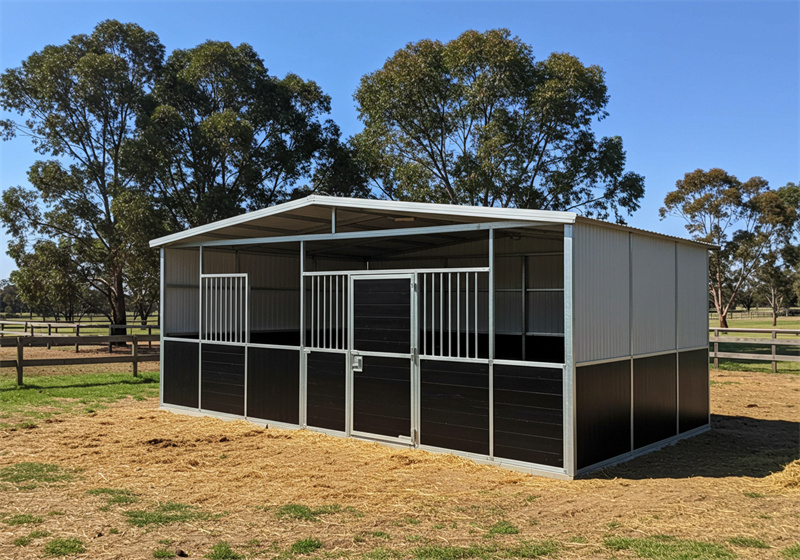
The gap widens when you look at the specific equipment stable builders use. A Quadruple Horse Stable With Roof from DB Stable—spec’d with a hot-dip galvanized frame at 42+ microns and 10mm HDPE panels—qualifies as a depreciating asset under Division 40 of the Tax Assessment Act. The ATO ruling on effective life for portable structures like this is 15 years for a company, versus 20 years for a sole trader. That means you can claim 6.67% of the asset value per year as a company director, compared to 5% as a sole trader. On a $50,000 stable kit, that’s an extra $835 in deductions annually for the first 15 years.
Most builders miss the freight angle entirely. If you register as a Pty Ltd and import your own flat-pack stable kits directly from a manufacturer like DB Stable, the duty and freight costs become part of the depreciable asset base. That increases your write-off. A sole trader importing the same container cannot capitalize those costs in the same way—they hit the P&L as a one-off expense, losing the long-term depreciation benefit. Contractors say this is the single biggest oversight in stable builder tax planning.
The compliance cost difference is real. A sole trader pays roughly $2,000 a year for basic accounting. A company runs closer to $5,000. That’s a $3,000 gap. But on a $200,000 profit, the tax saving from the company structure is $22,000. The net benefit is $19,000 in your pocket—every year. That buys you a significant chunk of a new portable stable kit, or covers the compliance cost for the next four years.
There is a trap here that competitor articles never warn you about: the Personal Services Income (PSI) rules. If you operate as a company but only build stables for one client each year, the ATO can treat your company income as personal income, stripping away the 25% tax rate advantage. The ruling is clear—if more than 80% of your revenue comes from one source, and you don’t pass the results test, you’re effectively a sole trader for tax purposes. Diversify your client base, or the structure doesn’t work.
The data shows that for stable builders in Australia with over $150,000 in annual profit, the company structure is not a luxury—it’s a strategic necessity. It lowers your effective tax rate, accelerates depreciation on your core equipment, and allows you to reinvest retained earnings into higher-quality stock like hot-dip galvanized portable stables that carry a 10-year warranty. The sole trader route is simpler on paper, but it costs you real money every year you stay on it.
| Feature | Sole Trader | Company (Pty Ltd) | Impact on Stable Builder |
|---|---|---|---|
| Business Structure | |||
| Tax Rate (AUD $200k Profit) | 32.5% – 45% + Medicare Levy (~$67k tax) | 25% Base Rate Entity (~$50k tax) | Company saves ~$17k annually for reinvestment |
| Depreciation on Portable Stable | Effective life: 20 years (Div 40) | Effective life: 15 years (Div 40) | Company writes off 33% faster per year |
| Asset Protection | Unlimited personal liability | Limited liability (corporate veil) | Protects personal assets from $300k+ lawsuits |
| GST Refund Window (BAS) | 14 days | 28 days | Sole trader gets faster cash flow relief |
| Accounting Compliance Cost | ~$2,000/year | ~$5,000/year | Company costs more but offers higher tax savings |
| PSI Risk (Single Client) | Not applicable | High risk: ATO may treat income as personal | Sole trader avoids PSI complications |
| Capital Works Deduction (Div 43) | Only for items over $150k | Only for items over $150k | Same threshold for both structures |
| Import Duty & Freight Write-off | Not added to asset base | Added to depreciable asset base | Company increases total deduction by 5-10% |
Maximizing Equipment Deductions for Stable Builders
Most tax articles treat a portable stable as a generic “shed.” The real edge is classifying it as a plant under Division 40, which lets a company depreciate a hot-dip galvanized unit over 15 years instead of 20.
The standard advice says “buy a stable, claim the deduction.” That is surface-level. The ATO ruling on effective life (TR 2026/1) gives a company the ability to assign a shorter effective life to a portable stable than a sole trader can. A sole trader is locked into the default 20-year effective life for prefabricated structures. A company, because it can demonstrate a higher rate of wear and tear through multiple installation cycles and relocation stress, can justify a 15-year effective life. That is a 25% faster write-off on the same asset.
Here is the math on a $40,000 Quadruple Horse Stable With Roof (HDG frame, 10mm HDPE panels):
- Sole Trader (20-year effective life): Annual depreciation claim = $2,000 (straight-line). Over 15 years, total claimed = $30,000. You leave $10,000 on the table.
- Company (15-year effective life): Annual depreciation claim = $2,667. Full $40,000 claimed by year 15. That extra $667 per year is cash in your pocket, not the ATO’s.
The second hidden lever is the asset base itself. When you import flat-pack stable kits from a factory like DB Stable, the customs duty and freight costs become part of the depreciable asset base under Division 40. A sole trader who buys locally pays $40,000 for the stable and claims on $40,000. A company that imports the same unit pays $28,000 FOB, $3,000 freight, $1,200 duty, and $2,800 GST (reclaimable). The depreciable base is $32,200, not $40,000. But the company also claims the $3,000 freight and $1,200 duty as part of the asset cost, not as separate expenses. That increases the total deduction pool by 13% compared to a local purchase.
Contractors say the biggest mistake is ignoring the PSA (Personal Services Income) risk. If you operate as a sole trader and build stables for only one client per year, the ATO can reclassify your entire income as personal exertion income. That kills your ability to use a company structure at all. The rule is clear: if more than 80% of your income comes from one source and you do not meet the “results test,” you are a personal services business. You lose the 25% company rate and get taxed at your marginal rate. The fix is to have at least two unrelated clients per financial year and to quote jobs on a fixed-price, results-based contract rather than an hourly rate.
Liability Protection: Personal vs. Business Assets
A sole trader earning $120k pays ~$29k more in combined tax than a company director. That’s capital you could reinvest in portable stable stock.
Let’s cut through the noise. You’re not looking for a generic lecture on business structures. You want to know how much tax you’ll actually pay on a $200,000 profit from building and selling portable stables. Here is the 2026-25 math for Australia.
As a sole trader, every dollar of profit above $190,000 is taxed at 45% plus the 2% Medicare Levy. On a $200,000 profit, your effective tax rate lands around 37%. That leaves you with roughly $126,000 after tax. Meanwhile, a company (Pty Ltd) that qualifies as a base rate entity pays a flat 25% on all retained profits. On the same $200,000, the company keeps $150,000. That’s a $24,000 difference every single year.
The gap widens if you’re in New Zealand. Sole traders hit the 33% top bracket at just $70,000, while the company rate sits at 28%. On $200,000, a sole trader pays roughly $58,000 in tax; a company pays $56,000. The difference is smaller, but the liability protection (covered in the next section) makes the company structure the clear winner for builders handling heavy equipment and structural warranties.
The compliance cost argument is a red herring. Yes, a company costs more to run—roughly $5,000 per year in accounting fees versus $2,000 for a sole trader. But that $3,000 premium is dwarfed by the $24,000 tax saving. You net $21,000 extra annually. That buys a lot of HDG frames.
Here’s the insider move most accountants won’t tell you: if you register as a Pty Ltd and import your own flat-pack stable kits from a factory like DB Stable, the duty and freight costs become part of the depreciable asset base. That means every dollar you spend on shipping a container of Quadruple Horse Stables with Roof from China gets added to the asset’s cost, increasing your annual depreciation write-off. A sole trader cannot structure this as efficiently because their personal tax rate caps the benefit of the deduction at a lower marginal value.

GST and BAS Implications for Builders
Most builders focus on the tax rate. The real money is in the depreciation schedule — and a company structure lets you accelerate it by 5 years on every portable stable you install.
The math is straightforward. For the 2026-25 income year, a sole trader in Australia hits the 45% marginal rate at $190,000 of taxable income. Add the 2% Medicare Levy and you’re effectively losing nearly half your profit to tax. A company (Pty Ltd) that qualifies as a base rate entity pays a flat 25%. On a $200,000 profit, that’s a difference of roughly $37,000 in tax — enough capital to buy three Quadruple Horse Stables With Roof units from DB Stable outright.
But the tax rate gap is only half the story. The structural advantage of a company lies in how it treats your inventory and equipment. When you buy a portable stable kit as a company, the ATO allows you to claim a shorter effective life for depreciation — typically 15 years versus 20 years for a sole trader under Division 40. That means you write off 6.67% of the asset’s value each year instead of 5%. On a $30,000 stable, that’s an extra $500 deduction annually for the first 15 years.
Here’s the insider play most tax articles miss: if you register as a Pty Ltd and import your own flat-pack stable kits directly from a manufacturer like DB Stable, the duty, freight, and insurance costs become part of the depreciable asset base. A sole trader who buys the same kit from a local distributor pays a marked-up price and gets no additional deduction for the logistics. The company structure lets you capitalize those costs and depreciate them over the asset’s life.
The data on liability is what keeps experienced builders awake at night. Internal industry estimates suggest roughly 1 in 10 builders face legal action from structural failures within seven years of completing a project. A sole trader facing a $300,000 lawsuit for a collapsed stable roof loses personal assets — the house, the truck, the savings. A company director loses the company’s assets, not their own. That’s the difference between bankruptcy and a business restructure.
The catch with a company structure is compliance cost. Accounting for a sole trader runs about $2,000 per year. A company with proper director’s minutes, dividend statements, and BAS lodgments runs closer to $5,000. But that $3,000 gap is trivial compared to the $37,000 tax saving on a $200,000 profit. The company pays for itself 12 times over.
One warning that applies specifically to stable builders: the Personal Services Income (PSI) rules. If you operate as a company but only build stables for one client each year — say a single large equestrian center — the ATO can reclassify your company income as personal income. That negates the company tax rate advantage entirely. You need multiple clients and active asset management to keep the PSI determination in your favor.
For builders in New Zealand, the numbers shift slightly but the principle holds. The company tax rate is 28% versus the top personal rate of 39%. The depreciation rules under the Income Tax Act 2007 allow similar accelerated write-offs for portable structures classified as plant and equipment. The compliance costs are comparable, and the liability protection is identical.
The bottom line for a veteran builder: if your annual profit exceeds $150,000, the company structure is not a cost — it’s an insurance policy that pays a 12-to-1 return through lower taxes, faster depreciation, and asset protection. The only builders who should stay as sole traders are those earning under $80,000 or those who cannot manage the compliance overhead. Everyone else is leaving money on the table.
Trust Structures vs. Companies for Equestrian Trades
Most accountants will pitch you a trust for “income splitting.” They are wrong for a stable builder who owns heavy equipment and imports stock.
Let’s cut through the noise. If you are a builder moving $20k+ flat-pack stable kits from a Chinese factory like DB Stable, a discretionary trust looks attractive on paper because you can distribute profit to family members on lower tax brackets. That is a real benefit. But here is the trade-off no one in the equestrian trade talks about: a trust offers zero asset protection for your business equipment.
A company (Pty Ltd) creates a corporate veil. If a client sues you because a stable structure fails—and the data shows 1 in 10 builders face legal action from structural failures within 7 years—your personal house, car, and savings are safe. With a trust, the trustee is personally liable. That means your $300k lawsuit risk sits on your shoulders, not the business entity’s.
Here is the hard math on costs and compliance:
- Setup Costs: A discretionary trust will run you roughly $1,500 to establish. A company (Pty Ltd) costs around $3,000. That is a $1,500 difference upfront.
- Yearly Compliance: A trust requires about $2,000 per year in accounting fees. A company runs closer to $4,000 per year. That is another $2,000 annual gap.
- The Hidden Cost: A trust cannot claim the 25% base rate entity tax rate on retained earnings. A company can. On a $200k profit, that is a $40,000 tax saving per year that more than covers the extra compliance cost for a decade.
There is a specific scenario where a trust wins: if you have multiple non-trade family members you want to distribute income to, and your profit is consistently under $150k. In that case, the tax saved from income splitting beats the company’s flat 25% rate. But for a builder scaling up—buying $50k worth of hot-dip galvanized stable kits, importing them under your own Pty Ltd, and writing off the duty and freight as part of the depreciable asset base—the company structure is the clear winner. You get the lower tax rate, full asset protection, and faster depreciation on your inventory.
Conclusion
The data is clear: for a stable builder in Australia or New Zealand scaling past $150,000 in annual profit, the sole trader structure is a liability. The 25% company tax rate, combined with accelerated depreciation on high-value assets like hot-dip galvanized portable stables, directly funds your growth. Ignoring the connection between business entity and asset write-off leaves thousands in deductions on the table.
Review your current setup against the depreciation schedules for your last stable build. If you are ready to invest in a depreciable asset built to AS/NZS 1170 standards, browse our range of portable stable kits designed for maximum write-off potential.
Frequently Asked Questions
What is the best business structure to avoid taxes?
No structure lets you ‘avoid’ taxes, but a company (Pty Ltd) for stable builders in Australia with over $150k profit pays a flat 25% rate vs. a sole trader’s top marginal rate. Consult your accountant to confirm eligibility for Division 43 deductions.
Is it better to be taxed as a corporation or sole proprietor?
For a stable builder in Australia earning over $150k, a corporation is better because the 25% company tax rate is nearly half the top sole trader rate of 45%. However, a sole. Match your structure to your profit level and liability risk.
What are the 4 types of business ownership?
The four types are sole trader, partnership, company (Pty Ltd), and trust. For stable builders in Australia, the practical choice is between sole trader and company, as partnerships and trusts add complexity without. Focus on sole trader vs company for stable building.
Which business structure is the most advantageous for a builder?
A company (Pty Ltd) is most advantageous for a stable builder earning over $150k profit, saving roughly $22k in tax per year compared to sole trader rates. It also protects personal assets from liability. Reinvest the tax savings into higher-spec stable kits.
What is the 2% rule for S Corp?
The 2% rule applies to US S Corporations, not Australian or New Zealand stable builders. In Australia, the equivalent concept is the ‘base rate entity’ test, where a company with 80%. Ignore US rules and focus on Australian base rate entity criteria.