A search for equine trade show australia throws up ticket pages, grandstand schedules and riding-helmet adverts before it shows you a single stall frame. That is not the same activity as shortlisting a buying trip. An importer or a yard builder has one question an event can answer: who else is selling stabling into my market, and what are their customers saying about it a year later.
The AU/NZ calendar is thinner than it looks and much of it is consumer-facing. This piece sorts the 2027 diary into four formats, says what each can and cannot prove, and lists the paper to bring back. Every figure from our own side is documented here: panels at 2844 × 1194 × 10 mm or 3494 × 1194 × 10 mm, about 200 kg each, front walls 2200 mm high with door widths of 1150 mm or 1300 mm.
Key Takeaways
- Sort events by who exhibits, not by ticket price: competing stabling brands, the distributors who resell them and the yard owners who bought two seasons ago.
- Four formats matter: a consumer equestrian fair, a performance-horse sale carnival, a regional field day with a trade village and a general agricultural exhibition.
- A show unit is a display piece. Ask what the buyer actually receives — documented here as 50 × 50 × 2.0 mm frame tube, 4.0 mm wire and 50 × 50 mm aperture.
- Coating is the line most often smoothed over: hot-dip galvanising to a factory commitment of 42 microns and above, on a process run to AS/NZS 4680.
- Nothing on a show floor replaces paper: an enquiry answered inside 6 hours, a drawing-based quote inside 24, MOQ 10 sets against output of about 20 a week.
Four kinds of event, four different jobs
The first format is the consumer equestrian fair. It is four days of competition, clinics and a shopping marketplace, and the stabling brands that exhibit there are selling to riders and small yard owners. You will learn what your customers are being shown, and you are unlikely to find a dedicated stabling importer walking that floor.
The second is the sale carnival built around performance-horse auctions and campdraft competitions, where vendors, buyers and trainers spend a week on site with horses and floats. They already buy yards, transport and stabling, and they talk about what failed.

The third is the regional field day with a trade village — three days of dressage and showjumping with exhibitor sites let to local businesses. It is where a regional distributor’s customers are standing in one paddock.
The fourth is the general agricultural exhibition, where stabling sits in a much bigger hall plan of machinery, fencing and stock handling and the buyers are farm businesses rather than equestrian ones.
The 2027 shortlist, and what each format proves
Dates below are as listed on organiser, venue and industry-calendar pages when this piece was written. Event schedules move; confirm each one on the organiser’s own page before you book travel, and check whether the format runs annually or on a two-year cycle.
| Event and venue | Format and listed 2027 window | What it proves | What it cannot tell you |
|---|---|---|---|
| EQUITANA Melbourne, Melbourne Showgrounds | Consumer equestrian fair, listed 11–14 November 2027; two-year cycle. The 2024 edition reported a 6,000 m² marketplace and 300-plus brands and exhibitors. | Retail price points and presentation standards your end customers will compare you with. | Trade terms, batch volumes or how a block survives a wet season. |
| Nutrien Equine Classic, AELEC, Tamworth | Sale and competition carnival, listed 27 January – 6 February 2027; the organiser calls it the southern hemisphere’s largest performance horse sale, running since 2007. | Where money is actually moving in performance horses, and who supplies the yards behind it. | A structured stabling comparison; most vendors there are horse businesses. |
| Farm World Equestrian Expo, Lardner Park, Gippsland VIC | Regional field day with a trade village run alongside Farm World; three days of dressage and showjumping. | What a country distributor’s customers ask for face to face, at trade-site pricing. | National coverage; expect one region’s buying habits. |
| Fieldays, Mystery Creek, Hamilton NZ | General agricultural exhibition, annual, listed in June (10–13 June in the 2026 calendar) and commonly positioned as the largest of its kind in the southern hemisphere. | How NZ farm buyers spec horse housing against stock and fencing gear. | Equestrian-specific fit-out detail; equine is one aisle of a very big hall. |
| Horse of the Year, Hastings NZ; National Horse & Pony Show, Dannevirke | Multi-day horse-sport meetings, listed in a NZ agri-event calendar as 24–29 March and 23 January 2026 respectively. | Temporary stabling and yard practice in the provinces, at the scale dealers actually move. | A reliable import comparison; exhibitor lists are thin and local. |

What to collect before you leave the stand
Show floors flatter products. A unit that has been assembled once by a two-person crew with a borrowed tool, then dressed for four days, is not the block your customer receives in a flat pack and erects in the rain. So the walk round is a question list, not a shopping list.
Ask five things and write the answers down on the same sheet. Tube section and wall thickness. Wire gauge and aperture. Board material and thickness. Coating, as a micron figure and the standard the process is run to. Then, and only then, price. Our documented figures are 50 × 50 × 2.0 mm square tube frames, 4.0 mm wire at 50 × 50 mm aperture, 10 mm HDPE boards and hot-dip galvanising to a factory commitment of 42 microns and above, on a process run to AS/NZS 4680. Anything a competitor cannot answer on the spot is a gap you can price.
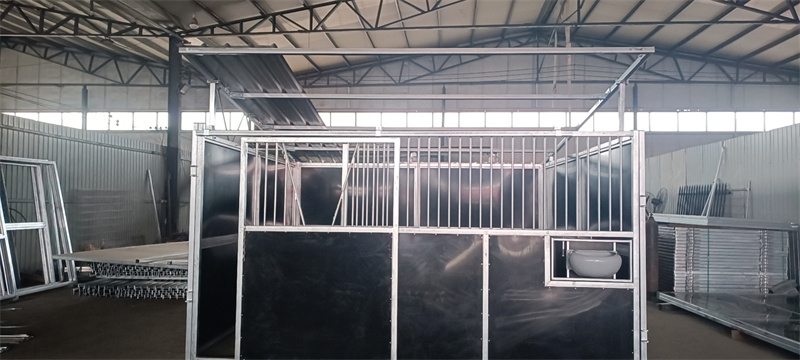
The unit in the photograph above is standing in a workshop, not on a show floor — that is the difference between a specification and a display. Hardware is where display units lie: hinges, bolts and pins carry a block, and a dressed stand hides them. Locking panel and door details on a written spec sheet is the same discipline applied before production, and it is the document to ask a competitor for.
If the calendar does not fit your year
We do not run a stand on the AU/NZ show diary, and the honest reason belongs in print: this is a manufacturing and export operation in Anping, China, portable horse stables since 2013, and the sales route is drawings, samples and a written quote rather than a four-day marquee. Nothing about missing an event stops a buyer from checking the same five numbers.
Demand is visible without a booth too. Boarding and agistment pressure is a capex signal in itself, set out in rising agistment charges and stable capex, and the demand side of the market is modelled in the 2027 demand signals piece.
One position on this: for most AU/NZ importers, the show worth attending is the one where your competitors exhibit and your customers complain, not the one with the best evening entertainment. A consumer fair tells you what a rider is asked to pay. A provincial field day tells you what a distributor is asked to deliver on a Tuesday. Book the second one.
Frequently Asked Questions
Is there a dedicated horse-stabling trade show in Australia?
Not really — stabling exhibits inside consumer equestrian fairs and general agricultural exhibitions. Filter the diary by exhibitor type rather than by event name.
What is the one question to ask at a stabling stand?
Coating as a micron figure plus the standard the process is run to. Our documented answer is 42 microns and above, hot-dip, on a process run to AS/NZS 4680.
Do event dates stay the same year to year?
No. Some formats run on a two-year cycle and windows shift, so treat any listed date as provisional and confirm it on the organiser’s page before booking.
Can I vet an overseas manufacturer without attending an event?
Yes, if you get the same five numbers in writing: tube section, wire gauge and aperture, board thickness, coating micron figure with its standard, and pricing against the 10-set minimum.
Conclusion
A shortlist is only worth booking if it changes what you buy. Two events a year, chosen for exhibitor mix rather than ticket sales, will usually tell you more about the AU/NZ stabling market than a month of browsing — and the five numbers you collect there are the same five any supplier has to answer in writing.
Compare them against the documented portable horse stable specification before you commit a season’s budget, and let the drawing do the talking.