Two spreadsheets can show the same stabling project and disagree by a wide margin, and the stabling cost ownership horizon is usually where they part: most comparisons start with a single assumption — that the block will still be standing in the same place, holding the same number of horses, in year ten. A fixed timber shed and a portable HDPE kit separate on the years, not on the invoice, on whether the block moves, gets extended or gets repaired.
This is the model for dealers and yard builders in AU/NZ who have to defend a kit quote against a timber shed quote on a five or ten year horizon. The numbers carry the kit side; the local rates have to be sourced, because this site publishes no price list.
Key Takeaways
- Panels per stall falls as the block grows, because dividers are shared — the documented configurations run from 3 side panels and 1 door for one stall to 11 panels and 6 doors for six back-to-back.
- Assembly is documented at two or three people about 30 minutes a set on tool-free corner pins; teardown is not a published figure, so a move has to be quoted in writing.
- Kit-side lines you can specify rather than hope: frames hot-dip galvanised to a factory commitment of 42 microns and above, on a process run to AS/NZS 4680, and 10 mm HDPE boards documented as washable, rot-proof and chew-proof.
- Two local numbers decide the answer: builder and trade rates for the fixed option, and council or certifier time and fees for either one.
Three questions that separate the budgets
Write the horizon on top of the sheet before you price anything, then answer three questions. Will the block still be needed at this address in year ten? Will it hold the same number of stalls? What will you repair on it? Those three answers split the budget into two kinds of cost: the part that stays with the land and the part that travels with the owner.
A shed built on a slab is an improvement to a property you may not own in 2036; a kit is an inventory of panels and doors. That is the biggest difference on a ten-year horizon, and worth putting in writing before you compare a single rate.
What the kit side brings on paper
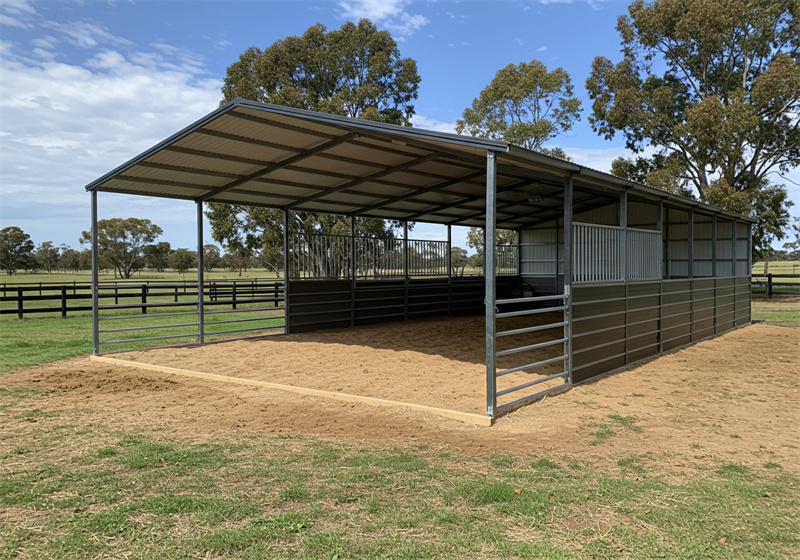
Apply the published configuration table before you reach for a rate. It gives 3 panels and 1 door for one stall, 5 and 2 for two adjacent, 7 and 3 for three, 9 and 4 for four, 11 and 5 for five, and 11 panels with 6 doors for six back-to-back. Read it as a divider count: stalls added in a row share sides, so panels per stall falls from 3.0 at one stall to about 1.8 at six. Scaling a documented 6-kit build works the same table up to a full block, and the panel is the unit that carries.
The same table is why an extension is a different purchase from a first block. Panels are about 200 kg each on 50 × 50 × 2.0 mm galvanised square tube with 10 mm HDPE boards, in two documented sizes — 2844 × 1194 × 10 mm and 3494 × 1194 × 10 mm — and front walls are 2200 mm high with 1150 mm or 1300 mm openings, which is the sizing maths in front wall opening sizes.
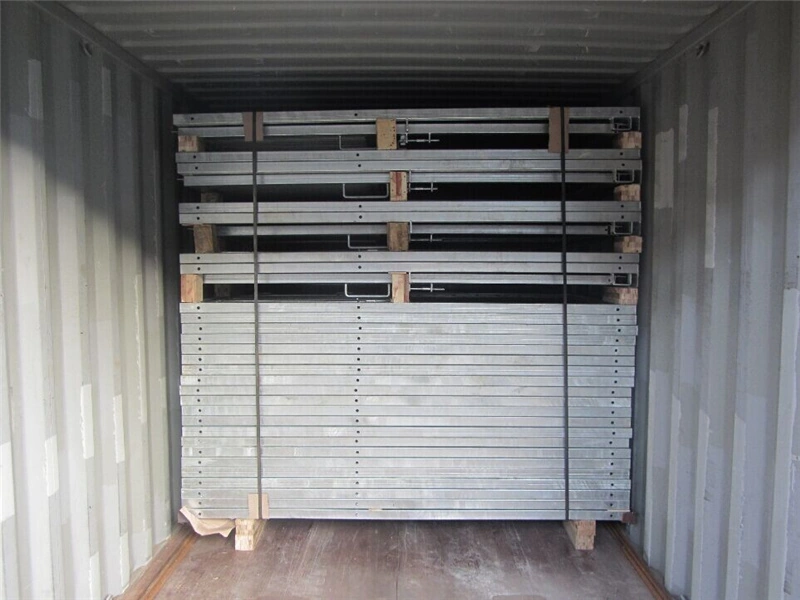
Labour is the line most often mis-modelled. Assembly is documented at two or three people about 30 minutes a set, on tool-free corner pins; teardown is not a published figure and must not be quoted as one — ask for it in writing. Flat pack is what makes the freight volume interesting, and the minimum order is 10 sets against output of about 20 a week, so a single extension stall rarely travels as its own consignment — that is the point made in the MOQ 10 starter order piece.
What the fixed side quietly adds
The fixed option carries three cost lines that never appear on a kit quote because they are not the kit seller’s business: the base, the services, and the approvals. Water, power and the crushed rock that makes a yard usable are priced the same way in budgeting yard services, and they are usually a local quote. The annual upkeep of any stabling — timber or steel — is set out in the ten-stall maintenance cost piece; use it as the shared denominator between your columns.
Approvals are where owners guess. Many fixed sheds may need council or certifier involvement depending on size, use and locality; requirements vary by council and state, so confirm current rules rather than assuming a portable kit is exempt or that a timber shed is automatic. For a kit, the question to put in writing is how your council treats a moveable structure on a leased yard.
Repair is the third quiet line. A chewed or rotten board on a timber shed is a carpentry job at whatever rate your local builder charges; on a kit it is a swap of a documented panel size. Neither is free, and the difference is often frequency rather than unit price — ask the builder how often boards get replaced on the yards down your valley. The board properties this site publishes (washable, rot-proof, chew-proof 10 mm HDPE) are the line to test for that conversation, not a substitute for it.
| Cost line | Fixed timber | Portable kit | Who supplies the number |
|---|---|---|---|
| Base and groundworks | Often one of the largest lines — from your earthworker quote | Site prep, often without a slab | Your earthworker, both columns |
| Structure | Builder’s materials and labour | Panels and doors per the configuration table | Builder quote / drawing-based supplier quote |
| Moves and extensions | Rebuild | Re-erect on shared dividers | Written teardown estimate from the supplier |
| Repairs | Carpentry, local rate | Documented panel swap | Local builder / factory parts line |
| Coating and boards | Paint or treat on cycle | 42 micron+ hot-dip (factory commitment); process run to AS/NZS 4680; 10 mm HDPE | Factory statement on the sheet |
| Exit in year ten | Stays with the land | Trucks to the next yard | Your own ten-year plan |
The numbers you have to source yourself
Five local quotes turn the framework into a budget: builder materials and labour for the timber option; earthworks and yard services for both; council or certifier fees; a teardown estimate for the kit; and your own repair frequency, collected from nearby yards rather than from a brochure. On the kit side the numbers are already documented — panel and door counts from the configuration table, freight on flat-pack volume, the coating line as a factory commitment plus the AS/NZS 4680 process, and third-party QC against the approved drawing. Ask for each as a number, before the deposit.
One position is worth stating plainly. For a five-year hold the gap between a timber shed and a kit is often settled on day one; for a ten-year hold where anything moves — a lease that ends, a block that grows from three stalls to six, a yard that relocates — the gap is a recurring line item, and the kit’s shared-divider arithmetic is what makes it recede. Asset treatment is a separate conversation with your accountant; the portable stable depreciation guide covers what to ask.
Frequently Asked Questions
Does a portable stable need council approval?
It usually turns on size, use, locality and tenure rather than on the word portable. Put the question to your council or a private certifier in writing, and ask how a moveable structure on a leased yard is treated.
Which is cheaper over ten years, timber or a kit?
Run both columns on local builder rates and documented panel counts, then compare cost per stall-year rather than purchase price: this site publishes no price list.
What belongs in the ten-year model?
Groundworks, services, approvals time, one move, one extension of three stalls and two repair events — panel counts from the configuration table, upkeep from the annual maintenance guide.
Can a kit be extended later without reordering everything?
The configuration table is built on shared dividers, so growth is normally extra panels and doors rather than a rebuild — and with a 10-set minimum, extensions usually travel inside another consignment.
Conclusion
An ownership comparison fails when it prices two different questions: what the block cost to build, and what it costs to keep, move and extend. The kit side answers the second with published arithmetic — panels and doors per configuration, coating and board properties on the sheet, assembly in units of two or three people about 30 minutes.
Take the same stall count to a builder and to a supplier, hold both to the ten-year column, and let the portable horse stable line price the part it can actually document.