Ask for a delivered quote on ten sets of portable horse stables and the answer arrives in panels, gates and a container. A crushed rock yard services budget never appears in that reply, because site work was never inside the specification. The ground underneath, the water running to a bowl and the cable reaching a wash point decide whether the kits are usable, and all three are priced by people who do not export stables.
The framing here is deliberately honest: the published documents for this product carry dimensions, a minimum order and a turnaround, and no price list at all — neither for the panels nor for the ground below them. So this is the shape of the budget, not a rate card: who quotes each line, what you fix before comparing three of them, and which numbers you already own from the drawing.
Key Takeaways
- The published specification is a product document — panel sizes, a 2200 mm front, a 10-set minimum — with no ground, water or power rates anywhere in it.
- Panels run close to 200 kg each, so hire gear is a booked line before the doors open, not an on-arrival improvisation.
- Two or three people can assemble a set in about 30 minutes; that figure describes assembly, not the yard work that precedes it.
- Wash bays and water bowls are published accessories; the supply running to them is a local trade quote in both markets.
- At a 10-set minimum, one site invoice covers at least ten bays — compare tenderers on bay count, not on a rounded total.
What the delivered quote stops covering
The published scope is clear about what it covers. Kits travel flat pack against a 10-set minimum from a plant stating about 20 sets a week; an enquiry gets a reply inside six hours and a drawing-based quote inside 24; third-party QC happens in plant; urgent pieces can go by air as an extra-cost option. Coating is stated as a factory specification of at least 42 microns galvanising with the process executed to AS/NZS 4680 — two statements, because 42 microns is the plant’s promise, not the standard’s minimum.
What the same documents do not carry: trade terms, payment terms, bulk production lead time, certificate numbers, and any site cost whatsoever. None of those absences is a defect in the quotation; they are the boundary of a product document. Build your budget in two columns — factory and site — and refuse any summary that merges them into one delivered number. The factory column is priced line by line in this six-stall budget breakdown; this page stays on the local half, because everything the factory does not price is still your cost, it just arrives on somebody else’s invoice.
Ground first: how crushed rock gets priced
Yard surfaces are bought in pieces: aggregate by the tonne, cartage, spreading, compaction, and usually edge restraint where the surface meets a fence line. Ask for a delivered-and-spread rate against a measured area rather than a per-tonne price alone, because the gap between two tenderers is normally cartage and labour, not rock.
You already own the numbers a contractor needs. Bays are published at 3000 mm and 3600 mm, fronts stand 2200 mm high, and side panels come at 2844 × 1194 × 10 mm or 3494 × 1194 × 10 mm. The configuration table turns those into a shape: four stalls in a row is 9 panels and 4 gates, a six-stall back-to-back block is 11 panels and 6 gates. Hand each tenderer the same footprint and access route, then ask the four questions that move a ground price: layer depth, compaction, fall to where, and perimeter restraint. A quote answering none is not comparable to one answering all four.
Surface inside the stall is a separate decision from surface outside it, and the trade-offs are different — the rubber mats versus bare ground comparison works that one.
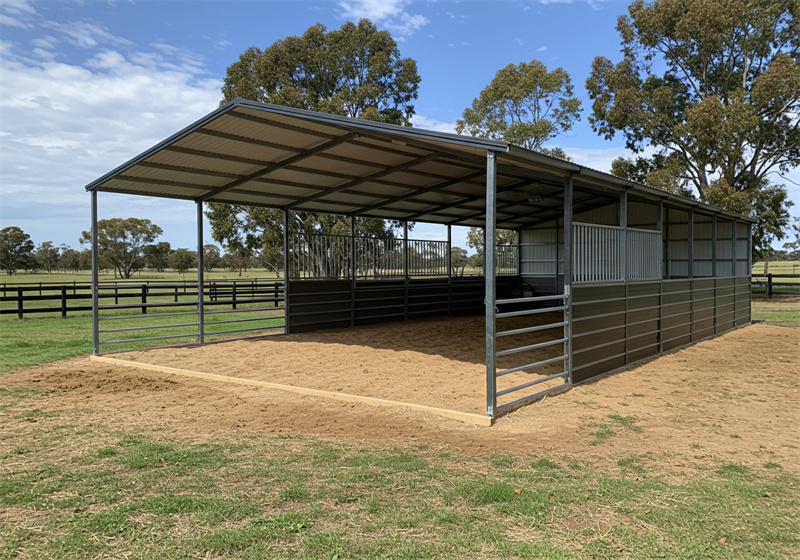
Water and power: three decisions each
Water asks three questions in order. Where does the animal drink — a bowl or feeder can be fitted to a front, and both are published accessories. Does the yard need a new connection, a stand-pipe or a tank — a plumber’s decision rather than yours. And where does the wash water go, the question that most often involves a council: drainage and wash-water disposal are typically regulated in Australian and New Zealand jurisdictions, so confirm current requirements with your local authority or a licensed plumber before siting a wash bay.
Power asks the same shape of question. What needs a cable — light, a pump, a fence energiser, a heater at the wash point. How far the supply runs. Who signs it off, since electrical work in both countries is generally restricted to licensed trades; confirm what applies to your site and keep the certificate with your import paperwork.
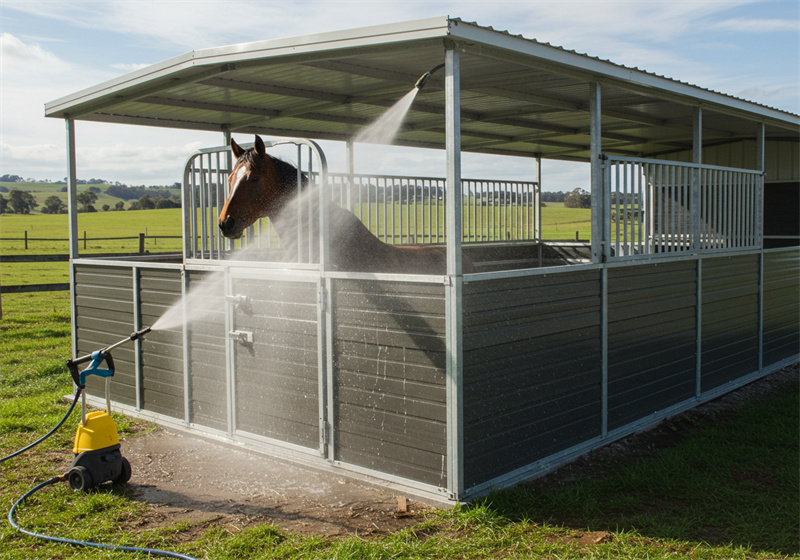
A wash point can work without a built bay, provided the water has somewhere to go. The photograph below shows one arrangement: a nozzle fixed to the barred front of an open shelter, with a pressure washer standing on hard ground nearby. It is a choice rather than a default, and it lands on both lines — the machine needs power where it works, and the water leaves as drainage wherever the ground takes it.
For a plumbed version, siting comes before specification: the wash bay planning guide covers water supply and drainage where the structure is built in.
Turning the site into a comparable number
The table below is the method in five rows. Nothing in the published factory documents covers these lines, which is why they need naming before the deposit.
| Site line | Who quotes it | Fix before comparing |
|---|---|---|
| Aggregate and cartage | Local supplier, often with an earthworks contractor | Measured area, layer depth, delivered-and-spread rate |
| Drainage and fall | Contractor, plus the local authority rules that apply to your site | Outfall position, fall direction, consent triggers |
| Water to the yard | Licensed plumber | Connection type, bowl and wash-point positions, disposal route |
| Power to the yard | Licensed electrician | Light, pump, energiser and wash-point circuit |
| Offload and handling | Hire company or your own labour plan | Panel weight near 200 kg, access path, hours versus fixed price |
Two habits make those quotes comparable. First, divide by bays rather than reading the rounded total: at the 10-set minimum, one site invoice serves at least ten stalls, so per-bay is the figure both a distributor and a yard owner can argue about. Second, give every tenderer the same bay count — the configuration table already fixes panels and gates per row. Getting close to 200 kg panels off a container is its own job, and it is walked through in this guide to unloading and handling on site.
Sequence it in your favour. Bulk production lead time is not published for this category and must be confirmed in writing, but a drawing-based quote comes back inside 24 hours — a day in which three local numbers can already be requested. Our position: have them in hand before the deposit, because the site line is what turns a good product price into an expensive project.
Frequently Asked Questions
Does the factory quote include ground preparation?
No site line appears in the published factory documents, which cover panels, gates, coating and turnaround. Ground, water and power are quoted locally, so they belong in a separate column of your budget rather than hidden inside a delivered number.
Who prices crushed rock for a stable yard?
An aggregate supplier for material and cartage, usually with an earthworks or fencing contractor for spreading, compaction and edge restraint. Ask for a delivered-and-spread rate against a measured area so three quotes mean the same job.
Can a wash bay be added to portable stables later?
The structure is not the obstacle — a wash bay sits in the published accessory list. The water run, the drainage route and any consent for wash-water disposal are what take time, so confirm those with a licensed plumber and your local authority before siting it.
How do I keep site cost per bay comparable between suppliers?
Fix the count before you ask for a price. Bays are published at 3000 mm and 3600 mm, and the configuration table gives panels and gates per row, so every tenderer can be quoted on the same area and the same number of stalls.
Conclusion
A stable import has two price sources and only one of them exports. The factory document says what the panels are made of and how fast a quote comes back; it is silent on rock, water and cable, and that silence is where a yard budget is won or lost.
Write the two columns before the deposit, hand every tenderer the same measured area and bay count, and put the local numbers on the same sheet as the delivered quote.