Portable horse stable costs are the first number an importer, dealer or stable builder puts in a spreadsheet — and often the first that turns out to be wrong. The problem is scope. A six-stall project is not one price: it is a product price, a freight price, a border cost, a tax treatment, a site-preparation line and a contingency. Budgets fail when the ex-works quote is treated as the budget.
This article builds the budget from the bottom up, anchored on DB Stable’s official configuration table: a six-stall back-to-back configuration is 11 side panels and 6 gates, and that bill of materials drives everything downstream. The factory has manufactured portable stables for the Australia and New Zealand market since 2013, and every specification below comes from its published data; commercial variables are marked for confirmation.
Key Takeaways
- A six-stall back-to-back configuration is 11 side panels and 6 gates — the piece count behind product price, freight and handling.
- The 11 side panels weigh roughly 2.2 tonnes (about 200kg each).
- Unit price is not the budget: six cost lines — ex-works, freight, border, GST, site works, contingency — each need a number and a source.
- The MOQ for this line is 10 sets, so a standalone six-stall order needs a direct conversation with the factory.
What a Six-Stall Order Actually Contains
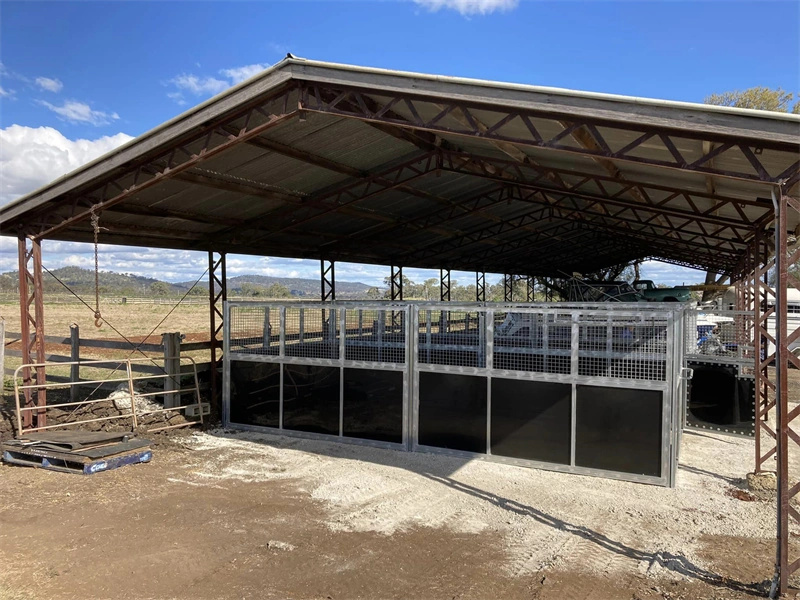
DB Stable’s configuration table lists a six-stall back-to-back row as 11 side panels and 6 gates. Six standalone single stalls would need 18 side panels (6 × 3) and 6 gates. The back-to-back layout builds the shared spine once instead of six times: less weight, less volume on the water. The piece-count logic behind that saving is worked through in our article on freight cost per stall across configurations.
Each side panel is a 2844×1194×10mm HDPE board (a 3494×1194×10mm long panel is also made) in a Q235 frame of 50×50×2.0mm square tube, weighing about 200kg. Frames are hot-dip galvanised — factory specification 42 microns or more, process carried out to AS/NZS 4680. Coating and frame grade are what you are pricing, not a generic “panel”.
The six gates sit in front walls 2200mm high and 1150mm or 1300mm wide. Doors are HDPE boards of 1024×1054×10mm; double swing doors are standard, with sliding (on a 2950mm twin-wheel track) and barn-style doors available. A roof is optional: the raised steel roof stands 2.65m high, runs 4.6m long, and carries a 70cm front eave overhang, with Colorbond sheeting an option. Door type, wall width and the roof decision each change the quote — hence the takeoff below prices against specifications, not a flat “per stall” rate.
The Six Cost Lines of a Six-Stall Budget
A defensible budget separates the lines the factory quotes from the lines other parties control. Blending them into a single “landed price per stall” is how projects end up under-funded.
1. Ex-works product price
The factory’s price for the physical order: 11 side panels, 6 front walls with gates, and the accessories you specify — feeders, water bowls, hay racks, latches, rug rails and wash bays are all optional. DB Stable returns drawing-based quotes within 24 hours, so this line firms up quickly. Incoterms (FOB, CIF) and payment terms belong in the same conversation.
2. Sea freight
Freight is quoted on volume and weight, and the flat-pack design reduces both: panels nest, not ship assembled. A back-to-back six-stall order ships 17 panels and gates rather than the 24 that six singles would require, and at about 200kg per side panel the panel weight alone is roughly 2.2 tonnes versus about 3.6 tonnes for 18 panels. The rate moves with the market and the port pair, so this line is a forwarder quote, not a factory fact.
3. Border charges: duty, customs, quarantine
Import duty, customs entry fees and any biosecurity inspection costs entering Australia or New Zealand depend on the tariff classification and your import setup. These figures are not published here because they are not factory specifications — confirm current rates with your customs broker before the budget locks. This line needs a named broker, a confirmed classification, and a written duty figure.
4. GST treatment
Imported stables attract GST at the border, and how that GST flows through your business — a cost, a credit, or a timing issue on your activity statement — depends on your entity, your registration and how the stables are used or resold. The rules differ between Australia and New Zealand and are covered in our article on the GST treatment of imported horse stables; budget the cash-flow impact with your accountant.
5. Site works and installation
This is the line most often forgotten at quoting stage: the level pad, drainage, and the labour to unload and assemble. Assembly is engineered to be cheap — the corner-pin design needs no tools, and two to three people assemble a stable in about 30 minutes, so a six-stall row is a day’s work on a prepared site. But unloading 2.2 tonnes of panels requires handling equipment. Price the pad and the plant, not just the crew hours.
6. Contingency
A structural budget holds a contingency for confirmed-but-variable items: freight surcharges, port charges, re-handling if dates slip, and accessories added after the first quote. Give it an owner and a release rule.
A Quantity Takeoff You Can Defend
The table below is the quantity takeoff for a six-stall back-to-back project, priced against the factory’s published specifications. The last column names the source of every figure.
| Budget line | Quantity | Specification to price against | Source of the number |
|---|---|---|---|
| Side panels | 11 | 2844×1194×10mm HDPE; Q235 50×50×2.0mm frame; ~200kg each; hot-dip galvanised, factory spec ≥42μm; process to AS/NZS 4680 | Factory config table; written quote |
| Front walls and gates | 6 | 2200mm high; 1150mm or 1300mm wide; HDPE door 1024×1054×10mm; double swing (standard), sliding or barn door | Factory spec; quote per door type |
| Roof (optional) | Per layout | Raised steel roof 2.65m high, 4.6m long, 70cm front eave overhang; Colorbond option | Factory spec; quote |
| Accessories | Per stall, optional | Feeder, water bowl, hay rack, corner post, latch, rug rail, tie ring, wash bay | Options list; quote |
| Sea freight | 17 major pieces, flat-packed | Volume and weight basis; ~2.2 tonnes of side panels alone | Forwarder quote (confirm) |
| Duty, customs, quarantine | Per shipment | Depends on tariff classification and import setup | Customs broker (confirm — no standard figure) |
| GST treatment | Per import | Varies by entity, registration and use of the stables | Your accountant (see our GST article) |
| Site works and install labour | 1 pad; ~30 min per stable | Tool-free corner pins, 2–3 people; unloading plant for ~2.2 tonnes | Factory assembly spec; local rates |
One line deserves emphasis: the MOQ for this product line is 10 sets. A six-stall configuration sits below that threshold, so the first question for a single-site buyer is how the order counts against the minimum — one set or six? Dealers rarely face this; a distributor mixing configurations into a 10-set order absorbs the row easily. Raise it in the first enquiry, answered within six hours.
Where Six-Stall Budgets Actually Fail
Portable horse stable costs rarely blow out on the ex-works price — they blow out on specification drift between quote and order, and on the commercial lines nobody wrote down. A quote priced on the 2844mm panel with the Q235 50×50×2.0mm frame and a hot-dip galvanised coating to the factory’s ≥42μm specification is not the same product as a cheaper panel with a pre-galvanised-plus-powder-coat finish. The factory offers both finishes, so name the finish in the budget document, not just the price.
Freight, duty and GST are the three numbers most often carried forward as round assumptions, and each has a professional whose job is to give you the real figure — a forwarder, a customs broker and an accountant. Get all three in writing before the budget is approved, and the project is being managed, not hoped for.
The Numbers to Confirm with the Factory
A specification-anchored budget ends with a short list of commercial unknowns the factory can close. Before signing anything on a six-stall project, confirm:
- Unit pricing per component: a written quote for 11 side panels, 6 front walls with gates, roof and accessories, priced against the named specification.
- Order counting against MOQ: how a six-stall back-to-back configuration counts against the 10-set minimum.
- Incoterms and payment terms: FOB or CIF, deposit and balance structure — these determine which cost lines the factory quote covers.
- Production and shipping timeline: current lead time, given production runs at up to 20 sets per week; expedited air freight is possible at extra cost.
- Finish confirmation: hot-dip galvanised (factory spec ≥42μm, process to AS/NZS 4680) or pre-galvanised with powder coat — named on the quote, not implied.
- Third-party inspection: third-party QC inspection before dispatch is supported; confirm the reporting and who arranges it.
Hand over drawings or reference images and the full quotation comes back within 24 hours — the product range and process are on the DB Stable manufacturer page.
Frequently Asked Questions
How many panels does a 6-stall back-to-back stable need?
Eleven side panels and six gates, per the factory’s official configuration table. Each panel is a 2844×1194×10mm HDPE board in a Q235 steel frame, weighing about 200kg.
Can I order just six stables when the MOQ is 10 sets?
The minimum order for this line is 10 sets. Dealers typically combine configurations into one order to clear the threshold; a single-site buyer should ask the factory how a six-stall configuration is counted.
Does the roof change the budget much?
It adds a structural line and extra freight volume: a raised steel roof 2.65m high and 4.6m long with a 70cm front eave overhang, Colorbond optional. Price it as a separate quote line — it changes shipping volume as well as product cost.
Conclusion
A six-stall back-to-back project starts from a traceable bill of materials — 11 side panels and 6 gates, about 200kg per panel, in a galvanised Q235 frame with 10mm HDPE infill — and builds outward into six cost lines, each with a named source: the factory datasheet, a written 24-hour quote, a forwarder, a customs broker, your accountant and local rates. The figures that could not be stated here are marked as confirmations — which is what makes the budget defensible.
If you are planning a six-stall order, put your layout and specifications in front of the factory, get the quote in writing, then close the commercial lines one professional at a time. The earlier the piece list is fixed, the fewer surprises survive to the border.