Flat pack panel storage is the unglamorous variable that decides whether stock ordered from China reaches an Australian or New Zealand customer in sellable condition — or as a write-off. DB Stable builds its portable horse stables to ship as flat pack kits because the design reduces shipping volume, but that same design shifts a real responsibility onto the importer: panels and gates may sit in a shed for months before resale or installation, and they need active management while they wait. One stable side panel measures 2844×1194×10mm or 3494×1194×10mm in HDPE and weighs roughly 200kg, so storage decisions here carry weight — literally.
Key takeaways:
- Each side panel weighs about 200kg and runs up to 3494mm long — plan mechanical handling and rack length before stock arrives.
- HDPE infill is UV-resistant, antibacterial, washable and will not rot, but it still needs support across its full width to avoid point-load damage.
- Hot-dip galvanised frames carry a factory coating specification of at least 42μm, with galvanising carried out to AS/NZS 4680 — trapped moisture, not open air, is the main threat in storage.
- Store kits complete: the tool-free corner-pin design means a 2–3 person crew assembles one stable in roughly 30 minutes only if every pin and gate is accounted for.
- With a minimum order of 10 sets, distributors should label kits by configuration and rotate stock first-in, first-out.
What You Are Storing: Panel Construction at a Glance
Storage rules fall out of construction facts, so start with the panels themselves. Each stable side panel pairs a 10mm HDPE infill sheet with a fully welded Q235 steel frame: 50×50×2.0mm square tube for the main frame, 25×25×1.6mm tube in the lower frame, and mesh infill of 4.0mm wire at 50×50mm apertures. The whole assembly weighs about 200kg per panel, and the two standard sizes — 2844mm and 3494mm long — both stand 1194mm high.
| Component | Specification | What It Means for Storage |
|---|---|---|
| Side panel (2 sizes) | 2844×1194×10mm or 3494×1194×10mm | Racks and bearers must span the full 3494mm panel length |
| Panel weight | About 200kg per panel | Forklift or pallet-jack handling; never drag panels |
| Main frame | Q235 steel, 50×50×2.0mm square tube, fully welded | Rest stack weight on frame rails, not on mesh or HDPE faces |
| Lower frame | 25×25×1.6mm square tube | Lighter section — keep it clear of point loads from bearers |
| Mesh infill | 4.0mm wire, 50×50mm apertures | Mesh flexes under load; do not stack cargo against it |
| Panel infill | 10mm HDPE — UV-resistant, antibacterial, washable, will not rot | Washable before storage; no rot risk, but avoid point loading |
| Frame finish | Hot-dip galvanised, factory specification ≥42μm, process to AS/NZS 4680 | Resists open-air exposure; main risk is trapped moisture |
The panel colour options — black, white or green — make no practical difference to storage. The frame geometry and the weight do.
Preparing the Storage Site

Footprint and access
Work the footprint out from the kit configuration, not from the shed you happen to have. A single stable uses 3 side panels and 1 gate; a four-stable run needs 9 panels and 4 gates. At roughly 200kg each, a five-stable order means eleven panels and five gates sitting in one place, and every one of them has to move again on the way out. Design the aisle so a forklift or pallet jack can reach the back of the stack without reshuffling the front — double handling 200kg panels is where edges get chipped and galvanising gets scraped.
Indoor versus outdoor storage
The materials are forgiving, within limits. HDPE infill is UV-resistant and will not rot, and the hot-dip galvanised coating is specified by the factory at 42μm or more, with the galvanising process carried out to AS/NZS 4680 (the joint Australian/New Zealand standard for hot-dip galvanising of structural steel). Short-term outdoor yarding on level ground is workable. For long-term storage, put panels under a roof or at minimum under cover with airflow on all sides — the coating fails from trapped moisture and packed organic matter far sooner than from open weather.
Never store panels directly on bare ground or on grass. Soil holds moisture against the lower frame, and the 25×25×1.6mm lower tube is the lightest section on the panel. Timber bearers laid level, close to the actual ground conditions you have, keep air moving underneath.
Stacking and Handling Panels
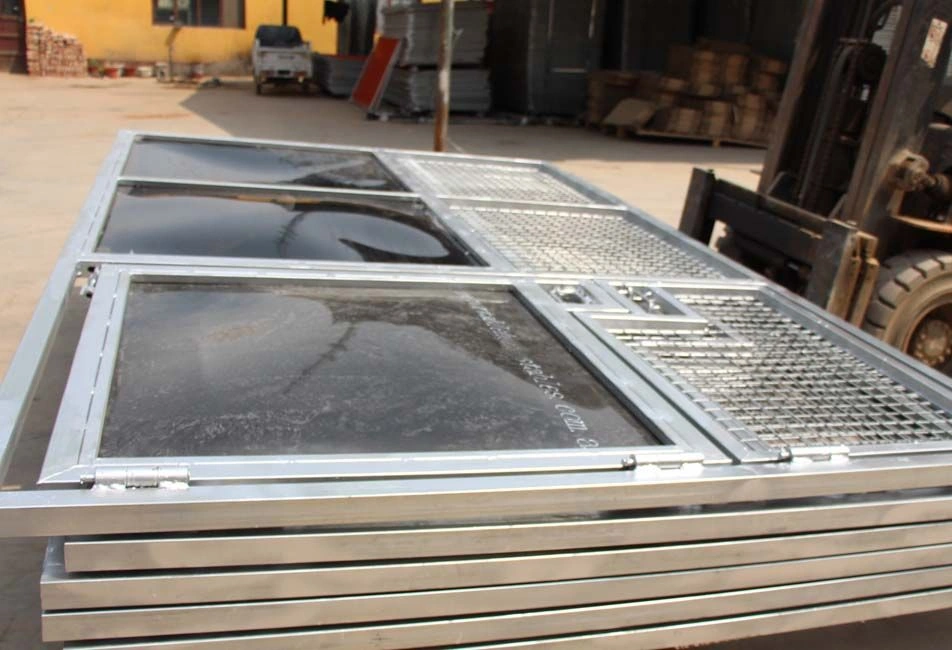
Panels arrive flat-packed by design, and the temptation is to leave them in tall flat stacks. Resist that. Our position on this is blunt: store panels on edge, leaning near-vertical against a rack or wall frame, rather than flat-stacked — a 200kg panel at the bottom of a flat stack bears the full weight of everything above it, and the mesh and HDPE faces are not structural in that direction. On-edge storage takes weight through the 50×50×2.0mm frame rails, which is exactly what they are welded for.
Where flat stacking is unavoidable:
- Lay level timber bearers across the full 2844mm or 3494mm panel length so no panel spans unsupported.
- Align bearers so successive panels bear on the same frame rails, keeping the load in the steel, not the HDPE face.
- Keep faces separated — dunnage or timber between panels stops galvanised frames rubbing HDPE sheets and mesh wire.
- Limit stack height to what one person can safely manage around; a panel pushed off a stack at 200kg is a site incident, not a storage detail.
Handling matters as much as stacking. Lift from the frame, never through the 50×50mm mesh openings — the 4.0mm wire takes a horse’s kick in service, but it is not a lifting point. And keep forklift tines clear of the HDPE sheet; a tine point against 10mm plastic under a 200kg load leaves a permanent witness mark a customer will see at unloading.
Protecting HDPE and Galvanised Surfaces Over Long Periods
HDPE infill
HDPE is close to ideal as a storage material: it is UV-stable, antibacterial, will not rot, shrugs off chewing and biting, and washes clean. If panels come back from a hire yard, a shared facility or a sale display, wash them down before they go into long-term storage. Dried-on organic matter against a panel face in a closed stack is the one condition HDPE does not shrug off well, and a dirty panel in stock is a panel you cannot ship the same week.
Galvanised frames
Hot-dip galvanising protects steel by forming a metallurgically bonded zinc layer — the factory specification is ≥42μm of coating, and the galvanising process is carried out to AS/NZS 4680. That coating does its job in open air. What damages it in storage is moisture that cannot dry: panels wrapped tight in plastic through a humid Australian summer, condensation under tarps pinned flush to the steel, or wet wraps of packaging left in contact with the lower frame. Ventilate instead of sealing. If panels must be wrapped, leave the wrap open at the ends and re-check after any significant weather event.
For panels already erected and then dismantled back into the stock pool, the same inspection rhythm applies — the seasonal checks in our winter maintenance schedule for galvanised stables translate directly to a storage-yard audit: look for coating damage at lifting points, white deposits where moisture sat, and debris packed against the lower frame.
Keeping Kits Complete: Hardware, Labelling and Stock Rotation

The assembly system is the reason kit integrity is a storage issue, not just a paperwork one. DB Stable panels join with a tool-free corner-pin design, and a crew of 2–3 people assembles one stable in roughly 30 minutes — a specification that holds only when every corner pin, gate and frame member is where the kit label says it is. A missing handful of pins turns a 30-minute job into a week-long parts chase, and the customer remembers the week, not the 30 minutes.
Panel counts per configuration are fixed, so kit completeness is auditable at a glance:
| Configuration | Side Panels | Gates |
|---|---|---|
| 1 stable | 3 | 1 |
| 2 stables (adjacent) | 5 | 2 |
| 3 stables | 7 | 3 |
| 4 stables | 9 | 4 |
| 5 stables | 11 | 5 |
| 6 stables (back-to-back) | 11 | 6 |
Orders start at a minimum of 10 sets, so a typical distributor consignment holds multiple kit configurations at once. Label each kit by configuration and customer order at the container, store kits together rather than mixed, and rotate first-in-first-out. Count panels and gates against the table above when stock lands and again when it leaves — it takes minutes and it is the cheapest quality control in the yard.
From Storage to Installation
Stock that stores well installs fast. A labelled, complete kit comes out of the rack, gets lifted by its frame, travels on bearers or a stillage, and reaches the pad ready for the corner pins — at which point 2–3 people have a stable standing in about 30 minutes with no tools in the critical path. If the job site cannot take delivery directly, the planning questions in our article on moving assembled stables without disassembly are worth settling before the truck leaves your yard, because they determine whether panels travel flat-packed or erected.
One last check before panels leave long-term storage: walk the stack, confirm coating condition on the frames, wash anything that came back dirty, and verify kit counts. Five minutes here protects the one claim that matters to a reseller — that stock sold months after arrival still presents like the day the container opened.
Conclusion
Flat pack panel storage succeeds on a handful of disciplines: bearers that span the full panel length, weight carried in the 50×50×2.0mm frame rails instead of the HDPE faces, ventilation instead of sealed wrapping around the ≥42μm galvanised coating, and kit labelling that keeps every corner pin with its stable. None of it is expensive, and all of it preserves what the flat pack design was built to deliver — low shipping volume that converts to a 30-minute assembly at the other end.
If you are planning a stocking order, start from the panel counts in the configuration table and work your yard layout backwards from there. The specifications above are the same ones our factory builds to on every order from Anping, and they are the numbers to hold your storage plan against.