Skip to content
Flat pack horse stables look cheap on the quote sheet right up until a container lands with light galvanizing, cracked boards, and paperwork your customs broker has to untangle at your expense. I’ve watched importers burn a full quarter of margin on claims they never priced in. One bad batch of panels, one vague warranty clause, one late vessel into Melbourne or Auckland, and suddenly your landed cost per stall is fiction and your dealer network is asking why hinges are staining after the first wet season.
What matters is simple. You need to know which SKUs actually turn cleanly in Australia and New Zealand, what coating proof to demand before you approve a PO, whether 10mm UV-resistant HDPE is enough for your market, how roofed and non-roofed kits change container density, where EXW starts to lie to you, and which spare-parts terms stop a minor panel issue from becoming a reputation problem in a regional install. I’m going to be blunt about the trade-offs, because generic “galvanized steel” claims and tidy brochure renders do not protect your margin.
Market Fit
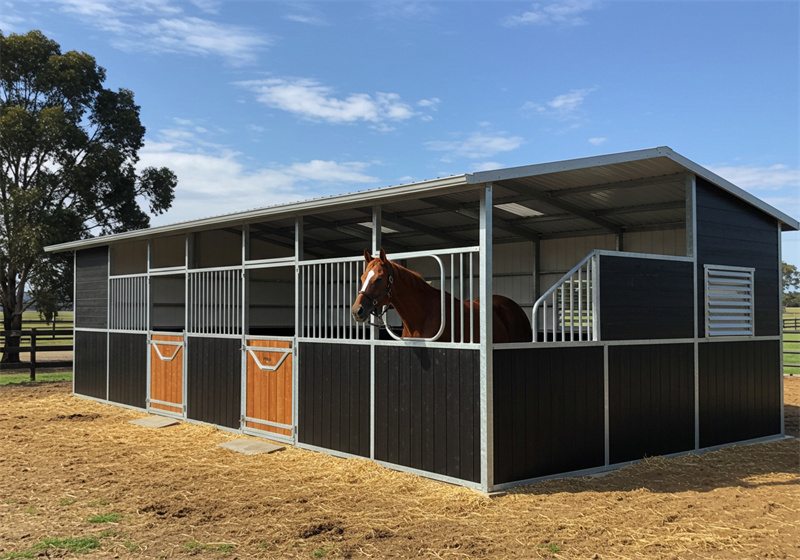
In Australia and New Zealand, flat-pack horse stables fit the market when they lower landed cost per stall, hold up in harsh outdoor conditions, and arrive as resale-ready SKUs.
Why flat-pack fits ANZ demand
The ANZ market is a practical market, not a fantasy market. Buyers want stable systems that can be shipped efficiently, installed without drama, and maintained without turning every service call into a margin leak. That is exactly where flat pack horse stables have an advantage over bulky welded structures.
For import distributors, the real value is freight math. A flat-pack design improves container utilization, reduces the freight burden per stall, and makes SKU planning easier across single, quad, five-bay, and ten-bay configurations. For farms, equestrian facilities, and stable builders, the appeal is different but related: less site fabrication, faster assembly, and easier part replacement later.
In Australia and New Zealand, low maintenance is not a side issue. Coastal exposure, strong UV, and year-round outdoor use punish weak coatings and cheap infill materials. That is why generic “galvanized steel” language is not enough. We recommend verifying hot-dip galvanized steel coating above 42μm and checking that the infill is 10mm UV-resistant HDPE board, because those two details directly affect claims risk and service life.
Why distributors prefer resale-ready SKUs over one-off fabrication
A distributor does not make money from reinventing the product on every order. They make money from repeatable SKUs, predictable gross margin, cleaner forecasting, and fewer post-sale surprises. One-off custom fabrication may sound flexible, but it usually creates quoting delays, inconsistent packing, and higher after-sales complexity.
Resale-ready flat-pack stable kits are easier to standardize for channel sales in Australia and New Zealand. A distributor can build a product ladder around roofed and non-roofed options, common stall formats such as 12×12 and 12×14, and scalable package formats from single stalls to larger conjoined systems. That is far easier to market and support than a stream of custom jobs with different dimensions, parts, and freight profiles.
This is also where supplier discipline matters. DB Stable’s product range is commercially closer to what distributors actually need: portable, export-oriented, modular systems backed by repeatable configurations rather than purely one-off fabrication logic. Since 2013, the business has been positioned around prefabricated portable horse stables for export, which is a better fit for wholesale portable horse stables in Australia than a workshop that mainly builds local bespoke jobs.
What ANZ buyers actually prioritize
ANZ buyers are usually more technical than suppliers expect. They are not just comparing brochure photos. They are stress-testing whether a portable horse stable supplier for Australia and New Zealand can protect reputation after the container lands. Four priorities show up repeatedly in serious buying conversations.
- Corrosion resistance: Buyers want proof, not adjectives. DB Stable states hot-dip galvanized steel coating thickness above 42μm. That is the kind of threshold procurement teams should verify before PO approval, because “galvanized” by itself is too vague.
- UV durability: Infill failure creates visible complaints fast. DB Stable states 10mm UV-resistant HDPE boards are used for panel infill, which is more relevant to ANZ exposure conditions than generic board claims with no thickness or UV detail.
- Container density: For a flat pack horse stables Australia distributor, the unit economics live or die on how many saleable stalls fit into a 40ft container and how cleanly the load is planned. Better loading density means lower landed cost per stall and better resale margin modeling.
- Supplier responsiveness: Fast replies are not just a nice touch. Buyers need quick drawing confirmation, spare-parts clarity, loading plans, Incoterms 2020 alignment, and claim response discipline. One missing answer can delay customs clearance, installation, or the next reorder.
There is also a trust issue underneath all of this. ANZ importers know that weak after-sales handling can damage the local distributor more than the overseas factory. That is why response speed, documentation quality, and spare-parts policy matter almost as much as frame size or panel layout.
Why ex-factory price is not the real buying cost
A low EXW price can still produce an expensive mistake. Serious import buyers in Australia and New Zealand calculate total buying cost, not just factory price. If a supplier wins on quotation headline but loses on freight efficiency, customs paperwork, or assembly support, the margin disappears after arrival.
- Port and inland charges: Terminal fees, local handling, customs clearance, and final delivery can materially change landed cost. This is why EXW versus DDP is not a paperwork detail; it changes who carries cost and coordination risk.
- GST and tax treatment: Australian and New Zealand buyers need the full imported cost base before margin planning. Ignoring GST at quote stage leads to fake profitability.
- Assembly support costs: A cheap kit that arrives with weak instructions, unclear part coding, or poor installer support often creates callouts, rework, and channel friction. For distributors, that cost usually comes out of local staff time.
- Documentation and compliance readiness: NZ biosecurity documentation readiness, packing detail, and customs-facing paperwork are not optional. If documentation is sloppy, delays and extra charges follow.
- Spare parts and claim handling: One cracked board, damaged feeder, or corroded hinge can become expensive if replacement terms are vague. Buyers should ask about spare-parts coverage and response SLA before ordering.
The blunt truth is this: the best market fit for flat pack horse stables in ANZ comes from suppliers that combine export-ready modular SKUs, corrosion and UV credibility, good 40ft container loading discipline, and responsive post-sale support. If those pieces are missing, a low quote is just a low quote. It is not a workable distribution product.

Stable Types
For ANZ buyers, the right stable type is the one that protects resale margin, fits container planning, and keeps warranty risk under control.
The main flat pack horse stable categories are single bay units, back-to-back multi-bay layouts, upper mesh designs, and roofed units. In practice, buyers do not choose between them based on appearance. They choose based on target customer, assembly workload, freight efficiency, and how easily the SKU can be resold in Australia and New Zealand.
At DB Stable, these categories sit on the same core commercial logic: export-oriented flat-pack construction, hot-dip galvanized steel above 42μm, 10mm UV-resistant HDPE board options, and a stated service life around 10 years under that material setup. That matters because many suppliers will simply say “galvanized” and stop there. We recommend checking the coating threshold before PO approval, not after a claims problem lands on your desk.
Main Flat-Pack Product Categories
- Single bay units: Best for entry-level stocking, private owner resale, temporary overflow accommodation, and market testing. They are the easiest format for distributors who want to test local demand without overcommitting container space or cash.
- Back-to-back multi-bay layouts: Built for commercial studs, riding schools, and larger farm projects. These layouts increase order value per customer and give distributors cleaner upsell paths from one-off stalls into site packages.
- Upper mesh designs: Suited to buyers who want more visibility, airflow, and a more open stable front profile. From a resale perspective, upper mesh variants usually appeal to performance-oriented facilities that care about day-to-day horse management, not just basic containment.
- Roofed units: Better matched to buyers who want a more complete portable shelter package in one PO. They carry more assembly steps than non-roofed units, but they also improve ticket value and reduce the need for the customer to source a separate cover solution.
How Buyers Usually Compare These Types
- Use case: Single bays are for small operators and overflow needs. Multi-bay systems are for commercial capacity planning. Upper mesh designs suit facilities that prioritize ventilation and sight lines. Roofed units suit buyers who want a more complete package on delivery.
- Resale appeal: Single bays are the safest broad-market SKU because they fit more end-buyer profiles. Multi-bay layouts have narrower demand but higher project value. Roofed units can lift perceived package value. Upper mesh versions help position the offer above bare-minimum budget stock.
- Assembly complexity: Single bays are the simplest to handle and explain to dealers or installers. Back-to-back multi-bay systems require more planning because alignment, anchoring, and bay sequencing matter more across the full run. Roofed units add another installation layer, so documentation and parts control become more important.
- Target customers: Single bays fit private owners, small breeders, and first-time import test programs. Multi-bay layouts fit riding schools, studs, commercial farms, and builders quoting larger sites. Upper mesh and roofed options often sell better to buyers who care about presentation and operational finish, not just lowest purchase price.
For a flat pack horse stables Australia distributor, the smart range build is usually not “stock everything.” It is choosing one low-risk starter SKU, one commercial multi-bay package, and one upgraded variant that supports better gross margin. That is how you avoid dead stock while still covering the main ANZ demand bands.
Single Bay SKUs
Single bay SKUs are the practical starting point for wholesale portable horse stables in Australia and New Zealand. They are easy to quote, easier to explain to smaller dealers, and less risky for first orders. If you are testing a new channel or region, a single bay format lets you validate demand before you commit to larger conjoined packages.
- Private owner fit: A single bay is the natural resale option for small farms, lifestyle blocks, and owner-operators who need one or two stalls rather than a full yard build.
- Temporary overflow: This SKU works well when customers need extra capacity during seasonal pressure, quarantine separation, or short-term site expansion.
- Pilot orders: For importers, single bays are the cleanest way to test a new supplier, packaging quality, assembly clarity, and claims rate before scaling up.
- Demand testing: If you are unsure which local market will move first, single bay stock gives you faster feedback on pricing, installer response, and reorder velocity.
This is also where flat-pack efficiency matters commercially. Buyers searching for a portable horse stable supplier Australia NZ are not impressed by “easy assembly” alone. They want confidence that the unit can be imported, palletized, supported with spare parts, and resold without margin leakage from freight surprises or avoidable warranty claims.
Multi Bay SKUs
Multi bay SKUs are where average order value starts to move. DB Stable’s commercially relevant formats include 4-bay, 5-bay, and 10-bay conjoined back-to-back layouts. These are not speculative brochure products. They are the formats that fit actual project buying by studs, riding schools, and larger equine operators that need repeatable capacity, not one-off improvisation.
- 4-bay conjoined layouts: A strong mid-range option for smaller commercial facilities or distributors building a project-ready package without jumping straight into large-site volume.
- 5-bay conjoined layouts: Useful when the buyer wants a more complete stable row and better per-project economics. This format often hits a practical balance between site capacity and manageable installation scope.
- 10-bay conjoined layouts: Best suited to commercial studs, riding schools, and large farm developments where procurement is driven by capacity planning, not casual retail demand.
- Upsell potential: Multi-bay jobs create room to add roofed options, feeders, panel upgrades, and spare-parts packages. That is where distributors improve margin beyond the base panel sale.
For the specialist stable builder or project-focused importer, multi-bay layouts also simplify quoting logic. Instead of pricing stall-by-stall, you can package a repeatable system around known material specs: hot-dip galvanized horse stable panels above 42μm, 10mm UV-resistant HDPE infill, and modular bay expansion. That makes procurement discussions more concrete and reduces the usual confusion that comes with loosely defined custom fabrication.
The bottom line is simple. Single bay SKUs help you test markets and service smaller buyers. Multi-bay SKUs help you grow average order value and win commercial projects. Upper mesh and roofed variants then give you room to segment by finish level and price point, which is exactly how a serious flat pack horse stables Australia distributor protects both volume and margin.
| Stable Type | Typical Configuration | Core Specs | Best Fit | Buyer Benefit |
|---|---|---|---|---|
| Single Portable Horse Stable | 1 bay, flat pack kit, roofed or non-roofed option | Hot-dip galvanized steel above 42μm, 10mm UV-resistant HDPE boards, modular panel build, stated lifespan around 10 years | Import distributors testing a starter SKU, small farms, resale into regional Australia and New Zealand | Low-risk entry product with simpler stocking, easier installer support, and clear landed-cost modeling per stall |
| Quadruple Portable Horse Stable with Roof | 4 conjoined bays, roofed package, flat pack export loading | Hot-dip galvanized frame above 42μm, 10mm UV-resistant HDPE infill, modular shared-wall design | Equestrian centers, project resellers, buyers needing a balanced volume SKU for wholesale portable horse stables Australia | Better footprint efficiency than single units, stronger resale appeal, and improved freight allocation across multiple stalls |
| 5-Conjoined Back-to-Back Portable Stables | 5 bays in back-to-back layout, roof optional depending project scope | Portable flat pack system, galvanized steel above 42μm, 10mm UV-stable HDPE panels, modular expansion ready | Stable builders and commercial farms needing mid-scale capacity with fast installation | Good container utilization, lower per-bay structure cost, and practical expansion path for phased site development |
| 10-Conjoined Back-to-Back Portable Stables | 10-bay commercial package, multi-bay portable stable system, export-oriented flat pack | Heavy-duty galvanized framework above 42μm, 10mm UV-resistant HDPE boards, large-format modular layout | High-performance equine facilities, racing operations, and large project tenders in Australia and New Zealand | Best suited to volume projects where freight efficiency, repeatable installation, and lower landed cost per stall drive ROI |
| Full HDPE Portable Horse Stable Panel System | Panel-based stable kit for custom single or multi-bay layouts | 10mm UV-resistant HDPE panel infill with hot-dip galvanized steel structure above 42μm, flat pack shipping format | Distributors and builders prioritizing panel durability, cleaner appearance, and reduced maintenance claims | Stronger resale confidence in UV-heavy climates, easier spare-parts planning, and a more premium spec for margin protection |
Material Specs
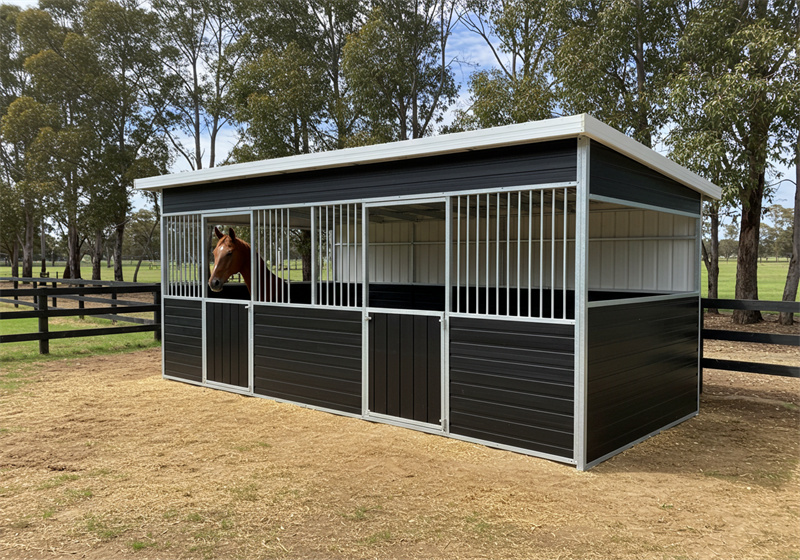
For ANZ resale, the minimum safe baseline is clear: hot-dip galvanized steel above 42μm and 10mm UV-resistant HDPE panels.
The resale baseline is not negotiable
If you are sourcing flat pack horse stables for Australia or New Zealand, generic “galvanized steel” and “plastic boards” are not enough. The practical resale baseline is hot-dip galvanized steel frames with coating thickness above 42μm, plus 10mm UV-resistant HDPE panel infill. That is the threshold that protects margin, not just the initial purchase price.
We see too many listings hide behind broad material claims because buyers do not always push for proof. That is where distributors get hurt later: rust complaints, damaged panels, and ugly warranty discussions with customers who expected commercial-grade stock. For a portable horse stable supplier Australia NZ buyers can rely on, the spec needs to be stated, documented, and repeatable.
What to compare before you approve a supplier
- Corrosion risk: Hot-dip galvanized steel above 42μm gives a more credible long-term corrosion barrier, especially in coastal zones and high-rain parts of Australia and New Zealand.
- Impact resistance: Stable panels take kicks, rubbing, and daily abuse. Frame strength matters, but panel infill quality matters just as much when horses test every weak point.
- Cleaning: HDPE is easier to wash down than timber because it does not trap moisture the same way and does not leave you dealing with flaking surfaces.
- Replacement frequency: Low-spec infill and weak coating usually look cheap only at PO stage. Later, they cost more through spare parts, claims handling, and site call-backs.
This is the real buying question for a flat pack horse stables Australia distributor: which material stack-up keeps claims low for the first 12 months and still looks presentable years later. If the answer is vague, move on.
Why the HDG frame spec matters in ANZ
DB Stable states a hot-dip galvanized steel coating thickness above 42μm for corrosion protection, and that matters more in ANZ than many offshore factories admit. Coastal air, high rainfall, and exposed rural sites will punish weak coatings fast. A frame that looks acceptable in a showroom can become a reputation problem in the field.
Many competitors talk about workshop-welded frames and modular layouts, but they often stop short of publishing the coating threshold buyers should verify. That is not a small omission. For wholesale portable horse stables Australia buyers, coating thickness is a risk-control item tied directly to lifespan, after-sales cost, and your local brand credibility.
DB Stable positions this material setup around an expected 10-year lifespan. That does not mean every site condition is identical, and no serious buyer should pretend otherwise. It does mean the supplier is giving you a measurable corrosion-protection baseline instead of hiding behind marketing language.
Proof you should request before approving a PO
Before you place a bulk order, ask for evidence, not promises. We recommend treating documentation as part of the product. If a supplier cannot show basic proof before deposit, do not expect cleaner paperwork after container loading.
- Coating documentation: Request written confirmation that the hot-dip galvanized steel coating is above 42μm, tied to the exact stable SKU you are buying.
- Weld-finish photos: Ask for clear close-up photos of welded joints after finishing, not distant factory shots that hide surface quality.
- Panel confirmation: Get the panel material and thickness in writing as 10mm UV-resistant HDPE, not a loose description such as “durable board.”
- Batch consistency evidence: For repeat distribution, ask whether the supplier can keep the same frame and infill spec across future orders.
This step is not bureaucracy. It is margin protection. A flat pack horse stables supplier that is serious about distributor business should already expect these questions.
Why 10mm UV-resistant HDPE beats timber for commercial resale
DB Stable uses 10mm UV-resistant HDPE boards for panel infill, and that is the right direction for importers selling into hard-use equine environments. Timber can look familiar, but it brings predictable problems: moisture exposure, edge wear, surface degradation, and a rougher long-term appearance once use gets heavy.
HDPE is lower maintenance than timber because it does not absorb moisture in the same way, and it stands up better to chewing and repeated wash-down routines. It also holds appearance better over time, which matters for equestrian centers, breeders, and project buyers who do not want their yard looking tired after one season.
For buyers searching hdpe horse stable kit import Australia options, this is not about novelty. It is about reducing the number of ugly service calls that start with “the boards don’t look right anymore.”
The commercial payoff for distributors and project buyers
Better material discipline leads to fewer warranty disputes. That is the headline. When the frame coating is verified and the infill is genuinely 10mm UV-resistant HDPE, you reduce early corrosion complaints, cut panel-related replacements, and keep internal staff from wasting time on preventable claims.
There is also a brand effect. Distributors build reputation one delivered project at a time, and they can destroy it just as fast with one bad batch. A stable system that stays presentable and serviceable supports reorder velocity, installer confidence, and cleaner conversations with dealers and end customers.
In plain terms, the right material spec does two jobs at once: it protects the product in the paddock and protects your name in the market. That is why hot dip galvanized horse stable panels 42 micron and 10mm UV-resistant HDPE should be treated as resale-ready requirements, not optional upgrades.
| Feature | Specification | Commercial Benefit | Buyer Verification Point |
|---|---|---|---|
| Frame Material | Hot-dip galvanized steel frame | Built for corrosion resistance in demanding equine and outdoor use | Request galvanizing process details and coating proof before PO approval |
| Galvanizing Thickness | Above 42μm coating thickness | Reduces early rust risk and supports lower warranty-claim exposure | Ask for coating test report or inspection evidence for >42μm |
| Panel Infill | 10mm UV-resistant HDPE boards | Suitable for Australia and New Zealand UV conditions and daily stable wear | Confirm HDPE thickness, UV rating, and replacement-panel availability |
| Thermal Stability | HDPE boards stated not to suffer from thermal expansion | Helps maintain panel fit and appearance across temperature changes | Check supplier warranty wording and field-use references in ANZ markets |
| Expected Service Life | Around 10 years under the stated material setup | Improves lifecycle value for distributors, farms, and commercial operators | Clarify what usage conditions, maintenance, and exclusions apply |
| Structural Baseline | Market comparison commonly uses 50mm x 50mm x 2mm RHS frames | Useful benchmark when comparing DB Stable against local and import alternatives | Match frame dimensions and wall thickness line by line during supplier evaluation |
| Configuration Compatibility | Material system used across single, quad, five-bay, and ten-bay modular layouts | Supports scalable SKU planning with consistent material standards | Confirm the same steel and HDPE specs apply across all configurations ordered |
| Roofed and Non-Roofed Options | Available in both roofed and non-roofed portable stable systems | Lets buyers match project budget, climate exposure, and resale channel needs | Verify if material specs differ between roofed and non-roofed versions |
| Portable Flat-Pack Design | Export-oriented prefabricated structure for flat-pack loading | Improves container efficiency and lowers per-stall freight burden | Request 40ft container loading plan, packing list, and palletization details |
| Accessory Material Option | Rust-free aluminum swivel feeders available | Adds a corrosion-resistant upsell option for premium stable packages | Check accessory material grade, hinge quality, and spare-parts policy |
Size And Layout
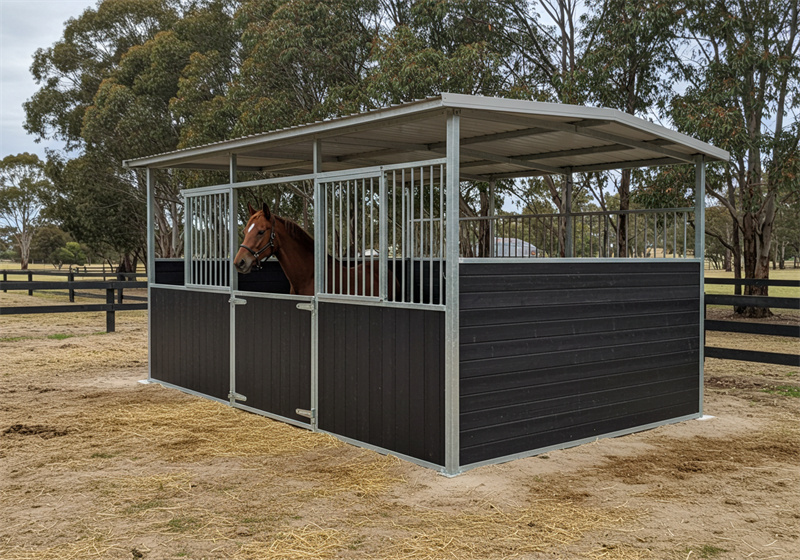
For ANZ resale, 12×12 is the safest baseline, 12×14 covers larger horses, and 10×10 is a niche SKU that needs careful positioning.
Resale guidance based on standard stall-size expectations
If you are building a flat pack horse stables range for Australia or New Zealand, start with what the market already expects. In practical resale terms, 12×12 is the common baseline for average horses, and 12×14 is the safer option for larger animals. That matters because distributors do not win by selling odd sizes that need too much explanation.
We recommend treating size as a margin-protection decision, not just a design choice. A standard footprint is easier for dealers to quote, easier for installers to understand, and easier for end buyers to compare against local alternatives. It also reduces the risk that your imported SKU looks underspecified next to workshop-built options already familiar in the ANZ market.
Use-case positioning for 10×10, 12×12, and 12×14
- 10×10: Best treated as a narrower, budget-sensitive or pony-focused option. Welfare objections can come up quickly if buyers try to use it for average full-size horses. For resellers, this is not the hero SKU; it is a controlled secondary offer that needs clear use-case limits.
- 12×12: The standard commercial baseline for average horses. It gives distributors the broadest resale appeal, fewer buyer objections, and the easiest comparison against common market expectations. If you only stock one core size, this is usually the safest place to start.
- 12×14: Better suited to larger animals or buyers who put more weight on comfort and movement space. It supports a stronger welfare position and gives resellers an easy upsell path. In premium or performance-equine channels, it often looks like the more credible specification.
The commercial point is simple. A 12×12 stall sells with less friction because buyers already see it as normal. A 12×14 stall gives you a premium tier for larger horses without forcing a full redesign of your product line. A 10×10 stall can still have a place, but only when your sales team is disciplined about how it is presented.
Why undersized stalls weaken resale appeal
Undersized stalls create two problems at once. First, they invite welfare objections from informed buyers who do not want to compromise horse comfort or movement. Second, they weaken resale appeal because a dealer has to spend time defending the size instead of closing the order.
That is bad business for a distributor. Every extra explanation increases sales friction, and every disappointed buyer increases the chance of claims, complaints, or local reputation damage. In wholesale portable horse stables Australia channels, the safer play is usually to lead with a size that looks commercially credible from day one.
Expandable layouts support phased purchasing
This is where modular flat pack horse stables make more sense than fixed builds. DB Stable supplies modular single, quad, five-bay, and ten-bay configurations, with roofed and non-roofed options, so buyers can start with a practical layout and expand later. That gives distributors a cleaner product ladder and gives project buyers a realistic path for phased capital spend.
For ANZ resellers, phased purchasing is not a minor feature. It helps customers buy what they need now, then add matching bays as herd size or facility use grows. Because the system is built around portable, flat-pack logic, expansion is operationally simpler than trying to stitch together unrelated structures later.
Why modular bays beat fixed builds when herd size grows
A fixed build can work on day one and still become a headache later. When herd numbers increase, fixed layouts often force redesign, extra site work, and awkward integration with the original structure. That usually means more cost, more delay, and more chance of mismatched specifications.
Modular bays are cleaner from a resale and planning standpoint. You can standardize around proven stall sizes such as 12×12 and 12×14, then extend capacity without reinventing the whole layout. For a portable horse stable supplier Australia NZ buyers can rely on, that is the difference between selling a one-off unit and selling a repeatable system.
| Option | Typical Size | Best Fit | Layout Notes | Buyer Benefit |
|---|---|---|---|---|
| Standard Single Stall | 3.6m x 3.6m (12ft x 12ft) | General riding horses, resale-friendly core SKU for Australia and New Zealand distributors | Market-baseline stall size commonly compared by buyers; easy to standardize across flat pack horse stables ranges | Supports broad demand, simpler container planning, and faster reorder velocity by configuration |
| Larger Single Stall | 3.6m x 4.2m (12ft x 14ft) | Larger horses, premium equine facilities, and buyers wanting more internal movement space | Useful upgrade SKU where operators prioritize horse comfort over maximum stall count | Helps distributors offer a higher-value option with stronger margin potential |
| Single Stall with Roof | Usually based on 3.6m x 3.6m or 3.6m x 4.2m modules | Sites needing faster deployment and weather protection without separate roof procurement | Combines stall and cover in one modular package; suited to flat pack stable kits with roof Australia demand | Reduces sourcing complexity and can improve project close rates for end users |
| Back-to-Back Quad Layout | 4 stalls built from standard modular bays | Small equestrian centers, breeders, and project buyers wanting balanced capacity and footprint efficiency | Compact multi-bay format that uses shared structure efficiently while keeping installation straightforward | Improves land use efficiency and gives distributors a proven mid-volume package SKU |
| Five-Bay Conjoined Layout | 5 connected stalls, typically using standard single-stall modules | Growing farms and commercial operators planning staged expansion | Modular format allows buyers to start with a practical row layout and expand with matching panels later | Supports scalable purchasing without forcing a full custom barn commitment |
| Ten-Bay Back-to-Back Layout | 10 stalls in a higher-density commercial arrangement | Larger equine facilities, training yards, and wholesale project packages | Designed for commercial capacity planning where circulation, feeding access, and labor efficiency matter | Creates stronger per-order revenue and better landed-cost leverage across container loads |
| Roofed Multi-Bay Package | Available across quad, five-bay, and ten-bay modular layouts | Professional operators needing a more complete portable stable supplier Australia NZ solution | Pairs modular stall rows with integrated roof coverage for a cleaner all-in-one specification | Simplifies quoting, reduces on-site coordination risk, and strengthens premium project positioning |
| Non-Roofed Panel System | Configured from standard stall modules to suit site plan | Distributors, builders, and farms that already have an existing shed or barn structure | Flexible for retrofits and custom installs where only internal stable partitions are required | Cuts unnecessary freight volume and helps protect margin on price-sensitive tenders |
| Modular Expansion Layout | Starts from 1 bay and scales to larger linked rows | Buyers testing a new SKU, new market, or phased capital rollout | Panel-based system supports interchangeable expansion if the supplier maintains dimensional consistency | Reduces initial inventory risk while preserving future upsell potential |
| Flat Pack Export Layout | Size depends on chosen stall module and bay count | Importers focused on 40ft container horse stable flat pack loading and landed-cost control | Layout selection should be reviewed alongside palletization, loading plans, and spare-parts allocation | Improves container utilization, lowers freight burden per stall, and supports cleaner resale margin modeling |
Explore Flat-Pack Stable Kits for Australia & New Zealand.
Freight Math
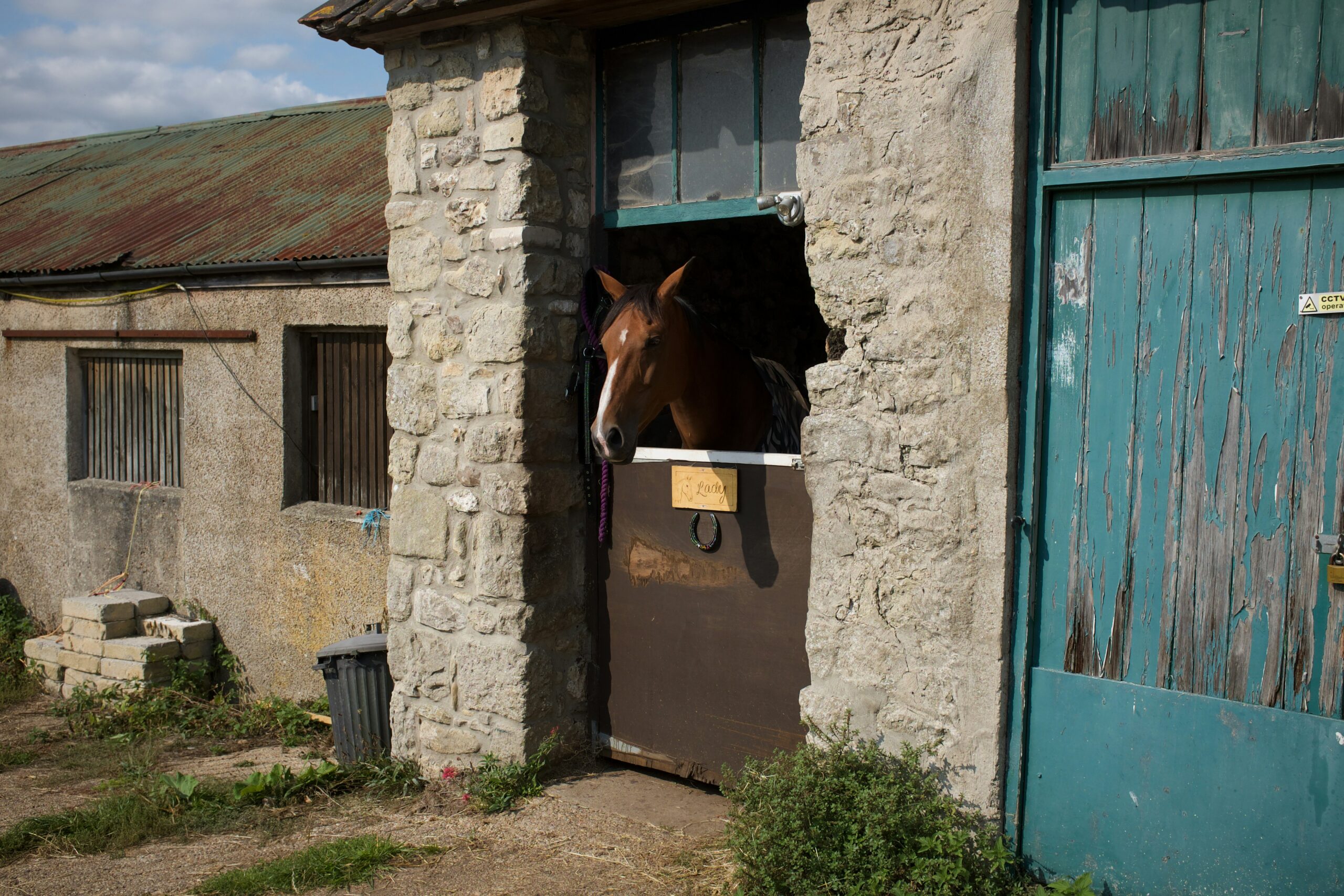
For flat pack horse stables, landed margin is usually won or lost in freight density, Incoterms, and document control, not in the quoted unit price.
If you are buying as an Australia or New Zealand distributor, start with landed cost per saleable bay, not ex-factory price. That is the only number that protects margin. A supplier can look cheap on paper and still cost you more after port charges, customs delays, unloading issues, repacking, and field assembly overruns.
This is where flat pack horse stables earn their place. The commercial advantage is not just easier setup. It is higher loading density in a 40ft container, lower freight burden per bay, and cleaner resale math across single, quad, five-bay, and ten-bay configurations.
Landed-cost analysis for flat-pack stable purchasing
A proper landed-cost model should include factory price, inland China charges if applicable, ocean freight, destination port fees, customs clearance, GST, local delivery, unloading, and contingency for breakage or claims. If you skip any of those lines, your gross margin forecast is fiction. We recommend modeling landed cost both per container and per saleable bay, because that is how distributors actually price stock and protect margin.
- Factory spec risk: Verify the product spec before costing. DB Stable states hot-dip galvanized steel above 42μm and 10mm UV-resistant HDPE boards, with an expected lifespan around 10 years under that material setup.
- Freight burden: Calculate total freight and destination charges divided by total saleable bays, not just by total shipment value.
- Assembly burden: Add labor assumptions for receiving, sorting, staging, and onsite install. Cheap kits become expensive when installers lose hours identifying mixed parts.
- Claims reserve: Hold a realistic reserve for breakage, missing hardware, or replacement panels. One damaged shipment can wipe out the margin on several clean orders.
For an Oceania buyer comparing a local fabricator against a portable horse stable supplier in Australia NZ supply chains, the honest comparison is landed cost plus claims risk plus install friction. That is the procurement view. Anything softer is brochure talk.
EXW vs DDP vs local delivery support
Incoterms 2020 matter because they decide who owns the mess when freight moves from quote to reality. There is no universally best term. The right term depends on whether your team can control export paperwork, ocean booking, customs, and final-mile delivery without creating avoidable leakage.
- EXW: Lowest apparent supplier price, highest buyer workload. You control pickup, export handling, freight, customs, and destination delivery. Good for experienced importers with trusted forwarders. Bad for teams that do not want admin risk.
- DDP: Highest headline convenience, but you need to inspect the quote carefully. Ask exactly what is included, what tax assumptions were used, and who carries the risk if customs values or GST treatment are challenged.
- Local delivery support: Often the most practical middle ground. You import under your own control, but the supplier helps with packing accuracy, booking support, unloading guidance, and final-mile coordination through nominated partners.
For a flat pack horse stables Australia distributor, EXW works when your freight desk is strong. DDP can work when the scope is crystal clear. Local delivery support is usually the safest commercial compromise because it keeps cost visibility with the buyer while reducing operational blind spots.
Freight checklist: port, customs, unloading, and damage control
Most freight losses do not come from one dramatic failure. They come from a stack of small misses that were predictable. The fix is a boring, disciplined checklist used before the container leaves and again before the truck arrives at your yard.
- Port readiness: Confirm arrival port, free storage period, terminal handling charges, and who is responsible for release timing.
- Customs readiness: Check invoice values, tariff coding, country of origin, and GST treatment before vessel arrival, not after.
- Unloading plan: Match forklift capacity, unloading space, labor count, and unloading sequence to the actual pallet and bundle plan.
- Damage control: Photograph container seal, internal loading condition, pallet labels, and any crushed corners before unloading is completed.
- Parts verification: Check panel count, hardware packs, feeder accessories, and roof components against the packing list on day one.
If you are importing hdpe horse stable kit import Australia stock, this checklist is not overkill. It is the difference between a clean receiving process and a claims argument where nobody can prove what happened.
Container planning and flat-pack density
Higher flat-pack density improves landed margin because freight is spread over more saleable bays. That sounds obvious, but many buyers still compare suppliers only by unit price and miss the container math. For 40ft container horse stable flat pack loading, density is a margin lever, not a warehouse detail.
This is why loading plans matter. A well-designed flat pack system can stack panels, frames, and accessories in a sequence that reduces dead space and protects fragile components. Poor packing burns cubic volume, raises damage risk, and leaves you paying ocean freight on air.
- Saleable density: Ask how many complete bays, not loose parts, fit per container under the proposed configuration.
- Configuration effect: Single-bay, quad, five-bay, and ten-bay mixes load differently. Do not assume one packing ratio applies to every SKU.
- Roof impact: Roofed and non-roofed options change bundle dimensions, weight distribution, and unload sequence.
- Margin effect: Better density lowers landed cost per bay and gives the distributor more room for dealer margin, promotional pricing, or claims absorption.
Documents to request before PO
Before issuing a purchase order, ask for the documents that prove the shipment can be loaded, moved, and received without improvisation. If the supplier cannot provide them early, that is a risk signal.
- Loading plan: Show bundle sequence, container layout, and how complete bays are grouped.
- Pallet count: Confirm total pallets, loose bundles, and accessory cartons so the receiving team can reconcile quickly.
- Weight distribution sheet: Needed to plan safe loading, unloading, and forklift handling.
- Packing list: Must map every frame, panel, roof part, and hardware set to a readable package reference.
- Commercial invoice draft: Review product description, quantity, values, and buyer entity details before shipment.
- Biosecurity-related paperwork: For New Zealand and some Australian pathways, confirm packaging and cleanliness records are ready before dispatch.
For portable horse stables NZ biosecurity documents, the smart move is early review. Waiting until the container is on the water is how avoidable holds turn into storage charges.
Hidden cost risks buyers routinely underestimate
Hidden costs are rarely hidden from experienced importers. They are usually ignored because the team wants the quote to work. That is a bad habit. On wholesale portable horse stables Australia programs, these line items deserve hard scrutiny before approval.
- Port storage: Delayed document release or missed pickup windows can trigger storage and demurrage fast.
- Customs exams: Random or targeted inspections create direct cost and indirect delay.
- GST errors: Wrong invoice values or tax treatment can create clearance delays and later accounting corrections.
- Repacking: Mixed bundles or weak palletization can force local labor to sort and rebuild packages before delivery.
- Breakage claims: If damage evidence is poor, the distributor often absorbs the loss while the factory disputes liability.
- Onsite assembly overruns: Missing labels, unclear hardware packs, or poor install logic turn into unplanned labor hours.
This is also where specification discipline matters. Buyers comparing generic galvanized products should not accept vague claims. DB Stable states hot dip galvanized horse stable panels above 42 micron, not just “galvanized steel,” and that level of clarity helps reduce post-sale disputes when customers in UV-heavy, corrosion-prone regions ask hard questions.
Prevention: complete commercial and packing documents supplied early
The cheapest risk control is early paperwork. Not glamorous, but true. When commercial documents and packing documents are supplied early, your forwarder can pre-check customs data, your warehouse can plan unloading, and your sales team can schedule downstream delivery with confidence.
We recommend pushing suppliers to issue draft invoice, draft packing list, loading plan, pallet count, and weight distribution sheets before final balance payment and before vessel departure. That gives your team time to catch description errors, quantity mismatches, and load-sequencing problems while they are still fixable.
For a flat pack horse stables Australia distributor, this is not admin for admin’s sake. It is margin protection. Early, complete documents reduce port delays, customs friction, unloading confusion, and claim disputes. In plain terms, better paperwork means fewer ugly surprises after the container lands.

Compliance Proof
For ANZ resale, paperwork is the proof. If a supplier cannot document materials, import readiness, and warranty terms, the commercial risk becomes yours.
If you are buying flat pack horse stables for Australia or New Zealand, do not rely on polished claims. Reduce trust gaps with documents you can file, forward to customs, hand to installers, and use in a warranty dispute. We recommend checking written proof for the hot-dip galvanized steel coating above 42μm, the 10mm UV-resistant HDPE board specification, installation guidance, spare parts support, and response commitments before PO approval. That is how a portable horse stable supplier Australia NZ buyers can actually resell with confidence instead of gambling on “factory says so.”
Documentation closes the trust gap
In this category, the biggest sourcing mistake is accepting generic wording like “galvanized steel” or “export quality.” Competitors often stop there. Serious distributors should ask for the actual material pack, because coating threshold, board thickness, and claim handling determine whether margin survives the first 12 months.
- Material proof: Request written confirmation that the frame uses hot-dip galvanized steel with coating thickness above 42μm, not vague anti-rust language.
- Panel proof: Confirm 10mm UV-resistant HDPE boards in the panel infill, because “plastic board” is not a specification.
- Lifespan statement: Ask for the stated service-life position under the declared material setup. DB Stable states an expected lifespan of around 10 years.
- Configuration pack: Make sure the supplier can document modular single, quad, five-bay, and ten-bay options, with roofed and non-roofed variants tied to actual SKUs.
That documentation matters even more if you are comparing against market baselines like 50mm x 50mm x 2mm RHS frames and 3.6m square layouts. Buyers are already using those numbers to benchmark offers. If your supplier cannot explain where its specification is equal, better, or different, you are buying blind.
What an ANZ resale compliance pack should include
For a flat pack horse stables Australia distributor, the compliance pack is not a nice extra. It is the file set that protects resale, installer handover, and claims handling. It should be practical, not decorative.
- Material specification sheet: Steel section details, coating statement above 42μm, HDPE board thickness at 10mm, and hardware description.
- Coating details: A clear written note on the galvanization method and the corrosion-protection claim under normal use.
- Installation guidance: Flat-pack assembly instructions, fixing sequence, anchoring guidance, and any limits on intended use.
- Loading and packing information: Palletization method, carton or bundle identification, and 40ft container horse stable flat pack loading plan for import planning.
- Region-aware support: Technical support that understands Australian and New Zealand site conditions, not generic advice copied from another market.
This is where flat-pack design becomes a B2B advantage. The value is not just easier assembly. It is cleaner palletization, better container density, lower freight burden per stall, and fewer surprises when you build resale pricing models.
AU and NZ document readiness
You do not need a supplier to make legal promises they cannot control. You do need them to show they understand what ANZ buyers will ask for. A supplier serving hdpe horse stable kit import Australia and portable horse stables NZ biosecurity documents enquiries should already be prepared for those questions.
- AS/NZS awareness: The supplier should understand that Australian and New Zealand buyers may request documentation aligned with local project, safety, and installation expectations, even when import approval itself is separate from product marketing.
- New Zealand biosecurity readiness: The supplier should be able to provide packing and cleanliness documentation that helps reduce MPI inspection risk, especially for timber-free or contamination-sensitive shipments.
- Pre-clearance paperwork: Commercial invoice, packing list, product description consistency, and any shipping marks should match exactly. Sloppy paperwork causes delays that eat margin fast.
If the supplier cannot discuss pre-clearance paperwork without sounding confused, expect trouble later. That problem usually shows up as delayed customs release, extra broker time, or stock arriving too late for a distributor launch window.
How to test whether a supplier understands ANZ conditions
A capable supplier should understand that local import rules and site conditions are not abstract. They affect packaging, corrosion expectations, install success, and claims rates. Ask direct questions and see whether the answers are specific or evasive.
- Incoterms 2020: Can they explain the operational difference between EXW and DDP for horse stable kit EXW DDP Australia shipments, including who carries inland, customs, and delivery responsibility?
- Container planning: Can they provide a realistic loading plan for a 40ft container and explain how palletization affects freight cost per stall?
- Regional installation: Can they discuss typical site realities such as remote delivery, uneven ground, anchoring expectations, and installer support for regional markets?
- Climate exposure: Can they explain why 10mm UV-resistant HDPE and galvanization above 42μm matter in harsh sun and outdoor use, instead of repeating generic durability language?
- Parts continuity: Can they define how replacement boards, hinges, latches, or feeders are supplied after arrival?
The quality of those answers tells you whether you are dealing with a real portable horse stable supplier Australia NZ buyers can build a program around, or just a factory chasing one container.
Warranty support that actually matters
Warranty language is one of the best filters for wholesale portable horse stables Australia programs. Do not just ask whether a warranty exists. Ask what it covers, under what conditions, and how fast the supplier responds when something goes wrong.
- Structural terms: Get written wording on frame-related warranty support and the exact start point of the warranty period.
- Corrosion coverage: Ask what corrosion protection is covered under normal use and what exclusions apply, especially for coastal or poorly maintained environments.
- Board and hardware scope: Confirm whether HDPE panels, hinges, latches, and feeders are covered separately or under one general statement.
- Spare parts availability: Require a written spare-parts policy for standard SKUs, including whether parts are stocked, made to order, or supplied with the first container.
- Response SLA: Ask for a documented service response commitment for technical questions, claim acknowledgment, and replacement-part confirmation.
This is not administrative detail. One cracked panel or one corrosion complaint can cost far more in staff time and local reputation than the original component cost. After-sales controls are often what separate a scalable supplier from a risky one.
Use after-sales terms to judge scaling risk
Before you commit to a container program, use the after-sales terms as a scaling test. A supplier may look competitive on first landed cost, but if claim handling is slow, parts support is unclear, or installer guidance is weak, your reorder velocity will suffer. That is the real margin leak.
For distributors building a flat pack horse stables Australia distributor model, the right question is simple: can this supplier support repeatable resale without consuming my team? If the answer is backed by material specs, loading plans, NZ biosecurity readiness, installation documents, and written warranty process, you are looking at a viable program. If not, keep walking.

SKU Selection Matrix
For ANZ importers, the first container should go to the SKUs that turn fastest, fit the widest buyer base, and create add-on sales without creating claim risk.
How to read the SKU matrix
The practical question is not which flat pack horse stables look best in a brochure. It is which configuration gives you the cleanest mix of resale speed, assembly simplicity, margin protection, and after-sales control. For Australia and New Zealand, we recommend giving priority to modular kits built around hot-dip galvanized steel above 42μm, 10mm UV-resistant HDPE boards, and flat-pack loading that keeps per-stall freight under control.
We use the matrix below as a buying filter. If a SKU serves only a narrow buyer group, takes too much installer support, or has weak upsell potential, it should not take prime container space in your opening order.
- Portable single-bay stable kit: Best fit for distributors, smaller farm operators, and first-time project buyers. Resale potential is high because it covers the entry price point and suits common 12×12 or 12×14 planning discussions. Assembly effort is relatively low. Upsell paths include extra panels, doors, feeders, and later expansion into multi-bay layouts.
- Single-bay with upper-mesh front or partition option: Best fit for premium buyers and equine facilities that want better airflow and a more open visual finish. Resale potential is solid in metro and premium rural markets. Assembly effort is still manageable. Upsell paths are stronger because buyers often add matching partitions, premium fronts, and rust-free aluminum swivel feeders.
- Quadruple portable horse stable with roof: Best fit for dealers selling into ready-to-operate farm packages and commercial horse owners comparing tax treatment of portable structures. Resale potential is high where buyers want a faster purchase decision and a bundled roofed solution. Assembly effort is medium. Upsell paths include drainage accessories, extra bays, and replacement HDPE infill panels.
- 5-conjoined back-to-back portable stables: Best fit for professional stable builders and commercial farms needing efficient footprint use. Resale potential is medium to high, but the buyer pool is narrower than single-bay kits. Assembly effort is higher because site planning matters more. Upsell paths include end panels, matching walkways, feeders, and future bay extensions.
- 10-conjoined back-to-back portable stables: Best fit for larger equestrian centers and serious farm projects. Resale potential is lower in general dealer stock because the ticket value and project complexity are higher. Assembly effort is high. Upsell potential is good on a per-project basis, but this is not usually the first SKU to allocate container space to unless you already have committed commercial buyers.
Which SKUs deserve container space first
If you are a flat pack horse stables Australia distributor or a portable horse stable supplier serving Australia and New Zealand, first container space should go to the SKUs with the broadest demand curve and the lowest support burden. That usually means one core single-bay unit, one premium-looking upper-mesh version, and one roofed package. Multi-bay back-to-back kits should follow once you have either project demand or installer partners who can handle them cleanly.
- First priority: Single-bay stable kit. It is the easiest SKU to price, explain, palletize, and resell across dealer, farm, and builder channels.
- Second priority: Single-bay upper-mesh option. It gives you a premium step-up without forcing a completely different sales process.
- Third priority: Quadruple roofed package. This helps you sell a higher-value bundled offer and gives sales reps a clear package for commercial enquiries.
- Fourth priority: 5-conjoined back-to-back kit. Add this when you want reach into stable builders and medium-scale farm projects without jumping straight into very large site packages.
- Hold or pre-sell: 10-conjoined back-to-back kit. Strong commercial SKU, but it should usually be tied to forecasted project demand, not speculative stock.
This approach is not about playing safe for the sake of it. It is about protecting reorder velocity. A 40ft container horse stable flat pack loading plan works better when the first shipment is built around SKUs that can move through both retail and project channels instead of sitting as slow-turn inventory.
Best seller mix for a first serious order
The cleanest starter mix is not ten similar products. It is four SKUs with distinct commercial jobs. That gives your sales team a budget offer, a premium upgrade, a scalable project package, and a weather-ready roofed option without bloating stock lines.
- Budget anchor: Portable single-bay stable kit with hot-dip galvanized steel above 42μm and 10mm UV-resistant HDPE boards. This is your volume SKU.
- Premium step-up: Single-bay upper-mesh option. This gives dealers a visible reason to protect margin instead of competing only on price.
- Commercial project SKU: 5-conjoined back-to-back portable stables. This is the bridge into builders, trainers, and medium-scale equine facilities.
- Ready-package seller: Quadruple portable horse stable with roof. This works well for buyers who want a more complete package and shorter decision cycles.
That mix covers most of the real demand spectrum: price-sensitive buyers, presentation-focused buyers, project buyers, and operators who want roofed coverage from day one. It also keeps your quoting process simple enough that staff can respond fast without constant custom engineering.
Starter assortment without inventory bloat
A common importing mistake is filling the first order with too many variations. That creates pricing confusion, fragmented spare parts, and slower claims handling. For wholesale portable horse stables in Australia, the better move is to standardize your opening assortment around shared components so one feeder, one panel type, and one frame logic can support multiple SKUs.
- Budget demand: Keep the base single-bay SKU simple and resale-ready. This is where landed cost discipline matters most.
- Premium demand: Use the upper-mesh variant to widen price laddering without changing the core material story.
- Commercial-farm demand: Use the roofed quadruple and 5-conjoined back-to-back kits to address larger enquiries without committing early to the heaviest project inventory.
- Inventory control: Favor modular parts commonality, spare panel availability, and documented claim support before adding more finishes or custom dimensions.
We recommend treating SKU selection and after-sales control as the same decision. If the supplier can provide consistent flat-pack loading plans, spare-parts coverage, and clear EXW or DDP documentation for ANZ imports, that SKU is more valuable than a cheaper line with vague support. In this category, margin leakage usually starts after the sale, not before it.
Conclusion
I’d buy the flat pack horse stables only if the supplier proves hot-dip galvanizing above 42μm and uses 10mm UV-resistant HDPE, because that is what protects your margin after the container lands. Generic “galvanized steel” claims are where claims start. If a seller can’t show coating proof, spare-parts coverage, and a realistic 10-year material setup, walk away.
Next move: ask for two landed-cost quotes on the same starter mix — one single-bay and one roofed quad — then request the loading plan, galvanizing evidence, panel spec sheet, spare-parts list, and Australia or NZ clearance documents before you approve a PO. Put those side by side and check three numbers first: cost per stall, container fill, and claim risk. That will tell you fast which SKU set you can resell without headaches.
Frequently Asked Questions
What does a 12×12 horse stall cost?
For Australia and New Zealand distributors, a 12×12 flat-pack portable stall kit typically sits in the entry range of about $1,000 to $2,500 per stall for the base unit, depending on frame specification, infill material, and hardware. However, the real commercial calculation should separate the base stall from optional roof systems, swivel feeders, partitions, freight, customs clearance, GST, and local assembly. DB Stable’s distributor approach is especially relevant here because flat-pack packaging improves container efficiency and helps reduce landed cost per SKU. For resale planning, buyers should price the complete installed package rather than the panel set alone.
Is 10×10 enough for a horse stall?
A 10×10 stall is generally considered the lower end for an average horse and may restrict comfort, turning space, and buyer acceptance in professional settings. In the Australia and New Zealand market, 12×12 is the more widely accepted benchmark because it offers better usability, safer movement, and stronger long-term resale value. For distributors building a practical SKU range, 10×10 can work as a budget option for selected applications, but it should not be the core standard for mainstream equine customers. DB Stable is better positioned when 12×12 is presented as the primary commercial size.
Is an 8×8 stall big enough?
In most cases, no—an 8×8 stall is not suitable for an average-sized horse in a serious commercial or equestrian environment. Market guidance consistently points buyers toward 12×12 as the standard working size, with 12×12 to 12×14 being more appropriate for larger animals. For ANZ distributors, offering 8×8 as a horse stall SKU could create customer dissatisfaction and weaken perceived product quality. A stronger strategy is to focus on portable stable formats that meet practical welfare expectations while preserving flat-pack shipping efficiency.
What size stable suits a 16.2 horse?
For a 16.2 horse, 12×12 should be treated as the minimum, while 12×14 is the better target where comfort, turning room, and lying space are important. Larger horses place greater demands on the stall environment, so sizing decisions should support both animal welfare and commercial durability. This is especially relevant for DB Stable’s target buyers, such as equestrian centers, farm owners, and professional stable builders who require practical, long-lasting layouts. In a distributor SKU guide, 12×14 is a strong premium option for larger horses and performance-focused customers in Australia and New Zealand.
How much does an Amish horse barn cost?
Amish horse barn pricing varies widely, with entry shed-style formats starting around $5,000 and full traditional barn builds increasing substantially depending on size, finish, and site work. For Australia and New Zealand import distributors, however, that comparison is less useful than evaluating modular flat-pack stall systems based on unit cost, freight efficiency, and installation speed. DB Stable’s portable model shifts the discussion from custom barn construction to scalable prefabricated stable components that are easier to ship, stock, and resell. In practical B2B terms, the more relevant benchmark is total landed cost per modular stall configuration, not the headline price of a conventional barn.