The mesh vs pipe stable front decision settles three things at once: how much air moves through the stall, how much the horse sees, and what happens when a hoof or a muzzle meets the infill. Both fronts hang in the same Q235 steel frame and both arrive at the same overall dimensions — front walls stand 2200mm high and come 1150mm or 1300mm wide — so the choice is entirely about the infill between the posts. That is worth getting right at order stage, because changing a front later means changing panels.
DB Stable manufactures both options for its Australia and New Zealand export lines, with mesh and pipe (tubular) fronts offered alongside PVC-coated and hardwood finish options. This guide compares them on the criteria buyers actually weigh — airflow, visibility, safety, maintenance — using the factory’s own specification numbers.
Key Takeaways
- Front walls stand 2200mm high in 1150mm or 1300mm widths; both mesh and pipe fronts share that frame, so the infill is the only variable.
- The mesh infill runs 4.0mm wire in a 50×50mm aperture across the panel system — small enough to stop a muzzle or hoof passing through.
- Pipe fronts trade that containment for open airflow and clearer sightlines; the frame tube system includes 50×50mm square, 60×30mm oval and 32mm round sections.
- Doors are independent of the front type: hinged HDPE doors are standard, with sliding and barn-door options on the 2950mm twin-wheel track.
- Both infills sit on hot-dip galvanised Q235 steel, factory specification 42 microns or more, process run to AS/NZS 4680 — corrosion behaviour is identical.
What the Two Fronts Actually Are
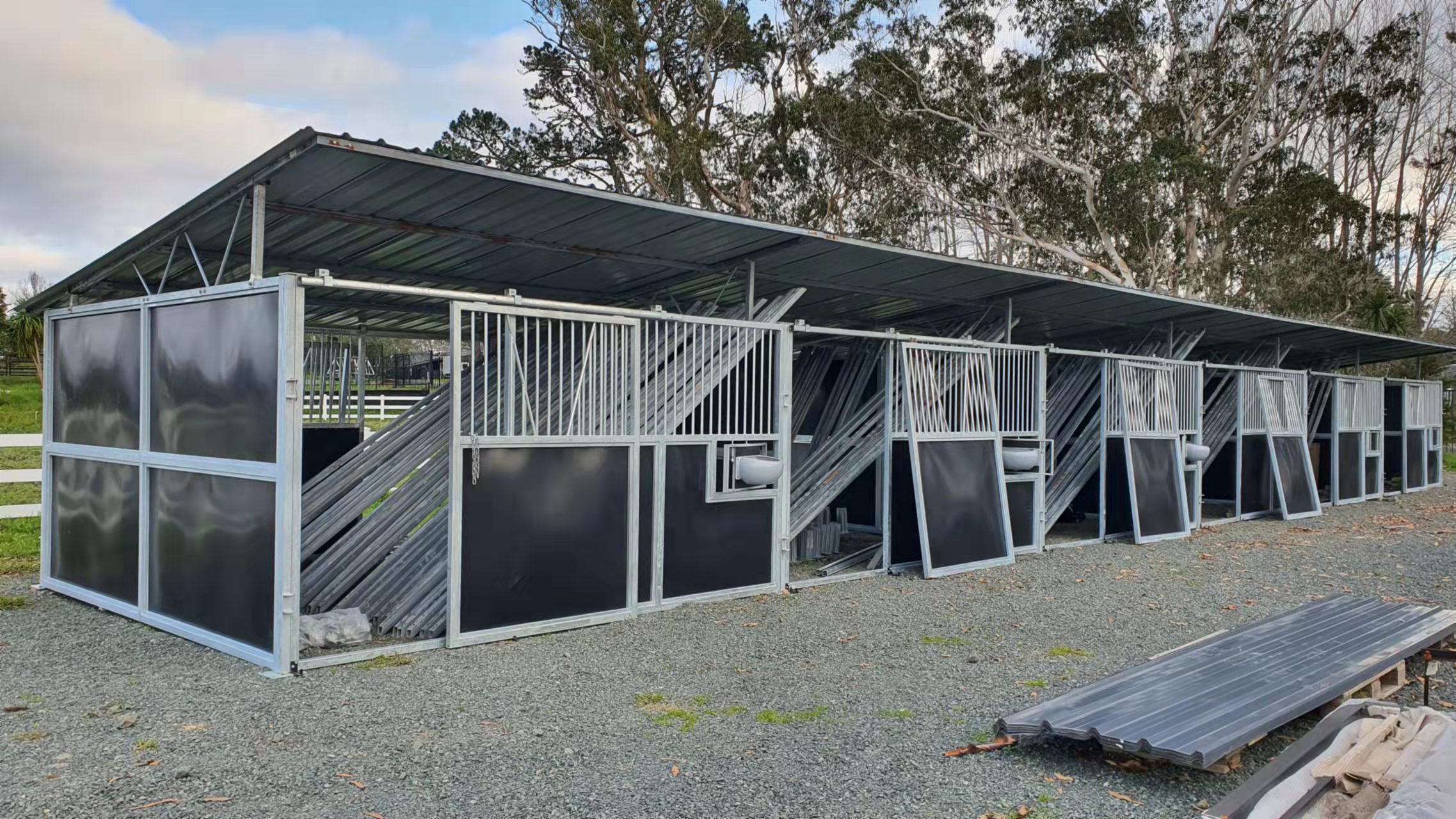
Strip the options back and a stable front is a welded Q235 steel frame with an infill. The frame members are the same sections used through the stable structure: 50×50mm square tube, 60×30mm oval tube and 32mm round tube, fully welded at every joint. A pipe front fills that frame with vertical tube bars. A mesh front fills it with welded wire: across the panel system, the mesh runs 4.0mm wire in a 50×50mm aperture, a grid fine enough to stop a hoof while letting air and light pass.
The finish options apply to both. Hot-dip galvanising is the base, carrying a factory specification of 42 microns or more with the process run to AS/NZS 4680, and the PVC-coated or hardwood finish options layer over it where the yard wants a specific look or extra protection at chew height. The door is specified separately from the infill: the standard hinged door carries an HDPE board at 1024×1054×10mm, and sliding or barn-door alternatives run on a 2950mm twin-wheel track. A mesh-fronted stall can carry a sliding door; a pipe-fronted stall can carry a hinged one. The decisions are independent.
Airflow: How Much Moves Through the Front
A pipe front is the open front. Vertical bars with clear air gaps between them move air almost as freely as no infill at all, which matters in Australian and New Zealand summers and in rows where stables back onto a wall or each other. In a back-to-back configuration — where two rows share a spine and the front is the main ventilation path — the openness of the pipe front does real work.
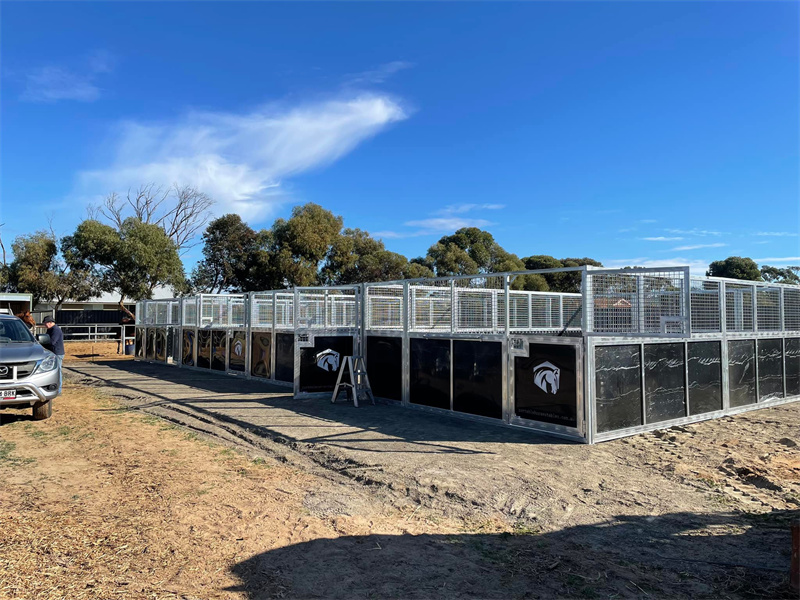
A mesh front slows that exchange down. The 50×50mm grid passes air, but the 4.0mm wire adds surface that breaks the flow, and dust loads on the wire the way it loads on any grid. A 50mm opening still moves far more air than a solid HDPE board. Where a yard pairs a mesh upper with the standard solid lower panels, the stall keeps its low-level shelter and still breathes above it.
The practical rule: if the stable row sits in still air, against a wall or under a roof with limited ridge ventilation, the pipe front’s openness earns its keep. If the row stands exposed and the concern is wind chill on clipped horses rather than heat, mesh’s damping effect on draughts becomes the feature rather than the cost.
Visibility and Horse Behaviour
Horses are herd animals that manage their world through sightlines. A pipe front gives the horse an almost unobstructed view of the aisle and its neighbours — the gaps between bars read as windows, not walls. Mesh reads differently: the horse sees through it, but the grid sits in the view the way a screen sits in a window, and at distance the mesh begins to read as a semi-solid surface.
Visibility runs in two directions. The pipe front lets handlers read the whole horse at a glance — useful in foaling yards and veterinary staging. The mesh front keeps that view for a person standing close, while blocking the nose-to-nose contact that pipe gaps allow. Yards that stable unfamiliar horses side by side treat that blocking as the point; yards that want maximum social contact treat it as a loss.
Safety Trade-Offs at the Front Line
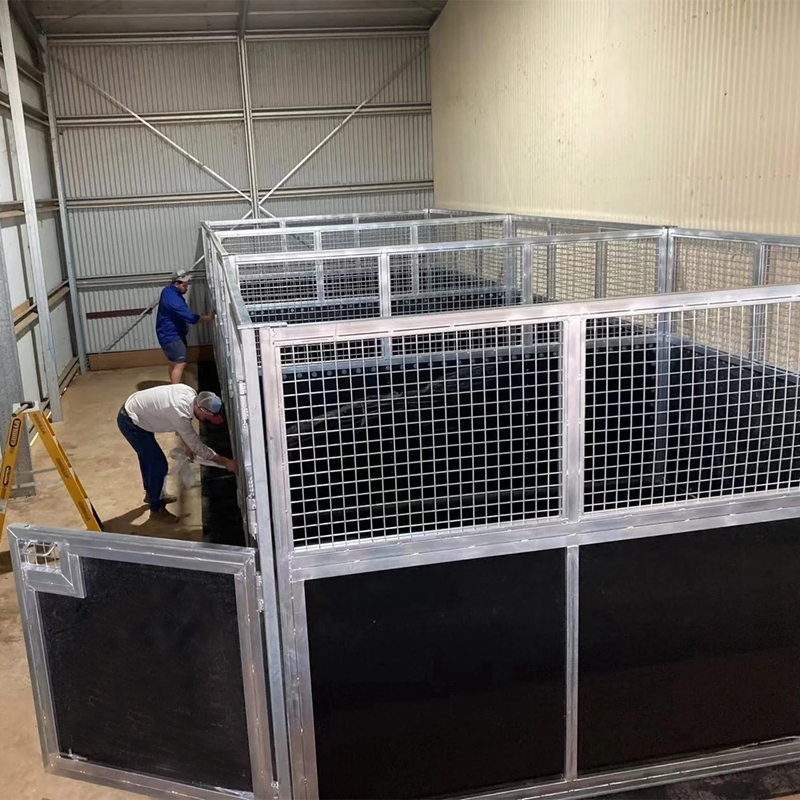
Safety is where the mesh vs pipe stable front question stops being aesthetic. The mesh front’s 50×50mm aperture of 4.0mm wire closes the classic failure modes: a hoof through the front during a kick, a muzzle wedged between bars, a head over the front into the neighbouring stall. The wire’s weld points are structural, and the lower frame section runs 25×25×1.6mm members that stiffen the panel against impact from inside.
The pipe front’s counter-argument is contact mechanics. A round tube presents a smooth, continuous surface with no wire ends and no grid to catch a shoe edge or a halter ring; where a horse does make contact, load spreads along the bar rather than concentrating at a weld point. The risk profile shifts to entrapment: gaps between bars that admit part of a hoof but not the whole hoof are the hazard mesh is designed out. Any yard running pipe fronts should confirm bar spacing against the size and behaviour of its stock.
Our position is blunt: for young stock, stallions and any horse with a track record of kicking or climbing, the mesh front’s containment wins the trade-off on its own. For mature, settled horses in an open yard where airflow and sightlines drive welfare, the pipe front is the better daily environment.
Maintenance and Repair Differences
Both fronts share the same corrosion story: hot-dip galvanising at 42 microns or more, process run to AS/NZS 4680, on the same Q235 frame. The inspection rules are identical — check the welds, treat scratches with zinc-rich paint before weather works on them. The Q235 steel guide on this site covers the frame metallurgy; the weld inspection guide covers what a sound joint looks like before you accept delivery.
Where the fronts diverge is damage behaviour. A bent pipe bar is a single-member repair — straighten or replace the bar and the front is back in service. Damaged mesh is harder to blend: a broken wire is a snag point until it is cut out or the panel section is replaced. Chewing attacks the two infills differently as well: pipe offers nothing to grip at chew height, while mesh gives a persistent chewer a grid to work on.
Choosing the Front for the Horse and the Yard
The comparison compresses into five rows. Read it against your own stock list and site plan.
| Criterion | Mesh front | Pipe front |
|---|---|---|
| Airflow | Good; 4.0mm wire in 50×50mm grid passes air while damping draughts | Best; open gaps between vertical bars move air almost freely |
| Visibility | Clear close-up; grid softens the view at distance | Open sightlines for horse and handler in both directions |
| Containment | 50×50mm aperture stops hooves and muzzles | Depends on bar spacing; check against stock size and behaviour |
| Damage behaviour | Broken wire becomes a snag point until cut out or panel replaced | Bent bar is a single-member repair; smooth surface, no wire ends |
| Corrosion base | Hot-dip galvanised Q235, ≥42 microns, process to AS/NZS 4680 | Identical specification on the same frame system |
Mixed orders are legitimate. A yard can run mesh fronts on the stalls holding young stock or stallions and pipe fronts on the settled geldings along the open aisle, all in the same 2200mm-high frame with the same door options. The configuration table scales across both: a single stable runs 3 panels and 1 gate, and rows extend by adding panels and gates, so a mixed-front row is a stocking decision, not a structural one.
Frequently Asked Questions
Can a horse put a hoof through a mesh front?
The 50×50mm aperture is too small for a hoof to pass through, which is the design’s central safety claim. The 4.0mm wire and its weld points carry impact load, and the 25×25×1.6mm lower frame members stiffen the panel against kicks from inside.
Do pipe fronts suit pony yards?
Only if the bar spacing is checked against a pony’s hoof and muzzle dimensions before ordering. The open airflow and sightlines of a pipe front work well in pony club settings, but containment depends entirely on the gap size, and ponies are exactly the stock most likely to test it.
Does the front type change which door I can order?
No. Hinged doors with the 1024×1054×10mm HDPE board are standard, and sliding or barn doors run on the 2950mm twin-wheel track regardless of whether the front is mesh or pipe. Front type and door type are independent specification choices.
Which front lasts longer in a coastal yard?
The corrosion base is identical — hot-dip galvanising at 42 microns or more, process to AS/NZS 4680, on Q235 steel in both cases. Lifespan differences come from damage, not material: whichever front takes fewer impacts and gets its scratches treated with zinc-rich paint will outlast the other.
Conclusion
Mesh and pipe fronts are two positions on one trade-off. Mesh buys containment — the 50×50mm aperture that keeps hooves and muzzles on their own side of the front — at the cost of some airflow and openness. Pipe buys air and sightlines at the cost of trusting the stock and the bar spacing. The frame, the galvanising and the door options are identical either way, so the decision can be made stall by stall.
When you are ready to put the mix on paper, review the portable horse stable options and specify front types per stall in the drawing — the factory quotes from drawings within 24 hours, and a mixed-front row is a routine order, not a custom exception.