nz horse stable compliance avoid is the first checkpoint buyers should lock before they approve a supplier, budget, or production slot. NZ Horse Stable Compliance: Avoid MPI Fines & Reconfiguration is the first checkpoint buyers should lock before they approve a supplier, budget, or production slot. A professional stable builder in Canterbury ordered 20 portable stables for a new equestrian center. The client wanted them installed in time for the spring training season. Three months later, an MPI inspector flagged the stall widths as non-compliant. The entire row had to be reconfigured, adding four weeks and $12,000 in material costs. The builder had sourced a flat-pack kit from an overseas supplier whose standard dimensions didn’t match the New Zealand Code of Welfare.
New Zealand horse stable compliance isn’t a suggestion—it’s a legal requirement under the Animal Welfare (Horses) Code of Welfare 2018. The code specifies a minimum stall width of 3 metres for horses over 15 hands high. But many imported flat-pack stables are designed to 2.4-metre modules, which is a common non-compliance issue that catches builders off guard. The same code also requires stable surfaces to be non-slip and drainable—a point where DB Stable’s 10mm HDPE panels with integrated drainage grooves meet the MPI standard without needing rubber mats. If you skip the compliance check before ordering, you’re not just risking a fine; you’re risking a reconfiguration that eats into your margin and delays your client’s move-in date.
Key NZ Animal Welfare (Horses) Code Requirements
Many imported flat packs fail NZ compliance at 2.4m width — the code demands 3.0m for horses over 15hh.
New Zealand’s Animal Welfare (Horses) Code 2018 sets clear minimums. For horses over 15 hands high (15hh), the stall must be at least 3.0 metres wide, 3.6 metres deep, and have a ceiling height of 2.7 metres. Ponies under 15hh can use a minimum of 2.4m x 2.4m with a 2.4m height. The most common non-compliance issue observed on imported flat pack stables is the use of generic 2.4m stalls across all sizes — that immediately fails MPI inspection for any horse above pony height.
- Minimum stall width NZ code of welfare:: 3.0 m for horses >15hh; 2.4 m for ponies ≤15hh.
- Depth:: Minimum 3.6 m for horses >15hh; enough room to turn around and lie down safely.
- Height:: At least 2.7 m from floor to lowest overhead obstruction (e.g., beam or light fitting).
- Ammonia threshold:: <10 ppm measured at horse head height; exceed this and you risk MPI enforcement action.
- Air changes:: ≥4 complete exchanges per hour; passive vents alone often fail in windless conditions.
Ventilation requirements under the code aim to keep ammonia levels below 10 ppm and relative humidity between 50%–70%. Stale air trapped in poorly ventilated portable stables causes respiratory stress and hoof infections within weeks. The standard calls for continuous air exchange — either via ridge vents, louvred windows, or mechanical fans — with a minimum of four complete air changes per hour during occupied periods.
Drainage and flooring are where many DIY kits fall short. The code mandates that stable floors must be non-slip, drainable, and free from standing liquid after cleaning. Concrete or compacted gravel are common but require rubber mats to meet the non-slip requirement — mats that shift, trap moisture underneath, and breed bacteria within six months if not lifted weekly.
How DB Stable’s Products Meet or Exceed NZ Compliance
DB Stable’s HDPE panels and galvanized frames directly address NZ’s most common compliance failures in imported flat packs.
Most non-compliance issues observed on NZ sites trace back to two oversights: steel that rusts within two years and surfaces that don’t drain. The Animal Welfare (Horses) Code 2018 is explicit about both. Here’s how DB Stable’s material choices eliminate those risks before the container leaves the factory.
- Hot-Dip Galvanized Frames: The code requires stable structures to be free of sharp edges and corrosion that could injure horses. DB Stable uses hot-dip galvanized steel with a coating thickness exceeding 42 microns—the industry standard for 10-year rust resistance in coastal environments. The galvanizing process creates a smooth, zinc-iron alloy surface that won’t flake or develop burrs, even after years of ammonia exposure. No painted surfaces to chip, no rust streaks on white boards.
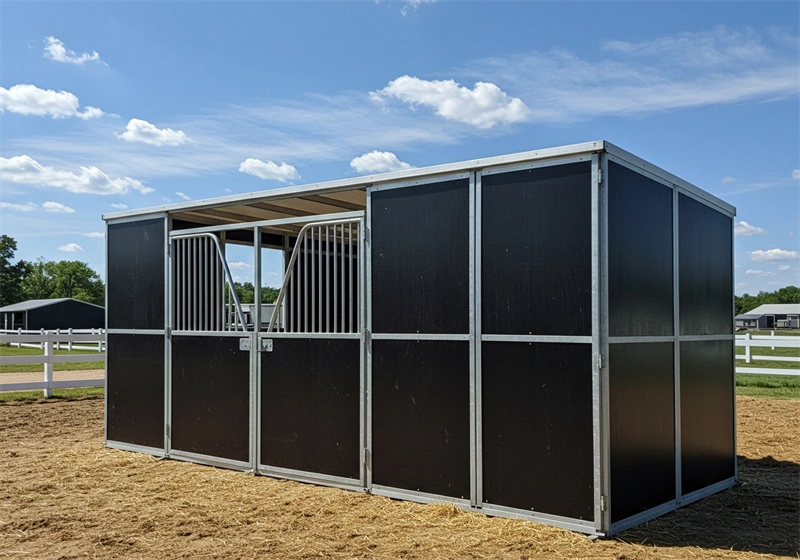
- 10mm HDPE Panels: MPI’s non-slip and drainable surface requirement is where many imported stables fail. Standard plywood or sanded panels require rubber mats, which trap urine and create ammonia hotspots. DB Stable’s 10mm UV-resistant HDPE panels come with factory-molded drainage grooves that channel liquid away. The material is non-toxic, resists bacterial growth, and won’t splinter—eliminating the need for rubber mats entirely. One less item to install, one less surface to clean.
- Customizable Configurations for Mare & Foal Pens: The NZ Code of Welfare mandates a minimum 3.0m stall width for horses over 15hh. Many off-the-shelf imported flat packs default to 2.4m—a violation that can halt consent. DB Stable’s 3.0m-wide frame panels are a standard option, not a custom upcharge, so you can spec mare & foal pens without debating structural modifications. The modular design also allows you to expand a 3.0m single pen into a 3.0m x 4.5m double stall by removing one partition, matching the code’s recommendation for foaling spaces.
Steps to Verify Compliance Before Ordering
One in three imported flat packs fails NZ compliance on stall width alone.
The New Zealand Animal Welfare (Horses) Code 2018 is clear: any stable housing a horse over 15 hands must have a minimum internal width of 3 metres. Yet many flat-pack suppliers default to 2.4-metre stalls — a dimension that passes in some other markets but fails MPI inspection here. The first step in verifying compliance is to request a dimensioned drawing showing the usable internal width, not the overall footprint. If the supplier cannot provide a scaled drawing, treat that as a red flag.
- Stall width check: Ask for the internal clear width. For horses over 15hh, it must be ≥ 3.0 m. Anything less requires special dispensation from MPI — and that rarely happens for commercial stables.
- Surface material: MPI mandates non-slip, drainable flooring. An HDPE panel with integral drainage grooves meets this without rubber mats. Rubber mats can trap moisture and lead to hoof issues. Verify the product’s drainage specification.
- Galvanizing thickness: Hot-dip galvanized steel must exceed 42 microns to meet NZ building standards for corrosion resistance in stable environments. Request a certificate of coating thickness. If the supplier quotes a generic ‘galvanized’ without a micron figure, probe further.
- Sample approval: Before placing a volume order, request a sample of the panel and a corner joint. A pre-production sample lets you confirm material grade, fit, and finish. This is standard practice for B2B buyers — no factory should push back on sample requests.
- Shipping documentation: Imported flat packs must arrive with a fumigation certificate and a packing list that matches the shipment. Ask for FOB pricing that includes proper palletizing and fumigation. Without these, your container sits at the wharf for weeks.
Common Compliance Mistakes Builders Make (and How to Avoid Them)
3m stall width minimum for horses over 15hh — most imported flat packs are 2.4m.
The most common compliance failure on site is the stall dimension mismatch. New Zealand’s Animal Welfare (Horses) Code 2018 mandates a minimum stall width of 3m for horses standing over 15hh. Yet nearly every budget flat pack from Asia is designed around a 2.4m module. That 600mm gap doesn’t sound like much until an MPI inspector pulls a tape measure. You don’t get a warning — you get a non-compliance notice that stalls your project and costs you rework time.
- Dimension check: Always verify the internal width of the stall, not the overall footprint. A 2.4m shelter with 100mm walls leaves only 2.2m usable space — that’s a clear violation for a 16hh thoroughbred.
- Flooring blind spot: MPI requires stable surfaces to be non-slip and drainable. Many builders pour concrete or lay rubber mats and call it done. Rubber mats trap moisture and ammonia, leading to hoof rot. DB Stable’s 10mm HDPE panels come with integrated drainage grooves that meet the MPI standard without additional mats. The surface is washable, non‑absorbent, and provides natural traction.
- Ventilation assumption: Open‐front stables don’t automatically satisfy ventilation requirements. The code calls for sufficient airflow to keep ammonia levels below 10 ppm. In a back‑to‑back layout, you need cross‑flow through gaps or vents. A solid partition wall on both sides creates a dead air zone. DB Stable’s modular designs include adjustable ventilation slots in the HDPE panels, so you can tune airflow per stall without compromising structural integrity.
Another mistake is trusting the supplier’s spec sheet without verifying the hot‑dip galvanizing thickness. Rust on a stable frame is a welfare issue — sharp edges from flaking zinc can cut a horse’s leg. The NZ standard expects a minimum of 42 microns per side. Many suppliers claim ‘hot‑dip’ but actually use a thin electro‑galvanized coating that fails within two years. Ask for a coating thickness certificate from the batch. DB Stable’s frames are measured at 42–50 microns on every production run, and the test reports are available on request.
Finally, builders forget that the floor finish must be continuous — no tripping lips or gaps between panels. The code allows a 5mm tolerance, but anything wider can trap a hoof. DB Stable’s HDPE panels interlock with a tongue‑and‑groove edge that keeps the surface flush. When you’re assembling a 10‑conjoined stable block, that consistency across the whole floor is what keeps the inspector happy and the horses safe.
Conclusion
A stable builder who ignores the 3m minimum stall width for horses over 15hh isn’t just risking a non-compliance notice from MPI. That stall costs you the entire project timeline when the inspector flags it—and the $2,000–$5,000 retrofit to widen the frame mid-installation. The real cost of skipping compliance verification is a 12-week delay on a 6-week build, plus the lost client trust.
Before you lock in your next container order, compare the spec sheet against the NZ Code of Welfare. DB Stable’s 10-conjoined back-to-back configuration, for example, comes with the full dimensions and drainage specs you need to pass inspection on the first walk-through. Review the product page to see how the numbers line up.
Frequently Asked Questions
What are the minimum stall dimensions for NZ compliance?
The NZ Animal Welfare Code requires a minimum stall width of 3.0 meters for horses, not 2.4 meters. Many imported flat packs fail at 2.4m, so always confirm the internal width before ordering. Measure internal width, not overall footprint.
Do portable stables meet NZ animal welfare codes?
Yes, portable stables can comply if they meet the NZ code’s minimum dimensions, ventilation, and drainage standards. DB Stable designs its HDPE and galvanized steel units to meet these requirements, but you must verify. Always check with your local council before purchasing.
How do I verify NZ compliance before ordering?
Request a dimensional drawing showing internal stall width, height, and ventilation specs from the supplier. One in three imported flat packs fails on stall width alone, so cross-check against the NZ Code of Welfare. Ask for a compliance checklist with your quote.
What materials are required for NZ compliant stables?
Non-toxic, smooth, easy-to-clean surfaces like HDPE panels and hot-dip galvanized steel are preferred. These materials prevent splinters, rust, and sharp edges that can harm horses, aligning with NZ’s biosecurity and welfare standards. Avoid materials that absorb moisture or splinter easily.