Paddock water trough placement is the part of a block drawing left to whoever is on site, and it decides how often someone walks a bucket across the yard. On a portable block the decision is harder than on a timber barn, because the building moves and a tap fixed to the ground does not. Water and feed points either travel with the panels or they get remade at every relocation.
Our kits carry the fittings in question: rust-free aluminium swivel feeders, water bowls, hay racks, corner posts and stainless bolts, with tie and rug rails on the same accessory list. Most of the layout is therefore solved on the wall rather than on the ground. What follows is where those points sit in a run of bays.
Key Takeaways
- Mount the drink on the panel, not the paddock. A bowl or feeder fitted through a wall opening travels with the stable; a ground trough has to be re-run at every move.
- The front wall is documented at 2200 mm high, with door openings of 1150 mm or 1300 mm. Keep the gate’s swing side clear of every feed and water point, or the door stops working before the horse does.
- A six-bay back-to-back block is documented as 11 side panels and 6 doors, so shared posts are where aisle traffic, a bowl and a rack compete for the same metre. Settle it on paper.
- Put water in the shade line, on a face you can hose. Our 10 mm HDPE is documented as washable and antibacterial, so a dirty drink point is a yard routine, not a material fault.
- Ask which points are supplied and which are site work: the accessory list names feeders, bowls and racks, while pipe, tap and trough are local installations to price separately.
What the block gives you to work with
Placement starts from documented numbers. Height is 2200 mm, length runs 3000 mm or 3600 mm, and the wall is a 2844×1194×10 mm or 3494×1194×10 mm HDPE board in a 50×50×2.0 mm square tube frame, with 4.0 mm mesh wire at 50×50 mm openings. How mesh and board combine in each bay is settled on the drawing, and the drawing is where a fitting gets its position.
The swivel feeder is the fitting built around the panel opening. It sits in an opening in the panel and turns, so the feed face is out in the aisle and the horse’s head is in. You feed a box without opening a gate, which is the point of the fitting. The fixing detail is in our technical guide to integrating swivel feeders into modular stable systems and the material figures in our aluminium swivel feeder spec sheet. This page is about position, not hardware.
| Point | Where it belongs | Where it fails |
|---|---|---|
| Swivel feeder | Aisle face of the front wall, away from the door swing. | Beside a hinged door that has to open full width. |
| Water bowl | End panel or aisle side, inside the shade line of the roof. | The corner where bedding, mud and hooves collect. |
| Hay rack | Front wall or partition, where chaff can be swept. | Over the turning point of a scraper, where waste turns the aisle to muck. |
| Tie or rug rail | Yard face, clear of the panel edge and the gate line. | A shared corner post already carrying two gates. |
Two of those four end up on a shared post in a long run. That is the placement argument most drawings lose, and it is lost before anyone orders a bolt. What corners carry once two gates and a rail sit on them is the subject of our piece on L-shaped blocks and corner posts.
Three placement rules that survive a move
First, assume the block will move. Every relocation resets drainage, gate swing and the distance to the boundary fence, so a fixed water run is only worth laying where the block will sit again. On leased agistment, wall fittings beat ground fittings: feeders, bowls and racks pack with the panels, and a slab-mounted trough does not.
Second, keep one clear lane. Aisle width is its own subject on this site, covered in our guide to stable aisle width in commercial blocks, and the working rule here is that no feed or water point belongs inside the swept path of a wheelbarrow. A bowl at the end of a run, where the barrow turns, is a bowl sitting in the way of it.
Third, respect the fence line. Horses kick and rub at the panel nearest a boundary, and a drink point placed there is exposed to that damage sooner. Put water and feed on faces the horse can reach with its mouth rather than its hind legs, and leave the outer run of panels to structure instead of services.
Water is the point that fails first
In a summer yard, a trough in full sun is warm water, green growth and more frequent wash-outs. Placement settles more of that than equipment does: inside the shade line of the roof, off the low spot where runoff collects, and on a face you can hose without moving a horse. Our panels are 10 mm HDPE, documented as washable, antibacterial, rot-proof and UV-stable, which is the material argument for putting a drink against a panel rather than against timber. How to clean and disinfect those panels in shared facilities is covered separately.
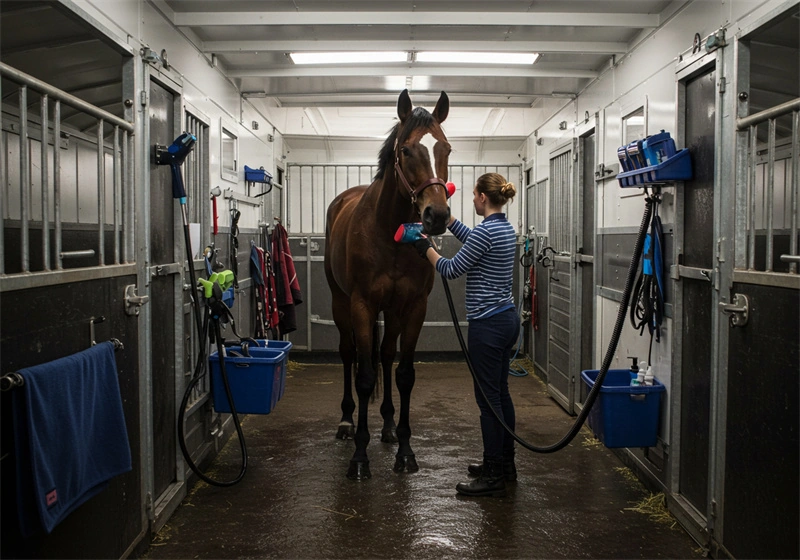
Where nights freeze, the drink point becomes a site plumbing question rather than a catalogue one, and so does supply. Ask what flow the yard delivers at the trough position before choosing a bowl, a trough or an automatic unit. Our guide to automatic waterers for horse stables compares those device types.
Feed: racks, feeders and the bale heap
A hay rack set in the wrong place is dust in the aisle and waste on the floor. It wants to sit where a horse can pull without standing in its own feed, and where chaff can be swept rather than scraped into a corner. That is a front wall or partition position, kept away from the turning point of the barrow. A feeder does the same job better where rations are weighed: the swivel face is measured from the aisle.
Bales need a position too. A round bale stored under an open shelter at the end of a run keeps the stack dry and out of the boxes, one of the reasons a roofed bay earns its place in an order. The water, power and crushed rock lines behind that position are costed in our note on budgeting yard services, and the rodent side of keeping feed is in our feed room design piece.
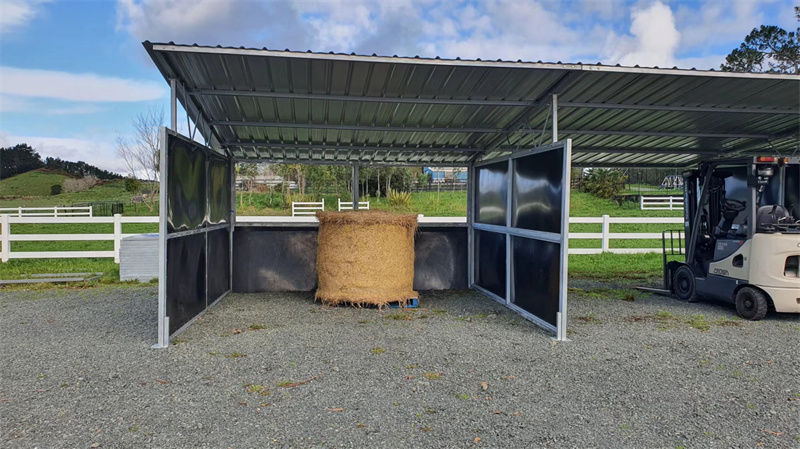
Our position, from a supplier that has built these for AU and NZ yards since 2013: a wall-mounted feed point beats a trough and a loose rack in almost every block that gets moved. Fewer ground fittings to remake, and the ration stays where the person holding the bucket can reach it. Have the positions marked against bay numbers before production. On paper the change is free; on site it is a panel drilled in the wrong place.
Conclusion
Water and feed points are layout, not plumbing. Put them on panels that move with the block, keep them out of the gate swing and barrow path, set the drink in the shade, and leave the boundary faces clear.
Send the bay drawing with feeder, bowl and rack positions marked before production. Two or three people and about 30 minutes assemble a set, and points settled on paper are the ones still working after the block moves.
Frequently Asked Questions
Where should a water trough go next to portable horse stables?
In the shade line of the block, off any low spot where water collects, and clear of the gate swing and the barrow path. On a kit that moves, a bowl mounted through a panel travels with the stable; a ground trough has to be relaid.
Can a water bowl be fitted to a portable stable panel?
The accessory list for these kits names water bowls alongside swivel feeders and hay racks, and the framed panels take fittings. Confirm which items ship with your order and which are left as site plumbing, in writing, before production.
Does every bay need its own feeder?
Not always. A swivel feeder serves one box from the aisle, so the number follows staffing and how rations are measured. A small-staff yard usually wants fewer points, well placed, and one dry stack rather than a fitting in every bay.
How close can feed and water sit to a boundary fence?
Far enough that a horse cannot reach the fitting with its hind legs. Panels facing a fence line take kicks and rubbing, so place drink and feed on fronts the animal can reach with its mouth.