Ordering racing stable equipment from a factory is a list discipline problem before it is a price problem. Thoroughbred trainers and racing yard managers who buy factory-direct rarely win on negotiation — they win because the equipment list was settled before the deposit moved: every front, feeder and latch priced once, in one quote.
DB Stable has built portable stables for Australian and New Zealand buyers since 2013 and quotes from drawings within 24 hours. This checklist is the order that list should follow — boxes first, fronts second, the equipment lines around them third, then the deposit. The point of the sequence is that nothing on it gets discovered after the container is packed.
Key Takeaways
- Count boxes before accessories: the official panel-and-door table runs from 3 panels and 1 door for a single stall to 11 panels and 6 doors for a 6-stall back-to-back block.
- Specify fronts as a system — 2200 mm front walls with 1150 mm or 1300 mm doors, hinged doubles as standard, sliding doors on a 2950 mm dual-wheel track where the aisle is tight.
- The 10 mm HDPE infill boards carry the durability load: UV-resistant, washable, rot-proof and kick-tolerant, in black, white or green.
- Feed and water are catalogue lines, not afterthoughts — the rust-free aluminium swivel feeder, drink bowls, hay racks, rug rails and tie points ride the same container as the boxes.
- Lock the equipment list before the deposit: the factory quotes drawings within 24 hours, and changes after production starts are the expensive kind.
Start With the Box Count, Not the Accessories
The configuration table is the cheapest specification tool in the kit. Panels and doors drive the container maths, the assembly time and the invoice, so fix the box count before anything else:
| Configuration | Side panels | Doors |
|---|---|---|
| 1 stall | 3 | 1 |
| 2 stalls (adjacent) | 5 | 2 |
| 3 stalls | 7 | 3 |
| 4 stalls | 9 | 4 |
| 5 stalls | 11 | 5 |
| 6 stalls (back-to-back) | 11 | 6 |
Box dimensions follow. Standard boxes run 3000 mm or 3600 mm long at 2200 mm high, with 3 m, 3.6 m, 4.0 m and 4.2 m lengths available, and each HDPE panel measures 2844 × 1194 × 10 mm or 3494 × 1194 × 10 mm at about 200 kg — heavy enough that the handling plan is worth writing before the truck arrives, not after.
The table also tells you where the doors land. A single run of adjacent stalls takes one door per stall, while a back-to-back block squeezes six doors out of eleven panels because the layout shares the centre line. Doors are the moving part of the order, so knowing the number before the quote is what stops it drifting. A racing yard counts from horses in work and the training schedule, then rounds to the nearest configuration the table supports.
Fronts, Doors and the Wear Points Worth Specifying First
The front wall is where a busy yard earns or spends its time. Fronts stand 2200 mm with doors at 1150 mm or 1300 mm wide; hinged double doors are standard, with sliding and barn-door styles as options, and the sliding doors ride a 2950 mm dual-wheel track.

Doors and latches are the parts that cycle every day, so they are the first places an upgrade earns its keep. Stainless door latches resist the corrosion that seizes cheaper hardware, and the fully welded Q235 frame — 50 × 50 mm square tube, 60 × 30 mm oval tube or 32 mm round pipe — leaves the front no bolted joints to work loose. Mesh infill is the catalogue standard for fronts, and the 10 mm HDPE lower boards take kicks and chewing without painting or rot; other infill and finish options exist, so confirm what is currently available in the quote.
Infill style solves different problems by row: an open mesh upper opens the sight line and airflow between boxes, while a more solid lower front stands up to horses that lean. Which suits a yard depends on the barn’s ventilation and how the horses use the front, and the choice is made per row, not per property.
That is the one place this checklist holds an opinion: spend the upgrade budget on moving parts before decorative ones. Brass caps and finials are pleasant; a latch that still closes cleanly in year three is better company.
Racing Stable Equipment Lines: Feed, Water and Wash-Down
The accessory catalogue is short, which is exactly why it is easy to under-order. Every line below is a factory item that ships with the container:
| Equipment line | What to specify | What it does |
|---|---|---|
| Swivel feeder | Rust-free aluminium, mounted at the front | Feed served from the aisle side, not the box |
| Drink bowls | Fitted into the front-wall opening | Water at the front, visible at a glance |
| Hay racks | Front-mounted, sized to the box | Forage off the floor and out of the bedding |
| Rug rail and tie points | One set per box | Drying and holding spots where staff work |
| Wash bay | Plumbed wash-down area | Wet work kept out of the row |
The swivel feeder earns its aluminium the boring way: it swings out from the front so it can be filled from the aisle, and the rust-free alloy avoids the flaking that painted finishes can develop in a wet feed area. Rug rails and tie points are the unglamorous lines that keep cooling-out and drying routines moving, and a wash bay plumbed at the end of the row keeps the wet work out of the boxes.
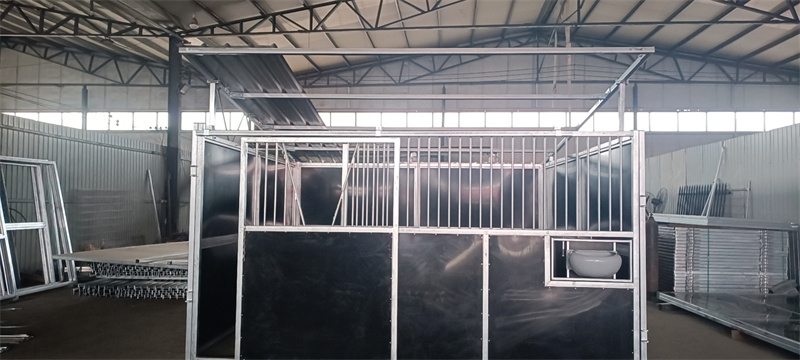
Order quantities against the yard’s routine rather than the catalogue: a feed point per box, water at the front where it can be checked in a walk-down, and wash-down provision sized to how many horses come in at once. Confirm final accessory specifications in the quote — fittings are confirmed against drawings, and the questions worth asking before any money moves are collected in our factory deposit questions guide.
Ordering: From Drawings to Deposit
The ordering path is short: send drawings or reference photos, receive a scheme and quote within 24 hours, pay the deposit, and production and shipping are scheduled. The minimum order is 10 sets, and flat-pack packing is what lets a whole block share one container and drop the freight per stall.
Fix these in the quote, because they are the lines that cost to change later: box count and configuration, panel colour — black, white or green — door style per bay, accessory quantities, and the coating specification. On galvanising, the wording to hold the factory to is a hot-dip coating at the factory spec of 42 microns or above, with the process executed to AS/NZS 4680. Front finish options are easier to swap on paper than on a welded frame — confirm what is available in the quote before the frame is welded.

Ask what the third-party QC inspection covers and which documents travel with the consignment, and budget the assembly while you are at it: panels join on tool-free corner pins, and two or three people can assemble a set in about 30 minutes. What the whole block should cost landed is its own exercise, laid out in our 6-stall budget guide.
Frequently Asked Questions
What is the minimum order for racing stable equipment from the factory?
Portable stables start at 10 sets, which suits a yard building in blocks. Fix accessory quantities in the same quote so everything ships in one container.
How many panels does a 4-stall block need?
Nine side panels and four doors on the official configuration table. A 6-stall back-to-back block takes 11 panels and 6 doors, because the layout shares the centre line.
Can panels be colour-matched to stable branding?
The 10 mm HDPE boards come in black, white or green against the galvanised steel frame. Confirm current colour availability in writing with the quote.
What should I check about galvanising before signing?
Ask for the coating to be written as a factory spec of 42 microns or above, with the process executed to AS/NZS 4680, and keep that line in the order confirmation.
How long does assembly take once the container arrives?
Panels join on tool-free corner pins, and a set goes up in about 30 minutes with two or three people; multi-box rows splice together the same way.
Conclusion
A factory-direct equipment order rewards the same habit that builds a good stable block: count first, specify second, spend last. Boxes from the configuration table, fronts specified as a system, feed and water added deliberately, and the whole list priced in one 24-hour quote before any deposit moves.
When the list is ready, put it in front of the range that builds to it — the portable horse stables page is the starting line, drawings optional but welcome.