verify steel frame quality is the first checkpoint buyers should lock before they approve a supplier, budget, or production slot. Every professional builder knows that verifying steel frame quality starts long before the kit arrives at the job site. When you import flat pack portable barns for the Australian or New Zealand markets, you are betting your reputation on a few critical engineering details hidden inside cardboard boxes.
Most generic suppliers will show you polished photos of finished stables, but the real failure points live in the welds and the zinc coating. Skipping the post-fabrication hot-dip galvanization step might save fifteen percent upfront, but it increases long-term corrosion liability by forty-six percent in high-ammonia environments. That is a margin-killer you cannot afford.
True quality requires demanding physical proof of the coating density and wall thickness. You need to see the laser-etched batch IDs that turn assembly from a guessing game into a precise, thirty-percent faster operation. These are the specific metrics that separate a durable asset from a warranty claim waiting to happen.

Why Generic Stable Frames Fail Early
Skipping post-fabrication galvanization saves ~15% upfront but increases corrosion liability by 46% in high-ammonia environments.
Most stable builders receive flat-pack kits with visible cosmetic finishes but hidden structural flaws. The primary failure point is the weld joint. When manufacturers use pre-galvanized steel and then weld the frame, they burn off the protective zinc layer at the seams.
Without a post-weld repair or full re-galvanization, these joints become the entry point for moisture and ammonia, leading to rust within the first year. For builders in Australia and New Zealand, this results in costly callbacks and damaged reputations. Understanding the difference between pre-galvanized and hot-dip galvanized after fabrication is the first step in avoiding these hidden defects.
- Weld Burn Risk: Competitors often sell pre-galvanized tubes welded together, leaving the zinc layer burned off at the seams. This causes rust to start at the welds within 12 months. True quality requires hot-dip galvanization the entire frame is welded to seal these joints.
- Ammonia Corrosion Factor: Standard galvanized coatings fail faster in stable environments due to ammonia in urine. The 42-micron threshold is specifically calculated to resist this chemical attack for a 10-year lifespan, a detail often omitted by generic suppliers.
- Labeling as Engineering: High-quality flat packs use laser-etched batch IDs on every tube. This isn’t just for aesthetics; it ensures the builder can assemble the frame in minutes rather than hours, directly impacting labor costs.

Real Cost Breakdown: Steel Grades and Coating Thickness
Demand ISO 1461 certification and 42-micron coating reports to prevent ammonia-induced rust callbacks.
Most stable builders receive flat-pack kits with visible cosmetic finishes but hidden structural flaws. The primary failure point is the weld joint. When manufacturers use pre-galvanized steel and then weld the frame, they burn off the protective zinc layer at the seams. Without a post-weld repair or full re-galvanization, these joints become the entry point for moisture and ammonia, leading to rust within the first year.
For builders in Australia and New Zealand, this results in costly callbacks and damaged reputations. Understanding the difference between pre-galvanized and hot-dip galvanized after fabrication is the first step in avoiding these hidden defects. True quality requires hot-dip galvanization after the entire frame is welded to seal these weak points.
- Steel Grade: Q235B (ASTM A36 equivalent) is the minimum standard for structural integrity. Lower-grade alternatives lack the necessary tensile strength to withstand horse kicks and environmental stress.
- Zinc Coating: ISO 1461 mandates a minimum average of 42.7 microns for heavy-duty applications. Frames falling below 42 microns fail salt-spray tests prematurely, especially in high-ammonia equestrian environments.
- Tube Thickness: 14-Gauge (2.0mm) minimum wall thickness is required to prevent kick-throughs. Thinner tubes compromise structural integrity and increase the risk of frame deformation during assembly or use.
- Verification: Demand a magnetic gauge report and a certificate of origin for every batch. Visual inspection alone is insufficient; you need physical proof of the coating density and wall thickness.
| Parameter | Value / Specification | Advantage |
|---|---|---|
| Material Grade | Q235B Structural Steel | Ensures structural integrity and impact resistance against horse kicks |
| Specification | ASTM A36 Equivalent | |
| Zinc Coating Thickness | Minimum 42.7 Microns | ISO 1461 compliant; resists ammonia corrosion for a 10-year lifespan |
| Galvanization Process | Hot-Dip After Fabrication | Seals weld joints to prevent rust; superior to pre-galvanized alternatives |
| Tube Wall Thickness | 14-Gauge (2.0mm) | Prevents structural failure and kick-throughs in high-traffic stables |
| Quality Verification | Magnetic Gauge & MTC | Provides physical proof of coating density and steel grade compliance |
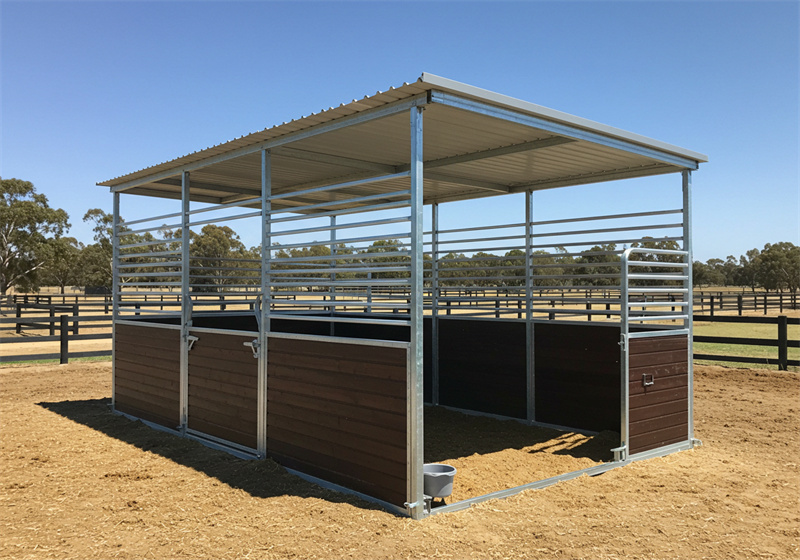
The Assembly Gap: Tolerances and Labeling
Precision labeling isn’t just logistics; it is the primary engineering control for assembly labor costs.
The most frequent cause of on-site assembly failure in portable stables is not shipping damage, but design and labeling incompetence. When a professional builder receives a flat-pack kit with unordered boxes and vague packing lists, skilled laborers are forced to measure, cut, and force-fit components. This creates a cycle of wasted labor hours, structural misalignment, and potential warranty claims that destroy project margins.
High-quality OEM manufacturers solve this by treating labeling as an engineering function. Every tube and panel is assigned a laser-etched batch ID that corresponds directly to the assembly sequence. This allows for rapid, error-free installation, reducing on-site labor hours by up to 30% compared to generic suppliers who rely on manual sorting.
- Precision CNC Cutting: Components are cut to exact flat pack horse stable assembly tolerances, ensuring that frames align perfectly without the need for on-site modification or welding.
- Laser-Etched Batch IDs: Unlike printed stickers that rub off during transit, laser-etched IDs on every tube ensure builders can identify parts instantly, regardless of packaging wear.
- Sequential Packing Lists: Generic suppliers provide unordered boxes; OEMs provide packing lists that match the installation sequence, preventing on-site delays and confusion.
- Labor Cost Impact: Proper labeling reduces assembly time by up to 30%, directly impacting the profitability of custom horse stable installation projects in New Zealand and Australia.

How to Audit Your Supplier Before Shipping
Demand a live video audit of the hot-dip tank and an ISO 1461 zinc thickness report before signing any PO.
Emailing a supplier for a spec sheet is no longer sufficient for vetting industrial-grade stable components. Trading companies can easily fabricate documents, but they cannot fake a live production environment. A direct OEM partnership requires visual and physical proof that the manufacturing process aligns with your technical requirements.
The most effective verification method is a live video audit of the factory floor. You must specifically request to see the raw steel inventory and the hot-dip galvanizing tank in operation. This allows you to verify that the steel is being galvanized the entire frame is welded. If a supplier refuses a live call, they are likely a middleman or a low-quality workshop lacking the necessary infrastructure.
Documentation is the next critical checkpoint. You must request a third-party inspection report that explicitly details the zinc coating thickness and the specific steel grade used. Visual inspection of a polished photo is completely insufficient for verifying structural integrity. You need physical proof of the coating density and wall thickness to ensure the frame can withstand the high-ammonia environment of a horse stable.
- Live Video Audit: Verify the hot-dip tank is active and that the entire welded frame is being submerged, not just pre-galvanized tubes.
- ISO 1461 Report: A third-party inspection report confirming the zinc coating thickness meets the minimum 42-micron threshold for corrosion resistance.
- Steel Grade Cert: Mill Test Certificates (MTC) proving the use of Q235B structural steel, rather than cheaper, weaker alternatives.
- Magnetic Gauge Data: Physical readings of the zinc coating thickness taken at multiple points on the frame to ensure uniform coverage.
To filter out unreliable vendors, watch for specific red flags during your due diligence. If a supplier provides vague answers regarding steel grades or refuses to specify Q235B, they are likely hiding substandard materials. Similarly, a portfolio consisting only of finished, polished photos with no factory footage is a major warning sign. These are classic indicators of a trading company masking a low-quality supply chain. Insisting on these specific proofs ensures you are partnering with a direct OEM that stands behind their engineering.
Conclusion
Verifying steel frame quality requires strict adherence to ISO 1461 standards: Q235B structural steel, 14-gauge (2.0mm) wall thickness, and a minimum 42-micron hot-dip galvanized coating applied after fabrication. These specifications eliminate the ‘weld burn’ vulnerability that causes premature rust in high-ammonia stable environments, ensuring zero warranty claims and reduced labor hours through laser-etched assembly labeling.
Frequently Asked Questions
How to check the steel quality?
Verify the frame uses Q235B structural steel with a post-fabrication hot-dip galvanized coating exceeding 42 microns. Request ISO 1461 certification to ensure the zinc layer seals weld joints against ammonia corrosion. Request ISO 1461 certification to validate coating thickness and process.
What is low quality steel?
Low quality steel typically relies on pre-galvanized tubes welded without post-treatment, leaving joints exposed to rust. This approach sacrifices long-term durability for lower upfront costs, increasing liability in harsh environments. Avoid pre-galvanized frames with untreated weld joints to prevent early failure.
How to identify a steel frame house?
Identify quality frames by checking for hot-dip galvanization after assembly and consistent wall thickness, typically 2.0mm. Look for precision labeling and flat-pack designs that indicate engineered tolerances for easy installation. Check for post-assembly galvanization and precision labeling for reliable identification.
What are the 4 classes of steel?
Steel classes generally refer to yield strength grades like Q235B, Q345, S235, and S355 used in construction. For portable stables, Q235B is standard due to its balance of strength and. Stick to Q235B for optimal balance of strength and weldability in stables.
How to tell if steel is good quality?
Good quality steel shows uniform coating thickness, smooth welds, and no signs of pre-weld galvanization burns. It meets specific structural grades like Q235B and undergoes rigorous post-fabrication hot-dip processes. Inspect for uniform coating and smooth welds to ensure structural integrity.