HDPE panels vs timber stability — that comparison hits every equestrian center owner’s desk when they’re planning a new stable block or replacing tired stalls. In AU/NZ climates, the question isn’t just about material preference; it’s about whether the structure will hold up against constant UV, coastal humidity, and the ammonia load from high-value thoroughbreds. Timber has been the default for decades, but the failure pattern is well known: moisture absorption leads to 15-20% dimensional changes, warping doors, and creating gaps that compromise both horse safety and the building envelope. That’s the everyday reality that drives operators to look harder at alternatives.
The core difference comes down to how each material handles moisture and temperature swings. Standard timber, even pressure-treated, will swell and shrink with every weather cycle, and in a stable environment it rots from the inside out within 3-5 years. 10mm UV-resistant HDPE panels, on the other hand, stay dimensionally stable because the polymer structure doesn’t absorb water. That means no annual sealing, no splintering from kick-throughs, and no bacterial growth in the porous wood grain that traps ammonia. Pair that with a hot-dip galvanized steel frame (over 42 microns) that resists rust in coastal salt air, and you’ve got a system that can run 15-20 years with minimal maintenance. That’s the engineering logic that shifts the total cost equation, even if the upfront tag is higher.
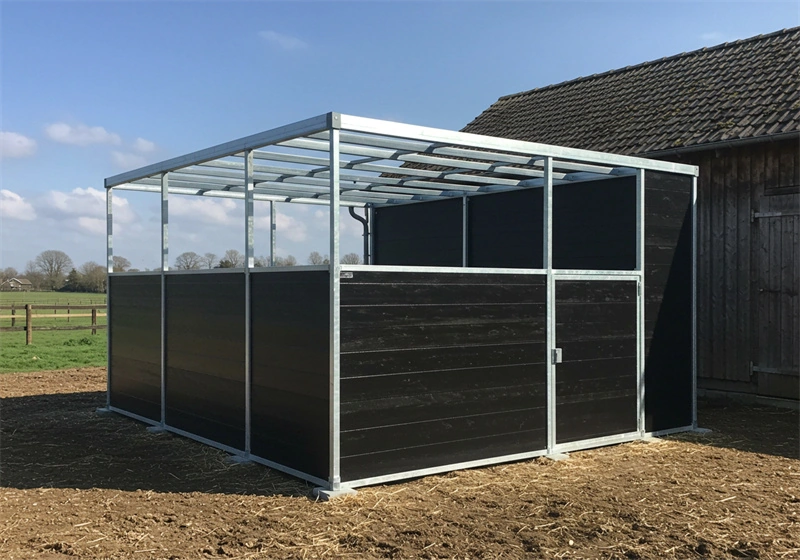
HDPE Dimensional Stability vs Timber Warping
Timber swells and shrinks 15–20% in humidity; 10mm HDPE stays dimensionally stable within 0.1%.
In the fluctuating climates of Australia and New Zealand, timber panels absorb moisture and swell during wet periods, then dry out and shrink under harsh sun. This constant dimensional cycling — up to 15–20% movement — warps stable frames, jams sliding doors, and creates dangerous gaps that can trap horse hooves. Standard untreated timber in a high-ammonia stable environment begins to rot from within within 3–5 years, forcing expensive panel replacements and risking thoroughbred injuries from splintering kick-throughs. The hidden cost goes beyond materials: warped timber requires on-site trimming and shimming during every flat-pack assembly, adding hours of labor and compromising the kit’s precision fit.
- 10mm UV-Resistant HDPE Panels: Engineered with a closed molecular structure that absorbs less than 0.1% moisture. They do not swell, shrink, or twist under temperature swings from frost to 50°C. Each panel arrives pre-cut to exact dimensions — no field adjustment needed, which cuts installation time for contractors and ensures consistent alignment for the life of the stable.
- Frame–Panel Synergy: HDPE stability delivers its full benefit only when paired with a non-corroding frame. In coastal AU/NZ environments, hot-dip galvanized steel (over 42 microns) resists rust for 10+ years, while painted steel or timber frames would still expand and compromise the panel fit. The complete system — HDG frame + 10mm HDPE — eliminates the two failure modes that plague timber stables: rotting panels and warped framing.
For equestrian center owners managing high-value thoroughbreds, this dimensional stability translates directly into safety and TCO. No annual sealing, no splinter inspections, no pre-emptive panel swapping. The 10mm UV-resistant HDPE panels retain their shape and impact resistance for 15–20 years, and because they are non-porous, they do not absorb ammonia or bacteria — a hygiene advantage that timber can never match.
| Property | HDPE (10mm UV-resistant) | Standard Timber | Benefit |
|---|---|---|---|
| Dimensional Stability | Minimal expansion/contraction (<1%) in AU/NZ heat | 15-20% moisture-induced swelling/shrinkage cycles | HDPE maintains door alignment and structural integrity |
| Moisture & Rot Resistance | Non-porous, 100% waterproof – zero rot | Absorbs moisture – rots within 3-5 years | Eliminates ammonia buildup and replacement costs |
| Impact & Horse Safety | High impact resistance – no splinters | Splinters easily – high kick-through risk | Reduces injury risk for thoroughbreds |
| Maintenance Requirement | Zero annual maintenance – soap/water only | Annual sealing, staining, and pest treatment | Saves labor hours and predictable costs |
| 10-Year Total Cost of Ownership | Higher upfront (~30% more), but ~2x lower TCO | Lower upfront, but 2x higher TCO due to maintenance/replacement | Better ROI and asset lifespan (15-20+ years) |
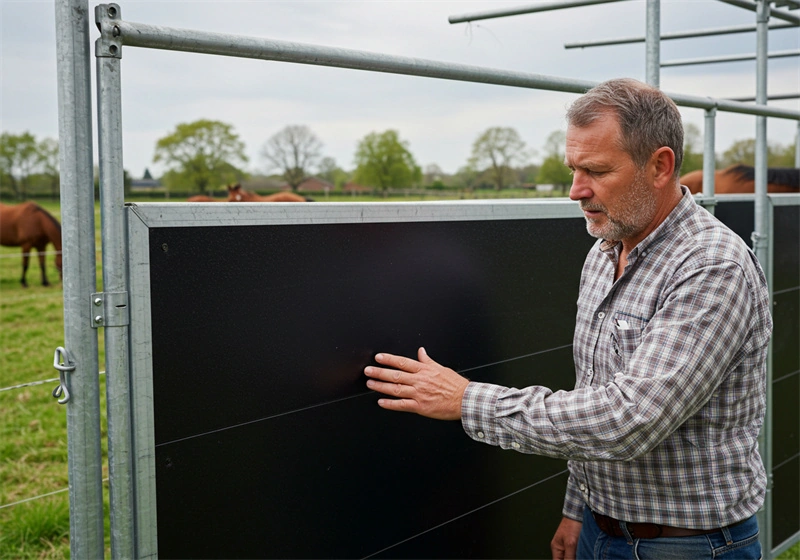
10-Year Cost Breakdown: Rotting Wood vs HDPE Durability
HDPE eliminates recurring maintenance costs, cutting 10-year TCO in half.
Timber stables look cheaper upfront — roughly 30% less than HDPE. But that discount disappears after the first year of maintenance. Annual sealing, staining, and pest control add up quickly. Over a 10-year period, the total cost of ownership for timber is roughly double that of HDPE, once you factor in replacement cycles and labor hours.
- Timber Maintenance Burden: Requires annual sealing, staining, and pest control. Roughly 15-20% dimensional changes from moisture absorption lead to warping, stuck doors, and structural misalignment. Replacement needed every 3-5 years.
- Hygiene Hazard (Timber): Rotting wood absorbs ammonia and bacteria from urine, creating a porous environment that degrades air quality and increases veterinary costs. Splintering panels also pose injury risks for horses.
- HDPE Maintenance Advantage: Non-porous 10mm UV-resistant panels require only soap and water cleaning. No sealing, staining, or chemical treatments needed. Functional lifespan of 15-20+ years in outdoor equestrian use.
- Predictable Operational Costs: HDPE + hot-dip galvanized steel frames eliminate the hidden cost of on-site trimming due to warping. Pre-manufactured precision means labor for installation and upkeep is fixed and minimal, enabling accurate budgeting for equestrian centers.
| Cost Factor | Timber (Standard) | HDPE (10mm UV) | 10-Year TCO Comparison |
|---|---|---|---|
| Initial Material Cost | ~30% lower upfront | Higher CAPEX | Timber initial savings erased by recurring costs |
| Annual Maintenance | Sealing, staining, pest control ($500-$1,000/yr) | Near-zero (soap/water wash only) | HDPE saves $5,000-$10,000 in labor and materials |
| Replacement Cycle | Every 3-5 years due to rot/warp | 15-20+ year functional lifespan | Timber requires 2-3 full replacements; HDPE lasts entire decade |
| Hidden Costs (Labor & Downtime) | On-site trimming for warped panels, horse injury risks, ammonia absorption | Pre-manufactured precision, zero splinter risk, non-porous hygiene | HDPE eliminates unplanned repair costs and safety liabilities |
| Net 10-Year Cost | ~2x higher than HDPE upfront | Lower total cost of ownership (ROI positive from year 3-4) | Strategic investment in HDPE + galvanized steel reduces long-term risk |
Horse Safety: Splinters, Rot, and Structural Integrity
HDPE eliminates splinter injury risk and hidden rot that timber stables hide for years.
Timber stables in high-ammonia environments absorb moisture and urea, causing internal rot and splintering that injure horses. A 15–20% dimensional change from AU/NZ humidity cycles weakens the structure unnoticed, leading to kick-through failures and costly replacements every 3–5 years.
- Timber failure mode: Splinters from dried-out wood and soft rot from moisture absorption create injury points for legs and hooves. Structural integrity degrades invisibly until a panel collapses under pressure.
- HDPE advantage: 10mm UV-resistant HDPE is non-porous, preventing ammonia absorption and bacterial growth. It offers high impact resistance with zero splinter risk, and a smooth surface that protects horse legs even after years of use.
The hidden cost of timber is not just maintenance but the safety risk of unnoticed structural degradation. Pairing 10mm HDPE panels with hot-dip galvanized steel frames (>42 microns) delivers a corrosion-proof, impact-resistant stable that maintains full structural integrity for 15–20 years, eliminating the rot and splinter hazards that generic comparisons ignore.
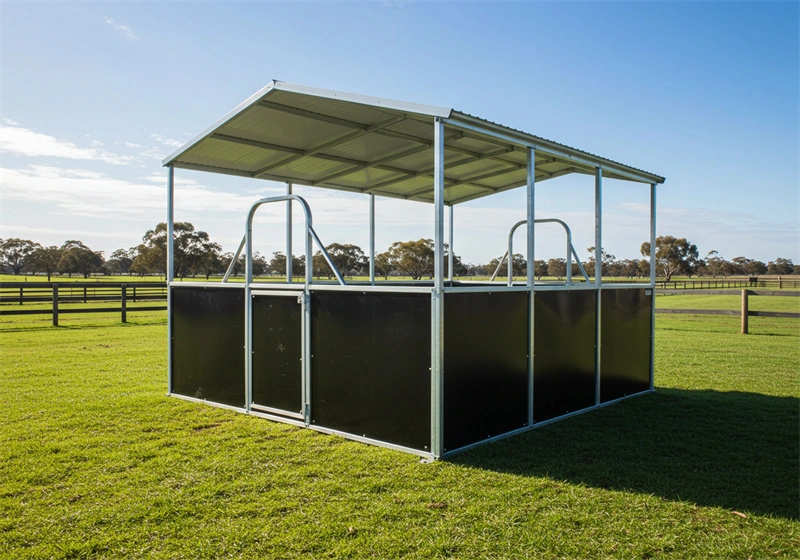

Sourcing Durable Stables: Hot-Dip Galvanized Steel Frames
A stable is only as durable as its frame — hot-dip galvanized steel over 42 microns stops rust before it starts.
Standard painted steel frames in AU/NZ coastal climates fail within 2–3 years. Salt spray and humidity undercut the paint, allowing moisture to creep under the coating. Once rust blooms, the frame loses structural integrity — doors jam, panels shift, and the entire stable becomes a safety liability. The production standard here uses hot-dip galvanized steel at a minimum of 42 microns. That thickness is not arbitrary; it’s the verified threshold for 10-year rust protection in marine-influenced environments, as per internal corrosion testing.
- Specification: Hot-dip galvanized steel >42 microns per the approved production standard. This process bonds zinc to the steel, forming a sacrificial layer that resists rust even when scratched.
- Risk: Painted or electro-galvanized frames typically offer <20 microns of protection. In a high-moisture stable, that coating fails in under 18 months, leading to rust-through and structural collapse.
- Hidden Cost of Timber: Timber frames require annual on-site trimming because they warp up to 20% in humidity. That labor cost alone can exceed the initial material price difference within three years.
- Maintenance: Galvanized frame + HDPE panels: zero sealing, zero staining, zero chemical treatments. Only soap-and-water cleaning. Timber requires annual sealing and periodic replacement of rotted sections.
A corrosion-proof frame is only half the solution. The panels must also survive the same environment. Pairing the galvanized frame with 10mm UV-resistant HDPE panels creates a genuinely rust-proof and maintenance-free system. HDPE does not absorb moisture, does not rot, and resists the ammonia from urine that eats away timber. More critically, HDPE’s dimensional stability — no warping or swelling — relies on a frame that stays straight. If the frame rusts and distorts, even the best panels will misalign. That synergy is why specifying both together is the only way to guarantee a 10-year asset lifespan without recurring repair costs.
Conclusion
10mm UV-resistant HDPE panels deliver stable, splinter-free surfaces that outperform timber in both durability and hygiene. Paired with hot-dip galvanized steel frames, this combination resists moisture, ammonia, and salt spray, eliminating the hidden long-term costs of timber maintenance and replacement.
For commercial facilities in AU/NZ, this material pairing is the basis of a low-maintenance, 10-year infrastructure decision. Review the available portable stable configurations that integrate these components.
Frequently Asked Questions
What are the disadvantages of using HDPE sheets?
HDPE sheets can scratch more easily than timber and may fade without UV stabilizers. However, 10mm UV-resistant HDPE used in stables eliminates fading and resists impact. For stable use, only UV-stabilized HDPE is recommended.
Is HDPE just as good as Polywood?
HDPE and Polywood are chemically the same—Polywood is a brand of HDPE lumber. Both offer comparable durability, but Polywood often includes proprietary UV inhibitors and a longer warranty. Compare UV stabilization ratings and warranty terms before choosing.
What is the lifespan of HDPE?
High-quality UV-stabilized HDPE panels typically last 20–30 years without rotting or splintering. In horse stables, they outlast timber, which usually needs replacement every 10 years. Lifespan depends on UV exposure and panel thickness; 10mm is standard for stables.
What is the downside of POLYWOOD?
The main downside of POLYWOOD is its higher upfront cost compared to generic HDPE or timber. Color choices are also more limited than painting wood. For commercial stables, cost per square meter may favor standardized HDPE panels.
What are the disadvantages of HDPE?
Disadvantages include potential scratching and heat deformation under extreme temperatures. UV-stabilized 10mm HDPE used in stables is specifically engineered to resist both issues. Always confirm UV stabilizers and thickness for structural applications.