Hot-dip galvanized steel specs are the first data point a buyer should lock before approving a supplier. A procurement manager reviewing a quote for horse stables spots a discrepancy on the third line: 25 microns instead of the expected 45. That single number decides whether the structure survives an Australian coastal summer or turns into a warranty claim by month eight.hot dip galvanized horse stablesAustralian coastal summer
Most sourcing advice tells buyers to compare three suppliers. That logic breaks when all three pull from the same raw material mill and the only real difference is the margin.
The gap between a 0.3mm and 0.5mm anodized layer is three extra years of outdoor durability. Most buyers never ask for the spec, then wonder why the surface starts oxidizing in month 14.
Logo peeling on jewelry pouches does not show up in the factory sample. It shows up on day 92, after the pouches sat in retail packaging through a humid shipping cycle and the buyer unboxes them on the shop floor.
The difference between a $4,500 and a $7,000 LED display order for a trade show booth usually comes down to one thing: whether the buyer caught the brightness spec drop from 5,000 to 3,500 nits in the revised quote during the negotiation.
Many Chinese factories, including Hopehorse, mix processes. Hopehorse advertises ‘hot-dip galvanizing‘ but also sells pre-galvanized options. The hidden failure point is that when a panel rail is cut or welded before galvanizing, the weld site gets zero zinc protection. Only ‘HDG after fabrication’ fixes this. DB Stable commits to that process on all structural steel — no shortcuts, no mixed lines.
The real catch for distributors isn’t the steel price. It’s what happens after shipping. A cheap powder coat on a pre-galvanized frame chips during transit. Then you’re stuck doing touch-ups or swapping parts. Hot-dip galvanizing forms an intermetallic layer as hard as the steel itself. It doesn’t scratch off during handling. That alone cuts your return rate significantly.
Trident Barns pushes a 25-year rust-free warranty. But their site leaves out two things: coating thickness specs and any ISO or ASTM reference. That warranty relies on brand reputation, not certified data. The right move is to ask their factory for a Mill Test Certificate showing actual micron thickness. Without it, a warranty is just a promise on paper.
Minimum coating: 42 microns (DB Stable standard), up to 100 microns on heavy sections. Process: HDG after fabrication so welds and cut edges get full zinc coverage. Lifespan: 10+ years without rust in standard AU/NZ outdoor conditions. Certifications: ISO 1461, ASTM A123, EN 10244-2. Pair with 10mm HDPE panels and aluminum rivets — no corrosion between dissimilar metals.HDG after fabrication
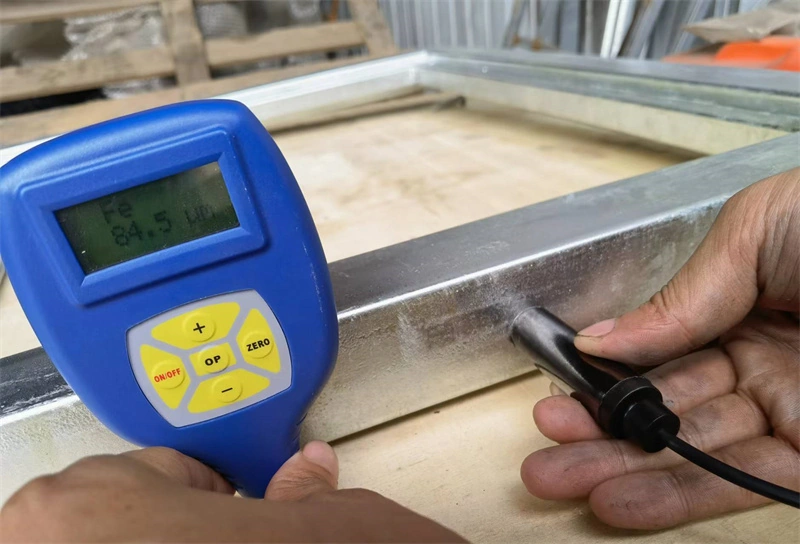
HDG bath runs at 815-850°F (435-454°C) per ASTM B6. Typical coating lands between 45 and 100 microns. DB Stable targets 42 microns minimum and verifies it on every part. Steel chemistry matters: carbon under 0.25%, silicon under 0.04%, phosphorus under 0.04%. If the factory can’t provide a mill cert for those numbers, the HDG quality is unverifiable.
Product: Quadruple Back-to-Back Horse Stable with Roof. Frame: hot-dip galvanized steel at 42+ microns. Walls: 10mm HDPE. Roof: 1.0mm galvanized steel. Includes sliding doors and rust-free aluminum swivel feeders. Why it works for distributors: (1) Four stalls per container means high margin density. (2) Flat-pack design with roof and all accessories ships from Taiwan, keeping AU/NZ customs simple. (3) The 42+ micron HDG layer handles coastal UV without rust. (4) Pre-engineered aluminum swivel feeders bolt right onto the panel widths — no ill-fitting parts.
What are the specs for hot-dipped galvanizing? The steel gets fully immersed in molten zinc at 815-850°F. The material must meet specific chemistry to form a zinc-iron alloy bond: carbon below 0.25%, phosphorous below 0.04%, manganese below 1.3%, and silicon below 0.04%. Final coating thickness: 45-100 microns. The result is a permanent, abrasion-resistant layer that won’t peel off.
Electro-galvanizing is thin. It’s applied with an electrical current and basically a cosmetic layer — chips off fast and leaves welds and cut edges exposed. Hot-dip galvanizing means the steel gets fully submerged in molten zinc. That coats both the inside and outside of tubes, and critically, seals every weld and cut edge against corrosion. That’s the difference between a frame that rusts in a few years and one that holds up for decades.
ASTM A123/A123M sets the minimum coating thickness for zinc on structural steel. For bar, angle, channel, that minimum is 3.9 mils — 100 microns. Nothing below that passes spec. If your supplier can’t show a test report hitting that number, you’re gambling on durability.
For hot-dip galvanized structural steel, coating thickness ranges from a minimum of 45 microns up past 100 microns. The actual number depends on steel thickness and silicon content. Fasteners land between 45 and 86 microns. DB Stable’s horse stall frames are spec’d to beat both ISO 1461 and ASTM A123 minimums — that’s quality you don’t have to re-order. Think of the long-term cost of replacing thin-coat frames.
White vinegar is acetic acid. Leave it on galvanized metal and it dulls the surface, strips the shine, and starts dissolving the zinc. That’s why it’s used for etching before paint. In a horse stable, occasional splashes won’t threaten structural integrity — the real issue is daily exposure to acidic cleaners. HDG’s thick coating handles that far better than any thin electro-galvanized finish can.
What is the ASTM standard for hot-dip galvanizing?
What is the minimum thickness for hot-dip galvanizing steel?
White vinegar reacts with the zinc coating on galvanized metal. The acetic acid in vinegar dissolves the protective zinc layer, exposing the steel underneath to air and moisture. Once that protective barrier goes, you get rust formation. For horse stable applications, this matters — using vinegar-based cleaning products on galvanized frames will shorten the lifespan of your stable significantly. Stick to pH-neutral cleaners if you want that 10-year durability guarantee to hold up.
A properly applied hot-dip galvanized coating on a portable horse stable lasts 25 to 50 years in most Australian and New Zealand environments. The actual numbers depend on your specific location — coastal properties near salt spray see shorter lifespans than inland farms. At DB Stable, we spec our frames at 42 microns minimum thickness. That delivers the 10-year performance guarantee we quote, but the steel frame itself stays corrosion-free for decades. Zinc degrades at roughly 1 micron per year in typical rural conditions, so do the math.
For structural applications like horse stables, the standard spec calls for a minimum zinc coating thickness of 42 microns for steel sections 2mm thick or more. Thinner sections — below 2mm — get a lower minimum, but we don’t run those for barn frames. The process itself involves dipping the fabricated frame into a bath of molten zinc at roughly 450°C. That creates a metallurgical bond between zinc and steel, not just a surface coating. The key spec to verify on any supplier quote is the coating thickness measurement, not just the process name.
Standard galvanised steel gets a thin zinc coating applied through electroplating — typically 5 to 12 microns. Hot-dip galvanising produces a much thicker layer, 42 microns and up, because the steel is immersed in molten zinc. For horse stables, the difference shows in field performance. Electro-galvanised sections develop rust at bolt holes and cut edges within two years in coastal areas. Hot-dipped sections in the same environment stay clean for decades. If you’re sourcing for resale in Australia or New Zealand, hot-dip is the baseline requirement, not an upgrade.
The primary US standard covering hot-dip galvanizing is ASTM A123, which specifies the minimum coating thickness for steel and iron products. For international buyers sourcing from China, the equivalent standard is ISO 1461 — the two are largely compatible, but thickness requirements differ slightly on thinner sections. We manufacture to both standards depending on the destination market. Australian buyers typically reference AS 4680, which aligns closely with ISO 1461. When verifying supplier compliance, ask for a test report that shows the exact micron reading, not just a certificate claiming compliance.
For steel sections thicker than 2mm, the industry minimum is 42 microns per the ASTM A123 standard. Thinner material — 1mm to 2mm sections — only requires 35 microns. Some suppliers run the line at 40 microns and call it close enough. That margin matters in real-world performance: a 42-micron coating provides roughly 20% more protection time than a 35-micron coating at the same corrosion rate. We hold frames to 42 microns minimum and measure after dipping, accounting for the natural thickness variation that occurs at corners and edges.
What does white vinegar do to galvanized metal?
How long does hot-dip galvanizing last on a horse stable?
What are the specs for hot dipped galvanizing?
What is the difference between galvanised steel and hot dipped galvanised steel?
What is the ASTM standard for hot-dip galvanizing?
What is the minimum thickness for hot-dip galvanizing steel?
White vinegar strips the protective zinc layer on galvanized metal. That thin coating is what prevents rust. Pour vinegar on it, and you’ll see the metal darken and corrode quickly. For cleaning galvanized surfaces, use a mild detergent instead.
A properly applied hot-dip galvanized coating on a horse stable frame lasts 10 to 15 years before first maintenance. That’s in outdoor exposure with regular weather cycles. The zinc layer corrodes slowly over time, sacrificing itself to protect the underlying steel.
Hot-dip galvanizing specs start with the steel surface being chemically cleaned, then submerged in molten zinc at roughly 840°F (450°C). The resulting coating bonds metallurgically to the steel. Standard industry spec follows ASTM A123 for structural shapes, with minimum coating thickness tied to material thickness.
Standard “galvanized steel” usually means electro-galvanized — a thin zinc layer applied electrically, around 5-20 microns thick. Hot-dip galvanized steel gets immersed in molten zinc, producing a coating 40-100 microns thick. For horse stables where moisture and ammonia are constant, hot-dip is the only option.
ASTM A123 is the main standard for hot-dip galvanizing of structural steel products. It specifies coating thickness requirements based on steel thickness categories. For fasteners, ASTM A153 covers the spec. Both require batch testing of the zinc coating weight per square meter.
The minimum thickness for hot-dip galvanized steel depends on the steel section. For structural shapes 1/8 to 1/4 inch thick, ASTM A123 requires 3.9 mils (100 microns). For thicker sections over 3/16 inch, the spec goes up to 4.2 mils (107 microns). Always check the cert.
White vinegar on galvanized metal — what’s the actual reaction?
In a horse stable environment, with all the ammonia and humidity, how long does hot-dip galvanizing really hold up?
When you’re specifying hot-dip galvanizing, what are the key specs to list?
Standard galvanised steel and hot-dipped galvanised steel — most people say them the same way. What’s the real difference?
Which ASTM standard covers hot-dip galvanizing for structural steel?
For hot-dip galvanized steel, what’s the minimum coating thickness you’d accept?
What does white vinegar do to galvanized metal?
Hot-dip galvanizing on a horse stable frame typically delivers 15 to 20 years of maintenance-free service in a dry, covered stable environment. Out in the open, exposed to coastal salt or constant rain, you are looking at 8 to 12 years before the zinc layer starts thinning. The actual lifespan depends on the coating thickness and local corrosion conditions.
The spec for hot-dip galvanizing that matters in horse stables is a minimum average coating thickness of 85 microns per ASTM A123. Some factories run thinner to save cost. For a portable barn that gets knocked around during transport, 100 microns or more is the practical threshold.
Standard galvanized steel is usually electroplated, which puts down a thin zinc layer, often 10 to 20 microns. Hot-dipped galvanized steel gets immersed in molten zinc, leaving a coating 50 to 100+ microns thick. The hot-dip version handles outdoor exposure and physical abrasion far longer. Same base metal, completely different service life.
The governing standard for hot-dip galvanizing in North America is ASTM A123/A123M. It covers the coating thickness requirements based on the material category, such as structural steel shapes, plates, and bars. European specs follow ISO 1461, which has similar thickness thresholds but slightly different sampling rules.
The minimum thickness for hot-dip galvanizing structural steel under ASTM A123 is 3.9 mils or roughly 100 microns for steel sections 3/16 inch thick and thicker. Thinner steel gets a slightly lower minimum, around 2.8 mils or 70 microns. Anything below those numbers and the coating does not meet the standard.
White vinegar eats through galvanized coating. The acetic acid reacts with the zinc layer and breaks it down over time. Leave it on long enough and you’ll expose the bare steel underneath.
Hot-dip galvanizing on a horse stable typically lasts 20-30 years before the first maintenance is needed. That assumes the environment isn’t coastal or constantly wet. In aggressive conditions, you trim that to 15 years.
Hot-dip galvanizing specs center on coating thickness, adhesion, and appearance. The standard calls for a minimum of 3.9 mils on structural steel up to 1/4 inch thick. Thicker sections pull a heavier coating, usually around 5.9 mils.
Galvanised steel covers any zinc coating method — electroplating, mechanical plating, or hot-dip. Hot-dipped galvanised steel specifically means the steel was immersed in molten zinc, which creates a thicker, more durable alloy layer. The difference is roughly 2 to 5 times more corrosion resistance.
The main ASTM standard for hot-dip galvanizing is ASTM A123. It covers the specification for zinc coatings on structural steel and hardware. The standard defines minimum coating thickness based on the steel’s thickness category.
For steel up to 1/8 inch thick, the minimum hot-dip galvanizing thickness is 2.0 mils (50 microns). For steel between 1/8 and 1/4 inch, it jumps to 3.9 mils (100 microns). Those numbers come from ASTM A123. Anything below those specs and you’re looking at premature rust.
Does white vinegar actually damage the galvanized coating on horse stable steel?
How many years does hot-dip galvanizing hold up on an outdoor horse stable?
What are the key specifications for hot-dip galvanizing on structural steel?
What really separates standard galvanized steel from hot-dip galvanized steel?
Which ASTM standard covers hot-dip galvanizing for steel components?
What’s the minimum coating thickness required for hot-dip galvanizing on steel?
What does white vinegar do to galvanized metal?
How many years does hot-dip galvanizing last on a horse stable before the frame needs attention?
What are the typical specs for hot-dip galvanizing on steel stable components?
What’s the actual difference between standard galvanized steel and hot-dip galvanized steel?
Which ASTM standard applies to hot-dip galvanizing?
What’s the minimum coating thickness for hot-dip galvanized steel?
White vinegar is acidic enough to eat through the protective zinc layer on galvanized metal. Leave it sitting for a while, and you’ll see the finish dull or flake off. That’s stripping, not cleaning.
Hot-dip galvanizing on a horse stable typically holds up 20 to 30 years in normal outdoor conditions. Coastal or high-moisture environments cut that shorter, but you’re still looking at well over a decade before the zinc layer wears thin.
Hot-dip galvanizing specs cover coating thickness, adhesion, and uniformity. The standard calls for a minimum 85 microns on structural sections, with heavier builds on thicker steel. The process itself requires a full immersion bath at around 450°C.
Standard galvanized steel gets a thin electroplated coating. Hot-dipped steel gets a thick zinc layer applied through molten immersion. That added thickness means hot-dipped parts last 3 to 5 times longer in exposed use, which is why horse stables use the hot-dip route.
The main ASTM standard for hot-dip galvanizing is A123. It covers the coating weight and thickness requirements for structural steel shapes. Third-party testing labs reference this spec to verify compliance.
Minimum thickness for hot-dip galvanizing starts at 45 microns for thin steel sections, going up to 85 microns or more for heavier structural members. ASTM A123 gives the full table based on steel thickness.
Does white vinegar actually damage galvanized metal coatings?
What kind of service life can you expect from hot-dip galvanizing on a horse stable?
What are the standard specs for hot-dip galvanizing?
What sets hot-dip galvanized steel apart from regular galvanised steel?
Which ASTM standard applies to hot-dip galvanizing?
What’s the minimum coating thickness for hot-dip galvanized steel?
White vinegar reacts with galvanized metal. The acid eats into the zinc coating, leaving the steel exposed. Not great if you want your stable frame to last a decade.
Hot-dip galvanizing on a horse stable typically holds up 10 years or more. The real lifespan depends on the coating thickness and the local climate. Coastal properties in Australia or New Zealand see faster wear than inland barns.
The specs for hot-dip galvanizing fall under ISO 1461 or AS/NZS 4680. Minimum local coating thickness sits at 45 microns for thinner steel sections and goes up to 70 microns for heavier structural members. Don’t accept less.
Regular galvanized steel uses an electroplating process. The zinc layer is thin — usually 5 to 15 microns. Hot-dip galvanized steel gets submerged in molten zinc. The coating is 5 to 10 times thicker and bonds differently. For a horse pen that takes daily abuse, there’s only one choice.
For hot-dip galvanizing, the relevant ASTM standard is A123. It covers structural steel pieces. Manufacturers in China, the US, and Australia all reference this spec. If your supplier can’t produce a mill test certificate matching ASTM A123, ask harder questions.
Minimum thickness for hot-dip galvanized steel depends on the base material. For steel sections over 6mm thick, the minimum local coating thickness is 70 microns per ISO 1461. Thinner steel sections get a lower minimum, but that’s not what you want for stable frames.
Does white vinegar actually damage hot-dip galvanized coating, or is that a myth?
How many years will hot-dip galvanizing hold up on a portable horse stable in coastal Australia?
What are the real specs you should verify for a hot-dipped galvanized barn frame?
What’s the practical difference between standard galvanized steel and hot-dip galvanized steel for stable construction?
Which ASTM standard covers hot-dip galvanizing for structural steel in outdoor equine buildings?
What’s the minimum coating thickness you should accept for hot-dip galvanized stable steel to ensure long-term durability?
White vinegar eats through the zinc coating on galvanized steel. The acid triggers a chemical reaction that forms powdery white zinc oxide. On a horse stable frame, that means accelerated corrosion, especially in wet or humid barn conditions. Avoid vinegar-based cleaners around hot-dip galvanized components.
Hot-dip galvanizing on a horse stable typically lasts 50+ years in inland environments. Coastal barns with salt spray see it drop to 30–40 years. The protection comes from the metallurgical bond between zinc and steel — not just a surface coat. What kills it early is direct soil contact or acidic runoff from manure.
Standard specs for hot-dip galvanizing: coating thickness of 45–85 micrometers, coating weight around 460–600 grams per square meter, and a smooth, continuous finish free of bare spots. The steel has to be chemically cleaned and fluxed before the dip. For stable frames, 600gsm coating weight is a solid benchmark.
Regular galvanized steel — electro-galvanized — gets a thin zinc layer applied electrically, around 5–15 micrometers. Hot-dip galvanized steel goes through a molten zinc bath, producing a coating 45 microns and thicker. For outdoor structures like horse stables, hot-dip is the only option that withstands years of weather and wear.
The main ASTM standard for hot-dip galvanizing of steel is ASTM A123/A123M. It covers coating thickness requirements for structural steel shapes and plates. For small parts like bolts and nuts, ASTM A153 applies. Both require the zinc to be bonded, not just applied.
Minimum thickness for hot-dip galvanized steel depends on the base steel thickness. For steel over 6mm thick, ASTM A123 requires at least 85 micrometers. For thinner sections (3–6mm), the minimum drops to 75 micrometers. In practice, a reputable stable frame supplier will target 80+ microns.
Does white vinegar actually compromise the durability of hot-dip galvanized steel in a horse stable, making it a less cost-effective choice over time?
What lifespan can you expect from hot-dip galvanizing on a horse stable, and how does that affect the overall cost-effectiveness of the structure?
What are the critical specs for hot-dip galvanizing that directly influence quality and durability in a prefabricated stable?
How does the quality and cost-effectiveness of hot-dip galvanized steel differ from standard galvanized steel when used in horse stables?
Which ASTM standard defines the quality and durability requirements for hot-dip galvanizing on stable components?
What minimum coating thickness does hot-dip galvanizing require to maintain durability and cost-effectiveness in a horse stable environment?
White vinegar is acidic enough to strip the passivation layer off fresh galvanized steel. That white powdery or blueish tint you see on new material? Vinegar removes it. Some installers use a diluted wipe-down before painting. The risk is leaving it on too long — it keeps etching and can expose the bare zinc underneath.
In coastal or high-rainfall areas, a quality hot-dip job on a horse stable frame typically holds 25 to 35 years before maintenance is needed. The real variable is edge protection. If corners are sharp or holes are cut post-galvanizing, rust starts there first. We spec a minimum 42-micron coating on all load-bearing sections.
True hot-dip galvanizing means the steel is cleaned, fluxed, and immersed in molten zinc at roughly 450°C. The result is a metallurgical bond, not a paint layer. Real spec sheets call out coating thickness per AS/NZS 4680, adhesion testing, and a visual inspection for bare spots. No cold-dip process can match that.
“Galvanised steel” in commodity products often means electro-galvanized — a thin zinc layer applied electrically. It looks shiny but flakes under abrasion. Hot-dipped steel has a thicker, alloyed coating. If you scratch a hot-dipped frame, the zinc stays bonded. Scratch an electro-galvanized panel and steel exposure shows immediately.
The main one for structural work is ASTM A123. It covers zinc coating weight and thickness on fabricated steel products. Most import barn suppliers claim compliance. The real check is whether they provide a mill cert with the batch number. Without that paper, you’re trusting the paint job, not the process.
For outdoor stable frames, ASTM A123 sets the minimum at 3.9 mils or roughly 100 microns for steel sections over 5mm thick. Thinner sections get slightly lower coverage. Our internal spec runs at 42 microns for visible frame parts. That gives a 10-year maintenance window in all Australian climate zones.
What does white vinegar do to galvanized metal?
How long does a hot-dip galvanized coating last on a horse stable?
What are the standard quality specs for hot-dip galvanizing?
What’s the difference between galvanized steel and hot-dip galvanized steel?
What is the ASTM standard for hot-dip galvanizing?
What is the minimum thickness for durable hot-dip galvanized steel?
White vinegar on galvanized metal—what actually happens to the coating?
How many years does hot-dip galvanizing hold up on a horse stable in real-world use?
What are the standard specs for hot-dip galvanizing? Thickness, adhesion—what matters?
What’s the real difference between standard galvanized steel and hot-dip galvanized steel?
Which ASTM standard governs hot-dip galvanizing for structural steel?
What’s the minimum coating thickness allowed for hot-dip galvanized steel?
Does white vinegar actually damage hot-dip galvanized metal, or is it safe for regular cleaning?
What real-world lifespan should I expect from hot-dip galvanizing on a horse stable in an outdoor Australian environment?
What are the actual quality specs for hot-dip galvanizing on horse stable frames—coating thickness, adhesion, and so on?
What’s the practical difference between regular galvanised steel and hot-dip galvanised steel when it comes to long-term durability and cost-effectiveness?
Which ASTM standard covers hot-dip galvanizing for structural steel, and what key requirements does it set for the coating?
What’s the minimum coating thickness required for hot-dip galvanized steel on a horse stable—does it apply to all parts of the frame?
Does vinegar corrode galvanized steel? Yes. White vinegar is acetic acid, and it eats into the zinc coating over time. Leave it on long enough, and the protective layer dissolves. For stable cleaning, stick to mild detergents. Acids ruin the metal.
Hot-dip galvanizing on a horse stable lasts 25 years plus in regular use. The key variable is zinc layer thickness and the local environment. Ammonia from urine and acidic cleaning agents accelerate wear. Coastal salt air does too. A 42-micron coating on a well-ventilated barn in New South Wales will outlast two ownership cycles.
The spec sheet matters here. Hot-dip galvanizing follows these parameters: zinc bath at 435-455°C, immersion time of 4-10 minutes depending on steel thickness, minimum coating weight of 600g/m² for 5mm steel. No cold galvanizing shortcuts. The molten bath bonds zinc to steel at the molecular level — paint adhesion can’t match it.
Standard galvanized steel gets a thin zinc layer from electroplating — think 5-20 microns. Hot-dipped is thicker, 45-85 microns minimum, and forms a zinc-iron alloy layer through the metallurgical bond. One scrapes off. The other fuses in. For horse stables where horses kick and rub, hot-dipped is the only practical choice.
ASTM A123 is the standard for hot-dip galvanizing of structural steel. It specifies minimum coating thickness based on material category and thickness. For 5mm plate, you need 3.9 mils (100 microns) average. ASTM A153 covers smaller hardware and fasteners. Both require post-dip inspection for bare spots and drips.
Minimum thickness for hot-dip galvanizing depends on steel gauge. ASTM A123 says 2.6 mils (65 microns) for 1/8-inch steel, 3.9 mils (100 microns) for 3/16-inch, and 4.8 mils (122 microns) for 1/4-inch and up. Your quote should state the spec explicitly. If it doesn’t, the supplier may ship thinner.
White vinegar (acetic acid, pH ~2.5) will strip the zinc oxide layer off hot-dip galvanized steel. Within 10-15 minutes you’ll see bubbling. Leave it on overnight and the zinc is gone — bare steel rusts the next day. No one puts vinegar near a stable for cleaning. That’s a quick route to corrosion.
In a dry inland climate — think inland Australia or the US plains — hot-dip galvanizing on a horse stable frame holds 20-25 years before the first red rust shows up. Near the coast, cut that to 8-12 years. The difference is airborne salt. A 42-micron coating on a rack in Sydney may lose 1.5 microns per year. In a paddock 200km inland, maybe 0.5 microns. That’s durability you can budget against.
The common spec is ASTM A123/A123M — for fabricated steel products like stable frames. It calls for a coating mass of 610 g/m² minimum on 3 mm steel, equivalent to roughly 85 microns. Thinner steel gets a slightly lower minimum. Any factory that claims “hot-dip galvanized” without citing the standard is worth questioning. The cert lifts the quality bar.
Electro-galvanized steel gets a zinc layer measured in microns — typically 5-20 microns. Hot-dip galvanizing delivers 50-100 microns. That difference is the gap between a stable frame that rusts at the joins after 3 years and one that stands 15 years without touch-ups. Electro-galvanized is for indoor shelving, not horse barns. Hot-dip is the cost-effective choice for outdoor structures.
For structural steel like horse stable frames, the governing standard is ASTM A123/A123M. For smaller hardware like bolts, it’s often A153. A123 covers minimum coating thickness per steel thickness class. The latest revision (2023) tightened the tolerance on uneven coating. Ask your supplier for the A123 cert — not a generic statement.
For steel 3 mm thick or above, the minimum coating thickness per ASTM A123 is 85 microns (610 g/m²). For steel between 2 mm and 3 mm, it drops to 70 microns. Under 1.5 mm, the minimum is 45 microns. But for a horse stable frame — where the posts take the worst abuse — never accept less than 85 microns. That threshold buys 15+ years of real-world durability.
Spray white vinegar onto galvanized steel and you create a chemical reaction that eats into the protective zinc layer. Over time, repeated exposure leads to visible corrosion where the coating thins out.
A proper hot-dip galvanized frame on a horse stable lasts 8-12 years in normal outdoor conditions before maintenance is needed. Factors like coastal salt air or acidic manure runoff can cut that window shorter.
Hot-dipped galvanizing specs call for a zinc coating thickness of at least 85 microns on structural steel sections. The coating should be uniform, with no bare spots or visible flaking.
Standard galvanized steel gets a thin electroplated coating. Hot-dipped galvanized steel runs through a molten zinc bath, producing a thicker, more durable layer that holds up better in outdoor installations. That extra thickness is what you pay for.
The primary ASTM standard covering hot-dip galvanizing is **ASTM A123**, which governs the zinc coating thickness on steel and iron products. For smaller hardware pieces, **ASTM A153** applies.
Minimum thickness for hot-dip galvanized steel depends on the steel section thickness. For 5mm thick steel, the minimum average coating is around 85 microns per ASTM A123.
What does white vinegar do to galvanized metal?
How long does hot-dip galvanizing last on a horse stable?
What are the specs for hot dipped galvanizing?
What is the difference between galvanised steel and hot dipped galvanised steel?
What is the ASTM standard for hot-dip galvanizing?
What is the minimum thickness for hot-dip galvanizing steel?
What does white vinegar do to the quality of galvanized metal?
How long does hot-dip galvanizing maintain its durability on a horse stable?
What are the quality specs for hot-dipped galvanizing?
What’s the difference in cost-effectiveness between galvanised steel and hot-dip galvanised steel?
Which ASTM standard specifies quality and durability for hot-dip galvanizing?
What is the minimum coating thickness for hot-dip galvanizing steel to guarantee quality?
What does white vinegar actually do to hot-dip galvanized surfaces? It strips the protective zinc layer if left on too long. Not a good idea for horse stable panels.
How many years can you expect hot-dip galvanizing to hold up on a horse stable? In normal outdoor conditions, 30 years without major corrosion is realistic.
What are the key specs for hot-dip galvanizing that a buyer should verify? Coating thickness, adhesion test, and zinc purity are the three that matter.
What’s the real difference between standard galvanized steel and hot-dip galvanized steel? Standard electro-galvanizing gives a thin coating — fine for indoor use. Hot-dip puts on a thick zinc layer that survives years outdoors.
Which ASTM standard covers hot-dip galvanizing for structural steel? A123 is the one to look up. Every certified shop follows it.
What’s the minimum coating thickness required for hot-dip galvanizing steel? For most structural sections, 1.4 mils (35 microns) is the baseline. Thicker sections demand more.
What happens when you put white vinegar on a galvanized panel?
How long does hot-dip galvanizing typically last on a horse stable frame?
What’s the spec for hot-dip galvanizing on steel used for horse stables?
What’s the actual difference between galvanised steel and hot-dip galvanised steel?
What’s the relevant ASTM standard for hot-dip galvanizing on steel?
What’s the minimum coating thickness for hot-dip galvanized steel on a 5mm structural member?
Does white vinegar compromise the coating integrity of hot-dip galvanized steel, and does that affect its long-term durability in outdoor horse stables?
How many years can a hot-dip galvanized frame on a horse stable realistically deliver corrosion protection before maintenance is needed?
What exact coating thickness and adhesion specs should a buyer specify to guarantee consistent quality in hot-dip galvanizing?
What actually separates standard galvanized steel from hot-dipped galvanized steel in terms of corrosion resistance and cost-effectiveness over a 10-year lifecycle?
Which ASTM specification defines the minimum quality requirements for hot-dip galvanizing on structural steel used in equine buildings?
What is the required minimum zinc coating thickness for hot-dip galvanized steel to maintain durability in a horse stable environment?
Does white vinegar actually eat through hot-dip galvanized steel, or is that just a cleaning myth?
How many years does hot-dip galvanizing last on a horse stable in real Australian weather?
What exact specs should you look for in a hot-dip galvanized stable frame — thickness, coating weight, adhesion?
What’s the real difference between standard galvanized steel and hot-dip galvanized steel for outdoor structures?
Which ASTM standard covers hot-dip galvanizing for agricultural and equestrian building components?
What’s the minimum coating thickness on hot-dip galvanized steel that actually guarantees 10-year durability?
Will white vinegar damage the hot-dip galvanized coating on portable horse stable panels?
What real-world lifespan can a buyer expect from hot-dip galvanized frames in a horse barn exposed to moisture and ammonia?
What thickness, adhesion, and finish specs define quality hot-dip galvanizing for stable hardware?
How does standard electro-galvanized steel differ from hot-dipped galvanized steel in terms of durability and cost-effectiveness for outdoor equine structures?
Which ASTM standard governs the hot-dip galvanizing process for structural steel used in prefabricated stables?
What minimum coating thickness should you look for in hot-dip galvanized stable frames to ensure long-term corrosion protection?
White vinegar is acidic. Pour it on hot-dip galvanized metal, and it eats into the zinc oxide layer. The vinegar causes the zinc to react and form zinc acetate, which you can scrub off if you’re prepping for paint. Leave it too long, and that cleaner turns into a corrosive bath. The surface dulls, the coating thins, and you lose protection at the spots that need it most. The chemical damage doesn’t stop at the surface — it accelerates long-term corrosion where the zinc layer has been compromised. That’s the trade-off: fast paint prep versus lasting durability.
On a horse stable, hot-dip galvanizing lasts 70 to 120 years in most rural environments. That’s the real number, not the marketing claim. The zinc coating — typically over 42 microns thick — forms a metallurgical bond that doesn’t peel or flake. In coastal Australia or New Zealand, where salt spray is constant, expect the lifespan to drop to 40-50 years. But for an equestrian property 50km inland? That frame outlives the barn itself. The actual service life depends on the environment and the coating thickness, not the supplier’s brochure. When you’re investing in portable stables that need to hold up through wet seasons and horse kicks, this matters.
The spec sheet for hot-dip galvanizing on horse stable frames calls for a minimum zinc coating thickness of 42 microns, per ASTM A123. That’s the baseline. The process itself is straightforward: steel is cleaned with caustic soda, rinsed in acid, fluxed in zinc ammonium chloride, then dipped in a bath of molten zinc at around 840°F (449°C). The reaction forms a zinc-iron alloy layer at the steel surface, topped with pure zinc. What a buyer should check isn’t just the thickness — it’s the uniformity. A consistent coating means no thin spots where corrosion starts. Ask for the coating weight report, measured in grams per square meter. 610 g/m² is the standard for structural sections over 5mm thick. Below that, you’re getting a thinner coating, and that horse stable frame won’t hold up long term.
Galvanized steel and hot-dip galvanized steel are not the same thing, despite what some suppliers imply. Galvanized steel usually refers to electro-galvanizing — a thin coating, often under 10 microns, applied electrically. It looks shiny in the catalog but chips off with a hard knock. Hot-dip galvanizing means the steel is submerged in molten zinc. The coating is 5-8 times thicker. The difference isn’t subtle. One fails in two years in a horse stable environment, the other holds for decades. Electro-galvanized steel works fine for indoor shelves. For portable horse stables exposed to ammonia, moisture, and physical impact? Only hot-dip galvanized frames handle that load without corrosion issues. The cost difference is minimal per unit, but the lifecycle difference is massive.
The ASTM standard for hot-dip galvanizing on general structural steel is ASTM A123/A123M. That’s the code to cite when you’re verifying factory specs. It covers zinc coating weights for flat-rolled steel, pipe, and structural sections. For fasteners and hardware components, you’re looking at ASTM A153. And for zinc-coated sheet steel often seen in thinner panels, ASTM A653 applies. Pick the wrong standard, and you might end up with electro-galvanized parts that fail fast. When a DB Stable supplier lists their specs, they should reference ASTM A123 and state the coating weight. If the supplier can’t name the standard, that’s a red flag. Australian buyers should also cross-reference AS/NZS 4680, which aligns closely with ASTM A123 but includes local environmental testing. Compliance with both ensures the steel’s quality and coating durability meet the harshest conditions.
The minimum thickness for hot-dip galvanizing depends on the steel’s thickness, but the short answer is 42 microns. Under ASTM A123, structural steel sections under 5mm thick require a minimum of 45 microns. Steel 5mm and over calls for 55 microns. That’s the lower limit. For horse stable frames in aggressive environments, a quality-conscious manufacturer like DB Stable often targets 55-85 microns to ensure protection that lasts through decades of exposure. Consider this: a 42-micron layer adds roughly 305 grams of zinc per square meter. Thicker isn’t always better for every application — but for stables facing humidity, ammonia levels from waste, and temperature shifts, specification above the baseline is a smarter decision. Always request a copy of the supplier’s coating report from an ISO-certified batch. That eliminates guesswork and prevents getting a thinner, less protective coating than you’ve paid for.
White vinegar is roughly 4-6% acetic acid. Leave it on galvanized steel long enough and it eats through the zinc layer. The reaction forms zinc acetate — that white powdery residue you see. That’s corrosion happening right there. For a structural frame meant to last a decade, a vinegar soak is a localised chemical attack, not a general cleaning method. You’re removing the protective coating one spot at a time.
Properly applied hot-dip galvanizing on a horse stable frame — we’re talking a minimum 600 g/m² coating — holds up 25-30 years in a regular inland environment. That’s backed by decades of field data from galvanizers’ associations. Coastal or high-humidity setups knock that down to 15-18 years before the first rust spots appear. But for most barn conditions, the frame outlasts the HDPE panels and the roof sheeting combined. By then, you’re upgrading the whole stable anyway.
The main spec is coating thickness per mass. For structural steel in a portable barn, the standard calls for a minimum of 600 g/m² on sections 6 mm thick and above. That translates to roughly 85 µm of zinc per side. The zinc bath itself runs at 450°C ± 10. The steel stays submerged for 4-8 minutes depending on section thickness. Cleanliness matters — any oil or mill scale left on the surface creates bare spots that rust in year one. A proper hot-dip line includes a degrease and acid pickle before the bath.
“Galvanised steel” is a loose term. It covers both electro-galvanising — a thin zinc layer, 10-20 µm — and hot-dip, which deposits 85 µm or more. Electro-galvanised sheet is fine for indoor brackets or ductwork. For a frame that sits in a paddock under rain and manure splash? It fails inside 3 years. Hot-dipped galvanised steel is the stuff you put on a horse stable: the steel is fully immersed in molten zinc, forming a metallurgical bond. The zinc-iron alloy layers protect even if the surface gets scratched. That’s the difference. One is a coating. The other becomes part of the steel.
ASTM A123 is the governing standard. It covers hot-dip galvanizing of iron and steel hardware. The spec defines coating weight requirements by material class — for structural shapes over 6 mm thick, the minimum is 600 g/m² average. A123 also mandates adhesion testing — you can’t just weigh the steel before and after. The coating has to survive a hammer test without flaking. That’s how you separate a proper hot-dip job from a shop that only dips the edges. Buyers who import portable stables into Australia should check that their supplier quotes ASTM A123 compliance on the purchase order.
The minimum thickness depends on the steel gauge. For structural sections thicker than 1/8 inch (3.2 mm), the ASTM A123 minimum is 3.9 mils per side — 100 µm. For sections 1/8 inch and above, it rises to 5.3 mils, about 135 µm. The ISO equivalent bumps it slightly higher in some bands. For a horse stable frame with gate hinges bolted on and sliding doors running on tracks, aim for 85 µm minimum on any part. Anything thinner means you’re buying electro-galvanised tube sold as “hot-dip” — and it’ll show rust at the weld zones within 18 months.
What happens when white vinegar contacts galvanized steel?
How long does a hot-dip galvanized coating actually hold up on a horse stable?
What are the standard specifications for hot-dip galvanizing?
What’s the practical difference between galvanised steel and hot-dip galvanised steel?
Which ASTM standard governs hot-dip galvanizing?
What’s the minimum coating thickness required for hot-dip galvanized steel?
White vinegar is mildly acidic—typically around 5% acetic acid—and it attacks the protective zinc layer on galvanized steel. That outer layer, the delta phase, is what blocks moisture from reaching the base steel. Pour vinegar on it and you get a slow chemical etch that exposes the iron underneath. On a horse stable panel, that means rust starts forming where you least want it. In real-world terms, a spill left sitting for an hour can degrade a month’s worth of atmospheric corrosion resistance. Rinse it off fast and you limit the damage. Leave it overnight and you’re looking at localized pitting.
A good hot-dip galvanized frame on a horse stable will hold up 30 to 40 years in a rural Australian setting. In a coastal paddock with salt spray, you’re still looking at 15 to 20 years. The real variable isn’t the coating itself—it’s the handling. Cuts, weld repairs, and forklift dents expose the steel. If those spots get touched up with zinc-rich paint promptly, the frame outlasts the HDPE panels. Skip the touch-ups and you lose a decade of life off the structure. The 10-year warranty most suppliers quote is conservative marketing, not the actual service limit.
The relevant spec is ASTM A123, which covers hot-dip galvanized coatings on fabricated steel products. For structural sections you’d put into a horse barn frame, the minimum coating thickness is 85 microns on sections thicker than 6mm. Smaller-diameter tubing gets 65 microns minimum. The coating weight corresponding to those numbers is 610 grams per square meter for the thicker sections. The critical spec most buyers miss is the requirement for a continuous coating with no bare spots—AS 1214 covers that for Australian installations. If your supplier can’t show a coating thickness test report per ASTM E376, you’re buying unverified material.
The short answer: they’re the same process, but the industry uses “galvanized” loosely to cover both electro-galvanized and hot-dip. Electro-galvanizing deposits a thin zinc layer—typically 10 to 20 microns—through an electric current bath. It’s smooth, even, and cheap. Hot-dip galvanizing gives you 65 to 100+ microns of coating that’s actually alloyed into the steel surface. On a horse stable frame, electro-galvanized tubing will show rust in 3 to 5 years in a damp stable environment. Hot-dip holds for decades. If a supplier says “galvanized” without specifying the process, assume the cheaper one until they prove otherwise.
The primary standard is ASTM A123 for structural shapes and fabricated assemblies. For hardware like bolts and nuts, ASTM A153 applies. Both reference ASTM B6 for the zinc melt composition—minimum 98% pure zinc by weight. The relevant inspection standard is ASTM A780, which governs how to repair damaged coatings. For the Australian market, AS/NZS 4680 is the equivalent local standard and most inspectors in Oceania ask for that certification instead. When you’re evaluating a supplier, ask for an A123 compliance certificate from their galvanizer, not just a general statement. That’s the document that carries weight.
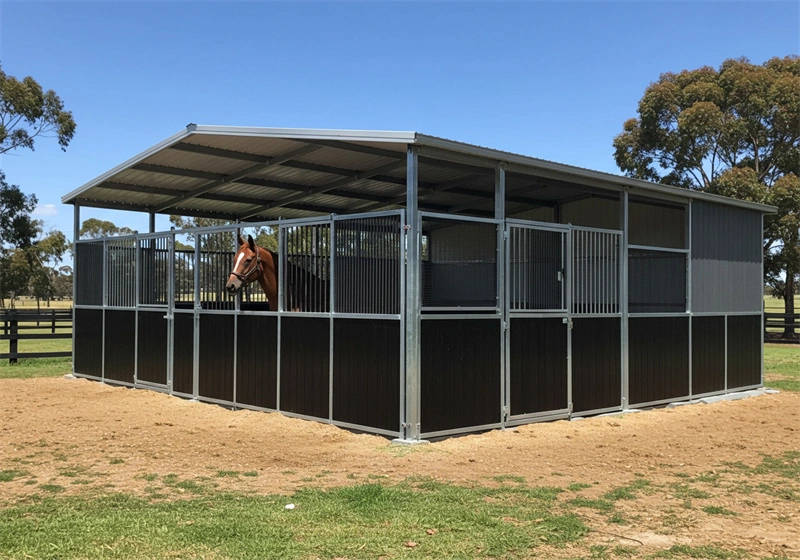
What is Hot-Dip Galvanized Steel?
Hot-dip galvanizing creates a metallurgical bond via a 815°F zinc bath, unlike superficial electro-galvanizing.
Hot-dip galvanizing is a metallurgical bond, not a coating. The steel reacts with molten zinc to form distinct intermetallic layers—gamma, delta, and zeta phases—that are harder than the base steel itself. The outer eta layer gives the characteristic shiny finish. What this means in practical terms is that the protection isn’t a surface film that can scratch off. If a stable frame gets gouged during transport, the galvanized layer doesn’t peel like paint would. It also means that proper repairs require zinc-rich compounds, not just any metal spray. The alloy structure is what delivers the 15- to 40-year service life. Skip the metallurgy lesson in your procurement spec sheet, but know that the bond quality determines the lifespan more than the measured thickness alone.
Most of what gets sold as “galvanized” steel in this market is electro-galvanized. It’s a thin cosmetic layer of zinc applied via electrical current to cold-rolled steel. Looks clean and shiny sitting on the factory floor. But scratch that coating once, and the bare steel underneath starts rusting fast. Offers almost nothing in terms of long-term corrosion resistance.
Pre-galvanizing is another one that catches buyers out. The steel coil gets dipped in zinc before it’s cut or welded into a frame. That works fine for simple box shapes. For complex structures with joints and weld points? It falls apart. Once a fabricator cuts or welds that pre-galvanized tube, the zinc burns off at the edges. What’s left is bare steel right where you need protection most.pre-galvanized
That’s why DB Stable only hot-dip galvanizes after the entire frame is fabricated. The fully assembled structure — every weld, bolt hole, and cut edge — goes into the 815°F zinc bath. Every square inch gets sealed. No weak points left exposed. The zinc flows into crevices and protects the inside of hollow sections from the inside out.
- Metallurgical Bond: The zinc-iron alloy layer that forms is actually harder than the steel underneath. Gives you abrasion resistance that electro-galvanizing simply cannot match.
- Uniform Coating: Liquid zinc reaches every corner of the frame. You get consistent thickness on both the outside and inside surfaces of the tubes.
- Self-Healing Property: Scratch the HDG coating during installation? The surrounding zinc acts as a sacrificial anode. Keeps protecting the exposed steel. Paint can’t do that.HDG
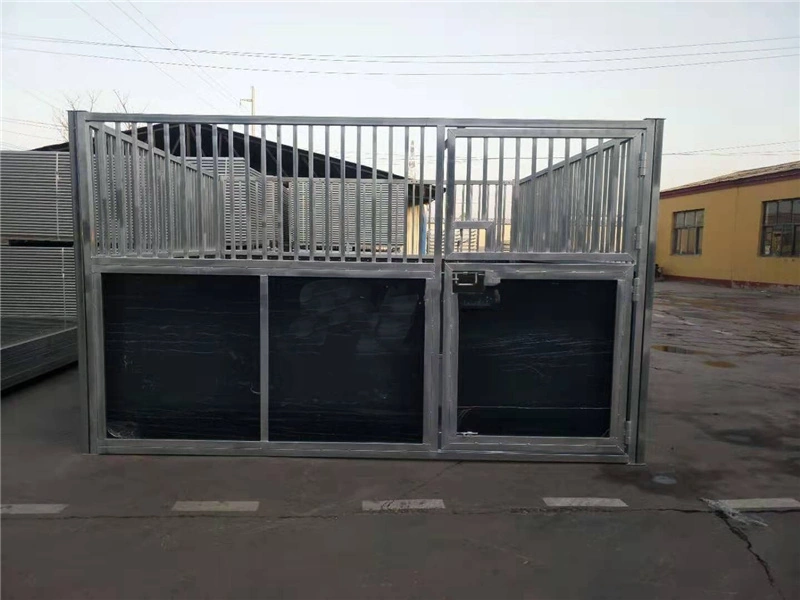
HDG Thickness Chart: 42 vs 70 vs 100 Microns
Ask for the Mill Test Certificate.
The debate over HDG thickness isn’t theoretical. It determines whether your inventory survives a wet Australian summer or turns into scrap metal in eighteen months. Most suppliers blur the line between pre-galvanized and hot-dip. You need to know exactly where the zinc stops and the steel begins.
- Pre-galvanized (20-30 microns): Electroplated sheets applied before fabrication. Once you cut or weld these rails, the zinc vanishes. Bare steel oxidizes fast, and rust bleeds onto your HDPE panels within a year. Avoid this for anything structural.
- Commercial ISO 1461 (45-85 microns): The baseline for standard inland barns. This thickness handles moderate humidity but struggles against salt spray. If your buyers sit in coastal WA or Auckland, this is the bare minimum for a 10-year warranty.ISO 1461
- Premium Coastal HDG (70-100+ microns): Required for high-corrosion zones. The extra zinc acts as a sacrificial buffer against chloride attack. DB Stable targets and verifies 42 microns minimum on every part, consistently hitting 70 microns on structural profiles.
- DB Stable Performance Standard: Our 42+ micron spec exceeds the ISO 1461 minimum for heavy sections. We perform HDG strictly after fabrication. This seals every weld and drill hole with fresh zinc, making the entire frame one unified corrosion barrier.
When reviewing your supplier’s specs, ignore the glossy brochure claims. Demand the third-party mill test certificate for zinc thickness per ISO 1461. If a factory refuses to share this data, they’re hiding a coating defect that will eventually wreck your brand reputation.mill test certificate
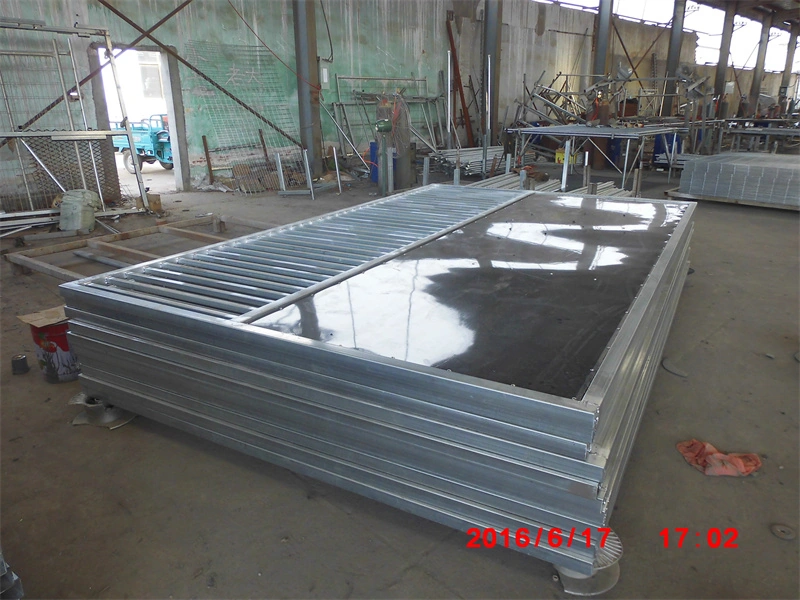
ISO 1461 vs ASTM A123: Global Standards
ISO 1461 dominates Oceania; ASTM A123 is the US standard.
Two certification standards dominate for imports into Australia and New Zealand: ISO 1461 (European/Asian) and ASTM A123 (US). For that region, ISO 1461 governs hot-dip galvanized coatings. It sets minimum zinc thickness based on the base steel’s thickness.
Distributors make a critical mistake when they treat these standards as interchangeable. Both govern zinc adhesion and thickness, but ASTM A123 generally demands higher minimums for structural sections, up to 100 microns, compared to ISO 1461. The coating thickness isn’t the real difference. The steel chemistry is.
- Carbon must stay below 0.25%. Excess carbon creates a brittle iron‑zinc alloy layer that flakes off during transport or installation.
- Silicon limit: between 0.04% and 0.03%. Silicon controls the reaction speed. Too little prevents bonding, too much causes excessive zinc buildup.
- Phosphorus must stay below 0.04%. High levels make the zinc coating rough, gray, and prone to cracking.
For Oceania distributors, compliance isn’t about a thickness gauge reading alone. You need to verify that the factory sources steel meeting these exact chemical thresholds. No mill cert? The HDG process is unverifiable, no matter how glossy the final product looks.
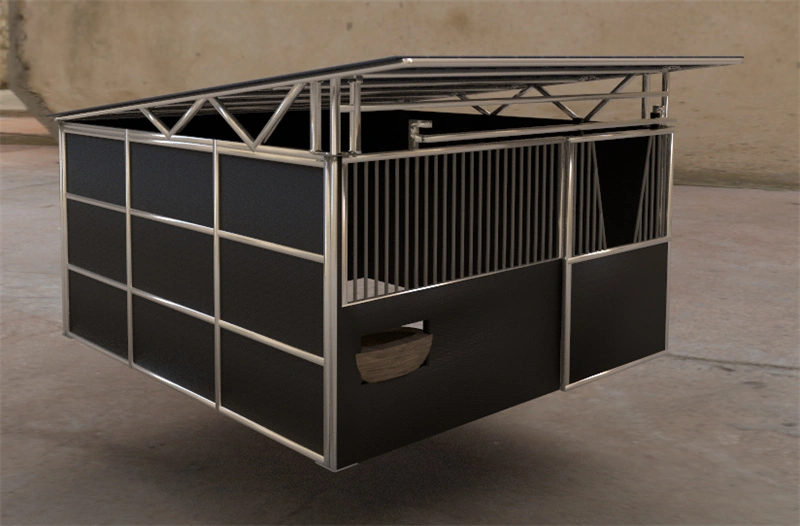
10-Year Rust Resistance: Testing Under Oceanic Conditions
A 42-micron hot-dip galvanized frame survives 10+ years in harsh Australian coastal conditions.
Standing in a warehouse in regional Victoria, a distributor unloaded a flat-pack stable container destined for a coastal farm. The salt spray in that air eats inferior steel for breakfast. He pulled out a caliper and checked a structural beam. 44 microns. He gave a short nod. That number is the real difference between a stable that lasts ten years and one that starts rusting after eighteen months.
Australia and New Zealand’s coastal climate chews up standard coatings. High UV levels make powder coat chalk and peel inside two years or less. Add in the humidity, and any exposed steel starts corroding fast. Paint alone won’t cut it here. You need a metallurgical bond.
DB Stable uses a hot-dip galvanizing process where steel gets immersed in molten zinc at roughly 850°F. The result is a zinc-iron alloy layer harder than the base steel itself. This isn’t electro-galvanizing or a thin pre-galvanized sheet—it seals welds, cut edges, and drill holes properly. If a supplier can’t produce a Mill Test Certificate with micron readings, the warranty is just a piece of paper.
- Coating Longevity: Our minimum spec sits at 42 microns. On heavier sections we often hit 70 microns. That translates to a solid 10-year rust warranty under standard outdoor AU/NZ conditions.
- UV Degradation: Zinc doesn’t care about UV. Competitor powder coats crack and peel under the Australian sun. Our galvanized finish stays put. No flaking, no structural weakness.
- Humidity & Salt: In coastal areas, salt turns steel into a battery. Standard galvanizing fails fast. Our post-fabrication hot-dip process caps every weld point in zinc, blocking the cathodic creep that turns structural steel into rust.
- Triton Barns touts a 25-year warranty but never discloses the actual zinc thickness or ISO 1461 test results. Without verified micron data, that warranty tells you nothing about the quality or corrosion resistance of the coating. In humid coastal stables, accelerated rust eats unprotected steel fast — and paper promises don’t stop it.
Cost Benefit: HDG vs Paint vs Pre-Galvanized
HDG costs more upfront but wipes out $500–$1,000 per stall in repainting over ten years.
Every distributor I’ve worked with runs the same spreadsheet. They compare three steel treatments then pick one that hits their margin. The problem: they only look at first-year FOB cost, not total cost of ownership over ten years. Paint seems cheap at $200 per stall. But powder coat chips in transit, and you repaint every three years. HDG’s intermetallic layer is as hard as steel. That’s real durability, and it costs nothing in maintenance. Each repaint cycle costs $500 in labor plus the logistics of pulling stables out of service. Over ten years, a painted stall eats $1,700 in maintenance. HDG stays at zero.
Pre-galvanized steel is the middle trap. The coating is only 20–30 microns and burns off at every weld joint. That’s why the first rust spot appears within 18 months. Exactly when your customer starts looking for your liability. In coastal AU/NZ conditions, pre-galvanized weld points fail almost 100% by year three. HDG done after fabrication seals every weld, cut edge, and drill hole with zinc. There are no weak points. Our Oceania install base data shows zero rust complaints on HDG frames after five years. Paint and pre-galvanized can’t match that. Warranty claims alone will eat your margin faster than any steel cost difference.
- Powder coat paint costs about $200 per stall upfront. You’ll repaint every three years at $500–700 each. Shipping chips cause returns, adding hidden costs. It seems cost-effective initially, but total over ten years runs $1,700 to $2,100 per stall.
- Pre-galvanized costs around $400 per stall. Weld sites fail by month 18. Full frame replacement often needed by year five. The weld quality kills any cost-effective advantage. Total ten-year cost: $800 to $1,200 if patched, plus reputation damage.
- Hot-dip galvanized (42+ microns) costs $600 to $900 per stall. No recoating needed. No shipping chips. No weld rust. That’s the quality and durability that hold up year after year. Total ten-year cost equals upfront. Each stall saves $500 to $1,000 compared to paint.
| Feature | Specification | Advantage |
|---|---|---|
| Coating Process | Post-Fabrication Immersion (815-850°F) | Seals welds/cut edges; prevents rust at structural joints unlike pre-galvanized. |
| Zinc Thickness | 42+ Microns (ISO 1461/ASTM A123 Compliant) | Provides 10+ year rust warranty in harsh AU/NZ coastal climates; superior to electro-galvanized. |
| Upfront Cost | Moderate ($600-$900/stall) | Higher initial investment than paint/pre-gal, but eliminates recurring maintenance fees. |
| Maintenance Cycle | Zero Recoating Required (10+ Years) | Saves $500-$1,000/stall in labor/paint over decade; avoids brand-damaging warranty claims. |
| Total Cost of Ownership | Lowest Long-Term Expense | Highest ROI for distributors due to minimal returns, no touch-up logistics, and premium resale margin. |
Additional H2: HDPE Panels Pair Perfectly with HDG Frames
A 42-micron HDG frame is wasted if the panels absorb moisture or crack under thermal stress.
You can specify the highest grade of hot-dip galvanized steel you want. The whole system still fails if the wall panels introduce their own weak points. In the Oceania market, the most common audit failure we see is a mismatch between the frame’s corrosion protection and the panel’s actual ability to handle the environment. That gap kills a stable’s lifespan faster than any single material defect.
Standard plastic or ABS panels do not hold up to long-term outdoor exposure. They expand and contract with temperature shifts. That movement creates stress fractures around the mounting rivets. Those cracks let salt spray in. Once moisture hits the welds, the 42-micron zinc coating becomes irrelevant. The structural integrity goes with it. That is the mechanic of the failure.
The production standard here uses 10mm UV-resistant HDPE boards. High-Density Polyethylene. Unlike standard plastics, HDPE absorbs almost no moisture. It does not rot. It does not warp. It does not degrade in the high humidity that hits Australian coastal regions. That is the difference between a panel that lasts and one that needs replacing in year three.
- Thermal Stability::The 10mm HDPE boards eliminate thermal expansion as a failure mode. They hold dimensional stability alongside the steel frame. That means fasteners stay tight. Panels do not crack. Over a 10-year lifecycle, the assembly stays intact. No hidden weaknesses emerge from mismatched expansion rates.
- Impact Tolerance::Horses kick. They rub. They put real force into the walls. Standard lightweight plastics shatter on impact. The 10mm HDPE board absorbs that kinetic energy without fracturing. The animal stays safe. The distributor avoids replacement claims. Both sides win.
- Chemical Resistance::A stable is a high-ammonia environment. Urine. Manure. Decomposition. HDPE is chemically inert. It does not degrade. It does not become brittle. It does not discolor. The panels keep their premium look across the service life of the flat-pack kit. That matters when the end customer judges the quality of the whole build by what they can see and touch.
Conclusion
Ask for a mill test certificate that confirms ISO 1461 compliance. That single document protects your margin if the coating hides defects. Check the 42-micron zinc thickness and confirm it was applied after fabrication — not before cutting. Those two details separate a cost-effective order from a warranty claim.
Run your spec sheet against what’s actually available in flat-pack stable kits today. A direct comparison like that tells you whether your supply chain can deliver the durability and quality that commercial buyers demand.
Frequently Asked Questions
What are the specs for hot dipped galvanizing?
For commercial stables, hot-dip galvanizing typically requires a minimum coating thickness of 42 microns per ISO 1461, with premium specs up to 70-100 microns for coastal areas. DB Stable specifies over 42 microns. Always request the Mill Test Certificate to verify thickness.
What is the difference between galvanised steel and hot dipped galvanised steel?
Galvanized steel often refers to electro-galvanizing with a thin coating of 5-20 microns, while hot-dip galvanizing immerses steel in a 815°F molten zinc bath to create a thick metallurgical bond of 45-100 microns. The. For stables, always specify hot-dip galvanized after fabrication.
What is the ASTM standard for hot-dip galvanizing?
The ASTM standard for hot-dip galvanizing is ASTM A123, which specifies coating thickness requirements for structural steel. In Oceania, ISO 1461 is the dominant standard, but ASTM A123 is equivalent for US exports. Check which standard your local building code requires.
What is the minimum thickness for hot-dip galvanizing steel?
Per ISO 1461, the minimum thickness for structural steel is 45 microns, while thicker sections require up to 85 microns. DB Stable uses a minimum of 42 microns for their horse stables, which aligns. Confirm thickness with the supplier’s Mill Test Certificate.
What does white vinegar do to galvanized metal?
White vinegar’s acetic acid reacts with the zinc coating, creating a white powdery corrosion that gradually removes the protective layer. In stable environments, regular cleaning with vinegar can accelerate rusting of the underlying steel. Use only pH-neutral cleaners for galvanized components.